Key takeaways
- AI search engines like ChatGPT and Perplexity are increasingly the first stop for tax and accounting software research -- if your brand isn't cited, a competitor is
- Compliance-heavy industries face unique GEO challenges: accuracy signals, regulatory terminology, and trust matter more than in most verticals
- The most effective GEO strategy for accounting brands combines prompt gap analysis, authoritative content creation, and citation tracking across multiple LLMs
- Monitoring-only tools won't move the needle -- you need platforms that help you act on the data, not just collect it
- Seasonal demand (tax season, year-end close) creates predictable windows where AI visibility can drive disproportionate pipeline
Why accounting and tax software brands need to care about AI visibility right now
When a CFO or small business owner asks ChatGPT "what's the best tax software for a 50-person company?" or "which accounting platform handles multi-state payroll compliance?" -- they're not getting a list of blue links. They're getting a direct answer. And that answer either includes your brand or it doesn't.
This is the core problem with traditional SEO for compliance-heavy software: you can rank on page one of Google and still be completely invisible in AI-generated responses. The two systems pull from different signals. Google rewards backlinks and on-page optimization. AI models reward authoritative, specific, well-cited content that directly answers the questions people are actually asking.
For accounting and tax software brands, the stakes are especially high. Buyers in this space are risk-averse by nature -- they're choosing software that touches payroll, tax filings, and financial reporting. They do more research than average, ask more specific questions, and trust AI-generated summaries more than they probably should. If an AI model consistently recommends a competitor when someone asks about "best accounting software for CPA firms" or "tax compliance tools for e-commerce businesses," that's a pipeline problem.
The good news: most accounting software brands haven't figured this out yet. The window to establish AI visibility before the space gets crowded is still open -- but it's closing.
What makes GEO different in compliance-heavy industries
GEO (Generative Engine Optimization) for accounting and tax software isn't just regular content marketing with a new label. The compliance context changes everything.
Accuracy signals matter more
AI models are increasingly cautious about financial and legal claims. When they cite sources on topics like tax law, payroll compliance, or audit requirements, they tend to prefer content that is specific, cites authoritative sources (IRS publications, GAAP standards, state tax codes), and avoids vague marketing language. A blog post titled "Why Our Software Is Great for Tax Season" will almost never get cited. A detailed guide titled "How to Handle Multi-State Sales Tax Nexus in 2026" has a real shot.
This means your content strategy needs to look more like a knowledge base than a marketing blog. Specific, factual, compliance-grounded content is what AI models pull from.
Regulatory terminology is a targeting opportunity
Tax and accounting software buyers use highly specific language: 1099-NEC filing, ASC 842 lease accounting, beneficial ownership reporting, R&D tax credit documentation. These aren't just keywords -- they're the exact prompts people type into ChatGPT when they're trying to solve a real problem.
If your site has authoritative content that uses this terminology correctly and in context, you have a structural advantage over competitors who write generic "accounting software features" content. The specificity is the signal.
Trust and credentialing signals
AI models pick up on trust signals in ways that differ from traditional SEO. Being cited by CPA associations, mentioned in accounting trade publications, having content that references specific regulatory bodies -- these all influence whether an AI model treats your brand as a credible source. For accounting software brands, building this kind of authority is both more important and more achievable than in most industries, because the credentialing infrastructure (CPA associations, state boards, AICPA resources) already exists.
Seasonal demand creates predictable GEO windows
Tax season (January through April), year-end close (November through December), and quarterly estimated tax deadlines create predictable spikes in AI search queries. A small business owner in February is much more likely to ask ChatGPT "what's the best software for filing my business taxes" than in July. If you build AI visibility before these windows, you capture demand at exactly the moment buyers are ready to act.
The GEO strategy framework for accounting and tax software brands
Step 1: Map the prompts your buyers actually use
Before you can optimize for AI search, you need to know what your buyers are asking. This isn't the same as keyword research. People prompt AI models differently than they search Google -- they ask full questions, describe scenarios, and often include context ("I run a 12-person accounting firm and we need software that handles client billing and tax prep -- what should I use?").
Start by brainstorming prompt categories:
- Software comparison prompts ("best accounting software for small businesses vs. QuickBooks")
- Compliance problem prompts ("how to handle 1099 filing for gig workers")
- Feature-specific prompts ("which tax software supports multi-state returns")
- Role-specific prompts ("best tools for CPA firms managing 200+ clients")
- Integration prompts ("accounting software that integrates with Shopify and handles sales tax")
Tools like Promptwatch can show you which of these prompts your competitors are being cited for but you're not -- which is exactly where to focus first.

Step 2: Audit your current AI visibility
Most accounting software brands have no idea how they appear in AI-generated responses. Before building a strategy, you need a baseline. Run your brand name and key product categories through ChatGPT, Perplexity, Claude, and Google AI Overviews. Ask the questions your buyers ask. Note:
- Is your brand mentioned at all?
- When it is mentioned, is the information accurate?
- Which competitors are being cited more consistently?
- What content is the AI pulling from when it does mention you?
This manual audit gives you a starting point. Scaling it requires a tool that tracks these responses systematically across multiple models and prompt variations.
Step 3: Build content that AI models want to cite
This is where most brands get stuck. They know they need "AI-optimized content" but don't know what that actually means in practice.
For accounting and tax software, the content types that get cited most reliably are:
- Definitive guides to specific compliance topics (e.g., "Complete Guide to Sales Tax Compliance for SaaS Companies in 2026")
- Comparison content that answers specific software questions (e.g., "QuickBooks vs. FreshBooks for Freelance Accountants: A Detailed Comparison")
- FAQ-style content that mirrors how people actually prompt AI models
- Content that cites primary sources (IRS, FASB, state tax authorities)
- Case studies with specific, verifiable outcomes
The key is specificity. Generic content doesn't get cited. Content that answers a specific question with specific information does.
Step 4: Track, measure, and iterate
GEO isn't a one-time project. AI models update their training data, competitors publish new content, and regulatory changes create new prompt opportunities. You need ongoing tracking to know whether your visibility is improving and which content is actually driving citations.
Best AI visibility tools for accounting and tax software brands in 2026
Here's a breakdown of the tools worth considering, with notes on what actually matters for compliance-heavy industries.
Promptwatch -- best for end-to-end GEO optimization
Promptwatch is the most complete option for brands that want to move beyond monitoring into actual optimization. The Answer Gap Analysis feature is particularly valuable for accounting software brands: it shows you the specific prompts where competitors are being cited but you're not, so you can prioritize content creation around real gaps rather than guessing.
The built-in AI writing agent generates content grounded in citation data -- meaning it's not producing generic SEO filler, but content engineered to get cited by the specific AI models your buyers use. For a tax software brand, that means articles that reference the right regulatory terminology, cite the right sources, and answer the specific questions that drive citations.
The crawler logs feature is also worth noting: you can see exactly which pages ChatGPT, Perplexity, and Claude are reading on your site, which pages are returning errors, and how often AI crawlers return. This is genuinely useful for compliance content -- if your IRS-related pages aren't being crawled, you're invisible for those prompts regardless of how good the content is.
Profound -- strong enterprise option
Profound is a solid choice for larger accounting software companies with dedicated marketing teams. It tracks brand mentions across 9+ AI search engines and provides competitive analysis. The main limitation is that it's primarily a monitoring platform -- it shows you where you stand but doesn't have built-in tools to help you improve.
Profound

Otterly.AI -- good for getting started
Otterly.AI is a more accessible entry point for smaller accounting software brands or firms that are just beginning to think about AI visibility. It tracks brand mentions across ChatGPT, Perplexity, and Google AI Overviews at a lower price point. The trade-off is limited depth -- no content generation, no crawler logs, no prompt volume data.
Otterly.AI

Peec AI -- useful for competitive benchmarking
Peec AI does a decent job of showing how your brand compares to competitors across AI models. For accounting software brands, this is useful for understanding whether you're losing ground to QuickBooks, Xero, or niche players in specific prompt categories. Like Otterly, it's monitoring-focused.

Semrush -- for brands already in the ecosystem
If your team already uses Semrush for traditional SEO, its AI search features are worth exploring as a complement to your existing workflow. The limitation is that Semrush uses fixed prompt sets, which means you can't customize for the specific compliance terminology your buyers use. It's a reasonable addition but not a primary GEO tool.
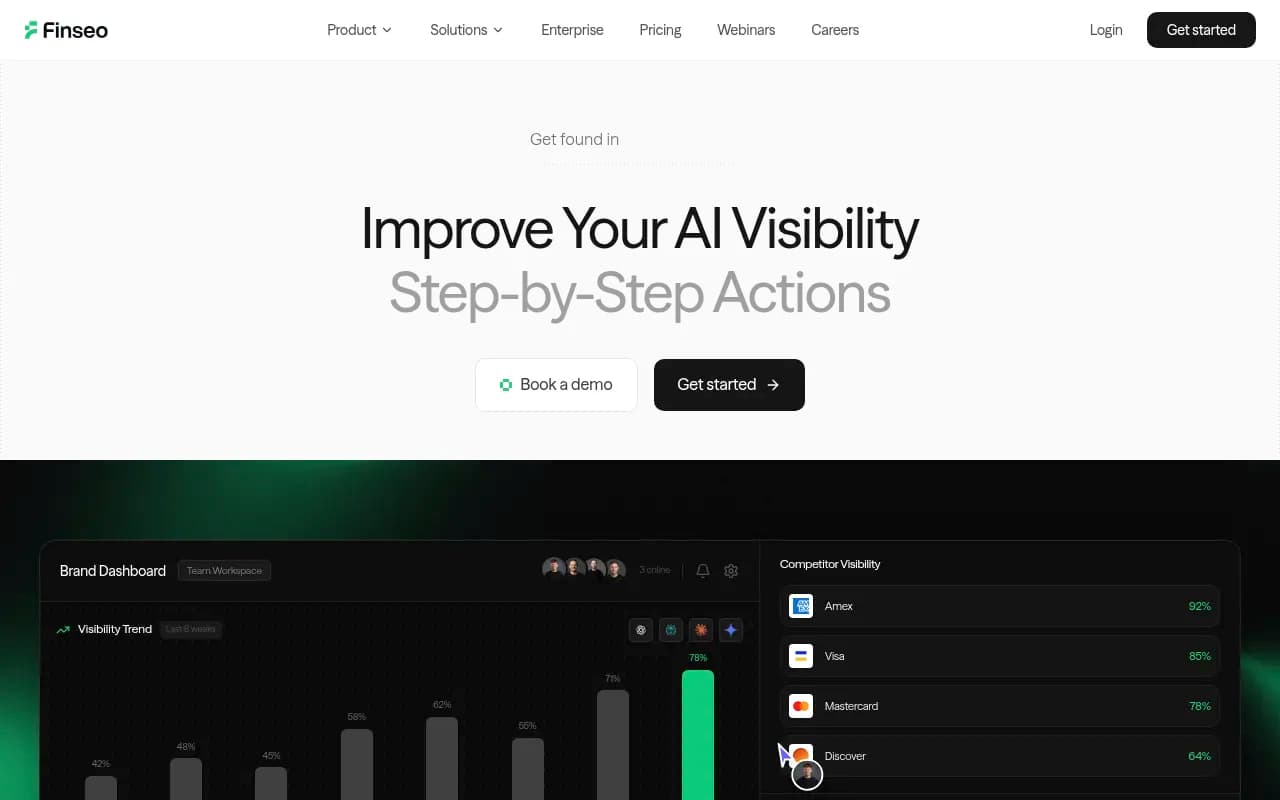
Finseo.ai -- built specifically for financial brands
Worth mentioning because it's purpose-built for financial services and fintech brands. If your accounting software targets regulated financial institutions, Finseo.ai's industry-specific focus may be relevant.
Tool comparison: AI visibility platforms for accounting and tax software brands
| Tool | Prompt customization | Content generation | Crawler logs | Citation tracking | Best for |
|---|---|---|---|---|---|
| Promptwatch | Yes (custom prompts) | Yes (built-in AI writer) | Yes | Yes (880M+ citations) | Full GEO optimization cycle |
| Profound | Limited | No | No | Yes | Enterprise monitoring |
| Otterly.AI | Limited | No | No | Basic | Getting started |
| Peec AI | Limited | No | No | Basic | Competitive benchmarking |
| Semrush | Fixed prompts | Partial | No | Limited | Existing Semrush users |
| Finseo.ai | Yes | No | No | Yes | Financial services focus |
Specific GEO tactics for accounting and tax software brands
Own the comparison queries
"QuickBooks vs. [your brand]" and "[your brand] vs. Xero" are among the highest-intent prompts in the accounting software space. AI models regularly generate these comparisons, and the content they pull from is usually third-party review sites, your own comparison pages, or competitor content.
Build dedicated comparison pages that are factually accurate, specific about feature differences, and cite verifiable information. Don't make them pure marketing -- AI models will deprioritize content that reads as promotional. Include honest trade-offs. The goal is to be the most useful source on this comparison, not the most flattering one.
Create compliance calendars and deadline content
Tax deadlines, reporting requirements, and compliance calendars are perennially useful and frequently searched. Content like "2026 Payroll Tax Deadlines for Small Businesses" or "Q4 2026 Accounting Compliance Checklist" gets cited because it's specific, timely, and directly answers questions people ask AI models when they're stressed about deadlines.
This type of content also has the advantage of being updated annually, which gives you a reason to refresh and republish -- keeping your content in AI training data cycles.
Build a glossary of compliance terminology
A comprehensive glossary of accounting and tax terms -- written with enough depth to be genuinely useful, not just definitional -- is one of the most reliable citation magnets in this space. When someone asks ChatGPT "what is ASC 842?" or "what does beneficial ownership reporting mean for my business?" you want your brand's glossary to be the source that gets cited.
This also builds topical authority over time, which influences how AI models perceive your brand's expertise in the accounting space.
Publish original data and research
AI models love citing original research. If your platform processes tax filings or accounting data, you're sitting on a goldmine of citation-worthy content. Annual reports on small business tax compliance rates, benchmarks on accounting software adoption, surveys of CPA firms -- this kind of original data gets cited by AI models and by the journalists and bloggers whose content also feeds into AI training data.
Target the "for [specific type of business]" prompts
"Best accounting software for restaurants," "best tax software for freelancers," "best payroll software for nonprofits" -- these vertical-specific prompts are highly cited in AI responses and often underserved by accounting software brands that focus on generic positioning.
If your software genuinely serves specific verticals well, build dedicated content for each one. The specificity makes it far more likely to be cited when someone asks a vertical-specific question.
Measuring GEO success in accounting and tax software
Traditional SEO metrics (rankings, organic traffic) don't capture AI visibility. You need different measurements:
- Citation rate: How often is your brand mentioned when relevant prompts are run across ChatGPT, Perplexity, Claude, and other models?
- Sentiment in citations: When your brand is mentioned, is the context positive, neutral, or negative?
- Prompt coverage: What percentage of the prompts your buyers use result in your brand being cited?
- Competitive share of voice: How does your citation rate compare to key competitors across specific prompt categories?
- AI-referred traffic: Are you seeing traffic from AI models? Tools that integrate with Google Search Console or analyze server logs can help attribute this.
Platforms like Promptwatch track all of these at the page level, so you can see which specific pieces of content are driving citations and which AI models are picking them up. That page-level data is what lets you iterate intelligently rather than publishing content and hoping for the best.
The compliance content trap to avoid
One mistake accounting software brands make is treating compliance content as a legal liability rather than a marketing asset. The instinct is understandable -- nobody wants to publish something that gets interpreted as tax advice and creates problems. But the solution isn't to avoid compliance content; it's to publish it correctly.
The standard approach: write content that explains compliance concepts, cites authoritative sources (IRS, FASB, state tax authorities), and includes a clear disclaimer that readers should consult a qualified tax professional for their specific situation. This is exactly what AI models want to cite -- specific, authoritative, appropriately caveated content. It's also what builds trust with the CPAs and finance professionals who are often the actual buyers of accounting software.
The brands that are winning AI visibility in this space right now are the ones that have figured out how to be genuinely useful on compliance topics without crossing into advice territory. That's a content strategy problem, not a legal one.
Getting started: a practical 90-day GEO roadmap
If you're starting from zero, here's a realistic sequence:
Days 1-30: Baseline audit. Run your brand and key competitors through the major AI models manually. Set up a monitoring tool to track this systematically. Identify the 10-15 prompts most relevant to your buyers where you're currently invisible.
Days 31-60: Content creation sprint. Build 5-8 pieces of high-specificity content targeting your biggest prompt gaps. Focus on comparison content, compliance guides, and vertical-specific pages. Publish and submit to Google Search Console.
Days 61-90: Measure and iterate. Check whether your new content is being crawled by AI models (crawler logs help here). Run your target prompts again and see if your citation rate has improved. Identify the next set of gaps to address.
GEO is a long game, but accounting and tax software brands that start now will have a meaningful head start over competitors who are still treating AI search as a future problem. The buyers are already there. The question is whether your brand shows up when they ask.