Finseo.ai Review 2026
Specialized platform for tracking brand visibility in AI search results with focus on enterprise and financial sector needs.
Summary
- Best for: Mid-market and enterprise brands (especially in finance, automotive, consumer goods, and e-commerce) that want to monitor and improve how AI engines recommend their products and services
- Core strength: Three-step workflow (prompt discovery → visibility tracking → optimization insights) with strong competitor benchmarking and citation analysis across 9+ AI platforms
- Key limitation: Pricing starts higher than monitoring-only competitors, and the platform is optimized for established brands rather than startups or solopreneurs
- Standout feature: GEO Audit tool that analyzes your content for AI citability and provides specific fixes to improve how LLMs understand and cite your pages
- Bottom line: If you're a brand manager or agency tracking AI visibility for clients with real revenue at stake, Finseo delivers the depth and actionability you need -- but smaller teams may find better value in lighter alternatives
Finseo.ai is a specialized AI visibility tracking and optimization platform designed for brands that need to understand and improve how they appear in AI-powered search engines like ChatGPT, Claude, Perplexity, and Gemini. Launched in 2024 by a German team, the platform has quickly gained traction with 200+ enterprise and mid-market customers including Würth Group, Kellogg's, SNOCKS, and Jägermeister. Unlike generic SEO tools retrofitted for AI search, Finseo was built specifically for what the industry calls Generative Engine Optimization (GEO) -- the practice of optimizing content to be cited and recommended by large language models.
The platform targets marketing teams, SEO professionals, and digital agencies managing brand visibility for established companies. If you're a startup founder or solopreneur, Finseo's pricing and feature set are likely overkill. But if you're a brand manager at a consumer goods company watching competitors get recommended by ChatGPT while you're invisible, or an agency managing AI visibility for 10+ clients, Finseo provides the depth and workflow you need.
How Finseo Works: The Three-Step Workflow
Finseo structures its platform around a clear three-step process that mirrors how brands actually approach AI visibility:
Step 1: Brand Cockpit & Prompt Discovery -- Finseo analyzes your brand, industry, and competitors to discover the exact prompts people are using in AI search engines. The platform's prompt research tool reveals high-potential search terms across multiple personas (homeowners, car enthusiasts, facility managers, etc.) and organizes them into category hierarchies with volume estimates. For example, a cleaning equipment brand might discover 3.5M monthly searches across categories like "Pressure Washers" (1M), "Floor Care" (877K), and "Industrial" (1.1M), with specific prompts like "What pressure washer for my patio?" or "Compare Kärcher vs Nilfisk." This isn't guesswork -- Finseo pulls from actual AI platform usage data to show you what people are asking.
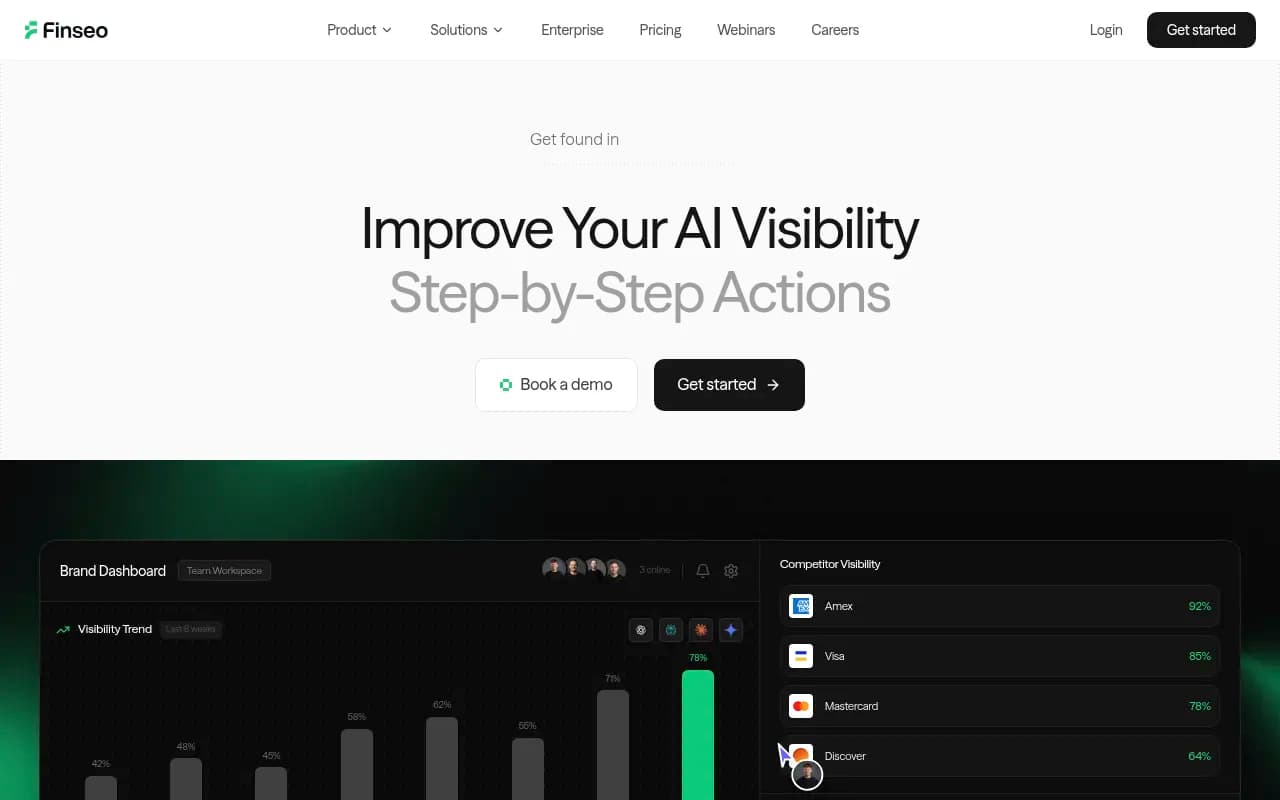
Step 2: AI Visibility Tracking -- Once you know which prompts matter, Finseo tracks your visibility across ChatGPT, Claude, Perplexity, Gemini, DeepSeek, Grok, Mistral, Copilot, Google AI Overviews, and Bing. The platform sends your tracked prompts to each AI engine daily, extracts the responses, and scores your visibility, mentions, and sentiment. You see exactly where you rank compared to competitors, which AI platforms favor your brand, and how your visibility trends over time. The competitor ranking view shows not just whether you're mentioned, but your position relative to 5-10 competitors across every prompt. For brands in competitive verticals (automotive, finance, SaaS), this competitive intelligence is the core value.
Step 3: Source & Citation Analysis + Optimization -- Finseo doesn't stop at showing you the problem. The platform analyzes which sources AI engines cite most frequently (Reddit threads, review sites like Trustpilot and G2, listicles on Wirecutter or Consumer Reports, YouTube videos, Wikipedia entries) and identifies where you need to be present. The GEO Audit tool scans your website content and flags specific issues that prevent AI engines from citing you -- things like vague claims ("industry-leading quality") that should be replaced with verifiable facts ("ISO 9001 certified"), JavaScript rendering problems that block AI crawlers, or missing structured data. You get a prioritized list of improvements with estimated visibility impact (e.g. "Boost visibility by 34%").
Key Features Breakdown
Multi-Platform AI Monitoring -- Finseo tracks 9+ AI platforms including ChatGPT, Claude, Perplexity, Gemini, DeepSeek, Grok, Mistral, Copilot, Google AI Overviews, and Bing. Each platform is queried daily with your tracked prompts from configurable locations (country-specific tracking for global brands). The platform extracts not just whether you're mentioned, but your ranking position, sentiment, and the exact sources cited in each response. This is more comprehensive than competitors like Otterly.AI or Peec.ai, which typically cover 3-5 platforms.
Competitor Benchmarking -- Every tracked prompt shows a competitor visibility heatmap. You define your competitive set (up to 10 competitors), and Finseo shows their visibility score, mention count, and sentiment for each prompt. The interface makes it immediately obvious where competitors are winning and where you have opportunities. For example, if BMW has 89% visibility and 24 mentions while you have 68% and 9 mentions, you know exactly where to focus optimization efforts.
Prompt Research & Volume Estimates -- Finseo's prompt discovery tool analyzes your industry and surfaces high-potential prompts organized by persona and category. Each prompt includes a search potential score and volume estimate. This helps you prioritize which prompts to track and optimize for. The platform also suggests related prompts and query variations, similar to how traditional keyword research tools work but tailored for conversational AI queries.
Citation & Source Analysis -- For every AI response, Finseo extracts and categorizes the sources cited: UGC (Reddit, forums), listicles (Wirecutter, CNET), reviews (Trustpilot, G2), news (TechCrunch, Forbes), retail (Amazon, Home Depot), and video (YouTube). You see citation counts and rates for each source type, helping you understand where to invest in content distribution. If Reddit threads are cited 34% of the time for your category, you know community engagement is critical.
GEO Audit & Content Scoring -- This is Finseo's standout optimization feature. The audit scans your website pages and flags specific issues that hurt AI citability: vague marketing claims without proof, JavaScript rendering problems that block AI crawlers, missing schema markup, lack of verifiable facts and citations. Each issue includes a recommended fix with examples. For instance, instead of "Trusted by thousands," the tool suggests "12,847 reviews (4.8★) on Trustpilot" with a link to the review profile. This level of specificity is rare in the GEO space.
Bot Traffic Monitoring -- Finseo tracks which AI crawlers (GPTBot, ClaudeBot, PerplexityBot, etc.) are accessing your website, which pages they visit, and any errors they encounter. This crawlability monitoring helps you ensure AI engines can actually index your content. The platform flags JavaScript rendering issues where dynamic content loads fine for human visitors but appears blank to AI crawlers.
Product Extraction & Shopping Tracking -- For e-commerce and product-focused brands, Finseo extracts which specific products AI engines recommend, including pricing, store mentions, and ratings. This is particularly valuable for tracking ChatGPT's shopping recommendations and product carousels. You can monitor whether your products appear, at what price points, and which retailers are cited.
Report Builder & Data Export -- Finseo includes a white-label report builder for agencies and in-house teams that need to present AI visibility data to stakeholders. You can export data via CSV or integrate with external tools. The platform also offers a Looker Studio connector for custom dashboards.
Global & Multi-Language Support -- Run queries from different countries and in multiple languages. This is critical for international brands that need to track how AI engines respond differently in Germany vs. the US, or in German vs. English.
Who Is Finseo For?
Finseo is built for mid-market and enterprise brands with established market positions and real revenue at stake in AI search visibility. Typical customers include:
Brand marketing teams at consumer goods companies (like Kellogg's, SNOCKS, Würth) tracking how AI engines recommend their products vs. competitors. These teams have budgets for specialized tools and need to report AI visibility metrics to leadership.
SEO and digital marketing teams at companies with 50-500 employees managing multiple product lines or regional markets. They need to track AI visibility across dozens or hundreds of prompts and optimize content at scale.
Digital agencies managing AI visibility for 5-20 clients. Finseo's white-label reporting and multi-brand workspace make it practical to manage multiple client accounts. The platform's depth justifies the cost when spread across an agency's client base.
Industries where AI recommendations drive purchase decisions: automotive (car comparisons, dealer recommendations), financial services (credit cards, investment platforms), SaaS (project management, CRM tools), consumer electronics, and e-commerce. If your customers are asking ChatGPT or Perplexity for product recommendations in your category, you need to be tracking this.
Who should NOT use Finseo: Startups with limited budgets, solopreneurs, or brands in niches where AI search isn't a meaningful traffic source yet. If you're a freelance consultant or small agency with 1-2 clients, the pricing won't make sense. You'd be better served by a lighter monitoring tool or even manual spot-checking.
Integrations & Ecosystem
Finseo integrates with Looker Studio for custom reporting and dashboards. The platform offers a REST API for developers who want to pull AI visibility data into their own systems or build custom workflows. There's also a JavaScript tracking snippet for attributing website traffic to AI referrals, similar to how Google Analytics works.
For content distribution, Finseo surfaces high-citation sources (Reddit, Trustpilot, G2, YouTube, Wikipedia) but doesn't directly integrate with these platforms -- you still need to manually create accounts and post content. The platform also doesn't integrate with content management systems like WordPress or Webflow, so implementing GEO Audit recommendations requires manual edits or developer work.
No browser extensions or mobile apps are currently available. The platform is web-based only.
Pricing & Value
Finseo uses tiered pricing based on the number of tracked prompts and brands:
Creator Plan: $19/month (annual billing) -- suitable for individual creators or very small brands just starting to track AI visibility. Limited prompt tracking and basic features.
Professional Plan: $39/month (annual billing) -- includes more prompts, competitor tracking, and citation analysis. This is the entry point for serious brand monitoring.
Enterprise Plans: Custom pricing starting around $200+/month for larger teams, agencies, or brands tracking hundreds of prompts across multiple markets and languages.
Compared to competitors, Finseo sits in the mid-to-high price range. Monitoring-only tools like Otterly.AI and Peec.ai start cheaper ($29-49/mo), but lack Finseo's optimization features. Full-featured platforms like Promptwatch offer similar depth with content generation capabilities starting at $99/mo. Finseo's pricing makes sense if you're a brand or agency that values the GEO Audit and competitor benchmarking features, but it's not the budget option.
There is a free trial available, though the website doesn't specify the duration. No freemium tier is offered.
Strengths
- Comprehensive platform coverage: Tracking 9+ AI engines including newer players like DeepSeek and Grok gives you a complete picture of AI visibility, not just ChatGPT
- Actionable optimization insights: The GEO Audit tool provides specific, implementable fixes rather than vague suggestions -- this is the difference between a monitoring dashboard and an optimization platform
- Strong competitor intelligence: The competitor visibility heatmaps and rankings make it easy to identify gaps and opportunities
- Citation source analysis: Understanding which Reddit threads, review sites, and listicles AI engines cite most helps you prioritize content distribution efforts
- Enterprise-ready: White-label reporting, API access, multi-brand workspaces, and global tracking make this viable for agencies and large marketing teams
Limitations
- No content generation: Unlike platforms like Promptwatch that include AI writing tools to create optimized content, Finseo only identifies what needs to be fixed -- you still have to write or commission the content yourself
- Higher price point: At $39-200+/month, Finseo is more expensive than monitoring-only competitors, which may be hard to justify for smaller brands or agencies
- Manual implementation: GEO Audit recommendations require manual content edits or developer work -- there's no CMS integration or one-click fixes
- Limited traffic attribution: While Finseo offers a tracking snippet for AI referral traffic, it's not as robust as platforms with Google Search Console integration or server log analysis
Bottom Line
Finseo.ai is a solid choice for established brands and agencies that need comprehensive AI visibility tracking with actionable optimization insights. The platform's three-step workflow (discover prompts → track visibility → optimize content) mirrors how marketing teams actually work, and the GEO Audit tool provides the kind of specific, implementable recommendations that justify the price.
Best use case in one sentence: Mid-market consumer brands and digital agencies tracking AI visibility across 50+ prompts and multiple competitors, with budget for a specialized tool and internal resources to implement optimization recommendations.
If you're a smaller brand or agency looking for a more affordable entry point with built-in content creation, or if you need deeper traffic attribution and crawler log analysis, platforms like Promptwatch offer more complete workflows at competitive pricing. But if competitor benchmarking and detailed citation analysis are your top priorities, Finseo delivers the depth you need.
Similar and alternative tools to Finseo.ai