Summary
Your content isn't showing up in AI Overviews because AI systems read differently than humans. They fragment text into passages, verify credentials against external sources, and prioritize structured, machine-readable signals over good writing. This guide walks you through a 30-day fix: diagnose what's blocking you, restructure your content for AI interpretability, add the technical signals AI engines need, and track your progress. No coding required.
Key Takeaways
- AI Overviews appear in 58% of informational searches and 60% of those end without a click -- you can rank #1 and get zero traffic
- Good writing alone doesn't work anymore: AI systems need answer-first architecture, schema markup, and verifiable E-E-A-T signals
- The fix is structural, not creative: front-load answers, add FAQ/HowTo schema, link author bios, refresh dates, and make your expertise machine-readable
- You can see measurable progress in 30 days by fixing your top 10 pages and tracking citation rates across ChatGPT, Perplexity, and Google AI Overviews
- Tools like Promptwatch show you which prompts competitors are cited for but you're not, then help you generate content engineered to close those gaps

The problem: your content is invisible to machines
You've done everything right. Your blog post ranks on page one. The writing is clear, the research is solid, the formatting looks good. But when Google serves an AI Overview for your target query, your site isn't cited. ChatGPT recommends your competitors. Perplexity pulls from Reddit threads instead of your article.
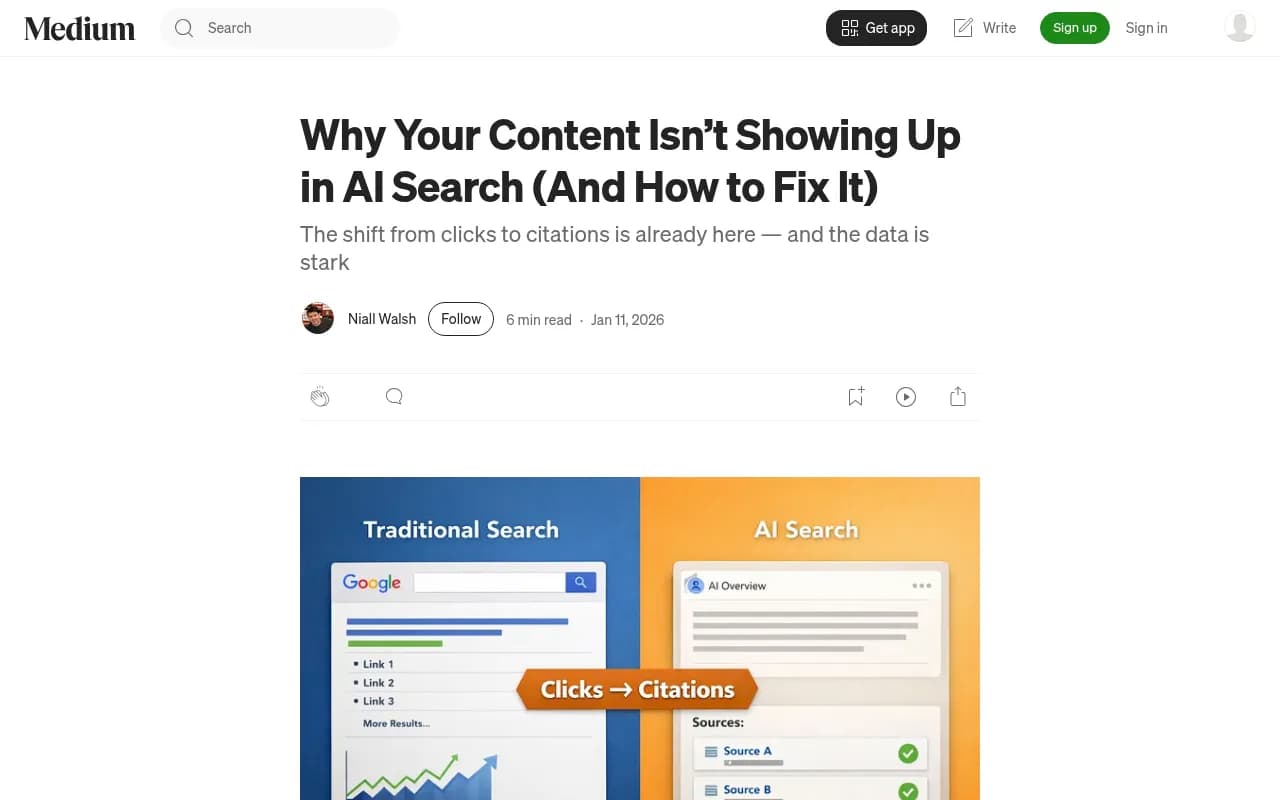
This isn't a quality problem. It's an interpretability problem. AI systems don't read your content the way humans do. They break text into small passages, check whether each passage directly answers a specific question, verify your identity and credentials against external sources, and decide whether to cite you or someone else. If your content isn't structured for machine extraction, it's invisible.
Julian Goldie, SEO entrepreneur with 300,000+ YouTube subscribers, put it bluntly in a recent Forbes piece: "Google is different. The search results you see today are not the same as last year. They're not even the same as six months ago. Something big shifted." That shift is AI Overviews appearing in roughly 58% of informational searches, with 60% of those searches ending without a click to any website. You could rank number one and still get zero traffic.
Why AI engines skip your content
AI systems evaluate content through a different lens than human readers. Here's what they're checking:
1. Answer proximity: Does the first sentence of each section directly answer the question in the heading? If your answer comes after two paragraphs of context, AI engines move on. They want immediate, extractable answers.
2. Structural signals: Is your content marked up with FAQ or HowTo schema? Do you use proper heading hierarchy (H2, H3)? Are lists formatted as actual lists, not paragraphs with bullet characters? AI systems rely on these signals to understand content structure.
3. Author verification: Is there a named, credentialed author with a bio page linked from the article? Can AI engines verify this person's expertise against external sources (LinkedIn, university pages, industry publications)? Anonymous or generic bylines are red flags.
4. Freshness signals: Has the content been updated recently? AI systems check publication dates, last-modified dates, and whether statistics and examples are current. Stale content gets deprioritized.
5. Entity recognition: Are key concepts linked to authoritative sources? Do you define technical terms? AI engines check whether they can confidently extract and verify the entities and claims in your content.
If you answer "no" to two or more of these, that's likely why AI Overviews are skipping your content.
The 30-day fix: a week-by-week plan
Week 1: Diagnose and prioritize
Day 1-2: Audit your top 10 pages
Pick the 10 pages that drive the most organic traffic or target your most important keywords. For each page, check:
- Does the first sentence under each heading directly answer the question?
- Is there FAQ or HowTo schema markup? (View source and search for "@type": "FAQPage" or "HowTo")
- Is there a named author with a linked bio page?
- Is the last-modified date within the last 6 months?
- Are key terms linked to authoritative sources?
Score each page 0-5 based on how many criteria it meets. Focus your effort on pages scoring 0-2 -- these are the easiest wins.
Day 3-4: Identify citation gaps
Use a tool to see which prompts your competitors are cited for but you're not. Promptwatch shows you the exact prompts where competitors appear in AI Overviews and you don't, then surfaces the specific content angles and topics AI models want but can't find on your site.
Alternatively, manually test 10-20 queries related to your niche in ChatGPT, Perplexity, and Google AI Overviews. Note which competitors get cited and what format their content uses (listicle, how-to, comparison table, etc.).
Day 5-7: Build your fix list
For each of your top 10 pages, write down:
- Which headings need rewritten first sentences
- Which sections need schema markup added
- Whether the author bio exists and is linked
- What date needs updating
- Which terms need authoritative links
This is your roadmap for weeks 2-3.
Week 2: Restructure for AI interpretability
Day 8-10: Rewrite for answer-first architecture
Go through your fix list. For each heading that doesn't have an immediate answer in the first sentence, rewrite it. Before:
How to optimize images for web performance
Images are one of the largest contributors to page weight. When users visit your site, large images can slow down load times significantly. This impacts both user experience and search rankings.
After:
How to optimize images for web performance
Compress images to WebP format, resize them to display dimensions, and lazy-load below-the-fold images. This reduces page weight by 60-80% without visible quality loss.
The second version gives AI engines an extractable answer in the first sentence. The explanation can follow.
Day 11-12: Add schema markup
If your CMS supports it (WordPress with Yoast, Rank Math, or Schema Pro plugins), add FAQ schema to pages with Q&A sections and HowTo schema to step-by-step guides. If you're on a custom platform, add JSON-LD markup manually:
{
  "@context": "https://schema.org",
  "@type": "FAQPage",
  "mainEntity": [{
    "@type": "Question",
    "name": "Why doesn't my content show up in AI Overviews?",
    "acceptedAnswer": {
      "@type": "Answer",
      "text": "AI systems can't extract answers from your content because it lacks structural signals like schema markup, answer-first architecture, and verifiable author credentials."
    }
  }]
}
Prioritize pages that already have a Q&A format -- these are the easiest to mark up.
Day 13-14: Fix author signals
If your articles don't have named authors, add them. Create author bio pages with:
- Full name and credentials
- Links to LinkedIn, Twitter, or professional profiles
- A list of articles they've written
- External mentions (publications, speaking engagements, certifications)
Link the author byline on each article to their bio page. This gives AI engines a way to verify expertise.
Week 3: Add technical signals and refresh content
Day 15-17: Update dates and statistics
Go through each page on your fix list and:
- Update the last-modified date (most CMSs do this automatically when you save)
- Replace outdated statistics with current ones (cite the source)
- Add recent examples or case studies
- Remove references to "last year" or "recently" that are now stale
AI systems check freshness. A page updated this month is more likely to be cited than one from 2023.
Day 18-19: Add authoritative links
For each key term or claim in your content, ask: "Can an AI engine verify this?" If not, link to an authoritative source:
- Link technical terms to Wikipedia, MDN, or official documentation
- Link statistics to the original research report or government database
- Link product names to the official product page
- Link people's names to their LinkedIn or company bio
This isn't about SEO link juice. It's about giving AI engines a way to verify your claims.
Day 20-21: Optimize for featured snippet formats
AI Overviews often pull from the same content that appears in featured snippets. Format your content to match common snippet types:
- Use numbered lists for step-by-step processes
- Use bulleted lists for feature comparisons or pros/cons
- Use tables for side-by-side comparisons
- Use definition lists (bold term, colon, explanation) for glossaries
Example comparison table:
| Tool | Free tier | AI features | Best for |
|---|---|---|---|
| Promptwatch | Yes | Content gap analysis, AI writing agent, crawler logs | Brands optimizing for AI search |
| Otterly.AI | No | Basic monitoring only | Simple tracking needs |
| Semrush | Trial | Fixed prompts, limited AI tracking | Traditional SEO teams |
Week 4: Track, test, and iterate
Day 22-24: Set up tracking
You need to know whether your changes are working. Set up tracking for:
- AI Overview appearances: Use Promptwatch to monitor which prompts now cite your content across ChatGPT, Perplexity, Google AI Overviews, and other engines
- Citation rates: Track how often your pages appear as sources in AI-generated answers
- Traffic attribution: Use Google Search Console to see if clicks are recovering, or add Promptwatch's tracking code to attribute traffic from AI referrals
Alternatively, manually test your target queries weekly in ChatGPT, Perplexity, and Google. Note whether your pages are now being cited.
Day 25-27: Test and refine
Run your target queries through AI engines and see what happens. If your content still isn't cited:
- Check if competitors use a different content format (listicle vs how-to vs comparison)
- Look at the sources AI engines do cite -- what structural patterns do they share?
- Test whether adding more specific examples or data points helps
This is an iterative process. Not every change will work immediately.
Day 28-30: Scale to more pages
Once you've fixed your top 10 pages and confirmed the approach works, apply the same process to your next 20-30 pages. Prioritize pages that:
- Target high-volume queries with AI Overview potential
- Already rank on page one but aren't cited
- Cover topics where competitors are getting cited
The goal is to systematically make your entire site AI-interpretable, not just a handful of pages.
Tools that actually help
Most SEO tools weren't built for AI search. Here's what works:
For tracking AI visibility:
- Promptwatch: Shows citation gaps, generates AI-optimized content, tracks crawler logs. The only platform that closes the loop from tracking to content creation to results.
- Otterly.AI: Basic monitoring across ChatGPT, Perplexity, and Google AI Overviews. No content optimization features.
- Semrush: Traditional SEO platform with limited AI tracking (fixed prompts, no content gap analysis).
Otterly.AI

For schema markup:
- Rank Math (WordPress): Easy FAQ and HowTo schema with visual editor
- Yoast SEO (WordPress): Schema support with less flexibility than Rank Math
- Schema.org validator: Test your markup before publishing
For content optimization:
- Clearscope: Content briefs based on top-ranking pages (doesn't account for AI Overviews)
- Surfer SEO: On-page optimization with competitor analysis (traditional SEO focus)
- Promptwatch AI writing agent: Generates content grounded in real citation data and prompt volumes, engineered to rank in AI search

Common mistakes that keep you invisible
Mistake 1: Blocking AI crawlers
Some sites added robots.txt rules to block GPTBot, Claude-Web, and other AI crawlers during the early wave of anxiety about AI training. If you did this, you're invisible by choice. Check your robots.txt file and remove blocks unless you have a specific reason to keep them.
Mistake 2: Burying answers in context
Human readers tolerate (and sometimes prefer) context before answers. AI systems don't. If your answer comes in paragraph three, AI engines won't wait. Front-load answers, then add context.
Mistake 3: Generic or missing author bios
Bylines like "Admin" or "Marketing Team" are red flags. AI engines can't verify expertise. Use real names, link to professional profiles, and build out author bio pages.
Mistake 4: Ignoring freshness
Content from 2022 is stale in 2026, even if it's still accurate. Update dates, refresh statistics, and add recent examples. AI systems prioritize current information.
Mistake 5: Writing for humans only
You're not choosing between human readers and AI systems. You're optimizing for both. Answer-first architecture, schema markup, and authoritative links make content better for humans too -- they just happen to be requirements for AI visibility.
What to expect after 30 days
Realistically, you won't see dramatic changes overnight. AI Overviews are volatile -- Google is still testing when and where to show them. But after 30 days of consistent fixes, you should see:
- 2-3 of your top 10 pages appearing in AI Overviews for target queries
- Increased citation rates in ChatGPT and Perplexity (track this manually or with a monitoring tool)
- Improved featured snippet appearances (AI Overviews often pull from the same content pool)
- Gradual traffic recovery as AI engines start citing your content instead of competitors
The real payoff comes at 60-90 days, once AI systems have re-crawled your updated pages and incorporated them into their training data or retrieval systems.
The bigger shift: from clicks to citations
This isn't just about fixing a technical problem. The entire model of web traffic is changing. Traditional SEO optimized for clicks. AI search optimizes for citations. Your content can be successful even if users never visit your site -- as long as AI engines cite you as the authoritative source.
That shift has implications:
- Brand awareness matters more than ever (AI engines cite brands they recognize)
- Direct searches and conversions become more valuable than organic traffic
- Content needs to serve two audiences: human readers who do click through, and AI systems that extract answers without clicking
The News/Media Alliance called Google's AI Mode "theft" -- taking content by force with no return. They're not wrong. But the reality is that AI search is here, and optimizing for it is now part of the job.
Next steps
Start with your top 10 pages. Follow the week-by-week plan. Track your progress. If you're not seeing results after 30 days, revisit the diagnosis phase -- you might be missing a structural issue that's blocking AI interpretability.
And if you want to skip the manual work, tools like Promptwatch automate the entire process: they show you which prompts competitors are cited for but you're not, generate content engineered to close those gaps, and track your visibility improvements across all major AI engines.
The shift from clicks to citations is already here. The question is whether you're going to adapt or watch your traffic disappear.