Surfer SEO Review 2026
Content optimization tool that uses AI to analyze top-ranking pages and provide data-driven recommendations to improve your content's search visibility.
Key Takeaways:
• Best for: Content teams, SEO agencies, and in-house marketers managing 10+ articles per month who need data-driven optimization guidance • Standout strength: Real-time Content Score that analyzes top 10 SERP competitors and provides specific on-page recommendations (word count, headings, NLP terms, images) • AI capabilities: Surfer AI generates full SEO-optimized articles in minutes, plus Auto-Optimize and Auto Internal Links features for one-click improvements • Limitation: Pricing can add up quickly for agencies managing multiple client sites — each site requires separate tracking • Bottom line: If you're serious about content SEO and want to remove guesswork from optimization, Surfer is the industry standard
Surfer SEO has become the go-to content optimization platform for over 150,000 marketers, agencies, and content teams who want to rank in Google without guessing. Founded in 2017 by Slawek Czajkowski and Michal Suski, Surfer pioneered the concept of SERP-based content analysis — analyzing what's actually ranking for your target keyword and reverse-engineering the on-page factors that matter. The platform has evolved from a simple SERP analyzer into a comprehensive content workflow tool that now includes AI writing, internal linking automation, and even AI search optimization for platforms like ChatGPT and Perplexity.
What sets Surfer apart is its focus on correlation-based data rather than generic SEO rules. Instead of telling you to "use your keyword 5 times," Surfer analyzes the top 10-50 ranking pages for your target query and shows you the actual patterns: average word count, heading structure, semantic keywords (NLP terms), image count, and more. This data-driven approach has made it a favorite among performance-focused SEO teams at companies like ClickUp, Bolt, FreshBooks, and Shopify.
Content Editor: Real-Time Optimization Guidance
The heart of Surfer is the Content Editor, a distraction-free writing environment that gives you live feedback as you write. Enter your target keyword, select your country and language, and Surfer analyzes the top-ranking competitors to generate a Content Score (0-100) based on how well your draft matches ranking patterns. The editor highlights missing NLP terms (semantically related phrases Google expects to see), suggests optimal word count ranges, recommends heading structures, and even tells you how many images to include. Writers love it because the guidance is specific and actionable — not vague SEO advice. You can write directly in the editor or use the Chrome extension, Google Docs add-on, or WordPress plugin to optimize in your preferred environment. The real-time feedback loop means you're not guessing whether your content is "SEO-friendly" — you know exactly where you stand before hitting publish.
Surfer AI: Generate Ready-to-Rank Articles in Minutes
Launched in 2023, Surfer AI is the platform's AI writing tool that generates full SEO-optimized articles from a single keyword. Unlike generic AI writers, Surfer AI is trained on SERP data — it analyzes top-ranking competitors, identifies content gaps, and writes articles that include the right NLP terms, headings, and structure to rank. You can customize tone of voice, add brand guidelines, and even upload reference materials to keep output on-brand. The AI also includes Surfy, an inline AI assistant that can expand sections, rewrite in active voice, add statistics, or answer questions about your topic without leaving the editor. For agencies producing 50+ articles per month, Surfer AI is a massive time-saver — one user reported creating 32 content briefs in 4.5 hours that would have taken days manually.
Auto-Optimize: One-Click Content Improvements
The Auto-Optimize feature scans your existing content and automatically inserts missing NLP keywords in natural places throughout your text. Instead of manually hunting for where to add "content marketing strategy" or "SEO best practices," Auto-Optimize does it for you in seconds. It's particularly useful for refreshing old content that's dropped in rankings — users report moving from page 2 to top 5 positions after running Auto-Optimize on underperforming articles.
Auto Internal Links: Automated Link Building
Surfer's Auto Internal Links feature crawls your website and automatically suggests relevant internal links to add to your content. It identifies contextually appropriate anchor text and target pages based on semantic relevance, helping you build a stronger internal linking structure without manual research. This is crucial for both traditional SEO (helping Google understand your site structure) and AI search optimization (helping ChatGPT and Claude understand your content relationships).
Content Planner: Keyword Research and Content Strategy
The Content Planner (formerly Keyword Surfer) integrates with Google Search Console to identify keyword opportunities based on your existing rankings. It clusters related keywords, shows search volume and difficulty scores, and helps you build a content calendar around high-potential topics. You can export keyword clusters directly to Content Editor to start writing, making the research-to-writing workflow seamless.
SERP Analyzer: Competitive Intelligence
The SERP Analyzer is Surfer's original tool and still one of its most powerful. Enter any keyword and it reverse-engineers the top 50 ranking pages, showing you exactly what's working: word count distribution, common headings, NLP term frequency, backlink profiles, domain authority, and more. You can compare multiple competitors side-by-side and identify content gaps — topics they're covering that you're not. This is invaluable for understanding why a competitor outranks you and what you need to add to compete.
Outline Builder: AI-Powered Content Briefs
The Outline Builder generates detailed content outlines based on SERP analysis, including suggested headings, questions to answer, and key points to cover. You can customize the outline, add your own sections, and export it as a brief for freelance writers. This ensures everyone on your team is working from the same data-driven blueprint.
Plagiarism Checker: Originality Safeguard
Surfer includes a built-in Plagiarism Checker to ensure your content (or your writers' content) is original. This is especially important when using AI writing tools or working with freelancers — you can verify uniqueness before publishing to avoid Google penalties.
Multi-Language and Multi-Region Support
Surfer supports content optimization in over 70 languages and lets you target specific countries for localized SERP analysis. Whether you're optimizing for "marketing automation" in English (US) or "automatización de marketing" in Spanish (Mexico), Surfer analyzes the actual SERPs for that language and region. This makes it a strong choice for international SEO teams and agencies managing multilingual clients.
AI Search Optimization: Beyond Google
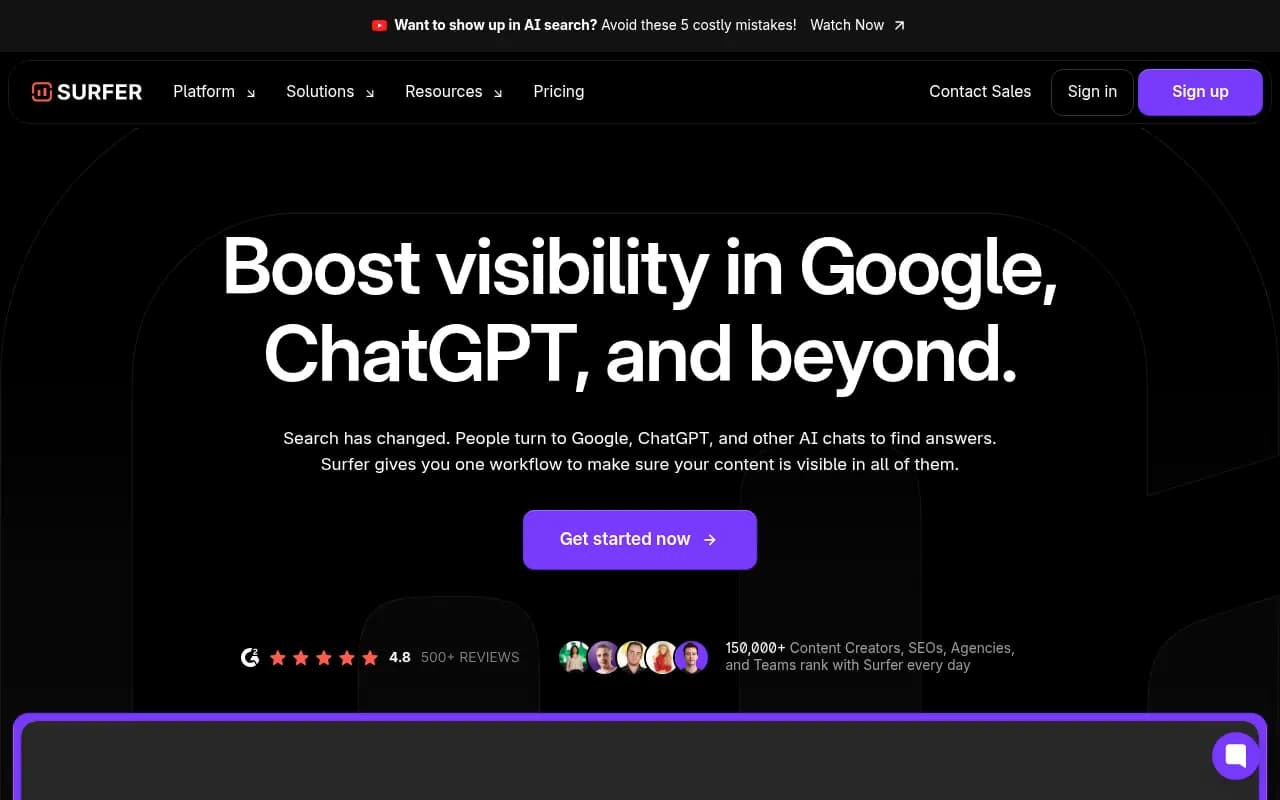
Surfer recently added AI Search Optimization features to help brands show up in ChatGPT, Claude, Perplexity, and other AI assistants. The platform now includes guidance on optimizing content for AI citations, tracking when AI models mention your brand, and understanding what content AI search engines are reading. This is a newer area but positions Surfer as forward-thinking as search behavior shifts toward conversational AI.
Who Is Surfer SEO For?
Surfer is ideal for content-focused SEO teams at SaaS companies, e-commerce brands, and digital publishers producing 10-100+ articles per month. It's particularly strong for SEO agencies managing multiple clients who need a scalable workflow for content briefs, optimization, and reporting. Freelance content writers and strategists use it to deliver data-backed recommendations to clients and justify their optimization decisions with hard numbers. In-house marketing teams at mid-sized companies (50-500 employees) find it hits the sweet spot between ease of use and depth of data — you don't need to be an SEO expert to use Surfer effectively, but it's powerful enough for advanced users. It's less ideal for local SEO (focused on Google My Business and citations) or technical SEO (site speed, schema, crawlability) — Surfer is purely about on-page content optimization. Solo bloggers or very small sites publishing 1-2 articles per month may find the pricing steep compared to simpler tools.
Integrations and Ecosystem
Surfer integrates with Google Docs (Chrome extension for real-time optimization), WordPress (plugin for optimizing directly in WP editor), Jasper AI (connect Surfer's SEO data to Jasper's AI writing), Contentful (headless CMS integration), Zapier (automate workflows), and ChatGPT (via API for AI-assisted writing). There's also a Surfer API for developers who want to build custom integrations or pull SERP data programmatically. The platform doesn't have a mobile app, but the web interface is responsive enough for quick edits on tablets.
Pricing and Value
Surfer offers four main plans: Essential ($99/month, billed annually) includes 30 Content Editor articles, 20 Auto-Optimize runs, and basic features — good for solo creators or small teams. Advanced ($179/month annually) adds 100 articles, Surfer AI credits, and team collaboration features — the sweet spot for growing agencies. Max ($299/month annually) includes 200 articles and priority support for larger teams. Enterprise (custom pricing) offers unlimited usage, dedicated account management, and custom integrations for large organizations. Surfer AI articles cost extra credits on top of your base plan (typically $10-20 per AI-generated article depending on length). There's a 7-day money-back guarantee but no free plan or freemium tier — you need to commit to a paid plan to use the platform. Compared to competitors like Clearscope ($170-350/month) or MarketMuse ($149-599/month), Surfer is competitively priced and offers more features at the entry level. The main cost consideration for agencies is that each client site requires separate tracking in Content Planner, which can push you into higher tiers quickly.
Strengths
Data-driven recommendations: Surfer's SERP analysis is based on real ranking data, not generic SEO rules, making recommendations highly specific and actionable. Ease of use: The Content Score and real-time feedback make optimization intuitive even for non-SEO experts — writers can follow the guidance without deep technical knowledge. Comprehensive workflow: From keyword research (Content Planner) to writing (Content Editor) to AI generation (Surfer AI) to optimization (Auto-Optimize) to internal linking (Auto Internal Links), Surfer covers the entire content SEO process in one platform. Proven results: Users consistently report ranking improvements — one case study showed a site moving to #1 after deleting 85% of content based on Surfer's analysis. Strong integrations: Google Docs, WordPress, and Jasper integrations make it easy to fit Surfer into existing workflows.
Limitations
Pricing can escalate: Agencies managing 10+ client sites can quickly hit article limits and need to upgrade to expensive tiers. Each Content Planner site and Surfer AI article consumes credits. Learning curve for advanced features: While Content Editor is intuitive, features like SERP Analyzer and Content Planner have more complexity and take time to master. Not a complete SEO suite: Surfer doesn't handle technical SEO, backlink analysis, or rank tracking — you'll still need tools like Ahrefs, Semrush, or Screaming Frog for those. Some users report that Surfer's recommendations can feel formulaic if followed too rigidly — it's important to balance data with editorial judgment and brand voice.
Bottom Line
Surfer SEO is the industry-standard content optimization platform for teams that want to remove guesswork from on-page SEO. If you're producing content at scale (10+ articles per month) and need data-driven guidance on what to write, how to structure it, and which keywords to target, Surfer delivers. The combination of real-time Content Score, AI writing tools, and automated optimization features makes it a productivity multiplier for agencies and in-house teams. It's not the cheapest option, but the ROI is clear — users consistently report faster rankings, higher traffic, and more efficient content workflows. Best use case in one sentence: SEO agencies and content teams producing 20-100+ articles per month who need a scalable, data-backed workflow for creating content that ranks in Google and AI search.
Tags:
Frequently asked questions
What is Surfer SEO and what does it do?
How much does Surfer SEO cost?
Is Surfer SEO free to use?
Who is Surfer SEO best for?
What is the Surfer SEO Content Score?
Does Surfer SEO have AI writing capabilities?
How is Surfer SEO different from other SEO tools like Ahrefs or SEMrush?
What are the limitations of Surfer SEO?
Does Surfer SEO integrate with Google Docs or WordPress?
When was Surfer SEO founded and who created it?
Similar and alternative tools to Surfer SEO