GEOReport.ai Review 2026
GEO tracking tool focused on measuring what AI engines actually see and cite, with emphasis on accurate visibility reporting across AI models.
Summary:
• Best for: Brands, agencies, and SEO teams who want to optimize their websites for AI search engines like ChatGPT, Claude, Gemini, and Perplexity • Standout feature: Four-pillar benchmark system (Search Alignment, Layout, Readability, Credibility) based on Princeton GEO research, providing specific, actionable fixes • Key limitation: Most advanced features (Content Audit, GEO Landing Builder, GEO Content Writer) are still in development or "coming soon" • Pricing: Free tier available, paid plans from $29/mo with white-label reporting at higher tiers • Bottom line: A promising audit-first platform for brands serious about AI visibility, though currently limited to site audits while competitors offer full monitoring and optimization suites
GEOReport.ai positions itself as the first comprehensive audit platform specifically designed to measure and improve how AI search engines understand your website. Launched in 2024 and grounded in academic research from Princeton, Georgia Tech, and IIT Delhi, the platform takes a fundamentally different approach than most AI visibility tools: instead of tracking where you appear in AI responses, it audits why you're not appearing and tells you exactly how to fix it.
The core value proposition is straightforward: traditional SEO is no longer enough when users are asking ChatGPT, Claude, Gemini, and Perplexity for answers instead of clicking through Google results. If your website isn't structured in a way that AI models can parse, cite, and trust, you're invisible in this new search paradigm. GEOReport exists to diagnose and solve that problem.
The Four-Pillar Benchmark System
What sets GEOReport apart from generic "AI visibility scores" is its multi-dimensional audit framework. Every page receives a GEO Health Score based on four distinct benchmarks:
Search Alignment measures how well your content matches the queries and topics AI models are likely to encounter. This isn't just keyword density -- it evaluates semantic relevance, topic coverage, and whether your page actually answers the questions users are asking AI chatbots. The platform analyzes heading structure, content flow, and topical authority to determine if AI models would consider your page a credible source for specific queries.
Layout evaluates page structure from an AI parsing perspective. AI models don't "see" your website the way humans do -- they parse HTML, extract structured data, and follow semantic markup. This benchmark checks for proper heading hierarchy (H1, H2, H3 usage), schema markup implementation, clean DOM structure, and whether key information is buried in JavaScript or accessible in the initial HTML. Issues flagged here include missing meta descriptions, poor heading structure, lack of structured data, and content hidden behind client-side rendering that AI crawlers might miss.
Readability assesses how easily AI models can extract and synthesize information from your content. This goes beyond traditional readability scores (Flesch-Kincaid, etc.) to evaluate sentence structure, paragraph length, use of lists and tables, and whether information is presented in a format that AI models prefer when generating responses. The platform flags overly complex sentences, walls of text without breaks, and content that lacks clear topic sentences or summaries.
Credibility measures trust signals that influence whether AI models will cite your content. This includes author attribution, publication dates, citation of sources, domain authority indicators, and presence of expertise markers (credentials, affiliations, references). AI models are increasingly selective about which sources they cite, and this benchmark identifies what's missing to make your content citation-worthy.
Each benchmark receives its own score, and issues are classified as Critical, Medium, or Minor with specific guidance on how each fix will improve your overall GEO Health Score. This granular approach means you're not guessing what to optimize -- you get a prioritized list of actionable improvements.
Site Audit: The Core Product (Currently Available)
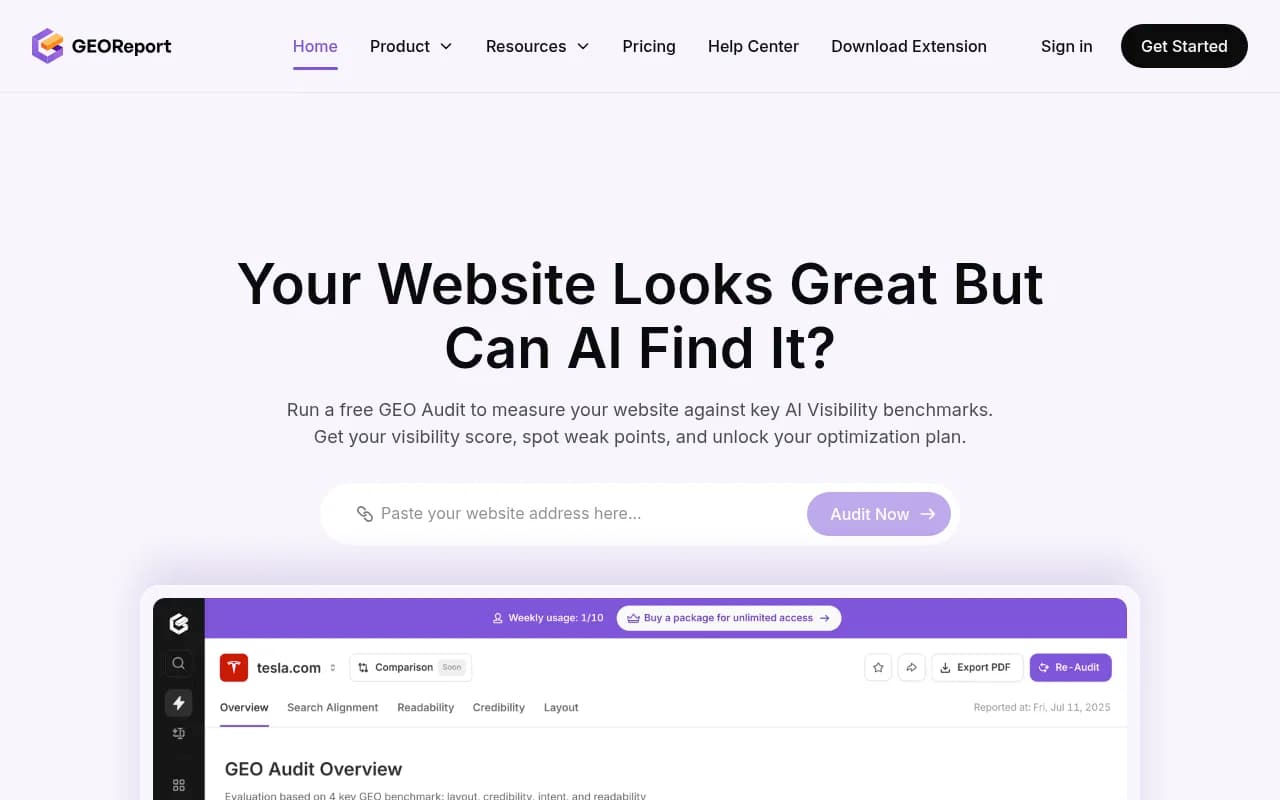
The Site Audit tool is GEOReport's flagship feature and the only one fully available as of early 2025. You can audit any URL -- your own pages or competitors' -- either through the web dashboard or via a Chrome extension that lets you run audits directly from any webpage you're browsing.
The audit process is instant: paste a URL, hit audit, and within seconds you receive a comprehensive report showing your GEO Health Score, individual benchmark ratings, and a detailed issue list. The report includes multiple views: a summary page score, individual tabs for each benchmark, an AI Model Comparison view (showing how ChatGPT, Gemini, Claude, and Perplexity would likely interpret your page), and a prioritized issue list.
Issue tracking is where GEOReport shines compared to competitors. Instead of vague recommendations like "improve AI visibility," you get specific, technical fixes: "Add schema.org Article markup to improve credibility," "Break 450-word paragraph into 3-4 shorter paragraphs for better readability," "Move H2 heading above introductory paragraph to improve layout structure." Each issue includes an explanation of why it matters and how fixing it will impact your score.
The platform supports multi-site management, letting you track multiple domains, view audit history, monitor progress over time, and compare page-level scores across your portfolio. This is particularly useful for agencies managing client sites or brands with multiple properties.
Chrome Extension for Instant Audits
The Chrome extension is a standout feature that competitors like Otterly.AI, Peec.ai, and AthenaHQ don't offer. Install it, browse to any page, click the extension icon, and get an instant GEO audit without leaving your browser. This makes competitive analysis effortless -- you can audit competitor pages, industry leaders, or any site you're researching in real-time.
The extension provides the same four-pillar breakdown and issue list as the dashboard, with the option to save audits to your account for later review. For agencies doing client prospecting or brands researching competitors, this is a massive time-saver.
Coming Soon: Content Audit, GEO Landing Builder, GEO Content Writer
GEOReport's roadmap includes three additional tools that are currently in development or marked "coming soon":
Content Audit will evaluate blog posts and articles specifically for AI search performance, analyzing text readability, semantic flow, long-tail keyword optimization, and how well the content would rank in AI-generated answers. This is intended to complement the Site Audit by focusing on content quality rather than just page structure.
GEO Landing Builder promises a guided page builder with live GEO scoring as you create landing pages. The idea is to build pages optimized for AI visibility from scratch, with real-time feedback on structure, layout, and search alignment as you add content.
GEO Content Writer will be an AI writing assistant with inline GEO suggestions and real-time scoring, helping you create blog posts and landing pages that are optimized for AI citation from the first draft.
These features sound promising, but as of early 2025, they're not available. This is a significant limitation compared to platforms like Promptwatch, which already offers AI content generation grounded in citation data, or Profound and Scrunch, which provide full content optimization suites. If you need content creation tools today, GEOReport isn't ready yet.
Who Is GEOReport For?
GEOReport is best suited for:
SEO teams and digital marketers at brands who are starting to think about AI visibility and want to audit their existing site structure before investing in broader AI search optimization. If you're responsible for a corporate website or e-commerce site and need to understand why AI models aren't citing your content, GEOReport gives you a clear diagnostic.
Agencies managing 5-20 client sites who need a simple, repeatable audit process to identify AI visibility issues and deliver white-label reports. The Agency plan includes custom branding for reports, making it easy to package audits as a service offering.
Content teams and web developers who want technical, actionable feedback on page structure and content formatting. The issue tracking is specific enough to hand directly to developers ("Add schema markup here") or content writers ("Break this paragraph into three shorter ones").
Competitive researchers who want to quickly audit competitor pages to understand why they're getting cited by AI models. The Chrome extension makes this use case particularly strong.
GEOReport is NOT ideal for:
Brands needing ongoing AI visibility monitoring across hundreds or thousands of prompts. GEOReport audits individual pages; it doesn't track your brand mentions across AI models over time. For that, you'd need a monitoring platform like Promptwatch, Otterly.AI, or Peec.ai.
Teams that need content creation tools now. The Content Writer and Landing Builder are still in development. If you need to generate AI-optimized content today, look at Promptwatch's AI writing agent or traditional SEO content tools.
Enterprise teams managing 50+ sites or needing API access for custom workflows. GEOReport is a relatively new platform without the enterprise features (API, Looker Studio integration, custom data exports) that larger teams require.
Pricing and Plans
GEOReport offers four pricing tiers:
Free Plan: Limited audits per month, access to basic GEO Health Score and benchmark breakdowns. Good for testing the platform or auditing a handful of pages.
Pro Plan ($29/mo estimated): Unlimited audits, full issue tracking, PDF exports, audit history, and multi-site management. This is the tier most individual marketers and small teams will need.
Agency Plan (pricing not disclosed): Everything in Pro plus white-label reports with custom branding, priority support, and higher audit limits. Designed for agencies delivering audits to clients.
Lifetime Plan (one-time purchase, pricing not disclosed): One-time payment for lifetime access to Pro or Agency features. This is appealing for agencies or brands that plan to use the tool long-term and want to avoid recurring costs.
Compared to competitors, GEOReport's pricing is on the lower end. Promptwatch starts at $99/mo, Profound and Scrunch are in the $200-500/mo range, and Otterly.AI is around $99-199/mo. However, those platforms offer monitoring, tracking, and content generation -- features GEOReport doesn't have yet. You're paying less because you're getting less: audits only, not a full optimization platform.
Integrations and Ecosystem
GEOReport currently has minimal integrations. There's no API, no Zapier connection, no Google Search Console integration, and no export options beyond PDF reports. The Chrome extension is the only "integration" in the traditional sense.
This is a significant gap compared to competitors. Promptwatch integrates with Google Search Console, offers a Looker Studio connector, and provides API access for custom workflows. Semrush and Ahrefs have extensive integration ecosystems. GEOReport is a standalone tool with no way to pipe data into your existing marketing stack.
For a brand-new platform, this is understandable, but it limits enterprise adoption and makes it harder to incorporate GEOReport into existing workflows.
Strengths
Actionable, specific issue tracking: Unlike tools that give you a vague "AI visibility score," GEOReport tells you exactly what's broken and how to fix it. The four-pillar framework is well-designed and grounded in research.
Chrome extension for instant audits: Being able to audit any page you're browsing is a killer feature for competitive research and quick diagnostics.
Grounded in academic research: The platform is built on the GEO framework from Princeton, Georgia Tech, and IIT Delhi, giving it credibility and a solid theoretical foundation.
Affordable pricing: At an estimated $29/mo for the Pro plan, it's significantly cheaper than most AI visibility platforms.
White-label reporting: Agencies can deliver branded reports to clients, making it easy to package audits as a service.
Limitations
Most features aren't available yet: Content Audit, GEO Landing Builder, and GEO Content Writer are all "coming soon." You're buying into a roadmap, not a complete product.
No ongoing monitoring: GEOReport audits pages, but it doesn't track your brand mentions across AI models over time. You won't know if your visibility is improving or declining without manually re-auditing pages.
No integrations or API: There's no way to connect GEOReport to your existing tools or export data beyond PDF reports.
Limited to page-level audits: You can't audit an entire site at once or get domain-level insights. Each audit is a single URL.
No prompt tracking or citation analysis: Competitors like Promptwatch show you which specific prompts your brand appears in and which pages are being cited. GEOReport only tells you if your page structure is optimized, not whether AI models are actually citing you.
Bottom Line
GEOReport.ai is a solid audit-first platform for brands and agencies that want to diagnose AI visibility issues and get specific, actionable fixes. The four-pillar benchmark system is well-designed, the Chrome extension is a standout feature, and the pricing is competitive. If you need a one-time or periodic audit to understand why your pages aren't AI-friendly, GEOReport delivers.
However, it's not a complete AI visibility solution. There's no monitoring, no content generation (yet), no integrations, and no way to track your brand's performance across AI models over time. For brands serious about AI search optimization, GEOReport is a useful diagnostic tool, but you'll likely need a more comprehensive platform like Promptwatch for ongoing tracking and optimization, or a content tool like Profound or Scrunch for creating AI-optimized content at scale.
Best use case in one sentence: GEOReport is ideal for agencies and brands that need a fast, affordable way to audit individual pages for AI visibility issues and deliver white-label reports to clients, but it's not a replacement for full AI search monitoring and optimization platforms.
Tags:
Similar and alternative tools to GEOReport.ai