Goodie AI Review 2026
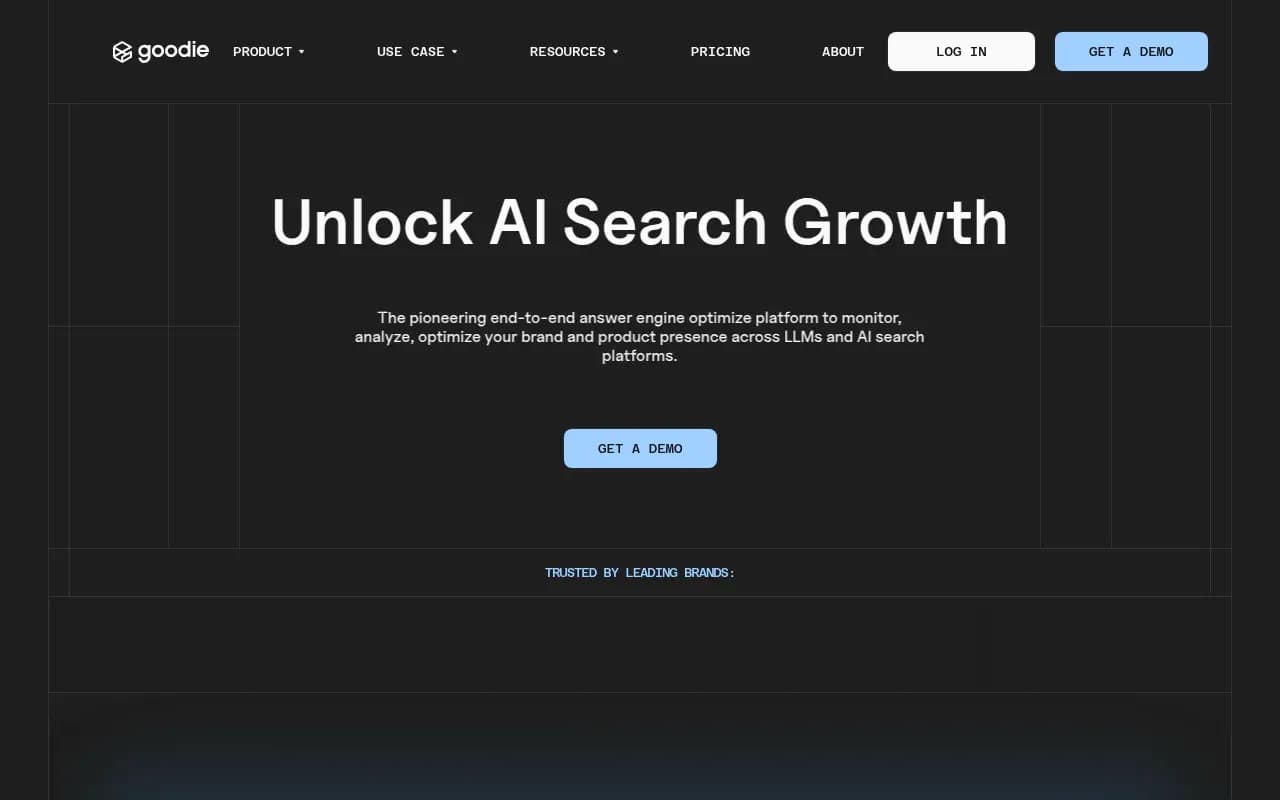
Goodie is an AEO and AI search visibility platform that tracks brand mentions, citations, and competitive positioning across 11 AI models including ChatGPT, Gemini, Perplexity, and Amazon Rufus. Built for enterprise brands, agencies, and marketing teams.
Key takeaways
- Goodie covers a broad set of AI models (11 total, including Amazon Rufus -- a rare differentiator) and wraps monitoring, prompt research, content writing, and attribution into one platform
- Lacks the depth of Promptwatch in several critical areas: no public evidence of query fan-outs, Reddit/YouTube source tracking, or prompt difficulty scoring; pricing is quote-only with no self-serve entry point
- The Agentic Commerce Suite is a genuine standout -- tracking product visibility in AI shopping experiences (ChatGPT, Amazon Rufus, Perplexity) is something few competitors have tackled seriously
- Pricing is entirely custom/quote-based, which makes it hard to evaluate without a sales call -- a real friction point for smaller teams
- Best suited for mid-market to enterprise brands in retail, fintech, travel, and SaaS that want a managed, full-service AEO platform
Goodie (marketed at higoodie.com) is an Answer Engine Optimization platform that positions itself as an end-to-end solution for brands trying to get cited, mentioned, and recommended by AI search engines. The company targets the same problem that's keeping a lot of marketing teams up at night right now: as users increasingly ask ChatGPT or Perplexity instead of Googling, traditional SEO metrics stop telling the full story. Goodie's pitch is that it covers the full loop -- research, monitor, act, measure -- rather than just handing you a dashboard of brand mention counts.
The platform tracks 11 AI models: ChatGPT, Google AI Overview, Google AI Mode, Gemini, Claude, Perplexity, Grok, Meta AI, Microsoft Copilot, DeepSeek, and Amazon Rufus. That last one is notable. Amazon Rufus is the AI shopping assistant embedded in Amazon's product discovery flow, and very few AEO tools have built dedicated tracking for it. For e-commerce and retail brands, that's a meaningful gap that Goodie fills where competitors don't.
Goodie's client list includes Dermalogica, SteelSeries, Rathbones (a UK wealth management firm), and the growth agency NoGood. The case study numbers they publish are striking -- 127% increase in AI conversions for Dermalogica, 335% traffic increase from AI sources for NoGood, 3.2x AI search conversion increase for SteelSeries in six months. These are specific enough to be credible, though as with any vendor-published case study, they reflect best-case outcomes.
Key features
Prompt research Goodie's prompt research module is designed to surface the actual queries customers type into AI search engines -- not keyword lists borrowed from traditional SEO tools. The idea is to find high-volume, high-intent prompts where your brand either has an opportunity or is currently invisible. In practice, this is the foundation of any AEO strategy: you can't optimize for prompts you don't know exist. The platform claims to show volume patterns and visibility opportunities, though it's not clear from public information whether it provides difficulty scores or query fan-outs (the branching sub-queries that stem from a single prompt) -- both of which Promptwatch offers explicitly.
Visibility monitoring The core monitoring layer tracks brand mentions, citations, and sentiment across all 11 supported AI models. You can see how often your brand appears in AI-generated answers, what sentiment those mentions carry, and how your share of voice compares to competitors. This is table stakes for any AEO platform, and Goodie's model coverage is genuinely broad. The competitive positioning view lets you benchmark against specific rivals, which is useful for reporting to leadership.
Optimization actions Rather than just showing you where you're invisible, Goodie claims to generate a prioritized playbook of what to fix. This is where the platform tries to go beyond pure monitoring. The "Optimization Actions" feature identifies gaps and recommends specific improvements across owned and earned assets. How prescriptive these recommendations actually are in practice -- whether they tell you exactly what content to create, or just flag that you're underperforming in a category -- isn't fully clear from public materials.
AEO Writer Goodie includes a built-in content generation tool that produces AI-optimized content designed to meet the authority and structure standards that LLMs prefer when selecting citations. The pitch is that it maintains your brand voice while engineering content for AI discoverability. This is a meaningful feature -- most monitoring-only tools leave you to figure out content creation yourself. The quality of AI-generated content tools varies enormously in practice, so this is one area where hands-on testing would matter a lot.
Agentic Commerce Suite This is Goodie's most distinctive feature and the one that sets it apart most clearly from the field. The Agentic Commerce Suite tracks how your products appear in AI shopping experiences -- specifically ChatGPT's shopping recommendations, Amazon Rufus product discovery, and Perplexity's commerce features. As AI agents increasingly handle product research and purchasing decisions, this kind of visibility matters enormously for retail and e-commerce brands. It's a forward-looking bet that's already paying off for clients like SteelSeries and Dermalogica.
Crawlers & Agents Goodie monitors how AI crawlers (the bots that ChatGPT, Perplexity, and others send to index your site) actually experience your website. This includes identifying technical gaps -- pages that aren't being crawled, errors that block AI indexing, and frequency patterns. Understanding crawler behavior is a prerequisite for fixing it, and this feature gives technical SEO teams something concrete to act on. It's comparable to Promptwatch's AI Crawler Logs feature.
Analytics & Attribution The attribution layer is designed to connect AI visibility to actual business outcomes -- traffic, conversions, revenue. This is the hardest problem in AEO right now, because AI-driven traffic often doesn't show up cleanly in Google Analytics. Goodie claims to solve this with attribution that shows "exactly how much growth AI search is driving." The Dermalogica case study (127% increase in AI conversions) suggests this is working in at least some implementations.
Multi-model, multi-market coverage Goodie supports multiple languages and markets, which matters for global enterprise brands. The platform is described as SOC 2 compliant, which is a requirement for many enterprise procurement processes, particularly in fintech and healthcare.
Who is it for
Goodie's sweet spot is mid-market to enterprise brands with dedicated marketing or SEO teams who want a managed AEO platform rather than a self-serve tool. The case studies skew toward established brands -- a skincare company, a gaming peripherals brand, a UK wealth management firm -- rather than startups or SMBs. The quote-only pricing model reinforces this: you're not going to spin up a Goodie account on a credit card to test it out.
For digital agencies managing multiple clients, Goodie offers multi-domain dashboards and white-label reporting, which are standard requirements for agency workflows. The NoGood case study (335% AI traffic increase) suggests it can work well in an agency context, though agencies with many smaller clients may find the pricing model difficult to scale.
E-commerce and retail brands are probably the most natural fit, given the Agentic Commerce Suite. If your products are being recommended (or not recommended) by Amazon Rufus and ChatGPT's shopping features, you need visibility into that -- and Goodie is one of the few platforms that provides it. Similarly, fintech and financial services brands will appreciate the SOC 2 compliance and the compliance-ready optimization framing.
Who should probably look elsewhere: smaller teams with limited budgets who need transparent, self-serve pricing. Startups running lean who want to experiment with AEO before committing to an enterprise contract. Teams that primarily need traditional SEO alongside AI monitoring -- Goodie is AI-native and doesn't try to replace your existing SEO stack.
Integrations and ecosystem
Goodie's public materials don't detail a specific integration marketplace, but the platform connects to Google's AI surfaces (AI Overview, AI Mode, Gemini) and tracks Amazon Rufus, which implies some level of data pipeline into Amazon's ecosystem. The attribution features suggest integration with web analytics tools, though specific connectors (Google Analytics, GSC, etc.) aren't called out explicitly in available documentation.
The platform is described as enterprise-grade, which typically implies API access for custom reporting and data export, but Goodie hasn't published API documentation publicly. White-label reporting is available for agencies. There's no mention of a browser extension or mobile app.
Pricing and value
Goodie uses quote-based pricing with no public tiers. Based on third-party reports and the enterprise positioning of the platform, it's safe to assume this is not a sub-$500/month tool. The lack of transparent pricing is a genuine friction point -- it means every evaluation requires a sales conversation, which adds time and creates uncertainty for budget planning.
For comparison, Promptwatch publishes clear pricing starting at $99/month (Essential: 1 site, 50 prompts, 5 articles), $249/month (Professional: 2 sites, 150 prompts, 15 articles, crawler logs), and $579/month (Business: 5 sites, 350 prompts, 30 articles). That transparency makes it much easier to evaluate fit before committing.
Goodie's value proposition is strongest for enterprise brands where the ROI of AI search visibility is large enough to justify a custom contract. If you're Dermalogica or SteelSeries and AI search is driving meaningful conversion volume, the investment makes sense. For a 10-person SaaS company, probably not.
Strengths and limitations
What Goodie does well:
- Amazon Rufus tracking is genuinely rare and valuable for e-commerce brands. Very few AEO platforms have built dedicated coverage for AI shopping agents.
- Agentic Commerce Suite as a concept is ahead of the curve. Tracking product visibility in AI shopping experiences is the right problem to be solving in 2026.
- Broad model coverage across 11 AI platforms, including some that competitors skip (DeepSeek, Grok, Meta AI alongside the obvious ones).
- Published case studies with specific numbers -- 127%, 335%, 3.2x -- give the platform more credibility than vague "improved visibility" claims.
- SOC 2 compliance makes enterprise procurement conversations easier, particularly in regulated industries.
Where it falls short:
- No transparent pricing makes evaluation difficult and signals that this is built for enterprise sales cycles, not self-serve adoption. Teams that want to start small and scale up will find this frustrating.
- Missing features compared to Promptwatch: there's no public evidence of Reddit and YouTube source tracking (which surfaces the discussions that actually influence AI recommendations), no query fan-out analysis, no prompt difficulty scoring, and no ChatGPT Shopping-specific tracking as a distinct feature. Promptwatch's Answer Gap Analysis -- which shows you the exact prompts competitors rank for that you don't -- is also not clearly replicated in Goodie's feature set.
- No self-serve trial or freemium tier means you can't evaluate the platform without talking to sales first. In a market where most buyers want to try before they commit, this is a real barrier.
- Limited public documentation on how the optimization recommendations actually work in practice -- it's hard to know how prescriptive the "playbook" really is without a demo.
Bottom line
Goodie is a serious AEO platform with genuine strengths, particularly for retail and e-commerce brands that need visibility into AI shopping experiences. The Agentic Commerce Suite and Amazon Rufus tracking are real differentiators. But the quote-only pricing, lack of self-serve access, and gaps in features like Reddit/YouTube tracking and prompt difficulty scoring mean it's not the right fit for everyone.
For teams that want a full optimization loop -- not just monitoring, but content gap analysis, AI content generation grounded in citation data, crawler logs, and traffic attribution -- Promptwatch covers more ground at transparent, published price points. Goodie is worth evaluating if you're an enterprise brand in retail, fintech, or travel with a budget to match, and the Agentic Commerce Suite is specifically relevant to your business.
Best use case: Enterprise retail or e-commerce brands that need to track and optimize product visibility across AI shopping agents like Amazon Rufus and ChatGPT, and have the budget for a managed, quote-based platform.
Tags:
Frequently asked questions
What is Goodie?
How much does Goodie cost?
What makes Goodie different from other AEO tools?
Is there a free trial for Goodie?
Who is Goodie best suited for?
How does Goodie compare to Promptwatch?
Similar and alternative tools to Goodie AI