Mangools Review 2026
Budget-friendly SEO suite under $50/month with KWFinder, SERPChecker, and LinkMiner. Best value alternative for small teams and freelancers.
Summary
• Best for: Freelancers, small agencies, and solopreneurs who need core SEO tools without enterprise pricing — plans start at $29/month • Standout strength: Exceptionally clean UI that makes complex SEO data accessible to beginners, backed by a support team with genuine SEO expertise • Key limitation: Smaller keyword database and fewer advanced features compared to Ahrefs or SEMrush — not ideal for large agencies managing 50+ clients • Unique value: Five integrated tools (KWFinder, SERPChecker, SERPWatcher, LinkMiner, SiteProfiler) plus new AI Search Watcher for tracking brand visibility in ChatGPT and other LLMs • Bottom line: The best value-for-money SEO suite for budget-conscious marketers who want essential features without the learning curve or $200+/month price tag
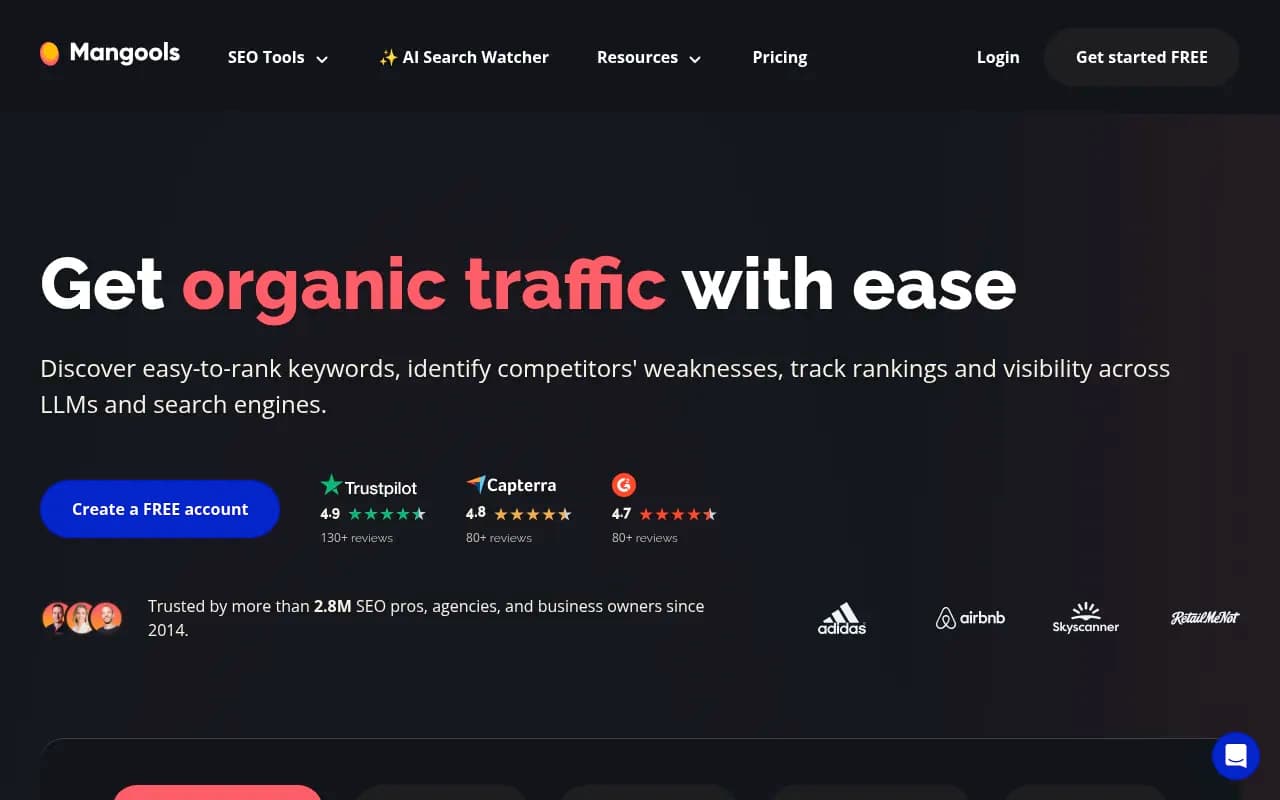
Mangools has quietly built one of the most beloved SEO toolkits in the industry since launching in 2014. While giants like Ahrefs and SEMrush dominate the enterprise market with feature-packed platforms and $200+ monthly price tags, Mangools carved out a different niche: affordable, beautifully designed SEO tools that don't require a PhD to use. With over 2.8 million users and consistently high ratings on Trustpilot (4.9/5), Capterra (4.8/5), and G2 (4.7/5), it's become the go-to choice for freelancers, small agencies, and solopreneurs who need real SEO capabilities without the enterprise overhead.
The platform bundles five core tools into one subscription: KWFinder for keyword research, SERPChecker for SERP analysis, SERPWatcher for rank tracking, LinkMiner for backlink analysis, and SiteProfiler for competitor research. In 2025, they added AI Search Watcher to track brand visibility across ChatGPT, Google AI Overviews, Claude, Gemini, Perplexity, and other LLMs — a timely addition as AI search reshapes how people discover brands. The entire suite starts at just $29/month (annual billing), making it one of the most accessible professional SEO toolkits on the market.
KWFinder: Keyword Research Without the Overwhelm
KWFinder is Mangools' flagship tool and the reason many users first discover the platform. It simplifies keyword research with a single, intuitive interface that surfaces the metrics that actually matter: search volume, keyword difficulty (KD), cost-per-click, and search volume trends over 12 months. The database includes 2.5 billion+ keywords across 65,000+ city-level locations worldwide, so you can research keywords for hyper-local campaigns ("plumber in Austin TX") or broad national terms.
The keyword difficulty score is particularly well-calibrated for small sites. Unlike some tools that show everything as "hard," KWFinder's KD score (0-100) realistically reflects how tough it will be for a newer site to rank. You can filter by KD to find "easy wins" — keywords with decent volume but low competition. The autocomplete feature pulls suggestions from Google, and you can analyze related keywords, questions people ask, and competitor keywords all in one view.
One standout feature: competitor keyword analysis. Enter a competitor's domain, and KWFinder shows you which keywords they rank for, their positions, search volumes, and estimated traffic. This is gold for finding content gaps — keywords your competitors rank for but you don't. You can export these lists and prioritize based on difficulty and volume.
KWFinder also supports bulk keyword analysis. Upload a list of up to 700 keywords (on higher plans), and it will return metrics for all of them at once — useful for validating a large keyword list from another source or analyzing keywords from a Google Search Console export.
Limitations: The keyword database is smaller than Ahrefs or SEMrush, so you might miss some long-tail variations. Keyword suggestions are capped at 200 per search on the Basic plan (unlimited on Premium and Agency), which can feel restrictive if you're doing deep research. And while the data is accurate, it's not updated as frequently as enterprise tools — expect a slight lag on trending keywords.
SERPChecker: Understand What It Takes to Rank
SERPChecker lets you analyze the top 50 Google results for any keyword in any location. You get a full breakdown of each ranking page's SEO metrics: Domain Authority (DA), Page Authority (PA), Citation Flow (CF), Trust Flow (TF), backlinks, social shares, and estimated monthly visits. This helps you gauge whether you can realistically compete for a keyword — if the top 10 are all DA 80+ sites with thousands of backlinks, you know it's a tough fight.
The tool also shows SERP features (featured snippets, People Also Ask boxes, local packs, image carousels, etc.) and their impact on click-through rates. You can see which URLs are triggering these features and study their structure to replicate the format. For example, if a competitor owns the featured snippet, you can view their page and see how they structured their content (lists, tables, concise answers).
One unique feature: downloadable SERP snapshots. You can save a visual snapshot of the actual Google SERP as it appears in the browser, which is useful for client reports or tracking how SERP layouts change over time. The tool also calculates estimated CTR for each position based on SERP features present — so you can see that position 1 might only get 15% CTR if there's a featured snippet and local pack above it.
SERPChecker includes 30 million+ SERPs in its database and supports 65,000+ city-level locations, so you can analyze local SERPs for "dentist near me" type queries. The interface is clean and visual, with color-coded difficulty indicators and charts that make it easy to spot patterns.
Limitations: The tool doesn't track SERP changes over time automatically (you'd need to manually re-run the analysis). And while the metrics are helpful, they're not as granular as Ahrefs' "Content Explorer" or SEMrush's "Organic Research" — you won't get detailed traffic breakdowns or historical ranking data for each URL.
SERPWatcher: Rank Tracking That Actually Looks Good
SERPWatcher is Mangools' rank tracking tool, and it's one of the most visually appealing rank trackers on the market. You can track up to 1,500 keywords (on the Agency plan) across unlimited domains and 65,000+ locations. The dashboard shows your overall "Dominance" score (a proprietary metric that combines rankings, search volume, and estimated traffic), daily rank changes, and a clean graph of your visibility over time.
The tool imports keywords directly from Google Search Console, so you can start tracking the keywords you already rank for without manual entry. It also supports desktop and mobile tracking, local vs. national tracking, and competitor tracking (monitor up to 5 competitors per domain to see how your rankings compare).
Reports are a strong point. You can generate white-label PDF reports with your logo and branding, or share interactive online reports via a public link (great for clients who want to check rankings without logging in). There's also a Looker Studio connector, so you can pull SERPWatcher data into custom dashboards alongside Google Analytics and Search Console data.
You get email notifications for significant rank changes (e.g., "Keyword X jumped from position 15 to position 3"), which helps you stay on top of wins and losses without checking the dashboard daily. The tool tracks rankings daily, and you can view historical data going back to when you started tracking.
Limitations: 200 tracked keywords on the Basic plan is tight if you're managing multiple sites or a content-heavy blog. The tool doesn't offer advanced features like rank tracking for YouTube, Amazon, or app stores (it's Google-only). And while the Dominance score is useful, it's a proprietary metric that doesn't map directly to industry-standard metrics like "Share of Voice," which can make it harder to compare with other tools.
LinkMiner: Backlink Analysis with Live Previews
LinkMiner is Mangools' backlink checker, and it stands out for one reason: live website previews. When you analyze a competitor's backlinks, you can click any backlink and see a live preview of the linking page with the anchor text highlighted. This makes it incredibly fast to assess link quality — you can instantly see if the link is in the footer, sidebar, or buried in a 3,000-word article. No need to open dozens of tabs.
The tool taps into a database of 9.5 trillion backlinks, which is respectable (though smaller than Ahrefs' 40+ trillion). You can filter backlinks by dozens of criteria: Link Strength (a proprietary metric combining DA, PA, and other factors), link type (dofollow vs. nofollow), anchor text, link placement (content, footer, sidebar), and more. You can also check for broken backlinks on competitor sites and reach out to replicate those links (a classic link building tactic).
LinkMiner supports bulk URL analysis — paste up to 100 URLs, and it will return backlink metrics for all of them. This is useful for vetting a list of potential link targets or analyzing a batch of competitor pages. You can save promising link opportunities to a "favorites" list for later outreach.
The tool also shows "new" and "lost" backlinks over time, so you can monitor your link profile's growth and spot any sudden drops (which might indicate a penalty or technical issue). You can export backlink data to CSV for further analysis or outreach campaigns.
Limitations: The backlink index is updated less frequently than Ahrefs or Majestic, so you might miss very recent links. The tool doesn't offer advanced link analysis features like "link intersect" (find sites linking to multiple competitors but not you) or "content explorer" (find link-worthy content in your niche). And the Link Strength metric, while useful, is proprietary and doesn't map to industry-standard metrics like Domain Rating (DR) or Domain Authority (DA), which can make it harder to compare with other tools.
SiteProfiler: Competitor Research in 60 Seconds
SiteProfiler gives you a quick overview of any domain's SEO health and authority. Enter a URL, and you get: Domain Authority, Page Authority, Citation Flow, Trust Flow, total backlinks, referring domains, organic traffic estimate, top organic keywords, and popular content (pages with the most backlinks or social shares).
This is the tool you use when you first discover a competitor and want to size them up fast. Are they a serious threat with 10,000 backlinks and DA 60, or a small player with DA 20? SiteProfiler answers that in seconds. You can also see their top-performing content and reverse-engineer what's working — if their "Ultimate Guide to X" has 500 backlinks, you know that format resonates in your niche.
The tool includes a "Insights" section that highlights notable patterns: domains with unusually high social shares, sites with strong backlink profiles but low traffic (possible penalties), or sites with high traffic but weak backlinks (likely relying on paid ads or brand searches).
Limitations: The data is high-level and not as detailed as Ahrefs' "Site Explorer" or SEMrush's "Domain Overview." You won't get granular traffic breakdowns by page, historical ranking data, or advanced filtering. It's a reconnaissance tool, not a deep-dive analysis tool.
AI Search Watcher: Track Your Brand in ChatGPT and LLMs
In 2025, Mangools launched AI Search Watcher to help brands monitor their visibility in AI-powered search engines like ChatGPT, Google AI Overviews, Claude, Gemini, Perplexity, and Grok. This is a timely addition as more users turn to AI chatbots for recommendations instead of traditional Google searches.
You can set up unlimited monitors (on the PRO plan) to track specific prompts like "best project management tools for remote teams" or "top CRM software for small businesses." The tool checks these prompts daily across multiple LLMs and shows you: whether your brand is mentioned, your position in the response, sentiment (positive, neutral, negative), and which competitors are mentioned alongside you.
The AI Search Watcher PRO plan (bundled with Mangools subscriptions at a discount) tracks up to 500 prompts across 6 LLMs. You can filter by LLM, track changes over time, and get alerts when your visibility drops or a competitor starts appearing in responses where you previously dominated.
There's also a free AI Search Grader tool that audits your brand's visibility across ChatGPT and other LLMs without requiring a login — useful for a quick spot-check before committing to a paid plan.
Limitations: This is a new tool, and the feature set is still evolving. It doesn't yet offer citation tracking (which sources the LLM is pulling from) or content recommendations to improve your visibility — it's purely a monitoring tool. For more advanced AI search optimization, tools like Promptwatch offer deeper insights into why you're being mentioned (or not) and what content to create to improve your rankings.
Who Is Mangools For?
Mangools is purpose-built for freelancers, solopreneurs, small agencies, and in-house marketers at startups or SMBs who need professional SEO tools without the enterprise price tag or complexity. If you're managing 1-10 sites, doing keyword research for blog content, tracking rankings for a handful of clients, or analyzing competitor backlinks to find link opportunities, Mangools gives you everything you need for $29-$97/month.
It's particularly strong for SEO beginners and generalists who don't live and breathe SEO 40 hours a week. The UI is intuitive enough that a content marketer or founder can jump in and find valuable keywords or track rankings without a tutorial. The support team has genuine SEO expertise (not just call-center reps reading scripts), so you can ask questions like "How do I find low-competition keywords for a new blog?" and get practical, actionable answers.
Mangools is also a favorite among bloggers and affiliate marketers who need to research keywords, track rankings, and analyze competitor content without spending $200+/month. The keyword difficulty scores are well-calibrated for smaller sites, and the SERP analysis helps you identify content gaps and opportunities.
Who should NOT use Mangools: Large agencies managing 50+ clients, enterprise SEO teams, or advanced SEOs who need features like rank tracking for YouTube/Amazon, advanced link intersect analysis, or real-time keyword tracking. If you're doing technical SEO audits, site migrations, or managing massive link building campaigns, you'll outgrow Mangools quickly and need Ahrefs, SEMrush, or Moz Pro.
Integrations & Ecosystem
Mangools integrates with Google Search Console (import keywords directly into SERPWatcher), Looker Studio (pull rank tracking data into custom dashboards), and offers a browser extension for Chrome and Firefox that surfaces SEO metrics (DA, PA, backlinks, traffic estimates) directly in Google search results and on any webpage you visit.
There's no public API, so you can't build custom integrations or pull data into your own tools. Export options are solid: CSV exports for keywords, backlinks, and rankings, plus white-label PDF reports for rank tracking.
The platform is web-based (no desktop app), but the interface is fast and works well on tablets. There's no mobile app, which is a limitation if you want to check rankings on the go.
Pricing & Value
Mangools offers three plans, all with annual billing (monthly billing is available but costs ~35% more):
• Basic: $29/month (annual) — 100 keyword lookups/day, 200 tracked keywords, 100k backlinks/month, 20 site lookups/day. Best for solopreneurs or freelancers managing 1-3 sites.
• Premium: $52/month (annual) — 500 keyword lookups/day, 700 tracked keywords, 500k backlinks/month, 70 site lookups/day, 3 extra user seats. Best for small agencies or in-house teams managing 5-10 sites.
• Agency: $97/month (annual) — 1,200 keyword lookups/day, 1,500 tracked keywords, 1.2M backlinks/month, 150 site lookups/day, 5 extra user seats. Best for agencies managing 10-20 clients.
All plans include access to all five tools (KWFinder, SERPChecker, SERPWatcher, LinkMiner, SiteProfiler) plus the browser extension and free mini-tools. There's a 10-day free trial (no credit card required) and a 48-hour money-back guarantee.
The AI Search Watcher PRO plan can be bundled with any Mangools subscription at a discount: $37/month (Basic + AI SW PRO), $52/month (Premium + AI SW PRO), or $97/month (Agency + AI SW PRO) when billed annually. Standalone AI Search Watcher pricing starts at $15.60/month.
Value assessment: Mangools is one of the best value-for-money SEO suites on the market. For $29-$97/month, you get five tools that would cost $200-$400/month if you bought them separately from competitors. The Basic plan is perfect for freelancers and bloggers who don't need enterprise features. The Premium plan is the sweet spot for small agencies. The Agency plan is competitive with Ahrefs Lite ($129/month) or SEMrush Pro ($139/month) but with a cleaner UI and better support.
The main trade-off: you're getting 80% of the features at 30% of the price. If you need the other 20% (advanced technical SEO, massive keyword databases, API access), you'll need to upgrade to Ahrefs or SEMrush eventually. But for most small teams, Mangools is more than enough.
Strengths
• Exceptional UI/UX: The cleanest, most intuitive interface in the SEO tools space. No clutter, no overwhelming dashboards — just the data you need, beautifully presented.
• Genuinely helpful support: The support team has real SEO expertise and provides practical, actionable answers — not generic "have you tried clearing your cache?" responses.
• Best value for money: Five professional SEO tools for $29-$97/month is unbeatable. No other suite offers this much functionality at this price point.
• Beginner-friendly without being dumbed down: The tools are accessible to non-experts but still provide the depth and metrics that experienced SEOs need.
• Live backlink previews: LinkMiner's live website previews with highlighted anchor text are a huge time-saver for link prospecting.
Limitations
• Smaller databases: Keyword and backlink databases are smaller than Ahrefs, SEMrush, or Moz. You'll miss some long-tail keywords and recent backlinks.
• No API: Can't build custom integrations or pull data into your own tools programmatically.
• Limited advanced features: No rank tracking for YouTube/Amazon, no advanced link intersect analysis, no technical SEO audit tools, no content optimization suggestions.
• Proprietary metrics: Metrics like "Dominance" and "Link Strength" are useful but don't map to industry-standard metrics, making it harder to compare with other tools or benchmark against competitors.
Bottom Line
Mangools is the best SEO suite for freelancers, small agencies, and solopreneurs who need professional tools without the enterprise price tag or learning curve. It won't replace Ahrefs or SEMrush for large agencies or advanced SEOs, but for 80% of users, it's more than enough — and it's a joy to use. If you're tired of clunky, overwhelming SEO tools and just want something that works beautifully and doesn't cost $200/month, Mangools is your answer. Start with the 10-day free trial and see if the clean UI and solid feature set fit your workflow. For most small teams, it will.
Tags:
Similar and alternative tools to Mangools