Evertune AI Review 2026
Optimize brand appearance in AI-generated answers with comprehensive generative engine optimization (GEO) insights and tracking.
Key Takeaways:
- Enterprise-focused GEO platform trusted by Fortune 500 brands (Roku, Miro, athenahealth, Virgin Voyages, HexClad) and major agencies like WPP to optimize visibility in AI search engines
- Four core capabilities: AI brand monitoring with competitive benchmarking, website optimization for AI crawlers, data-driven content strategy with source influence analysis, and AI retargeting through The Trade Desk and Index Exchange integrations
- Premium pricing starts at $3,000/month, positioning it as an enterprise solution rather than a self-service tool for SMBs or individual marketers
- Strongest for brands with significant budgets who need white-glove service, statistical rigor, and agency-level support -- not ideal for startups, freelancers, or small businesses looking for DIY GEO tools
- Unique AI retargeting feature lets brands run programmatic ads on the exact URLs AI models cite most frequently, capturing high-intent users who click through to validate sources
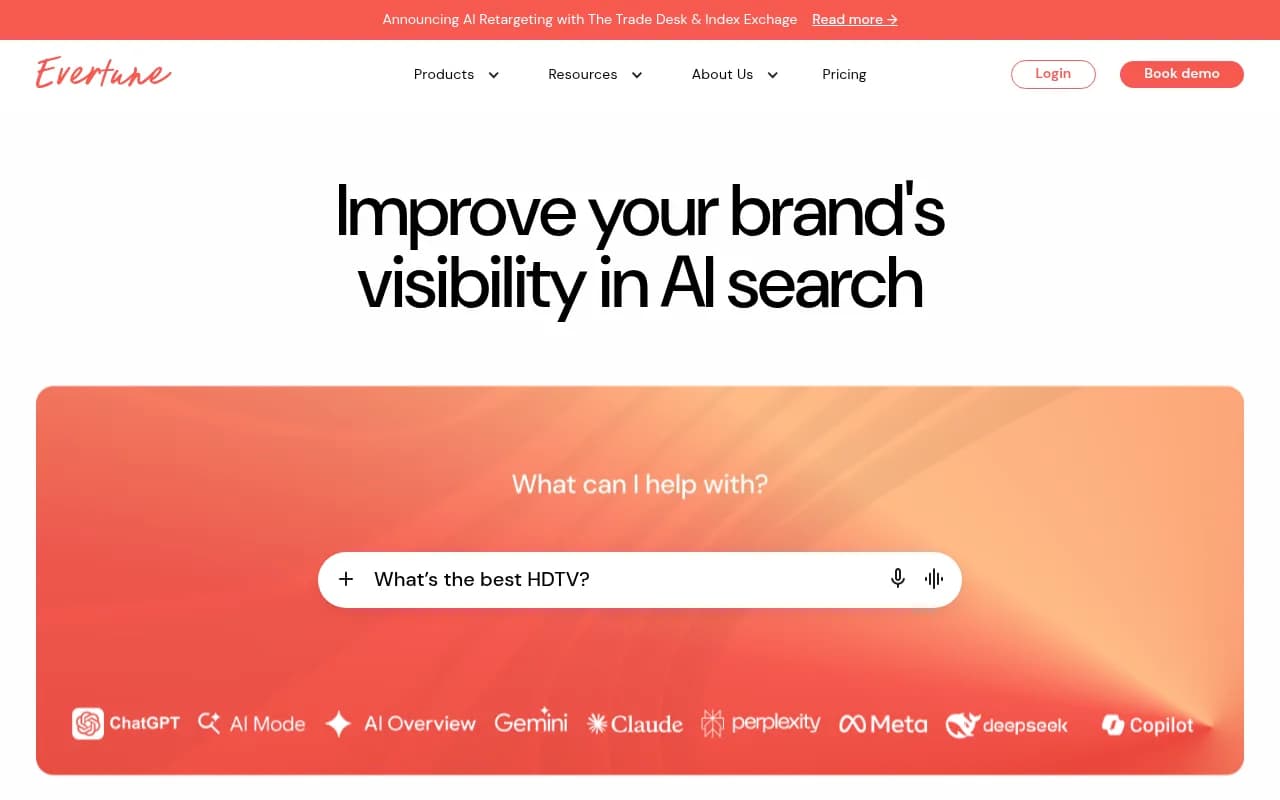
Evertune is a Generative Engine Optimization (GEO) platform built specifically for enterprise brands and agencies that need to understand and improve how they appear in AI-powered search experiences. Founded in 2024 and backed by $4 million in seed funding, Evertune has quickly positioned itself as the premium option in the emerging GEO category, with clients including Roku, Miro, athenahealth, Virgin Voyages, HexClad, and WPP's Choreograph. The company's pitch is straightforward: as consumers shift from traditional search engines to AI chatbots for product research and recommendations, brands need a new optimization playbook -- and Evertune provides the data, insights, and execution support to build it.
The platform monitors how brands appear across all major AI search engines: ChatGPT, Google AI Overviews, Google AI Mode, Claude, Gemini, Perplexity, Meta AI, DeepSeek, and Microsoft Copilot. Unlike monitoring-only competitors, Evertune combines tracking with actionable optimization recommendations, content creation support, and a unique AI retargeting capability that lets brands reach users who click through from AI responses to validate sources.
AI Brand Monitoring
Evertune's core offering is comprehensive brand tracking across AI platforms. The platform runs thousands of prompts relevant to your category and tracks whether your brand appears in AI responses, how it's described, what sentiment is expressed, and how you compare to competitors. This isn't just vanity metrics -- Evertune emphasizes statistical significance in its data collection, meaning the insights are based on large enough sample sizes to be actionable.
The AI Brand Index dashboard shows your share of voice across different AI models, broken down by product category, query type, and competitor set. You can see which competitors are winning specific prompts, what attributes AI models associate with each brand, and how sentiment varies across platforms. For example, a luxury SUV brand might discover it's mentioned frequently in ChatGPT but rarely in Perplexity, or that competitors are consistently recommended for "family-friendly" queries while the brand dominates "performance" prompts.
Competitive intelligence is a major focus. Evertune doesn't just show you where you rank -- it reveals the exact prompts where competitors are visible but you're not, the sources AI models cite when recommending competitors, and the product attributes that drive recommendations in your category. This level of detail helps brands understand not just that they're losing, but why they're losing and what to fix.
AI Website Optimization
Evertune audits how AI crawlers interpret your website and provides specific recommendations to improve discoverability. This goes beyond traditional SEO -- AI models read websites differently than Google's traditional crawler, prioritizing structured data, clear product descriptions, and authoritative signals that help them understand what your brand offers and who it's for.
The platform identifies technical issues that prevent AI models from understanding your site: missing schema markup, unclear product categorization, thin content on key pages, or navigation structures that confuse crawlers. You get a prioritized list of fixes with implementation guidance. For enterprise brands with complex sites, this audit alone can be worth the subscription cost -- many companies discover their beautifully designed marketing sites are essentially invisible to AI because they lack the structured data and clear signals AI models need.
Evertune also tracks how AI models cite your website over time. You can see which pages are being referenced in AI responses, how often, and in what context. This helps you double down on content that's already working and identify gaps where you should be cited but aren't.
AI Content Strategy
This is where Evertune moves from monitoring to optimization. The platform analyzes which product attributes drive AI recommendations in your category, which sources have the most influence on AI's perception of your brand, and what content gaps exist between you and competitors.
Product attribute mapping uses radar charts to show which features AI models prioritize when making recommendations. For example, in the TV category, Evertune might reveal that "picture quality" and "smart features" drive 60% of recommendations, while "design" and "brand reputation" matter less. This helps brands understand what to emphasize in their messaging and content.
Source influence analysis is one of Evertune's most valuable features. The platform identifies the exact URLs, domains, Reddit threads, YouTube videos, and other sources that AI models cite most frequently in your category. You see which publications, review sites, forums, and social platforms have the most influence on AI recommendations -- and can prioritize partnerships, guest posts, or content distribution accordingly. This is data most competitors don't provide at all.
Evertune then turns these insights into ready-to-publish content. The platform generates blog posts, product comparison articles, and category guides optimized for AI visibility. These aren't generic AI-written filler pieces -- they're grounded in the actual attributes, sources, and prompts that drive recommendations in your category. The content is designed to get cited by AI models, not just rank in traditional search.
Partner Connect takes this a step further by connecting brands directly with high-influence publishers and platforms. If Evertune's data shows that TechRadar, CNET, or specific Reddit communities heavily influence AI recommendations in your category, Partner Connect facilitates partnerships to get your brand featured on those sources. This is essentially a managed service layer on top of the data -- Evertune doesn't just tell you where to publish, they help you actually do it.
AI Retargeting
This is Evertune's most innovative feature and a capability no other GEO platform offers. The concept: 12% of users who get an AI-generated answer click through to the cited sources to validate information before making a decision (according to Gener8 research). If your brand isn't mentioned in the AI response, you can still reach these high-intent users by running programmatic ads on the URLs AI models cite most frequently.
Evertune identifies the exact sources AI models reference in your category, then connects you directly to The Trade Desk and Index Exchange so you can run programmatic campaigns on those URLs. When users click through from ChatGPT or Perplexity to fact-check a recommendation, your ads are there. This is retargeting at the highest-intent moment possible -- users who are actively researching your category and validating AI recommendations.
Any Trade Desk or Index Exchange customer can also activate AI retargeting on Evertune's pre-built source lists and PMP deals covering 250+ product categories -- no Evertune subscription required. This makes AI retargeting accessible even to brands that aren't ready for the full platform.
Who Is Evertune For
Evertune is built for enterprise brands and agencies with significant marketing budgets and complex optimization needs. The $3,000/month starting price (confirmed in search results) positions it as a premium solution, not a self-service tool for SMBs or individual marketers. Typical customers include:
- Fortune 500 brands in competitive categories (consumer electronics, automotive, travel, pharma, CPG, B2B tech) where AI recommendations directly impact purchase decisions. Roku, Miro, athenahealth, Virgin Voyages, and HexClad are confirmed customers.
- Marketing teams at mid-to-large companies ($50M+ revenue) who need to justify GEO investments with rigorous data and executive-level reporting. Evertune's emphasis on statistical significance and competitive benchmarking makes it easier to build business cases.
- Digital agencies managing multiple client brands, particularly those working with WPP (a confirmed customer through Choreograph). Agencies need white-label reporting, multi-client dashboards, and strategic insights they can present to clients -- Evertune provides this.
- Brands in high-stakes categories where a single AI recommendation can swing millions in revenue: consumer electronics, luxury goods, financial services, healthcare, automotive. These brands can't afford to guess -- they need data-driven optimization.
Who should NOT use Evertune: Startups, freelancers, small businesses, or individual marketers looking for affordable DIY GEO tools. At $3,000+/month, Evertune is out of reach for most SMBs. Brands that need basic monitoring without strategic support or content creation would be better served by lower-cost alternatives like Promptwatch, Otterly.AI, or Peec.ai. Evertune is also overkill if you're just starting to explore GEO -- you need enough existing visibility and content to make the optimization recommendations actionable.
Integrations & Ecosystem
Evertune integrates directly with The Trade Desk and Index Exchange for AI retargeting campaigns. The platform also connects with Partner Connect, Evertune's proprietary network of high-influence publishers and platforms, to facilitate content partnerships.
The platform monitors 10 AI search engines: ChatGPT, Google AI Overviews, Google AI Mode, Claude, Gemini, Perplexity, Meta AI, DeepSeek, Microsoft Copilot, and others. This is one of the broadest coverage sets in the GEO category.
Evertune uses EverPanel, a proprietary consumer panel, to supplement direct LLM integration and consumer app data. This gives the platform access to real user behavior and prompt data that competitors relying solely on API access can't match.
There's a Help Center (docs.evertune.ai) for self-service support, but given the enterprise focus, most customers likely work with dedicated account managers rather than navigating documentation themselves.
Pricing & Value
Evertune's pricing starts at $3,000 per month according to search results. No public pricing tiers are listed on the website -- interested customers must book a demo to get a custom quote. This is standard for enterprise SaaS, where pricing varies based on brand size, number of competitors tracked, prompt volume, and level of service.
For context, this makes Evertune significantly more expensive than monitoring-focused competitors like Promptwatch ($99-579/mo), Otterly.AI ($200-500/mo), or Peec.ai ($300-600/mo). It's positioned closer to enterprise SEO platforms like Semrush or Ahrefs at the agency/enterprise tier, but with a focus on AI search rather than traditional SEO.
The value proposition for enterprise customers: Evertune isn't just a dashboard -- it's a managed service with strategic support, content creation, partnership facilitation, and unique capabilities (AI retargeting) that competitors don't offer. For a Fortune 500 brand spending millions on digital marketing, $3,000-10,000/month for GEO optimization is a rounding error if it drives even a small increase in AI-driven conversions.
For smaller brands, the ROI calculation is harder. If you're a $5M revenue e-commerce brand, spending $36,000+/year on GEO monitoring and optimization is a significant bet. You'd need to see measurable increases in AI-driven traffic and conversions to justify the cost -- and that requires both the platform's insights and the internal resources to execute on them.
Strengths & Limitations
Strengths:
- Enterprise credibility: Customer roster (Roku, Miro, athenahealth, WPP) and media coverage (WSJ, Forbes, Business Insider, Axios, The Economist) establish Evertune as a serious player in the GEO space. This matters for enterprise buyers who need vendor stability and executive buy-in.
- AI retargeting: No other GEO platform offers programmatic ad integrations with The Trade Desk and Index Exchange. This is a genuinely unique capability that extends GEO beyond organic optimization into paid media.
- Source influence analysis: Identifying the exact URLs and domains that influence AI recommendations is incredibly valuable and not something most competitors provide in depth.
- White-glove service: Enterprise customers get strategic support, content creation assistance, and partnership facilitation through Partner Connect -- not just a self-service dashboard.
- Statistical rigor: Evertune emphasizes large sample sizes and statistical significance, which matters for brands that need to justify GEO investments to executives and boards.
Limitations:
- Price barrier: At $3,000+/month, Evertune is inaccessible to SMBs, startups, freelancers, and most individual marketers. This limits the addressable market to enterprise brands and agencies.
- No transparent pricing: The lack of public pricing tiers makes it hard for potential customers to self-qualify. You have to book a demo and go through a sales process to learn if it's even in your budget.
- Limited self-service: Evertune is positioned as a managed service, which is great for enterprise customers but frustrating for marketers who want to DIY. If you're looking for a tool you can log into and start using immediately, this isn't it.
- No free trial or freemium tier: Unlike competitors like Promptwatch or Otterly.AI, there's no way to test Evertune before committing to a multi-thousand-dollar annual contract. This increases the barrier to adoption.
- Newer player: Founded in 2024, Evertune is still building its track record. Enterprise buyers may prefer more established vendors with longer histories, especially in a category as new as GEO.
Bottom Line
Evertune is the premium choice for Fortune 500 brands and agencies that need enterprise-grade GEO with white-glove service, statistical rigor, and unique capabilities like AI retargeting. If you're a large brand in a competitive category where AI recommendations directly impact revenue, and you have the budget for a $3,000+/month platform plus the internal resources to execute on its insights, Evertune delivers value that monitoring-only competitors can't match. The combination of brand tracking, website optimization, content strategy, source influence analysis, and programmatic ad integrations makes it a comprehensive solution for brands serious about winning in AI search.
But if you're a startup, SMB, or individual marketer looking for affordable DIY GEO tools, Evertune is out of reach. You'd be better served by platforms like Promptwatch (which offers monitoring, content gap analysis, and AI content generation starting at $99/mo), Otterly.AI, or Peec.ai. Evertune is built for enterprise buyers who need strategic support and are willing to pay for it -- not for marketers who want to log in, run some prompts, and start optimizing on their own.
Best use case in one sentence: Enterprise brands in competitive categories (consumer electronics, automotive, travel, pharma, CPG) that need rigorous AI brand monitoring, strategic optimization support, and unique capabilities like AI retargeting to justify significant GEO investments to executives.
Tags:
Similar and alternative tools to Evertune AI