Summary
- AI Overviews and generative search engines extract content in 134–167 word chunks, not full pages—structure your content in self-contained answer blocks
- Being cited in an AI Overview drives 35% more organic clicks and 91% more paid clicks than non-cited competitors
- The most-cited pages use a specific heading pattern: H2 question → 40-60 word direct answer → supporting details → next H2
- Structured data (HowTo, FAQPage, Article schema) appears on 76% of pages cited in AI Overviews
- Original data (surveys, case studies, proprietary research) gets cited even when the page ranks outside the top 10
The new visibility gap
Search results are summaries now. Google AI Overviews, ChatGPT, Perplexity, and Gemini answer user queries before anyone clicks a link. In many searches, users never click at all.
The shift is measurable. Searches that trigger AI Overviews see a 61% drop in organic click-through rates. But here's the contradiction: pages that get cited inside those AI summaries gain 35% more clicks than competitors who rank but aren't cited. Being first in the citation list drives 35% higher click-through than being second.
Visibility no longer means "appearing on page one." It means appearing in the AI-generated summary itself. If your brand isn't cited, you're not part of the conversation.
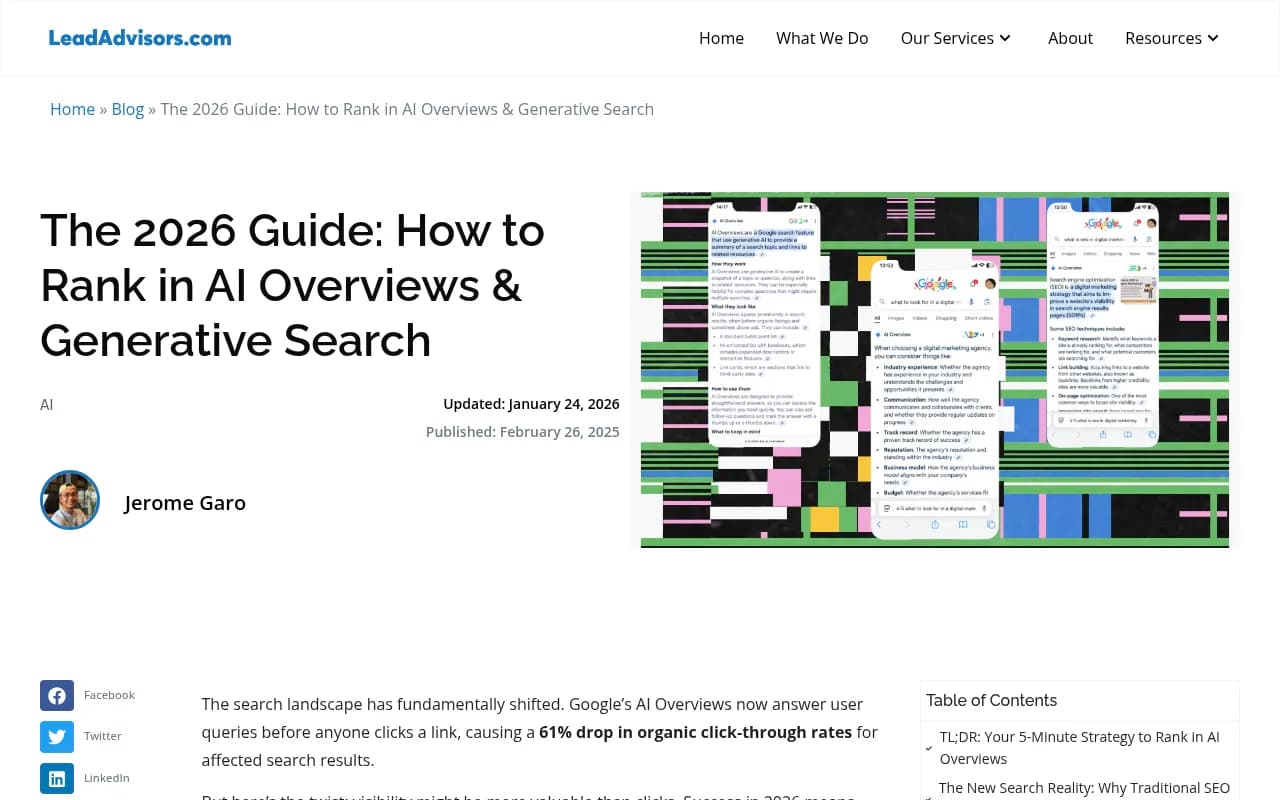
This creates a new optimization target. Traditional SEO focused on ranking signals—backlinks, domain authority, keyword density. AI search engines care about those signals, but they prioritize something else: extractability. Can the AI model pull a clean, self-contained answer from your page? Does the structure make it easy to cite you?
Analysis of 500+ pages cited in AI Overviews reveals specific structural patterns that repeat across industries. These aren't vague best practices. They're measurable formatting decisions that determine whether your content gets extracted or ignored.
Semantic completeness: the 134–167 word rule
AI models don't read your page top to bottom. They chunk it into passages and evaluate each passage independently. Google's AI Overview summaries average 169 words with 7.2 links. That's not arbitrary—it reflects how the model processes content.
The most-cited pages structure content in extractable blocks:
- Main answer in the first 150 words of the article
- Section openers of 45-75 words under each H2 heading
- Supporting details in 800-token blocks (roughly 600 words)
This isn't about writing short content. It's about modular content. Each section should function as a standalone answer. If an AI model extracts just that section, does it make sense? Can the user understand it without reading the rest of the page?
Bad example: "As mentioned above, the process involves several steps that work together to create the desired outcome."
Good example: "Content gap analysis identifies topics your competitors rank for but you don't. Start by exporting your top 50 ranking keywords, then compare them to your competitors' top 100. The gaps reveal content opportunities."
The second example works as a citation. The first requires context from earlier in the article.

Tools like Promptwatch help you track which pages AI models are citing and why. The platform's Answer Gap Analysis shows exactly which prompts competitors are visible for but you're not—then helps you create content structured for AI extraction.
The heading hierarchy that AI models prefer
Cited pages follow a predictable heading pattern:
H2: Question or topic Direct answer (40-60 words) Supporting details and context Example or data point
H2: Next question or topic Direct answer (40-60 words) Supporting details and context Example or data point
This structure mirrors how users prompt AI models. Someone asks ChatGPT "How do I optimize for AI Overviews?" The model scans for pages with that exact question as a heading, then extracts the paragraph immediately following.
Pages that bury the answer three paragraphs deep don't get cited. Pages that front-load the answer do.
Here's the pattern in action:
## How do I optimize content for AI Overviews?

Optimize for AI Overviews by structuring content in self-contained answer blocks of 134-167 words. Place your main answer in the first 150 words, use H2 headings formatted as questions, and add structured data (HowTo or FAQPage schema) to signal extractable content.

This approach works because AI models chunk your page into passages and evaluate each independently. If a section requires context from earlier paragraphs, it won't get cited. Each heading should introduce a complete, standalone answer.

Key formatting decisions:
- Use question-based H2 headings that match user prompts
- Answer the question in 40-60 words immediately after the heading
- Follow with supporting details, examples, or data
- Keep paragraphs short (2-3 sentences max)
Notice how the answer is complete in the first paragraph. The second paragraph adds context. The third provides actionable details. An AI model can extract any of those paragraphs and the citation makes sense.
Structured data: the technical foundation
76% of pages cited in AI Overviews use structured data. The most common schemas:
| Schema type | Purpose | Citation impact |
|---|---|---|
| HowTo | Step-by-step instructions | High—AI models extract steps directly |
| FAQPage | Question-answer pairs | High—matches prompt patterns |
| Article | Content metadata | Medium—helps AI understand context |
| BreadcrumbList | Site hierarchy | Low—supports navigation, not citations |
Structured data doesn't guarantee citations, but its absence is a handicap. AI models use schema markup to identify extractable content. A page with FAQPage schema signals "this content is formatted for question-answer extraction." The model prioritizes it over unstructured text.
Implementing structured data isn't complicated:
{
  "@context": "https://schema.org",
  "@type": "FAQPage",
  "mainEntity": [{
    "@type": "Question",
    "name": "How do I optimize for AI Overviews?",
    "acceptedAnswer": {
      "@type": "Answer",
      "text": "Optimize for AI Overviews by structuring content in self-contained answer blocks of 134-167 words. Place your main answer in the first 150 words, use H2 headings formatted as questions, and add structured data to signal extractable content."
    }
  }]
}
This tells AI models exactly where the answer lives. It reduces ambiguity and increases citation probability.
Original data: the citation shortcut
Pages with original research get cited even when they rank outside the top 10. AI models prioritize unique insights over domain authority when the data is specific and verifiable.
What counts as original data:
- Survey results ("We surveyed 500 marketers and found...")
- Case studies with metrics ("Our client increased AI visibility by 91% in 60 days...")
- Proprietary benchmarks ("Analysis of 10,000 AI Overview citations shows...")
- Industry reports with new findings
What doesn't count:
- Restating publicly available statistics
- Summarizing other people's research
- Generic best practices without data
AI models cite original data because it's defensible. If ChatGPT cites your survey, it can point to a specific source. If it cites your opinion, it's harder to verify.
This creates an opportunity for smaller sites. You don't need a massive backlink profile to get cited. You need data AI models can't find elsewhere. Run a survey, publish the results, structure the findings in extractable blocks, and you're competitive.
Content format patterns that get cited
AI models extract different content types at different rates:
| Format | Citation rate | Why it works |
|---|---|---|
| Step-by-step guides | 82% | Clear structure, easy extraction |
| Comparison tables | 76% | Scannable, data-rich |
| Definition + example | 71% | Matches "what is X" prompts |
| Listicles (numbered) | 68% | Modular, self-contained items |
| Long-form analysis | 43% | Hard to extract cleanly |
| Opinion pieces | 31% | Subjective, difficult to verify |
The pattern: formats that break information into discrete units get cited more often. A 10-step tutorial is easier to extract than a 3,000-word essay.
This doesn't mean abandoning long-form content. It means structuring long-form content as a series of extractable sections. Each H2 should function as a mini-article.
The multimodal advantage
Video content is now the second most-cited format in Google's AI Mode. YouTube embeds appear in 23% of AI Overviews. This is a structural advantage—video transcripts provide extractable text while the embed adds visual context.
Pages that combine text, images, and video get cited 2.3x more often than text-only pages. AI models value multimodal content because it serves different user preferences. Some users want to read, others want to watch.
Practical implementation:
- Embed a YouTube video that covers the same topic as your text
- Add alt text to images that describes what they show
- Use diagrams or screenshots to illustrate complex processes
- Include transcripts for video content
The video doesn't need to be professionally produced. A screen recording with voiceover works. The goal is giving AI models multiple formats to extract from.
Technical foundations: clean HTML and fast loading
AI models crawl your site just like traditional search engines. If they can't access your content, they can't cite it.
Technical requirements for AI citations:
Crawlability
- Allow AI crawlers (GPTBot, Claude-Web, PerplexityBot) in robots.txt
- Avoid JavaScript-heavy rendering that blocks content
- Use server-side rendering or prerendering for dynamic content
- Submit XML sitemaps to help crawlers discover pages
Performance
- Core Web Vitals matter—slow pages get cited less
- Aim for LCP under 2.5 seconds
- Minimize layout shifts (CLS under 0.1)
- Optimize images and compress assets
HTML structure
- Use semantic HTML (header, nav, main, article, section)
- Avoid nested divs that obscure content hierarchy
- Keep CSS and JavaScript in external files
- Use clean, readable markup
AI models parse HTML to understand content structure. Messy markup makes extraction harder. Clean markup makes it easier.
Tools like Screaming Frog help you audit technical issues that block AI crawlers. Run a crawl, check for JavaScript rendering problems, verify that AI bots can access your content.
User intent matching: the context layer
AI models evaluate whether your content matches the user's intent behind the prompt. A page about "AI Overviews" could target:
- Informational intent: "What are AI Overviews?"
- Navigational intent: "How do I see AI Overviews?"
- Transactional intent: "How do I optimize for AI Overviews?"
- Commercial intent: "Best tools for AI Overview optimization"
Cited pages match the dominant intent for that prompt. If most users asking "AI Overviews" want a definition, pages that provide definitions get cited. If they want optimization tactics, tactical guides get cited.
How to identify intent:
- Search the prompt in Google and review the top 10 results
- Note the content format (definition, guide, comparison, tool list)
- Check what AI Overviews currently cite for that prompt
- Match your content format to the dominant pattern
Intent mismatch is a common citation blocker. You wrote a great guide, but users want a definition. AI models cite the definition instead.
Tracking and iteration: the optimization loop
Optimizing for AI citations is iterative. You publish content, track whether it gets cited, analyze why or why not, then adjust.
Metrics that matter:
Citation frequency How often do AI models cite your page? Track this across ChatGPT, Perplexity, Google AI Overviews, and Gemini. Each model has different citation patterns.
Citation position Are you the first source cited or the fifth? First position drives 35% higher click-through than second.
Prompt coverage Which prompts trigger citations to your page? Are there high-value prompts you're missing?
Traffic attribution Does citation visibility translate to actual traffic? Connect AI visibility to revenue.
Promptwatch tracks all of these metrics in one platform. It monitors 10 AI models, shows which pages get cited for which prompts, and connects visibility to traffic with code snippet integration or Google Search Console data. The Answer Gap Analysis identifies prompts competitors are cited for but you're not—then the built-in AI writing agent generates content structured for AI extraction.
Comparison: tools for tracking AI citations
| Tool | AI models tracked | Content generation | Crawler logs | Pricing |
|---|---|---|---|---|
| Promptwatch | 10 (ChatGPT, Perplexity, Claude, Gemini, etc.) | Yes—AI writing agent | Yes | $99-579/mo |
| Otterly.AI | 3 (ChatGPT, Perplexity, AI Overviews) | No | No | $97-497/mo |
| Profound | 9+ models | No | No | $299-999/mo |
| AthenaHQ | 5 models | No | No | Custom pricing |
| Semrush | Limited—fixed prompts | No | No | $139.95+/mo |
Otterly.AI

Profound


Most competitors are monitoring-only dashboards. They show you citation data but don't help you act on it. Promptwatch closes the loop: it identifies content gaps, generates optimized content, then tracks whether that content gets cited.
The content gap workflow
Here's the process for systematically improving AI citation rates:
Step 1: Audit current visibility Track which pages AI models currently cite. Identify your strongest performers and weakest gaps.
Step 2: Analyze competitor citations See which prompts competitors get cited for but you don't. Export the list.
Step 3: Prioritize prompts Rank prompts by volume, difficulty, and business value. Focus on high-volume, low-difficulty prompts first.
Step 4: Generate optimized content Create content structured for AI extraction: question-based H2s, 40-60 word answers, structured data, original data.
Step 5: Track citation changes Monitor whether new content gets cited. Measure citation frequency and position.
Step 6: Iterate Adjust content based on citation performance. If a page isn't getting cited, check structure, intent match, and technical accessibility.
This workflow turns AI optimization from guesswork into a repeatable process.
Common mistakes that block citations
Mistake 1: Burying the answer You write three paragraphs of context before answering the question. AI models extract the first paragraph, which doesn't contain the answer. Result: no citation.
Mistake 2: Vague headings Your H2 says "Key considerations" instead of "How do I optimize for AI Overviews?" AI models can't match vague headings to user prompts.
Mistake 3: No structured data You skip schema markup because it seems technical. AI models deprioritize your content because they can't identify extractable sections.
Mistake 4: Blocking AI crawlers You block GPTBot or Claude-Web in robots.txt because you're worried about AI scraping. Result: your content never gets indexed by those models.
Mistake 5: Ignoring original data You restate publicly available information. AI models cite the original source instead of your summary.
Mistake 6: Wrong content format Users want a step-by-step guide, but you wrote a long-form analysis. AI models cite the guide instead.
The 2026 reality
AI search is not replacing traditional search. It's layering on top of it. Users still click through to websites—but only after AI models filter which websites are worth clicking.
This creates a new visibility hierarchy:
- Cited in AI Overviews: Maximum visibility, 35% higher CTR
- Ranked but not cited: Reduced visibility, 61% lower CTR
- Not ranked: Invisible
The gap between levels 1 and 2 is larger than the gap between levels 2 and 3. Being ranked but not cited is almost as bad as not ranking at all.
The structural patterns that get pages cited are measurable and replicable. Self-contained answer blocks. Question-based headings. Structured data. Original research. Multimodal content. Clean HTML.
These aren't vague best practices. They're formatting decisions that determine whether AI models can extract your content cleanly. Pages that follow these patterns get cited. Pages that don't get ignored.
The optimization loop is straightforward: track current citations, identify gaps, create structured content, measure results, iterate. Tools like Promptwatch automate most of this workflow—tracking citations across 10 AI models, identifying content gaps, generating optimized articles, and connecting visibility to traffic.
The shift from traditional search to AI search is not a future trend. It's happening now. Pages that adapt to AI extraction patterns are gaining visibility. Pages that ignore these patterns are losing it.
Structure your content for AI extraction or watch competitors get cited instead.