Summary
- AI search engines (ChatGPT, Perplexity, Google AI Overviews) now drive millions of brand discoveries -- optimizing for them is no longer optional
- AI search traffic converts 5X better than traditional Google (14.2% vs 2.8%), making generative search visibility a high-ROI channel
- This checklist covers 15 concrete elements your content needs: structured data, entity signals, citation-worthy depth, fresh updates, multi-format content, and more
- SEO remains the foundation -- GEO (Generative Engine Optimization) builds on top of it with strategies focused on how AI models read, cite, and trust content
- Tools like Promptwatch help you track where you're visible, identify content gaps, and optimize pages to rank in AI-generated answers

What changed in 2026 (and why this checklist exists)
ChatGPT reached 400 million weekly users. Google AI Overviews now appear on 13-60% of all searches depending on the query type. Perplexity, Claude, Gemini, and other AI engines are answering questions that used to send users to your website.
The shift is real: people ask AI instead of Googling. If your brand isn't showing up in those AI-generated answers, you're invisible to a massive and growing audience.
Traditional SEO focused on ranking in the top 10 blue links. Generative Engine Optimization (GEO) focuses on being cited, mentioned, and recommended inside AI-generated responses. The rules are different. The checklist below covers what actually works.
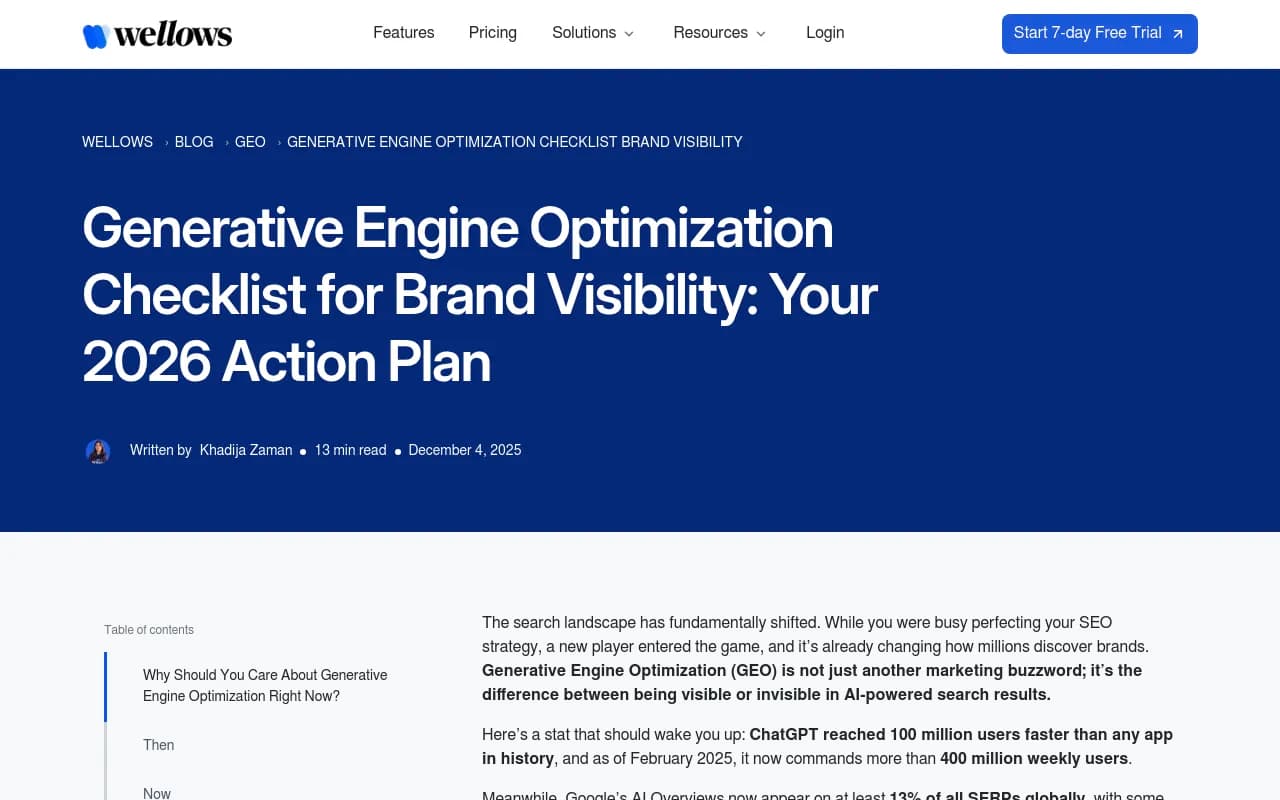
The 15-element checklist
1. Structured data markup (schema.org)
AI models parse structured data to understand what your page is about. Without it, they're guessing.
What to do:
- Add Organization schema to your homepage (name, logo, social profiles)
- Use Article schema for blog posts (headline, author, datePublished, dateModified)
- Add Product schema for product pages (name, description, price, reviews)
- Implement FAQ schema for pages with question-answer pairs
- Use HowTo schema for step-by-step guides
Why it matters: Structured data gives AI engines explicit signals about entities, relationships, and content type. Pages with proper schema get cited more often because the AI can confidently extract facts.
Tool to use: Google's Structured Data Testing Tool or Schema Markup Generator plugins for WordPress.
2. Entity signals and brand mentions
AI models build knowledge graphs. If your brand isn't recognized as an entity, you won't get cited.
What to do:
- Claim and optimize your Google Business Profile, Crunchbase, and Wikipedia (if applicable)
- Get mentioned on authoritative sites in your industry (news outlets, industry publications, review sites)
- Ensure your brand name, tagline, and core offerings are consistent across all platforms
- Build a "brand" section on your site explaining what you do, who you serve, and why you exist
Why it matters: AI engines rely on entity recognition. If they see your brand mentioned across multiple trusted sources, they treat you as a credible entity worth citing.
3. Citation-worthy depth (not fluff)
AI models cite content that answers questions thoroughly. Surface-level blog posts don't make the cut.
What to do:
- Write 1500-3000 word guides that cover a topic end-to-end
- Include data, examples, and specific details (not vague generalities)
- Answer follow-up questions within the same article
- Use subheadings that match natural language queries ("How to X", "Why Y happens", "What Z means")
Why it matters: AI engines scan for authoritative, complete answers. Thin content gets ignored. Deep, specific content gets cited.
4. Content freshness (update or die)
AI models prefer recently updated content. A 2-year-old article loses visibility fast.
What to do:
- Update key pages every 2-3 months (add new data, refresh examples, revise outdated sections)
- Add a "Last updated" timestamp at the top of articles
- Republish updated content with a new dateModified in your schema markup
Why it matters: Research shows pages updated within the last 2 months earn significantly more AI citations than older content. Freshness is a ranking signal.
5. Multi-format content (text + images + video)
AI engines are multimodal. They process text, images, and video transcripts.
What to do:
- Embed relevant images with descriptive alt text
- Add video transcripts to pages with embedded videos
- Use infographics and diagrams to explain complex concepts
- Include screenshots of tools, dashboards, or processes
Why it matters: Multimodal AI models (like GPT-4 Vision, Gemini) can analyze images and video. Pages with rich media get cited more often because they provide multiple ways to understand the content.
6. Clear, scannable structure
AI models extract information from well-structured content. Walls of text confuse them.
What to do:
- Use descriptive H2 and H3 headings that match search intent
- Break paragraphs into 2-3 sentences max
- Use bullet points and numbered lists for key takeaways
- Add a summary or "Key Takeaways" section at the top of long articles
Why it matters: AI engines scan for patterns. Clear headings and lists make it easy for them to extract facts and cite your content accurately.
7. Internal linking with descriptive anchor text
AI models follow links to understand relationships between pages.
What to do:
- Link related articles together with descriptive anchor text (not "click here")
- Create topic clusters: a pillar page linking to 5-10 related subtopic pages
- Use breadcrumbs to show page hierarchy
Why it matters: Internal links help AI engines map your site's knowledge graph. A well-linked site gets treated as a more authoritative source.
8. Author credibility signals
AI models evaluate authorship. Anonymous content gets less weight.
What to do:
- Add author bios to blog posts (name, credentials, LinkedIn profile)
- Link to author profiles on your site
- Mention author expertise in the article ("As a [role] with [X years] experience...")
Why it matters: AI engines look for E-E-A-T (Experience, Expertise, Authoritativeness, Trustworthiness). Author signals boost credibility.
9. Citations and external links
AI models trust content that cites credible sources.
What to do:
- Link to authoritative sources (research papers, industry reports, official documentation)
- Cite statistics with a source link
- Reference competitor content when it adds value
Why it matters: AI engines evaluate trustworthiness by checking if you back up claims. Pages with citations get cited more often.
10. Comparison tables and structured comparisons
AI models love tables. They're easy to parse and cite.
What to do:
- Create comparison tables for tools, products, or approaches
- Use markdown tables with clear column headers
- Include pros/cons lists for each option
Why it matters: Tables are machine-readable. AI engines can extract data from tables and present it in their responses.
| Element | Why it matters | How to implement |
|---|---|---|
| Structured data | Helps AI understand entities | Add schema.org markup |
| Entity signals | Builds brand recognition | Get mentioned on authoritative sites |
| Citation-worthy depth | AI cites thorough answers | Write 1500-3000 word guides |
| Content freshness | Recent content gets prioritized | Update pages every 2-3 months |
11. FAQ sections with natural language questions
AI engines pull answers from FAQ sections.
What to do:
- Add an FAQ section to key pages
- Write questions in natural language ("How do I X?" not "X instructions")
- Keep answers concise (2-3 sentences)
- Use FAQ schema markup
Why it matters: FAQ sections match how people prompt AI engines. A well-structured FAQ increases your chances of being cited.
12. Prompt-aligned content (not just keywords)
AI search is conversational. People ask questions, not type keywords.
What to do:
- Research how your audience prompts AI engines (use tools like Promptwatch to see actual prompts)
- Write content that answers full questions, not just keyword phrases
- Use conversational language in headings ("Why X happens" instead of "X causes")
Why it matters: AI engines match prompts to content. If your content aligns with how people actually ask questions, you get cited.
13. Reddit and community mentions
AI models cite Reddit threads, Quora answers, and community discussions.
What to do:
- Participate in relevant subreddits and answer questions
- Link to your content when it genuinely helps (no spam)
- Monitor Reddit discussions about your industry and contribute value
Why it matters: AI engines treat Reddit as a credible source of real user opinions. Getting mentioned in Reddit threads boosts your visibility.
14. Page speed and technical health
AI crawlers (GPTBot, PerplexityBot, etc.) skip slow or broken pages.
What to do:
- Optimize images (compress, use WebP format)
- Enable caching and CDN
- Fix broken links and 404 errors
- Ensure your robots.txt allows AI crawlers
Why it matters: AI crawlers have limited budgets. Slow pages get skipped. Fast, healthy pages get crawled and indexed.
Tool to use: Google PageSpeed Insights, Screaming Frog, or Promptwatch's crawler log analysis.
15. Monitor and iterate (track what's working)
You can't optimize what you don't measure.
What to do:
- Track which pages get cited in AI responses
- Monitor your brand mentions across ChatGPT, Perplexity, Google AI Overviews, and other engines
- Identify content gaps (prompts where competitors get cited but you don't)
- Update underperforming pages based on what AI engines are citing
Why it matters: AI visibility is not set-and-forget. You need to track performance, diagnose gaps, and iterate.
Tool to use: Promptwatch tracks your visibility across 10 AI engines, shows which pages get cited, and identifies content gaps.
How to prioritize (you can't do everything at once)
Start with the elements that give you the biggest lift:
- Structured data (quick win, high impact)
- Content freshness (update your top 10 pages first)
- Citation-worthy depth (rewrite thin content into comprehensive guides)
- Monitoring (set up tracking so you know what's working)
Once those are in place, layer in the rest: entity signals, FAQ sections, multi-format content, and prompt alignment.
Tools that help
You don't need to do this manually. Several platforms help you track AI visibility, identify gaps, and optimize content:
- Promptwatch: Tracks your visibility across ChatGPT, Perplexity, Google AI Overviews, and 7 other engines. Shows which pages get cited, identifies content gaps, and includes an AI writing agent that generates citation-worthy content.
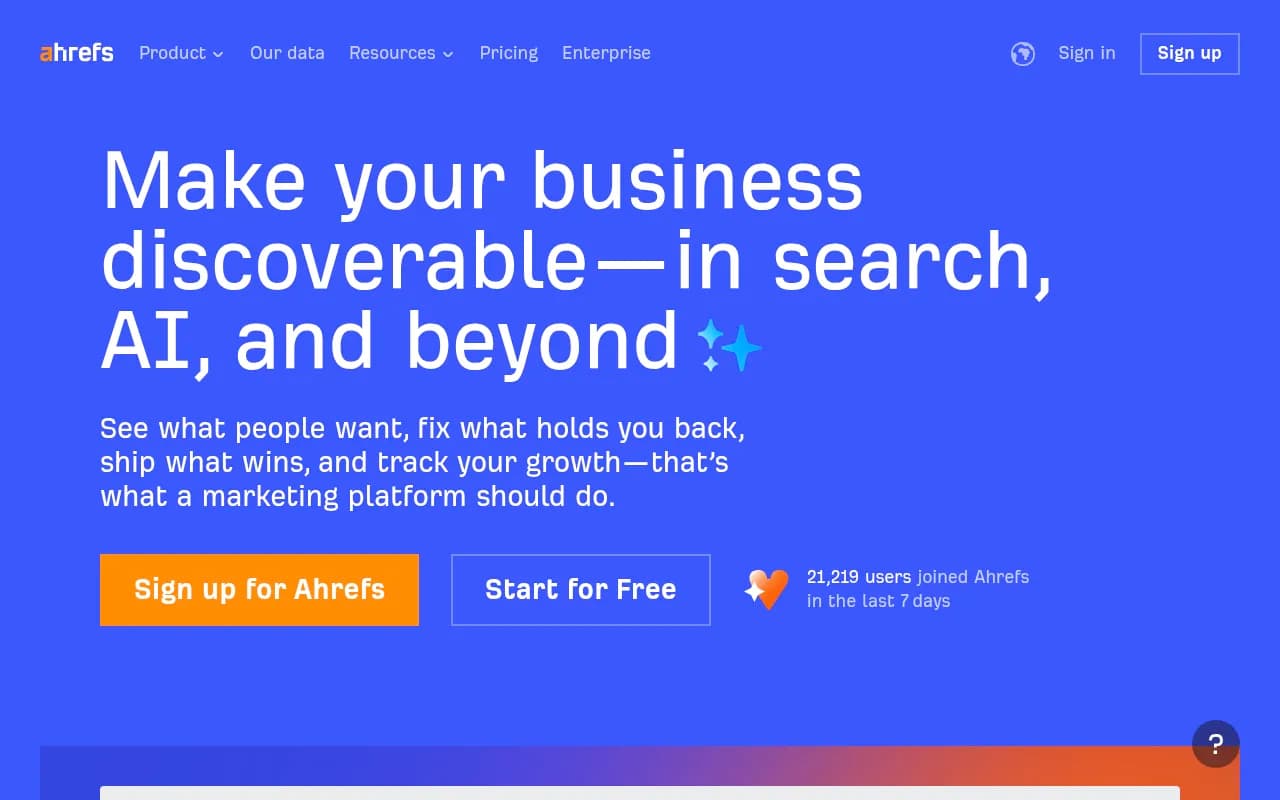
- Ahrefs: Traditional SEO tool with emerging AI search tracking features.
- Semrush: All-in-one platform with basic AI search monitoring.
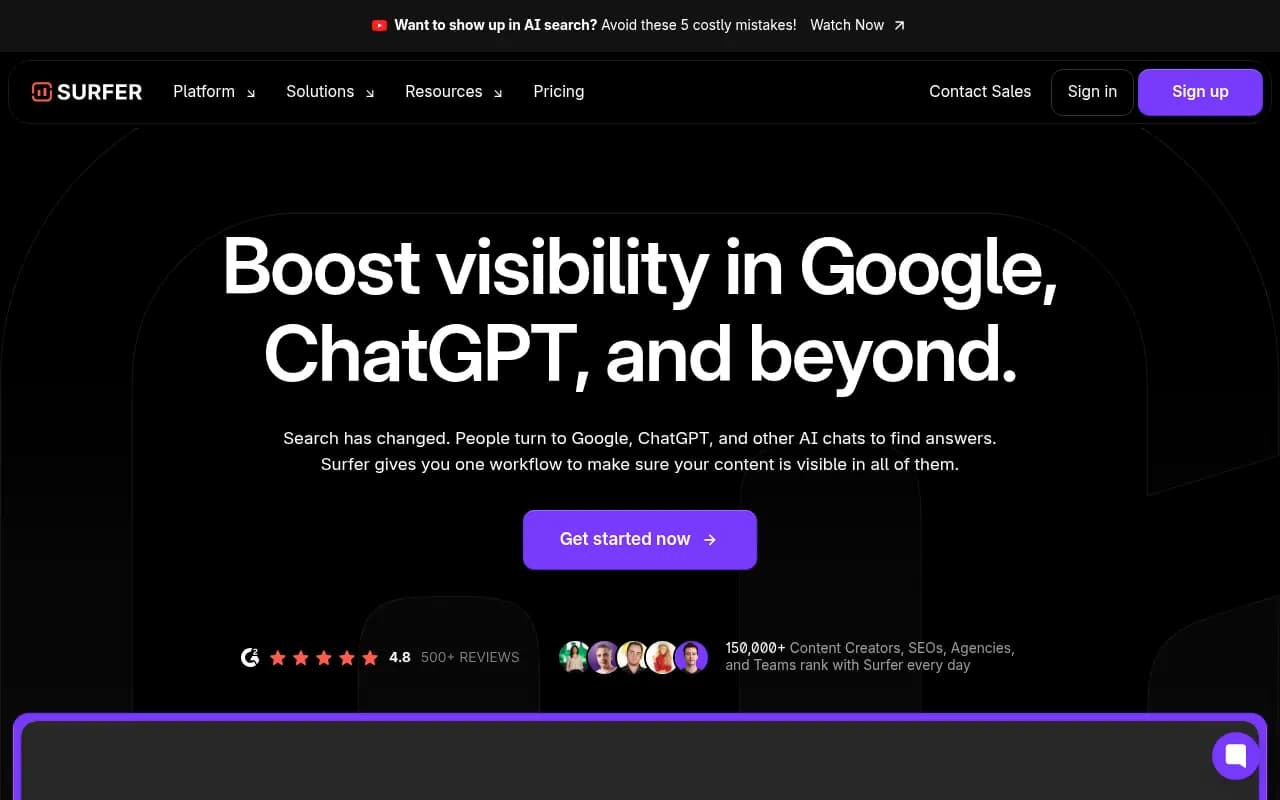
- Surfer SEO: Content optimization platform that helps you write citation-worthy articles.
Common mistakes to avoid
Mistake 1: Treating GEO like SEO AI engines don't rank pages -- they cite content. Stop optimizing for "position 1" and start optimizing for "being cited."
Mistake 2: Ignoring freshness Old content dies in AI search. Update or lose visibility.
Mistake 3: Writing for keywords instead of prompts People don't type keywords into ChatGPT. They ask full questions. Your content needs to match that.
Mistake 4: Skipping structured data AI engines rely on schema markup to understand your content. No schema = no citations.
Mistake 5: Not monitoring You can't improve what you don't measure. Track your AI visibility or you're flying blind.
What happens if you ignore this
Your competitors are already optimizing for AI search. If you don't, you'll lose visibility in the channels that matter most:
- ChatGPT users won't see your brand in recommendations
- Perplexity won't cite your content in answers
- Google AI Overviews won't feature your pages
- Your traffic will decline as more searches shift to AI engines
The brands that win in 2026 are the ones that show up in AI-generated answers. The ones that lose are the ones still optimizing for 2019-era SEO.
Final takeaway
Generative search visibility isn't a separate strategy -- it's the next evolution of SEO. The 15 elements in this checklist are what actually work in 2026. Start with structured data, freshness, and depth. Layer in the rest. Track your progress. Iterate.
And if you want to see where you stand right now, tools like Promptwatch give you a baseline: which prompts you're visible for, which pages get cited, and where your competitors are beating you. From there, it's a matter of closing the gaps.