Ahrefs Review 2026
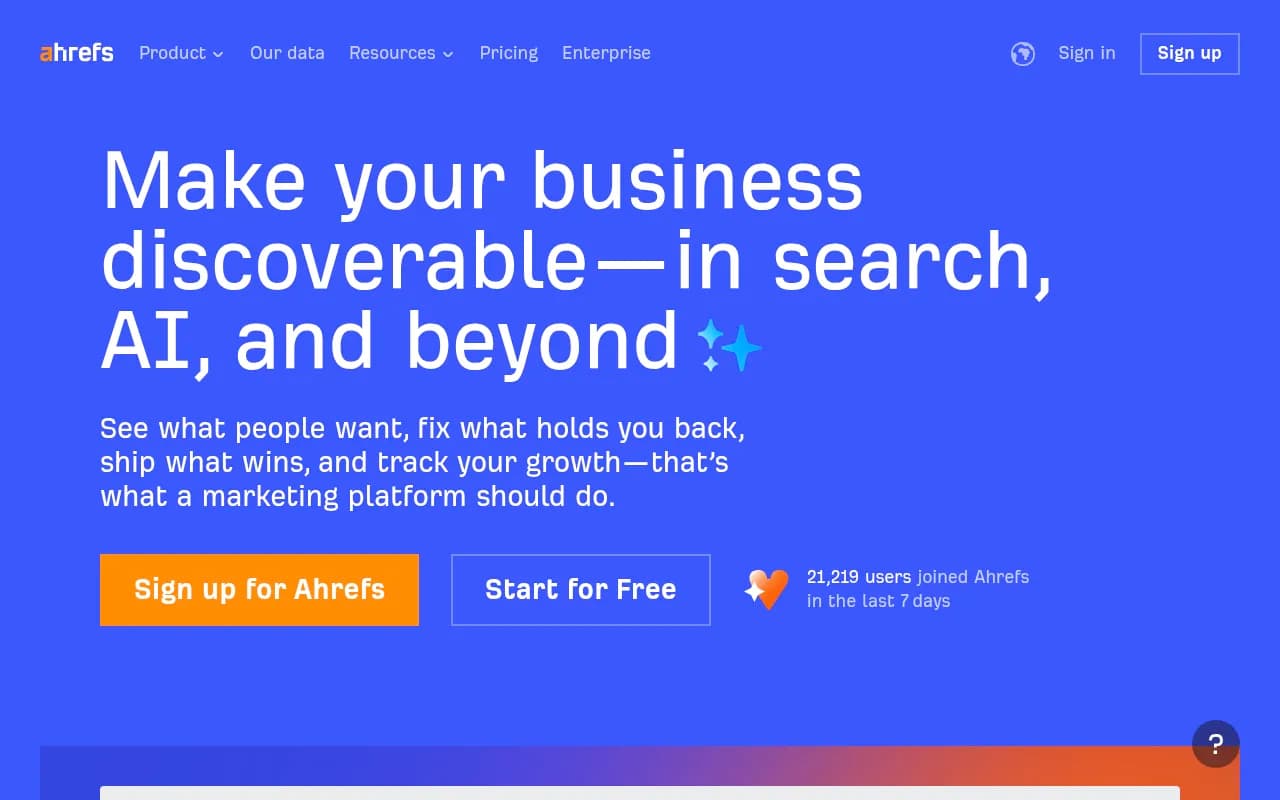
Ahrefs is a comprehensive SEO and marketing intelligence platform used by 44% of Fortune 500 companies. It combines traditional SEO tools (site audits, backlink analysis, rank tracking) with newer AI search monitoring through Brand Radar, plus content creation workflows, PPC research, and social media management—all powered by the web's largest backlink index and keyword database.
Summary
• Best for: Mid-to-large marketing teams and agencies managing multiple clients who need both traditional SEO and emerging AI search visibility in one platform • Standout strength: Massive proprietary dataset (28.7B keywords, #1 SEO crawler globally) combined with enterprise-grade infrastructure and API access • Key limitation: Brand Radar (AI search tracking) uses fixed prompts and lacks the depth of specialized GEO platforms like Promptwatch—no custom prompt tracking, no content gap analysis for AI, no AI traffic attribution • Pricing reality: Starts at $83/mo (Lite) but most teams need Standard ($166/mo) or higher; Starter plan ($29/mo) is extremely limited • Bottom line: If you're already invested in Ahrefs for traditional SEO and want basic AI search monitoring as an add-on, Brand Radar is convenient. If AI visibility is a priority, dedicated GEO platforms offer far more actionable insights.
Ahrefs has been a dominant force in SEO tooling since 2010, building its reputation on having the web's largest and most frequently updated backlink index. The Singapore-based company (founded by Dmitry Gerasimenko) operates its own data centers and ranks as the #34 supercomputer globally according to TOP500. That infrastructure powers everything from their web crawler—which Cloudflare Radar ranks as the #1 SEO bot by traffic volume—to their expanding suite of AI-powered features. In 2024-2025, Ahrefs repositioned itself as an "AI Marketing Platform," adding Brand Radar for AI search monitoring, AI Content Helper for content generation, and integrations with ChatGPT and Claude. The shift reflects the industry's pivot toward Generative Engine Optimization (GEO), though Ahrefs' approach remains rooted in its traditional SEO strengths rather than being purpose-built for AI search.
The platform serves marketing teams at Adobe, eBay, IBM, LinkedIn, Shopify, and thousands of agencies worldwide. Its core audience has always been SEO professionals and content marketers who need deep competitive intelligence, backlink prospecting, and keyword research. With the addition of AI search tracking and social media management, Ahrefs now positions itself as an all-in-one marketing platform—though in practice, most users still rely on it primarily for SEO.
Core SEO Features (What Ahrefs Does Best)
Site Explorer remains Ahrefs' flagship tool. Enter any domain or URL and you get a complete breakdown: organic traffic estimates, backlink profile (including new and lost links), top-performing pages, referring domains, anchor text distribution, and historical ranking data. The backlink index updates every 15 minutes and includes 43 trillion links—far larger than competitors like Moz or Semrush. For agencies auditing client sites or brands monitoring competitors, this is the gold standard. You can filter by link type (dofollow/nofollow), platform (Reddit, YouTube, news sites), and even see which pages link to multiple competitors but not to you—prime link-building targets.
Keywords Explorer covers 28.7 billion keywords across 217 countries and 173 languages. Each keyword shows search volume, keyword difficulty (0-100 scale), cost-per-click estimates, SERP features (featured snippets, People Also Ask, video carousels), and parent topic groupings. The "Traffic Potential" metric estimates how much traffic the top-ranking page actually gets from all related keywords—more useful than raw search volume. You can also see "Clicks" data (how many searches result in actual clicks vs. zero-click searches), which helps prioritize keywords that drive traffic rather than just impressions. Keyword lists can be exported, saved, and tracked in Rank Tracker.
Site Audit crawls your website to surface technical SEO issues: broken links, redirect chains, duplicate content, missing meta tags, slow-loading pages, mobile usability problems, and structured data errors. The "Health Score" gives you a quick snapshot, and you can prioritize fixes by impact. For enterprise teams, the new Patches feature (in beta as of 2026) lets you deploy meta tag fixes, canonical tags, and hreflang attributes directly from Ahrefs without touching your CMS—useful for large sites where dev resources are scarce, though it requires adding Ahrefs' JavaScript snippet to your site.
Content Explorer indexes 13.5 billion pages and lets you search by topic, backlink count, social shares, or traffic estimates. Find the most-linked-to articles in your niche, discover content gaps (topics competitors cover but you don't), and identify guest post opportunities. You can filter by domain rating, publication date, and even exclude certain domains. For content teams planning editorial calendars, this is a research goldmine.
Rank Tracker monitors your keyword rankings across desktop and mobile, with support for local rankings (city/state-level tracking) and international markets. You can tag keywords by topic, set up automated reports, and compare your visibility against competitors. The "Share of Voice" metric shows what percentage of total clicks you're capturing for a keyword set. Unlike some competitors, Ahrefs updates rankings daily (not weekly), which is critical for tracking the impact of algorithm updates or new content launches.
AI Search & Brand Monitoring (Brand Radar)
Brand Radar, launched in late 2024, tracks how your brand appears in AI chatbots (ChatGPT, Perplexity, Claude, Gemini) and Google AI Overviews. You enter your brand name and competitors, and Ahrefs monitors a fixed set of prompts to see where you're mentioned, how often, and in what context (positive, neutral, negative sentiment). You can see which AI models cite you most frequently, compare your visibility to competitors, and export reports.
The limitation: Brand Radar uses a predefined prompt set—you can't add custom prompts or track specific queries your customers actually use. There's no content gap analysis showing which prompts competitors rank for but you don't. There's no AI traffic attribution to connect visibility to actual conversions. And there's no crawler log analysis to see how AI models are indexing your site. For brands serious about AI search optimization, this is a monitoring dashboard, not an optimization platform. Tools like Promptwatch offer custom prompt tracking, Answer Gap Analysis (showing exactly what content you're missing), AI-generated content creation based on citation data, and traffic attribution—capabilities Ahrefs doesn't provide. If AI visibility is a secondary concern and you just want basic brand monitoring, Brand Radar is fine. If it's a strategic priority, you'll need a specialized GEO platform.
AI Content Tools
AI Content Helper generates article outlines, introductions, and full drafts based on target keywords. It pulls in SERP data (top-ranking pages, People Also Ask questions, related searches) and suggests headings, subheadings, and talking points. The output is decent for first drafts but requires heavy editing—it's not grounded in citation data or optimized for AI search the way purpose-built GEO content tools are. There's also an AI Content Grader that scores your existing content for SEO and readability, and an AI Detector that flags AI-generated text (useful for editorial teams maintaining quality standards).
Social Media Manager lets you schedule posts across Facebook, Instagram, LinkedIn, and X (Twitter), monitor brand mentions, and track engagement metrics. It's a basic social scheduling tool—fine for small teams who want everything in one platform, but not competitive with dedicated tools like Buffer or Hootsuite. The influencer discovery feature searches for creators by niche and follower count, pulling data from Ahrefs' web index.
PPC & Competitive Intelligence
Site Explorer includes a PPC tab showing competitors' paid search keywords, ad copy, and landing pages. You can see which keywords they're bidding on, estimated ad spend, and traffic distribution between organic and paid. This is useful for PPC specialists benchmarking campaigns or finding high-intent keywords to target. The data comes from Ahrefs' SERP crawling, not direct ad network access, so it's not as granular as dedicated PPC tools like SpyFu or Semrush's Advertising Research, but it's solid for competitive analysis.
Local SEO (GBP Monitor)
GBP Monitor tracks your Google Business Profile rankings in local search and Google Maps. You can monitor multiple locations, see how you rank for local keywords (e.g., "plumber near me"), and compare your visibility to local competitors. It also alerts you to changes in your GBP listing (reviews, photos, business hours) and tracks review sentiment. For multi-location businesses or local SEO agencies, this is a time-saver, though it's not as feature-rich as dedicated local SEO platforms like BrightLocal.
Reporting & Dashboards
The Dashboard gives you a high-level view of all your tracked projects: organic traffic trends, ranking changes, backlink growth, and Site Audit health scores. Portfolios let you group multiple sites (useful for agencies managing client accounts) and compare performance across them. Report Builder creates custom PDF or shareable link reports with Ahrefs data, Google Search Console metrics, and Google Analytics traffic. You can white-label reports for clients, schedule automated delivery, and customize branding. For enterprise teams, the API (available on higher-tier plans) provides 100+ endpoints for building custom dashboards, integrating Ahrefs data into internal tools, or connecting to BI platforms like Looker or Tableau.
Who Is Ahrefs For?
Ahrefs is built for SEO professionals, content marketers, and digital agencies who need deep competitive intelligence and backlink analysis. Specifically:
• SEO agencies managing 10-50+ client sites: The combination of Site Explorer, Rank Tracker, and Site Audit covers 90% of client reporting needs. Portfolios and white-label reports streamline client communication. The API lets larger agencies build custom dashboards.
• In-house SEO teams at mid-to-large companies (50-500+ employees): If you're managing a content operation, tracking dozens of competitors, and need reliable traffic forecasts for business planning, Ahrefs' data quality and update frequency justify the cost. The enterprise plan includes SSO, 2FA, and ISO27001 certification for security-conscious orgs.
• Content marketers planning high-volume editorial calendars: Keywords Explorer and Content Explorer surface thousands of topic ideas. The traffic potential metric helps prioritize what to write. AI Content Helper speeds up first drafts (though you'll still need human editors).
• PPC specialists benchmarking competitor ad strategies: The PPC tab in Site Explorer shows which keywords competitors are bidding on and what ad copy they're testing. Not as deep as SpyFu, but useful for cross-channel insights.
• Investors and M&A analysts doing due diligence on digital businesses: Site Explorer's traffic estimates and backlink profiles help validate a company's organic growth claims. You can spot traffic drops, link spam, or over-reliance on a few keywords.
Who should NOT use Ahrefs:
• Solopreneurs or small businesses with <$5K/mo marketing budgets: The Starter plan ($29/mo) is too limited (5 projects, 500 tracked keywords, no API, no historical data), and the Lite plan ($83/mo) is still expensive if you're just starting out. Tools like Ubersuggest or Mangools offer 80% of the functionality at a fraction of the cost.
• Brands prioritizing AI search optimization over traditional SEO: If your goal is to rank in ChatGPT, Perplexity, and Claude, Brand Radar won't get you there. You need custom prompt tracking, content gap analysis, and AI traffic attribution—capabilities only specialized GEO platforms like Promptwatch provide.
• Teams needing advanced social media management: The Social Media Manager is barebones compared to Buffer, Hootsuite, or Sprout Social. If social is a core channel, use a dedicated tool.
Integrations & Ecosystem
Ahrefs integrates with Google Search Console (import ranking and traffic data), Google Analytics (compare Ahrefs estimates to actual traffic), Looker Studio (build custom dashboards), and Zapier (automate workflows like sending Slack alerts when rankings drop). The API is available on Standard plans and above, with rate limits based on your tier. You can also connect Ahrefs to ChatGPT, Claude, and Microsoft Copilot via API to query data conversationally (e.g., "Show me my top 10 backlinks from the last 30 days").
There's a Chrome extension (Ahrefs SEO Toolbar) that shows domain rating, backlink count, and traffic estimates directly in Google search results. No mobile app, which is a gap for teams who want on-the-go access.
Pricing & Value
Ahrefs offers five plans:
• Starter ($29/mo): 5 projects, 500 tracked keywords, 1 user, no API, no historical data. Extremely limited—only viable for freelancers testing the platform.
• Lite ($83/mo or $999/yr): 10 projects, 750 tracked keywords, 1 user, 6-month historical data. This is the entry point for small agencies or in-house teams.
• Standard ($166/mo or $1,999/yr): 25 projects, 2,000 tracked keywords, 3 users, 2-year historical data, API access. Most teams land here.
• Advanced ($333/mo or $3,999/yr): 100 projects, 5,000 tracked keywords, 5 users, 5-year historical data, API access. For larger agencies or enterprise teams.
• Enterprise (custom pricing): Unlimited projects, custom keyword limits, unlimited users, SSO, 2FA, dedicated support. Starts around $999/mo based on user reports.
All plans include access to Site Explorer, Keywords Explorer, Site Audit, Content Explorer, Rank Tracker, and Brand Radar. The main differences are project limits, keyword tracking capacity, and historical data depth. Annual billing saves 20%.
Value assessment: Ahrefs is expensive compared to alternatives like Semrush (starts at $139.95/mo for similar features) or Moz ($99/mo). You're paying for data quality—Ahrefs' backlink index is the largest and freshest in the industry. If backlink analysis and competitive intelligence are core to your workflow, it's worth it. If you mostly need keyword research and rank tracking, cheaper tools will suffice. The Starter plan is a poor value—it's too limited to be useful for anything beyond casual research.
Strengths
• Unmatched backlink data: 43 trillion links, updated every 15 minutes. No competitor comes close.
• Reliable traffic estimates: Ahrefs' organic traffic projections are consistently more accurate than Semrush or Moz, based on third-party audits.
• Fast, intuitive interface: The UI is clean, reports load quickly, and the learning curve is gentle compared to enterprise SEO platforms.
• Best-in-class keyword research: 28.7B keywords, traffic potential metrics, and SERP feature tracking make Keywords Explorer a powerhouse.
• Enterprise-grade infrastructure: Owning their own data centers means faster updates, better uptime, and more control over data quality.
Limitations
• Brand Radar is a basic monitoring tool, not an AI optimization platform: Fixed prompts, no custom tracking, no content gap analysis, no AI traffic attribution. If AI search is a priority, you need a specialized GEO tool like Promptwatch.
• Expensive for small teams: The Starter plan is too limited, and the Lite plan ($83/mo) is still pricey for solopreneurs or small businesses.
• Social media features are underdeveloped: The Social Media Manager is barebones compared to dedicated tools. Most teams will still need Buffer or Hootsuite.
• No mobile app: You're stuck using the web interface, which is frustrating for teams who want on-the-go access.
• AI content tools are generic: AI Content Helper produces decent first drafts but isn't optimized for AI search the way specialized GEO content tools are.
Bottom Line
Ahrefs remains the gold standard for traditional SEO—backlink analysis, competitive intelligence, and keyword research. Its massive dataset, fast updates, and enterprise infrastructure justify the premium pricing for agencies and in-house teams who rely on SEO for revenue. The addition of Brand Radar and AI content tools shows Ahrefs is adapting to the AI search era, but these features are surface-level compared to what specialized GEO platforms offer. If you're already using Ahrefs for SEO and want basic AI search monitoring as a bonus, Brand Radar is a convenient add-on. If AI visibility is a strategic priority—if you need to understand why competitors rank in ChatGPT but you don't, or if you want to generate content specifically optimized for AI citations—you'll need a dedicated GEO platform like Promptwatch that offers custom prompt tracking, Answer Gap Analysis, AI traffic attribution, and content creation grounded in real citation data. Ahrefs is a legacy SEO platform pivoting to AI search; specialized GEO tools are purpose-built for the future of search.
Tags:
Frequently asked questions
What is Ahrefs and what does it do?
How much does Ahrefs cost?
Is Ahrefs free to use?
Who is Ahrefs best for?
Does Ahrefs track AI search visibility?
What are Ahrefs' standout features?
How does Ahrefs compare to specialized AI search tracking tools?
What makes Ahrefs' data different from other SEO tools?
What is the difference between Ahrefs Lite and Standard plans?
When was Ahrefs founded and who owns it?
Similar and alternative tools to Ahrefs