ScrunchAI Review 2026
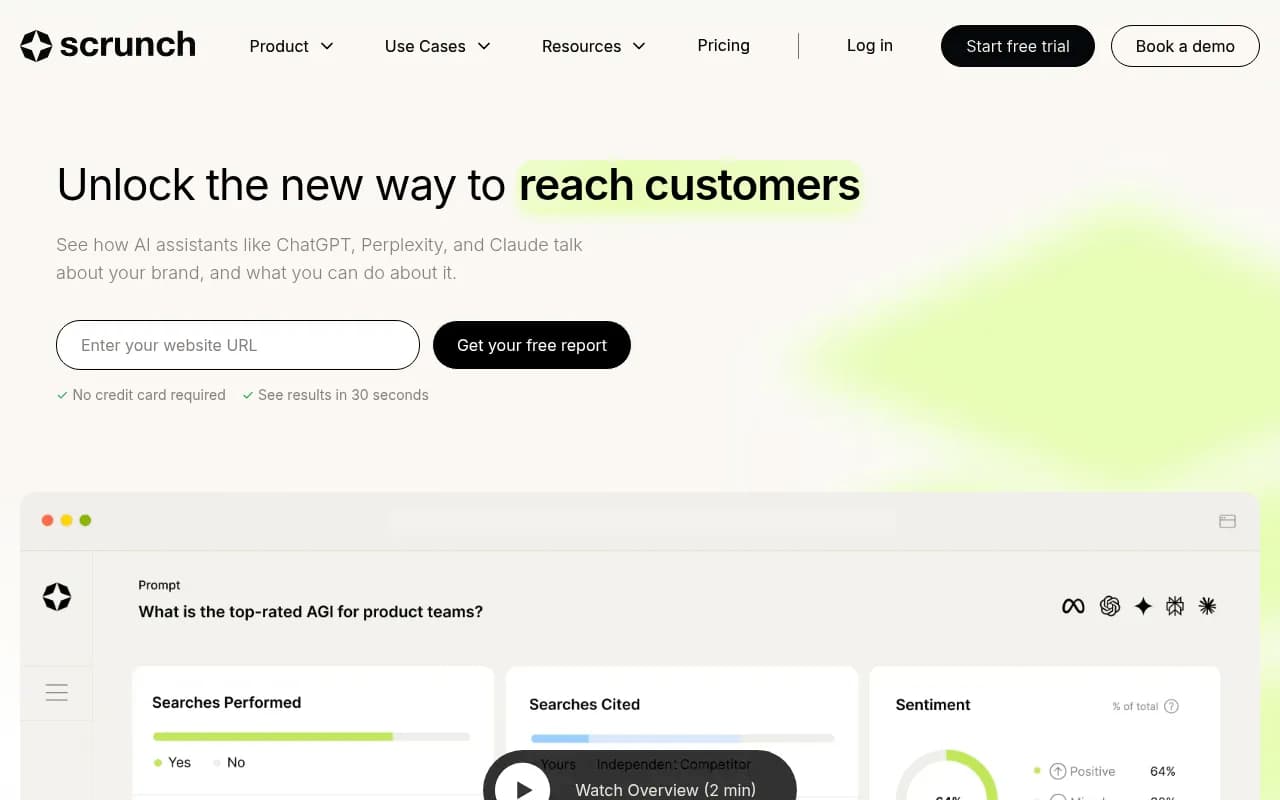
Scrunch monitors how AI assistants like ChatGPT, Perplexity, and Claude mention your brand. Track AI search performance, analyze citations, detect crawler errors, and optimize content for AI visibility. Includes an Agent Experience Platform (AXP) to serve AI-optimized content directly to LLM bots.
Key Takeaways:
• What it does well: Real-time AI bot crawler monitoring, citation tracking across major LLMs, and a unique Agent Experience Platform (AXP) that serves AI-optimized content to bots • Major limitations: Dated UI, missing core features like multi-language support and advanced competitor analysis, significantly behind competitors like Promptwatch in functionality and data depth • Best for: Small teams or startups just getting started with AI search visibility who need basic monitoring and don't require enterprise-grade analytics • Skip if: You need robust prompt tracking, deep competitive intelligence, or are managing AI visibility at scale -- the platform lacks the sophistication for serious AI SEO work
Scrunch is an AI search visibility platform that helps brands monitor and optimize how they appear in responses from ChatGPT, Perplexity, Claude, and other large language models. Launched as part of the emerging AI search optimization (AEO) category, Scrunch positions itself as a tool for understanding your "AI presence" -- tracking when and how AI assistants mention your brand, which pages they cite, and how you compare to competitors. The company claims over 500 customers including recognizable names like Lenovo and Penn State University, though the platform itself reveals significant gaps compared to more mature competitors in this space.
The core promise is straightforward: as more users turn to AI assistants for recommendations and research, brands need visibility into these new search channels. Scrunch attempts to provide that visibility through monitoring dashboards, citation analysis, and optimization recommendations. However, the execution falls short of what serious marketers and SEO teams need for comprehensive AI search strategy.
Monitoring & Performance Tracking
Scrunch's monitoring dashboard tracks your brand's presence across multiple LLMs including ChatGPT, Perplexity, and Claude. You can see performance metrics like mention frequency, citation counts, and how you rank for specific prompts. The platform provides breakdowns by competitor, topic, and geography, giving you a sense of where you're visible and where you're not.
The AI traffic monitoring feature shows real-time logs of AI bot crawlers hitting your site -- you can see when ChatGPT's crawler, Perplexity's bot, or Claude's scraper visits specific pages. This is genuinely useful for understanding which content AI systems are actually reading. Traffic trend graphs show crawler activity over time, helping you spot patterns or sudden changes in AI bot behavior.
However, the monitoring capabilities are basic compared to platforms like Promptwatch. There's no evidence of tracking actual user prompts at scale (Promptwatch monitors over 1.1 billion real prompts), and the competitor analysis appears limited to simple comparisons rather than deep competitive intelligence. The interface for exploring this data is reportedly clunky and dated, making it harder to extract actionable insights quickly.
Prompt Analytics
Scrunch lets you track specific prompts to see if AI mentions your brand in responses. You can monitor trends, see which competitors appear alongside you, and track your ranking position for queries relevant to your business. The platform claims to show citation sources -- which websites AI is pulling information from when it mentions brands in a category.
This feature sounds useful in theory but lacks depth in practice. There's no indication that Scrunch tracks prompt volumes (how often users are actually asking these questions), competition levels, or trending queries in your category -- all capabilities that more advanced platforms offer. The prompt tracking appears to be more of a manual monitoring tool where you input specific queries rather than a comprehensive system that discovers what prompts are driving visibility in your space.
Insights & Optimization
The Insights module analyzes how AI interprets your site and provides recommendations to improve visibility. Scrunch scans your content and suggests optimizations to increase the likelihood of being cited by AI models. The platform identifies citation patterns -- showing which types of content and which external sites AI assistants prefer to reference.
Error detection is a standout feature: Scrunch alerts you when AI bots encounter problems crawling your site, whether due to robots.txt restrictions, server errors, or other technical issues. This is valuable because if AI can't access your content, you have zero chance of being mentioned. The platform flags these issues so you can fix them before they cost you visibility.
That said, the optimization recommendations appear generic compared to competitors. There's no mention of AI-powered content generation, no detailed analysis of why competitors are outranking you for specific prompts, and no clear workflow for implementing and testing optimizations. The insights feel more like basic SEO suggestions adapted for AI rather than sophisticated AEO strategy.
Agent Experience Platform (AXP)
Scrunch's most distinctive feature is the Agent Experience Platform -- a system that creates a parallel, AI-optimized version of your site specifically for AI bot traffic. When an AI crawler visits your site, Scrunch can serve it specially formatted content designed to maximize citation likelihood. This is conceptually similar to how sites have long served different content to mobile vs desktop users, but optimized for machine readers instead of humans.
The AXP approach is interesting because it acknowledges that AI bots consume content differently than humans. By reformatting your content structure, emphasizing key facts, and organizing information in ways that LLMs prefer, you theoretically increase your chances of being cited. Scrunch provides a dashboard (described as terminal-style) where you can manage this AI-specific content layer.
The execution here is unclear from available information. It's not evident how much manual work is required to set up and maintain this parallel content layer, whether it's automatically generated or requires significant customization, or how Scrunch ensures the AI-optimized content stays in sync with your main site. This could be a powerful differentiator or a maintenance headache depending on implementation.
Site Maps
A recently introduced feature called Site Maps provides a visual overview of how AI consumes your website. It shows where AI bots are struggling with your site structure, helps you prioritize fixes, and integrates with the AXP to deliver optimized content. This appears to be Scrunch's attempt at a unified workflow for AI search optimization -- identify problems, fix them, and serve better content to AI, all in one place.
The Site Maps feature addresses a real need: understanding the gap between what you think your site communicates and what AI actually extracts from it. However, without hands-on experience, it's hard to assess whether this tool provides genuinely actionable intelligence or just surface-level diagnostics.
Who Is Scrunch For?
Scrunch targets startups, small companies, and individual marketers who are just beginning to think about AI search visibility. The $100/month entry point (Starter plan) is accessible for teams testing the waters of AEO without major budget commitment. Companies with 1-5 person marketing teams who need basic monitoring and want to understand if AI is mentioning their brand at all could find value here.
The Growth plan at $500/month is positioned for teams at growing companies, though it's unclear what additional capabilities this tier unlocks beyond the Starter plan. The enterprise tier offers custom pricing for larger organizations managing multiple brands, regions, or languages, plus features like role-based access control and API access.
Scrunch is NOT ideal for agencies managing multiple clients, enterprise brands requiring sophisticated competitive intelligence, or companies serious about AI search as a core acquisition channel. The platform's limitations -- dated UI, missing features, shallow analytics compared to competitors -- make it unsuitable for professional SEO teams or anyone who needs to make data-driven decisions about AI visibility strategy. If you're comparing Scrunch to platforms like Promptwatch (which monitors real user prompts at massive scale, provides multi-language/multi-region support, and offers deep competitor analysis), Scrunch feels like a minimum viable product rather than a mature solution.
Integrations & Ecosystem
Scrunch offers a Data API for enterprise customers, allowing you to pull monitoring data into your own dashboards, internal systems, or AI workflows. This is useful for larger organizations that want to integrate AI visibility metrics into existing reporting infrastructure.
Beyond the API, there's no mention of integrations with common marketing tools, SEO platforms, or analytics systems. No Slack notifications, no Google Search Console integration, no Zapier connections -- the platform appears to operate as a standalone tool. For a monitoring platform, this lack of integration ecosystem is a significant limitation. Marketers want AI visibility data flowing into the same dashboards where they track traditional SEO, paid search, and other channels.
Pricing & Value
Scrunch offers three pricing tiers:
Starter: $100/month (paid monthly) -- For individuals at startups and small companies getting started in AI search. The feature set at this tier is not clearly detailed, but presumably includes basic monitoring and limited prompt tracking.
Growth: $500/month (paid monthly) -- For teams at growing companies. Again, specific feature differences from Starter are not transparent on the website, which makes it difficult to assess value.
Enterprise: Custom pricing -- Includes multi-brand/multi-site management, role-based access control, API access, and dedicated support. Designed for large organizations with complex needs.
There's a 7-day free trial available, and the company offers a free report that shows how AI currently talks about your brand -- a useful lead magnet that gives you a taste of the platform's monitoring capabilities.
Compared to competitors, Scrunch's pricing is in the mid-range. Promptwatch offers similar starting prices but delivers significantly more functionality, including real prompt data (not simulations), crawler logs, multi-language support, and shopping data from ChatGPT. For the money, Scrunch appears to offer less value unless the Agent Experience Platform proves to be a game-changer for your specific use case.
Strengths
Real-time AI bot crawler monitoring -- The ability to see exactly when and how AI bots are accessing your site is genuinely useful for technical SEO and troubleshooting.
Agent Experience Platform concept -- Serving AI-optimized content specifically to bot traffic is an innovative approach that could provide an edge if implemented well.
Error detection -- Proactively alerting you when AI bots can't access your content helps prevent invisible problems from costing you citations.
Accessible entry price -- At $100/month, small teams can experiment with AI search monitoring without major financial commitment.
Limitations
Dated, clunky interface -- Multiple sources indicate the platform UI feels outdated and is difficult to navigate, which hampers productivity and makes data exploration frustrating.
Missing core features -- No multi-language support, limited competitor analysis, no evidence of tracking real user prompts at scale, and shallow analytics compared to mature competitors like Promptwatch.
Lack of integrations -- Operating as a standalone tool without connections to the broader marketing tech stack limits its utility for teams with established workflows.
Unclear feature differentiation -- The website doesn't clearly explain what you get at each pricing tier, making it hard to assess value before signing up.
Limited prompt intelligence -- No indication of prompt volume data, trending queries, or discovery of new prompts driving visibility in your category -- you're mostly limited to tracking prompts you manually input.
Bottom Line
Scrunch is a basic AI search visibility tool suitable for small teams or startups taking their first steps into AI search optimization. If you need simple monitoring to see whether ChatGPT or Perplexity mentions your brand, and you're willing to tolerate a dated interface and limited features, the $100/month entry point makes it accessible for experimentation. The Agent Experience Platform is conceptually interesting and could provide value if you have the resources to set it up and maintain it.
However, for anyone serious about AI search as a growth channel -- agencies, enterprise brands, or companies where AI visibility is a core part of acquisition strategy -- Scrunch falls short. The platform lacks the depth, sophistication, and polish of competitors like Promptwatch, which offers real prompt data, comprehensive multi-LLM coverage, advanced competitor analysis, and a modern interface. Scrunch feels like an early-stage product that hasn't kept pace with the rapidly evolving AEO category. Unless the AXP feature solves a specific problem you have, most teams will get better ROI from more mature platforms.
Best use case in one sentence: Small startups with limited budgets who need basic AI mention monitoring and are willing to overlook significant feature gaps and UI issues.
Similar and alternative tools to ScrunchAI