PromptReach Review 2026
PromptReach is a basic AI business listing directory that promises to make your company discoverable by ChatGPT, Claude, and Gemini through structured schema markup. While it offers free listings, it's essentially a stripped-down clone of established GEO platforms, missing critical features like crawler logs, content gap analysis, prompt intelligence, and actual citation tracking that serious businesses need.
Key Takeaways:
• What it is: A free business directory that claims to optimize your listing for AI assistants like ChatGPT and Claude using schema markup • Major limitation: Lacks virtually all core GEO features -- no crawler logs, no content gap analysis, no prompt data, no citation tracking, no optimization tools • Who it's for: Very small local businesses wanting a basic free listing, not companies serious about AI visibility • The reality: This is essentially a clone of established platforms like Promptwatch but without the features that actually matter for AI search optimization • Bottom line: If you're serious about AI visibility, you need a real GEO platform with actual data and optimization capabilities
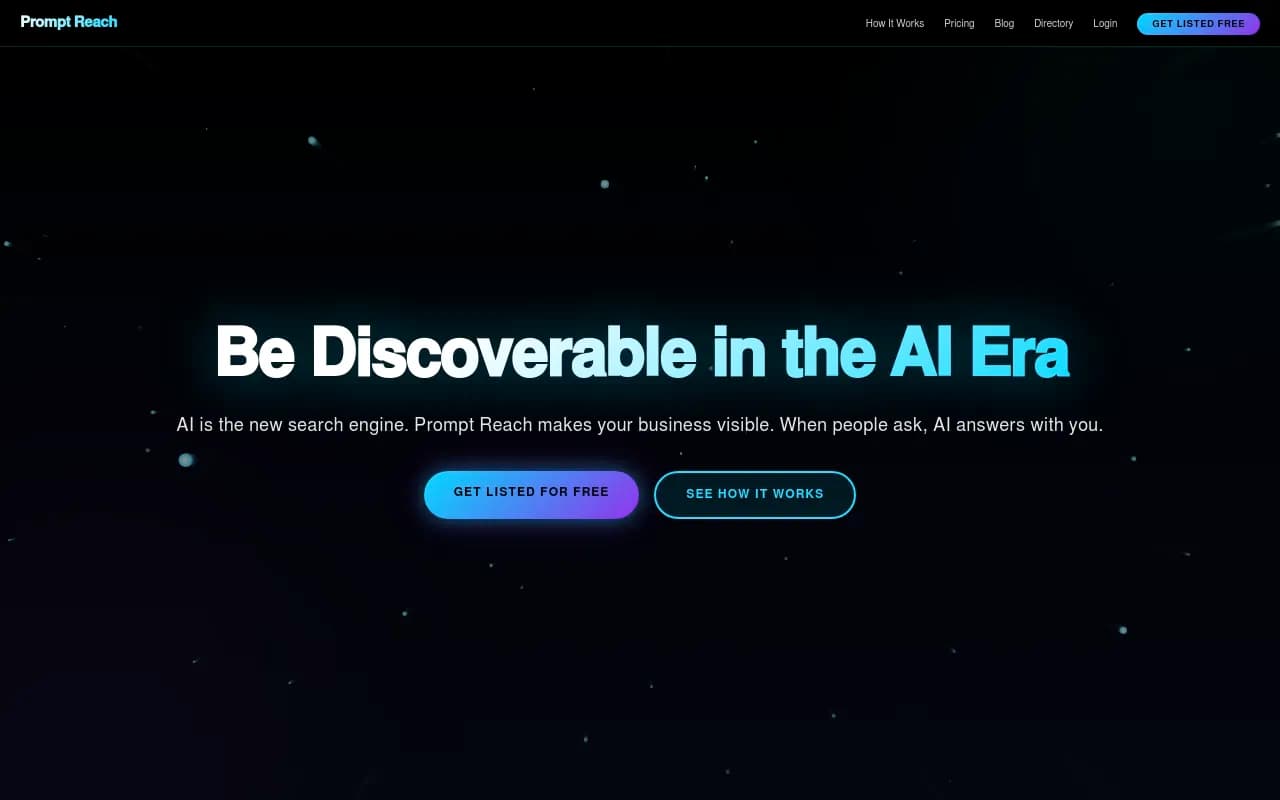
PromptReach positions itself as a solution for making businesses discoverable by AI assistants like ChatGPT, Claude, and Google Gemini. The pitch is simple: create a free business listing with "AI-optimized schema markup" and supposedly your company will start appearing when people ask AI assistants for recommendations. It sounds appealing, especially with the "free" angle, but the reality is far less impressive than the marketing suggests.
The platform is run by a small operation that also offers "AI Phone 360" (an AI receptionist service) and free SEO consultations. The business listing service is their main offering, targeting local businesses and service providers who want to be visible in the emerging world of AI search. The problem? They're trying to solve a complex problem with an extremely basic solution.
What PromptReach Actually Offers
The core offering is straightforward: you fill out a form with your business details (name, location, services, description), and PromptReach creates a listing page on their directory with structured data markup. The theory is that AI models will crawl this directory, read your structured data, and cite your business when relevant prompts come up.
Free Business Listing: You can create a basic listing at no cost. This includes your business name, description, services, location, and contact information formatted with schema markup. The listing lives on promptreach.ai/your-business-name.
Schema Markup: They implement structured data (likely LocalBusiness or Organization schema) on your listing page. This is standard SEO practice that's been around for years -- it helps search engines understand your business details in a machine-readable format.
Founding Member Program: For a one-time payment starting at $20, you can become a "founding member" which includes a blog post mention and recognition on their site. This is more about supporting their platform than getting meaningful AI visibility benefits.
Free SEO Consultation: They offer to help businesses "adapt for the future" with free consultations, which appears to be a lead generation tactic for their other services.
What's Missing (And Why It Matters)
Here's where PromptReach falls dramatically short compared to actual GEO platforms. If you're serious about AI visibility, these missing features aren't nice-to-haves -- they're essential:
No Crawler Log Data: PromptReach has no way to show you whether AI models are actually crawling your listing, how often they visit, which pages they read, or what errors they encounter. Real GEO platforms like Promptwatch provide detailed crawler logs showing exactly when ChatGPT, Claude, Perplexity, and other AI engines access your content. Without this, you're flying blind -- you have no idea if AI models are even seeing your listing.
No Citation Tracking: The platform doesn't track whether your business is actually being cited by AI assistants. You can't see which prompts trigger mentions of your business, how often you're cited, or which AI models are recommending you. This is the core metric that matters for AI visibility, and PromptReach simply doesn't measure it.
No Content Gap Analysis: There's no analysis of which prompts your competitors are visible for but you're not. Real GEO platforms identify the specific topics, questions, and angles where you're missing coverage, then help you create content to fill those gaps. PromptReach just creates a static listing and hopes for the best.
No Prompt Intelligence: No data on prompt volumes, difficulty scores, or query variations. You don't know which prompts are high-value opportunities or how people are actually asking AI assistants about businesses like yours. Without this intelligence, you can't prioritize or optimize strategically.
No Multi-Model Monitoring: While they claim to make you visible to ChatGPT, Claude, and Gemini, there's no actual monitoring across these models. You can't see how your visibility differs between ChatGPT vs Perplexity vs Google AI Overviews. Real platforms track 10+ AI models simultaneously.
No Optimization Tools: Beyond the initial listing creation, there are no tools to help you improve your AI visibility. No content generation, no optimization recommendations, no A/B testing of different descriptions or positioning. You're stuck with whatever you initially submitted.
No Competitive Analysis: You can't see how your AI visibility compares to competitors, which businesses are dominating AI recommendations in your category, or what they're doing differently. This competitive intelligence is crucial for strategic planning.
No Traffic Attribution: There's no way to connect AI visibility to actual business outcomes. You can't track whether people who see your listing in AI responses actually visit your website or become customers.
The Fundamental Problem
PromptReach is built on a flawed assumption: that simply having a schema-marked-up listing on a directory will make you visible to AI assistants. The reality of AI search optimization is far more complex. AI models don't just read schema markup and automatically cite businesses -- they evaluate content quality, relevance, authority, freshness, and dozens of other signals. They pull from millions of sources including your own website, Reddit discussions, YouTube videos, news articles, and yes, sometimes directories -- but a basic directory listing is one of the weakest signals.
Think of it this way: PromptReach is like buying a business card and expecting customers to magically find you, while real GEO platforms are like having a full marketing team that tracks where customers are looking, creates content that attracts them, and measures what's working. The gap between these approaches is enormous.
Who Might Consider PromptReach
There's a very narrow use case where PromptReach makes sense:
Very small local businesses (single-location restaurants, hair salons, local contractors) who want a free listing and have zero budget for AI visibility. If you're just dipping your toe into the concept of AI search and want a free directory listing with proper schema markup, PromptReach provides that. It's better than nothing, but only marginally.
Businesses testing the waters who want to understand AI search concepts before investing in a real platform. You could create a free listing, see how schema markup works, and learn the terminology -- then graduate to an actual GEO platform when you're ready to take it seriously.
Who Should Absolutely Not Use PromptReach
Pretty much everyone else:
Any business serious about AI visibility: If you're investing in content marketing, SEO, or digital advertising, you need real data and optimization tools. PromptReach provides neither.
Multi-location businesses or chains: Managing multiple listings with no centralized tracking or optimization is a nightmare. You need enterprise-grade tools.
B2B companies and SaaS businesses: Your buyers are asking complex questions that require content-level optimization, not just a directory listing. You need content gap analysis and prompt intelligence.
Agencies managing client AI visibility: You can't report on results or demonstrate ROI with PromptReach. You need citation tracking, competitive analysis, and traffic attribution.
E-commerce brands: If you're trying to appear in ChatGPT Shopping recommendations or product queries, a basic directory listing won't cut it. You need product-level optimization and shopping-specific tracking.
Integrations & Technical Capabilities
PromptReach appears to have minimal technical infrastructure:
No API: There's no developer API for programmatic access or custom integrations.
No Analytics Integrations: Can't connect to Google Analytics, Search Console, or other analytics platforms to measure impact.
No CMS Integrations: No plugins for WordPress, Shopify, or other platforms to sync your business data automatically.
No Reporting Tools: No Looker Studio connector, no CSV exports, no white-label reporting for agencies.
The platform is essentially a form that creates a static listing page. That's it.
Pricing Reality Check
PromptReach offers free listings with a $20+ "founding member" upgrade that adds minimal value (a blog post mention). Compare this to actual GEO platforms:
Promptwatch Essential: $99/month gets you 50 tracked prompts, crawler logs, citation tracking, content gap analysis, AI content generation (5 articles/month), and visitor analytics. This is what real AI visibility optimization looks like.
Promptwatch Professional: $249/month adds 150 prompts, 15 articles/month, state/city-level tracking, and advanced crawler logs.
The price difference reflects the feature difference. PromptReach is free because it provides almost nothing of value beyond a basic listing. Real GEO platforms cost money because they provide actual data, optimization tools, and measurable results.
The Competitive Landscape
PromptReach exists in a space dominated by far more capable platforms:
Promptwatch: The market leader with 880M+ citations analyzed, full crawler logs, content gap analysis, AI content generation, and tracking across 10 AI models. Used by 6,700+ brands including Booking.com and Center Parcs. This is what a real GEO platform looks like.
Otterly.AI, Peec.ai, AthenaHQ: Even these monitoring-focused platforms (which lack optimization features) still provide actual citation tracking and prompt data that PromptReach doesn't have.
Profound, Scrunch: Higher-end platforms with robust feature sets and competitive analysis capabilities.
PromptReach isn't competing with these platforms -- it's not even playing the same game. It's like comparing a business card to a full CRM system.
Honest Assessment: Strengths & Limitations
The one thing PromptReach does okay:
• It's free: If you literally have zero budget and want a schema-marked-up listing on a directory, it provides that at no cost.
The many things it fails at:
• No actual visibility data: You have no idea if AI models are citing your listing or even crawling it • No optimization capabilities: Can't improve your visibility beyond the initial listing creation • No prompt intelligence: Don't know which queries matter or how to target them • No competitive insights: Can't see how you compare to competitors or what they're doing better • No traffic attribution: Can't measure business impact or ROI • Static and limited: Just a directory listing, not a dynamic optimization platform • Missing core GEO features: Everything that makes AI visibility optimization actually work is absent
Bottom Line
PromptReach is a well-intentioned but fundamentally inadequate attempt at solving the AI visibility problem. It's built on the naive assumption that a schema-marked-up directory listing is enough to make you discoverable by AI assistants. In reality, AI search optimization requires sophisticated tracking, content gap analysis, prompt intelligence, and continuous optimization -- none of which PromptReach provides.
If you're a tiny local business with zero budget and you want a free listing that might possibly help a tiny bit, PromptReach is harmless. But if you're serious about being visible in AI search results -- if you want to actually track citations, understand which prompts matter, identify content gaps, and optimize your presence across ChatGPT, Claude, Perplexity, and other AI models -- you need a real GEO platform with actual data and optimization tools.
The gap between PromptReach and established platforms like Promptwatch isn't a matter of degree -- it's a matter of kind. One is a static directory listing with no data or optimization capabilities. The other is a comprehensive platform that shows you where you're invisible, helps you create content to fix it, and tracks the results. For any business that takes AI visibility seriously, the choice is obvious.
Tags:
Similar and alternative tools to PromptReach