Koala AI Review 2026
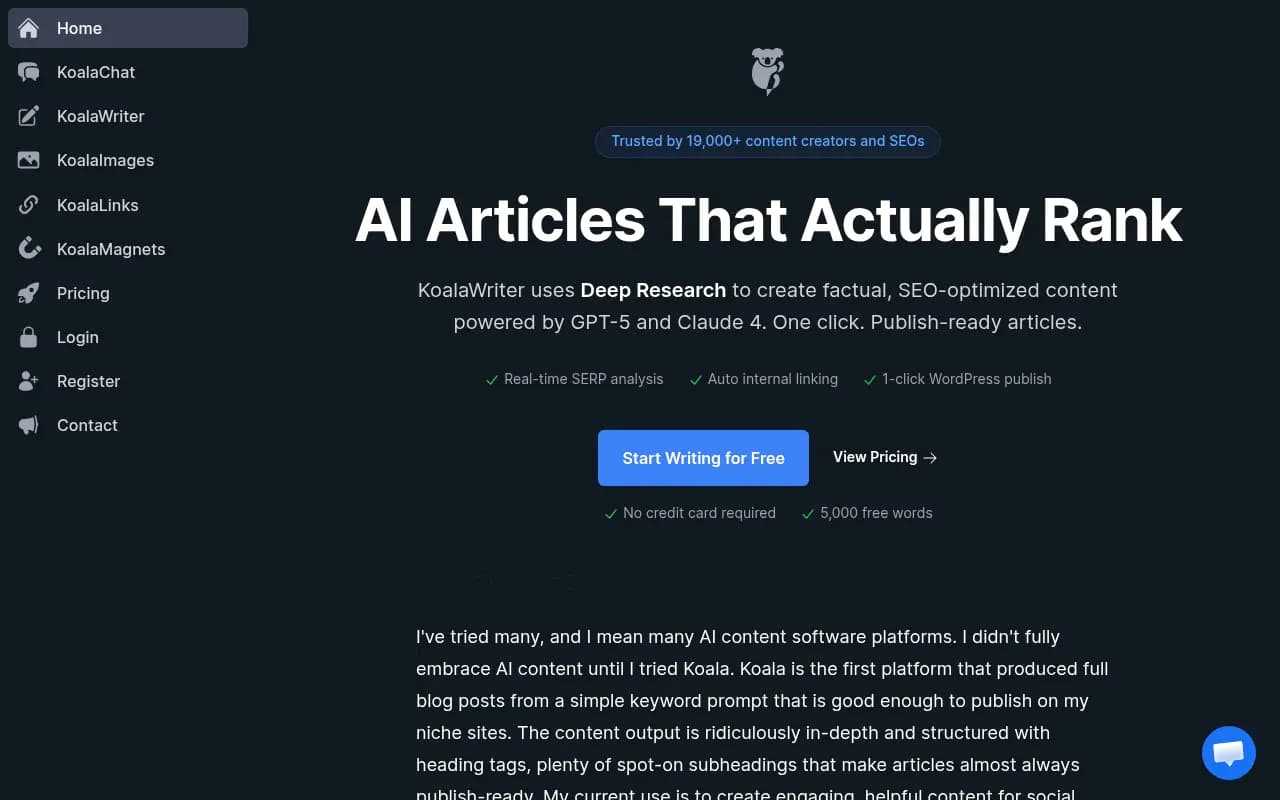
Koala AI is an AI-powered content creation platform built specifically for SEO professionals and content creators. It combines KoalaWriter for long-form article generation, KoalaChat for research assistance, and tools for images, internal linking, and lead magnets. Used by 19,000+ creators, it analy
Summary
• Best for: SEO agencies, affiliate marketers, and content teams producing 20+ articles per month who need publish-ready drafts with minimal editing • Standout strength: Deep Research mode pulls from authoritative sources and analyzes SERPs in real-time to create factual, well-cited content that actually ranks -- not generic AI filler • Key limitation: Still requires human editing for brand voice and expertise -- it's a powerful drafting tool, not a replacement for writers • Pricing sweet spot: $25/mo Starter plan offers 50,000 words and all core features, making it significantly cheaper than Jasper or Surfer AI for comparable output • Bottom line: If you're scaling SEO content and tired of AI tools that produce shallow, repetitive articles, Koala's research-first approach and built-in optimization features make it worth testing
Koala AI launched in 2023 as a response to the wave of generic AI content tools flooding the market. Built by SEO practitioners who were frustrated with tools like Jasper and Copy.ai producing surface-level content, Koala focuses on one thing: creating articles that actually rank in Google. The platform now serves over 19,000 content creators, SEO agencies, and affiliate marketers, with testimonials from established publishers like Jon Dykstra of Fat Stacks praising it as the first AI tool that produces "publish-ready" content from a simple keyword prompt.
What sets Koala apart is its research-first approach. While most AI writers simply rephrase existing content or generate generic outlines, Koala's Deep Research mode analyzes top-ranking pages for your target keyword, identifies semantic entities and related terms, then pulls from authoritative sources to create factual, well-cited articles. The result is content that reads less like AI output and more like something a human researcher would write after spending hours studying the topic.
Deep Research Mode is the engine behind Koala's content quality. When you enter a keyword, Koala doesn't just generate an outline and start writing. It first scrapes the top 10-20 results for that keyword, extracts entities, semantic keywords, and content patterns, then uses that data to inform the article structure and content. This means your article naturally includes the terms and concepts Google expects to see for that query. The system uses 100x more context than standard AI writing modes, pulling from multiple authoritative sources and citing them inline. For topics requiring factual accuracy -- health, finance, technical subjects -- this research layer is critical. You're not getting hallucinated facts or outdated information; you're getting content grounded in real sources.
Real-Time SERP Analysis runs automatically during article generation. Koala analyzes what's currently ranking for your keyword, identifies content gaps in lower-ranking articles, and ensures your piece covers all the angles top results are covering. This isn't just keyword stuffing -- it's semantic optimization. If the top results all mention "side effects" when discussing a supplement, Koala will include that section. If they compare multiple products, your article will too. This SERP-aware approach is what helps Koala-generated content rank faster than generic AI articles.
Automatic Internal Linking is a feature most AI writers completely ignore. Koala indexes your entire website (via sitemap or manual URL list), then automatically inserts contextual internal links as it writes. The system has created over 10 million internal links to date across user sites. You can control link density, specify priority pages to link to, and exclude certain URLs. For large sites with hundreds of articles, this alone saves hours of manual work. The links are natural and contextual -- not forced or spammy -- because Koala understands the semantic relationship between your pages.
Outline Editor gives you full control before generation. Koala suggests an outline based on SERP analysis, but you can add, remove, or reorder H2s and H3s to match your content strategy. Want to add a comparison section? Insert it. Need to skip a section that's not relevant to your audience? Delete it. This level of control is rare in AI writers, where you typically get what the AI decides to write. With Koala, you're directing the structure, and the AI fills in the content.
Amazon Affiliate Articles are a specialized feature for affiliate marketers. Koala pulls live Amazon data -- product specs, pricing, customer reviews, ratings -- and generates product roundups or single-product reviews. The content includes real review snippets (not made-up testimonials), current pricing, and product comparisons. For affiliate sites publishing "best of" lists, this feature automates 80% of the research and writing process. You can customize which products to include, how many to feature, and the article angle (budget picks, premium options, best for specific use cases).
1-Click Publishing integrates directly with WordPress, Shopify, Webflow, and Ghost. Once your article is generated, you can publish it to your CMS without copy-pasting. Formatting, images, and internal links carry over intact. For WordPress users, Koala can even set categories, tags, and featured images automatically. This seamless workflow is a huge time-saver for agencies managing multiple client sites or publishers cranking out daily content.
Polish (AI Editing) is a one-click post-generation feature that improves readability. It splits long paragraphs, reduces repetition, tightens sentences, and adjusts tone. Think of it as a light editing pass that takes a solid draft and makes it more polished. It's not a replacement for human editing, but it does catch obvious issues like overly long sentences or redundant phrasing that AI writers often produce.
Bulk Content Creation lets you queue up multiple articles and generate them simultaneously. Upload a CSV of keywords, and Koala will process them in the background. This is essential for agencies or large publishers who need to produce 50-100 articles per month. You can customize settings per article (word count, tone, outline) or apply the same template across all.
Schema Markup is automatically generated for entities mentioned in your content. Koala identifies people, places, products, and organizations, then creates structured data markup you can add to your site. This helps search engines understand your content and can improve your chances of appearing in rich snippets or knowledge panels.
KoalaChat is the platform's AI assistant, similar to ChatGPT but optimized for SEO and content tasks. It has access to real-time web data, so you can ask it to research competitors, summarize articles, or generate content briefs. It also includes specialized commands for SEO tasks like keyword clustering, content gap analysis, and SERP feature extraction. For content strategists, KoalaChat is useful for pre-writing research and planning.
KoalaImages generates custom AI images in multiple styles (photorealistic, illustration, 3D render, etc.). You can create featured images, infographics, or in-content visuals without leaving the platform. The image quality is on par with Midjourney or DALL-E, and you can regenerate or tweak prompts until you get the result you want.
KoalaLinks is a standalone tool for adding internal links to existing content. Upload your sitemap, and KoalaLinks will analyze your site structure and suggest thousands of contextual internal links. You can review and approve them in bulk, then export the updated HTML or publish directly to WordPress. This is a massive time-saver for sites with 100+ articles that need better internal linking.
KoalaMagnets lets you create custom GPTs embedded on your site. These are interactive tools (calculators, quizzes, recommendation engines) that attract backlinks and generate leads. For example, a fitness site could create a "Workout Plan Generator" GPT that visitors use and share. It's a creative way to build engagement and earn links without traditional outreach.
Who Is It For
Koala AI is built for SEO-focused content creators who need to produce high volumes of quality content without hiring a full writing team. The primary users are affiliate marketers running niche sites (think product review sites, comparison blogs, "best of" lists), SEO agencies managing 10-50 client sites, and in-house content teams at SaaS companies or e-commerce brands producing educational blog content. If you're publishing 20+ articles per month and spending hours on research, outlining, and drafting, Koala can cut that time by 70-80%.
It's particularly strong for affiliate marketers because of the Amazon integration and product roundup features. Publishers like Jon Dykstra (Fat Stacks) and other niche site operators have publicly endorsed it as the first AI tool that produces content they're comfortable publishing with minimal edits. For agencies, the bulk generation and WordPress integration make it easy to scale content production across multiple clients without adding headcount.
Koala is also a fit for solo bloggers or small teams who want to compete with larger publishers. If you're trying to build topical authority in a competitive niche, Koala's SERP analysis and deep research help you create comprehensive content that covers all the angles top-ranking pages are covering. You're not guessing what to write -- you're reverse-engineering what's already working.
Who should NOT use Koala: If you're writing highly technical content that requires deep subject matter expertise (legal analysis, medical research, advanced engineering topics), Koala will give you a solid draft but you'll still need significant editing and fact-checking. It's not a replacement for expert writers -- it's a tool to speed up the drafting process. Also, if you're focused on brand storytelling, thought leadership, or content that requires a unique voice, Koala's output will feel generic. It's optimized for informational and transactional content, not creative or opinion-driven pieces.
Integrations & Ecosystem
Koala integrates directly with WordPress, Shopify, Webflow, and Ghost for one-click publishing. For WordPress, it can set categories, tags, featured images, and custom fields automatically. The platform also supports Zapier for connecting to other tools in your workflow (e.g., trigger article generation when a new keyword is added to a Google Sheet).
Koala has an API for developers who want to build custom workflows or integrate article generation into their own tools. The API is well-documented and supports bulk operations, making it suitable for agencies building white-label solutions.
For research and planning, KoalaChat can pull real-time data from the web, so you're not limited to the AI's training data cutoff. This is useful for topics that change frequently (product releases, industry news, trending topics).
There's no mobile app, but the web interface is responsive and works on tablets. Most users do their writing and editing on desktop, where the outline editor and bulk features are easier to navigate.
Pricing & Value
Koala offers a free trial with 5,000 words (no credit card required), which is enough to generate 2-3 full articles and test the quality. After that, pricing is straightforward:
• Essentials: $9/mo for 15,000 words (about 5-7 articles). Includes KoalaWriter, KoalaChat, and KoalaImages. Good for solo bloggers testing the platform. • Starter: $25/mo for 50,000 words (about 20-25 articles). All features unlocked. This is the sweet spot for most users. • Professional: $49/mo for 125,000 words (about 50 articles). Adds priority support and higher rate limits. • Boost: $99/mo for 300,000 words (about 120 articles). For agencies or high-volume publishers. • Growth: $179/mo for 600,000 words (about 240 articles). • Elite: $350/mo for 1.25 million words (about 500 articles). For large agencies or enterprise teams.
All plans include access to KoalaWriter, KoalaChat, KoalaImages, KoalaLinks, and KoalaMagnets. There are no feature gates -- you get the full platform at every tier. The only difference is word count.
Compared to competitors, Koala is significantly cheaper. Jasper AI starts at $49/mo for 50,000 words with fewer SEO features. Surfer AI charges per article ($29-$59 per piece depending on length), which adds up fast if you're producing 20+ articles per month. Frase is $45/mo but lacks the deep research and Amazon integration. For the feature set and output quality, Koala's $25/mo Starter plan is hard to beat.
The value proposition is clear: if Koala saves you 5-10 hours per week on content creation, it pays for itself even at the highest tier. For agencies, the time savings on internal linking alone can justify the cost.
Strengths & Limitations
Strengths: • Research quality: Deep Research mode produces factual, well-cited content that requires less fact-checking than most AI writers. The SERP analysis ensures you're covering all the angles top-ranking pages cover. • Built-in SEO features: Automatic internal linking, schema markup, and real-time SERP analysis are features most competitors charge extra for or don't offer at all. • Amazon affiliate support: The ability to pull live product data and reviews is a game-changer for affiliate marketers. No other AI writer does this as well. • Publishing workflow: One-click WordPress publishing with formatting intact saves hours of copy-pasting and reformatting. • Pricing: At $25/mo for 50,000 words, it's one of the most affordable AI writers with this feature set.
Limitations: • Still needs editing: Koala produces solid drafts, but you'll still need to edit for brand voice, add personal insights, and fact-check claims. It's not a "set it and forget it" tool. • Generic tone: The writing style is clear and informative but not particularly engaging or unique. If you need content with personality or a distinct voice, you'll spend time rewriting. • Limited creative content support: Koala is optimized for informational and transactional content (how-tos, product reviews, comparisons). It's not great for storytelling, opinion pieces, or thought leadership. • No built-in plagiarism checker: You'll need to run content through Copyscape or Grammarly separately to check for originality.
Bottom Line
Koala AI is the best AI writing tool for SEO-focused content creators who need to produce high volumes of publish-ready articles without hiring a full writing team. The combination of deep research, real-time SERP analysis, automatic internal linking, and one-click publishing makes it a complete content production system, not just a writing assistant. For affiliate marketers, the Amazon integration alone is worth the price. For agencies, the bulk generation and WordPress integration make it easy to scale across multiple clients.
You should buy Koala if you're publishing 20+ articles per month, spending hours on research and outlining, and tired of AI tools that produce shallow, repetitive content. The $25/mo Starter plan is the sweet spot for most users -- enough words to produce 20-25 articles per month with all features unlocked.
Best use case in one sentence: SEO agencies and affiliate marketers who need to produce 50-200 factual, well-optimized articles per month without hiring additional writers.
Tags:
Frequently asked questions
What is Koala AI and what does it do?
Who is Koala AI best for?
How much does Koala AI cost?
Is Koala AI free to use?
What is Koala AI's Deep Research mode?
How does Koala AI compare to Jasper or Surfer AI?
Can Koala AI fully replace human writers?
What features are included in Koala AI?
How many users does Koala AI have?
When was Koala AI launched?
Similar and alternative tools to Koala AI