Ceyo Review 2026
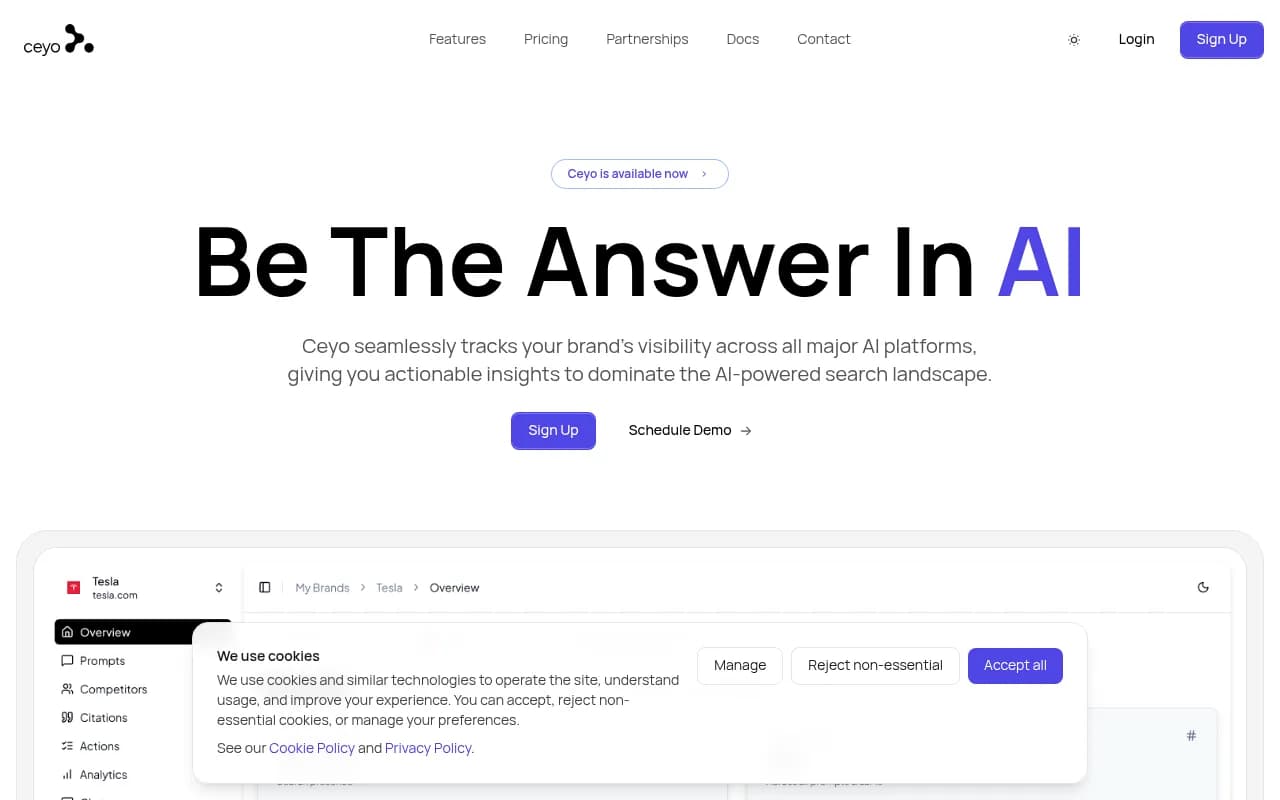
Ceyo is an AI visibility monitoring platform that tracks how your brand appears in responses from ChatGPT, Gemini, Claude, Perplexity, and other LLMs. Built for agencies, SEO teams, and brand managers, it monitors brand mentions, sentiment, and competitive positioning across thousands of prompts with daily updates and actionable insights.
Key takeaways
- Monitoring-only platform -- Ceyo tracks brand mentions and sentiment across AI models but lacks content generation, AI crawler logs, and traffic attribution that Promptwatch offers
- Covers ChatGPT, Gemini, Perplexity, Grok, and Google AI with daily monitoring and real-time alerts
- Strong competitive benchmarking and source intelligence features show which domains AI platforms cite when mentioning your brand
- Pricing starts at $49/mo for the Core plan, making it accessible for small teams and agencies
- Best for agencies and brand managers who need basic AI visibility tracking but don't require optimization tools or content creation capabilities

Ceyo launched in 2025 as an AI visibility monitoring platform targeting the growing need for brands to understand how they appear in AI-generated search results. As ChatGPT, Perplexity, and other LLMs increasingly replace traditional search engines, companies need to know whether AI models recommend their products, how they're positioned against competitors, and what sources influence those recommendations. Ceyo addresses this by tracking brand mentions across major AI platforms and providing daily updates on visibility, sentiment, and competitive positioning.
The platform is built for marketing teams, SEO specialists, and agencies managing multiple client brands. It's particularly relevant for companies in competitive verticals like SaaS, e-commerce, and consumer goods where AI-driven product recommendations directly impact purchase decisions. Ceyo positions itself as a "Share of Answer" tracker -- measuring how often your brand appears in AI responses compared to competitors, similar to how traditional SEO measures share of voice in search results.
Key features
Prompt analytics dashboard tracks visibility, sentiment, and brand mentions across thousands of custom prompts. You define the queries that matter to your business (e.g. "best project management tools", "top CRM for startups") and Ceyo monitors how AI models respond. Each prompt shows visibility percentage, sentiment (positive/neutral/negative), average ranking position, impact level, and which competing brands appear in the same responses. The dashboard includes category tagging and geographic tracking so you can see performance by market. This is the core feature -- it tells you where you're visible and where you're not.
Real-time brand mention tracking monitors how LLMs recommend your brand across different queries. When an AI model mentions your product, Ceyo captures the full response, identifies which brands were mentioned, and tracks your position relative to competitors. You can see the exact wording AI models use to describe your product, which features they highlight, and whether the recommendation is positive or neutral. This is useful for reputation management and understanding how AI platforms frame your brand.
Competitive benchmarking compares your AI visibility against competitors. You can see which brands dominate specific prompts, how your visibility percentage stacks up, and where competitors are winning. The platform shows which queries your competitors rank for that you don't, though it doesn't provide content gap analysis or recommendations on how to close those gaps. It's a monitoring feature, not an optimization tool.
Source intelligence reveals which domains and articles AI platforms cite when mentioning your brand. This is one of Ceyo's stronger features -- it shows you the specific publications, blog posts, Reddit threads, and YouTube videos that influence AI recommendations. If you're mentioned in a TechCrunch article and that article is cited by ChatGPT, you'll see it. This helps you understand which PR and content efforts are actually moving the needle in AI search.
Multi-LLM coverage tracks ChatGPT, Gemini, Perplexity, Grok, and Google AI (including AI Overviews). Claude and Copilot are listed as "coming soon". Each model is monitored separately so you can see performance differences -- for example, your brand might rank higher in Perplexity than ChatGPT for the same query. This is important because different AI models have different training data and citation preferences.
Geographic tracking monitors AI responses across multiple countries including the US, UK, Germany, Netherlands, Singapore, Japan, Australia, Brazil, India, Canada, and France. This is useful for global brands that need to understand regional differences in AI visibility. A brand might be highly visible in US-based AI responses but invisible in European markets.
Daily monitoring and alerts automatically re-runs your tracked prompts daily and sends notifications when visibility changes significantly. You don't have to manually check the dashboard -- Ceyo alerts you when your brand drops out of AI responses or when a competitor suddenly appears. This keeps you informed without requiring constant monitoring.
AI-powered analytics assistant lets you query your data in natural language. You can ask questions like "How is my brand performing on ChatGPT?" or "Which competitors are mentioned most often?" and get instant answers. This is a convenience feature that makes the platform more accessible to non-technical users.
Smart action plans provide prioritized recommendations to improve AI visibility. The platform generates a to-do list with tasks like "optimize homepage content for AI crawlers", "create comprehensive FAQ section", and "build industry authority content". Each action includes an impact rating (high/medium/low) and category (content/strategy/analysis). However, these are generic recommendations -- Ceyo doesn't provide specific content suggestions, gap analysis, or tools to actually create the content. It tells you what to do but doesn't help you do it.
Who is it for
Ceyo is built for three primary audiences: digital marketing agencies managing multiple client brands, in-house SEO and marketing teams at mid-sized companies, and brand managers at consumer-facing businesses. The platform is particularly useful for agencies that need to report on AI visibility as part of their service offering -- the multi-brand dashboard and daily monitoring make it easy to track 5-10 clients without switching between accounts.
SEO specialists and GEO (Generative Engine Optimization) practitioners will find Ceyo useful for understanding how AI search differs from traditional SEO. If you're tracking keyword rankings in Ahrefs or Semrush, Ceyo shows you the parallel universe of AI-generated recommendations. It's a monitoring layer that sits alongside your existing SEO stack.
Brand managers at e-commerce companies, SaaS businesses, and consumer goods brands will appreciate the competitive intelligence and sentiment tracking. If your product competes in a crowded category (project management tools, CRM software, laptops, etc.), Ceyo shows you how AI platforms position your brand relative to competitors. This is useful for understanding market perception and identifying gaps in your messaging.
Ceyo is NOT for companies that need optimization tools or content creation capabilities. If you want to actually improve your AI visibility (not just monitor it), you'll need a platform like Promptwatch that includes content gap analysis, AI content generation, and crawler log tracking. Ceyo tells you where you're invisible but doesn't help you fix it.
It's also not ideal for enterprise teams that need deep technical integrations, API access, or custom reporting. The platform is designed for ease of use, not extensibility. There's no mention of API access, Looker Studio integration, or server log analysis.
Integrations and ecosystem
Ceyo's integration ecosystem is limited. The platform monitors ChatGPT, Gemini, Perplexity, Grok, and Google AI directly, but there's no mention of integrations with Google Search Console, analytics platforms, CMS systems, or marketing automation tools. This is a standalone monitoring dashboard -- you can't connect it to your existing tech stack or export data for custom reporting.
There's no API access mentioned, which limits automation and custom workflows. If you want to pull Ceyo data into your own dashboards or trigger actions based on visibility changes, you're out of luck. Most competitors in this space (Promptwatch, Profound, Otterly.AI) offer API access for enterprise customers.
The platform does include an AI analytics assistant that uses natural language queries, which is a form of integration with the underlying LLM technology. But this is an internal feature, not an external integration.
For agencies managing multiple clients, Ceyo offers a multi-brand dashboard that lets you switch between client accounts. This is useful but not the same as white-label reporting or client-facing dashboards that some agencies require.
Pricing and value
Ceyo offers three pricing tiers with both monthly and annual billing options. The Core plan is $49/mo and includes basic AI visibility tracking for one brand, daily monitoring across all supported LLMs, prompt analytics, and competitive benchmarking. This is the entry-level option for small businesses or agencies testing the waters with AI visibility tracking.
The Pro plan pricing isn't explicitly listed on the website but is mentioned in comparison articles as ranging from $89-199/mo. This tier likely includes more brands, more tracked prompts, and additional features like source intelligence and geographic tracking.
The Enterprise plan is custom pricing and includes features like monthly strategy sessions with the Ceyo team, priority support, and presumably higher limits on brands and prompts.
Compared to competitors, Ceyo is positioned at the lower end of the market. Promptwatch starts at $99/mo but includes content generation, crawler logs, and traffic attribution. Profound starts around $400/mo with more advanced analytics. Otterly.AI and Peec.ai are similarly priced to Ceyo but offer even fewer features.
The value proposition depends on what you need. If you only want monitoring and competitive intelligence, Ceyo's $49/mo entry point is attractive. But if you need optimization tools, content creation, or technical features like crawler log analysis, you'll outgrow Ceyo quickly and need to upgrade to a more comprehensive platform.
There's no mention of a free trial, though the website has a "Try Now" button that likely leads to a signup flow. Annual billing offers a discount but the exact percentage isn't specified.
Strengths and limitations
Ceyo's main strength is its clean, accessible interface and straightforward monitoring capabilities. The prompt analytics dashboard is well-designed and easy to understand -- you can see at a glance which queries you're visible for, how you compare to competitors, and what sentiment AI models express about your brand. For agencies that need to report on AI visibility without getting into technical details, this simplicity is valuable.
The source intelligence feature is genuinely useful. Knowing which specific articles, Reddit threads, and YouTube videos influence AI recommendations helps you focus your PR and content efforts. Most monitoring-only tools don't surface this level of detail.
Geographic tracking across 11+ countries is another differentiator. If you're a global brand, understanding regional differences in AI visibility is important. Ceyo makes this easy to track.
The limitations are significant. Ceyo lacks content optimization and creation tools entirely. The "smart action plans" provide generic recommendations but no specific guidance on what content to create or how to optimize existing pages. There's no content gap analysis showing which prompts competitors rank for that you don't, and no AI writing agent to help you create content that ranks in AI search. This is the biggest gap compared to Promptwatch, which includes Answer Gap Analysis and an AI content generation engine grounded in 880M+ citations.
There are no AI crawler logs, so you can't see which pages ChatGPT, Claude, or Perplexity are actually reading on your website. You don't know if AI models are encountering errors, how often they return, or which pages they prioritize. This makes it hard to diagnose indexing issues or understand how AI engines discover your content.
There's no traffic attribution or visitor analytics. You can see that your brand is mentioned in AI responses, but you can't connect that visibility to actual website traffic or revenue. Promptwatch offers code snippet integration, GSC integration, and server log analysis to close this loop. Ceyo doesn't.
The platform doesn't track Reddit or YouTube insights separately, even though these channels heavily influence AI recommendations. Promptwatch surfaces Reddit discussions and YouTube videos that AI models cite -- Ceyo only shows source domains without this level of detail.
ChatGPT Shopping tracking is missing. As ChatGPT increasingly recommends products directly in shopping carousels, tracking your brand's presence in these recommendations becomes critical. Ceyo doesn't monitor this.
There's no mention of prompt volume estimates or difficulty scoring. You can track any prompt you want, but you don't know if that prompt is high-volume or low-volume, easy to rank for or highly competitive. Promptwatch provides this data to help you prioritize winnable prompts.
Bottom line
Ceyo is a solid monitoring-only platform for agencies and brand managers who need basic AI visibility tracking without optimization tools. If your goal is to understand where your brand appears in AI responses, how you compare to competitors, and which sources influence those recommendations, Ceyo delivers at an accessible price point. The $49/mo Core plan is a low-risk entry into AI visibility tracking.
But if you want to actually improve your AI visibility -- not just monitor it -- Ceyo falls short. It tells you where you're invisible but doesn't help you fix it. There's no content gap analysis, no AI content generation, no crawler log tracking, and no traffic attribution. For teams that need optimization capabilities, Promptwatch is the stronger choice. It costs more ($99/mo starting) but includes the full action loop: find gaps, generate content, track results.
Best use case: Agencies managing 5-10 client brands who need a simple dashboard to report on AI visibility as part of their monthly deliverables, without the need for deep optimization or content creation tools.
Tags:
Frequently asked questions
What is Ceyo and what does it do?
How much does Ceyo cost?
Which AI models does Ceyo monitor?
Does Ceyo help you create content or just monitor visibility?
Who should use Ceyo?
How does Ceyo compare to Promptwatch?
Similar and alternative tools to Ceyo