Key Takeaways
- Ceyo starts at $49/mo (Core plan) vs Peec AI at €89/mo (~$103) -- Ceyo is roughly half the price at entry level
- Peec AI offers a free trial and focuses on instant data access with a cleaner interface, while Ceyo emphasizes comprehensive prompt analytics and GEO recommendations
- Both track the same four major LLMs (ChatGPT, Gemini, Claude, Perplexity), but differ in how they present and analyze the data
- Ceyo provides more granular prompt-level metrics including impact scoring and category tagging, while Peec AI prioritizes simplicity and competitive benchmarking
- For agencies managing multiple clients, Peec AI's Growth plan (€199/mo) includes 2 workspaces vs Ceyo's single-brand focus at lower tiers
- Neither platform offers content generation or optimization tools -- if you need to act on visibility gaps, Promptwatch complements either option by helping you create content that actually ranks in AI search

Overview
Ceyo
Ceyo
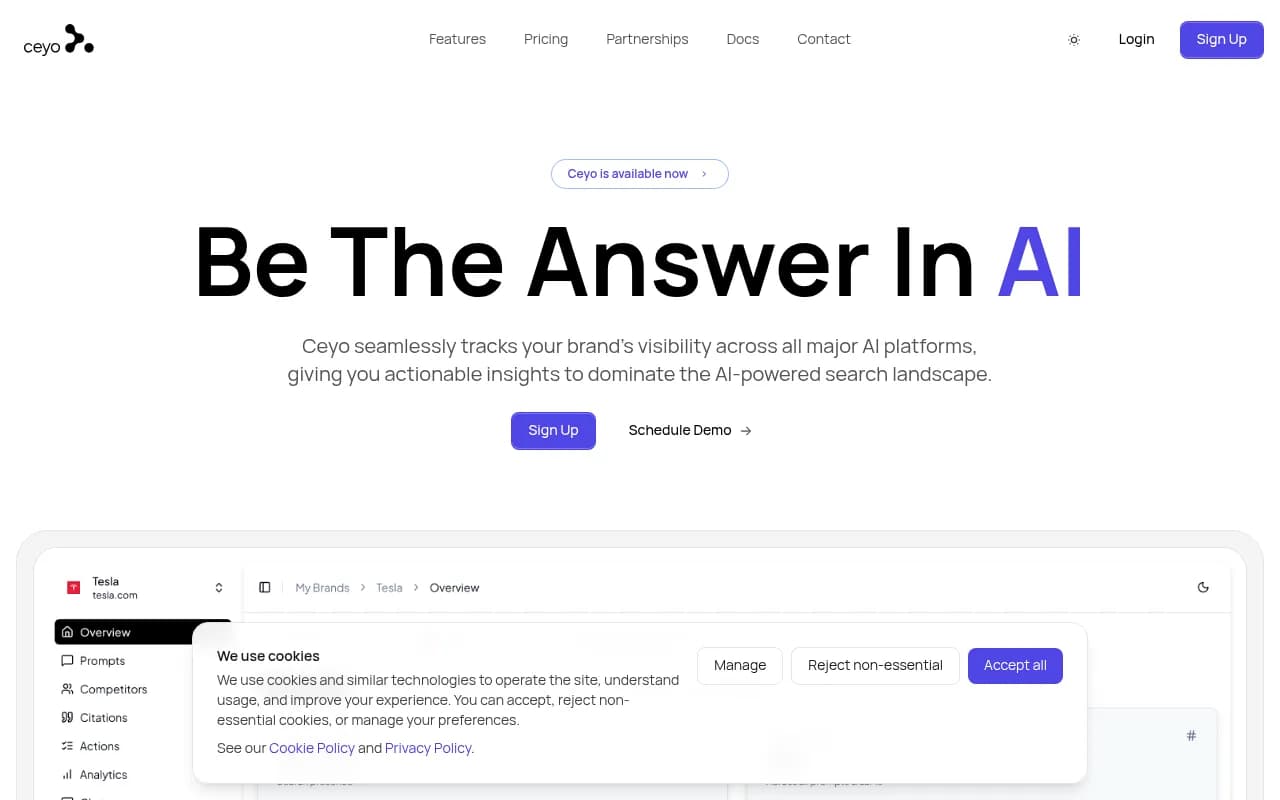
Ceyo positions itself as a GEO (Generative Engine Optimization) platform that monitors brand visibility across ChatGPT, Gemini, Claude, and Perplexity. The platform tracks thousands of prompts and provides sentiment analysis, competitor mentions, and actionable recommendations. Ceyo's interface shows detailed prompt-level analytics including visibility percentages, average position, impact scores, and brand comparisons. The company is trusted by partners including BrandFirm, Zigt, and Enreach.
Peec AI

Peec AI is an AI search analytics platform built for marketing teams who need to understand brand performance across major LLMs. The platform tracks three core metrics -- Visibility, Position, and Sentiment -- and emphasizes competitive benchmarking. Peec AI's dashboard shows trending data, competitor comparisons, and citation source analysis. The platform is used by 1,500+ marketing teams and agencies, with a focus on fast strategic assessments through a clean, user-friendly interface.
Side-by-Side Comparison
| Feature | Ceyo | Peec AI |
|---|---|---|
| Starting price | $49/mo (Core) | €89/mo (~$103, Starter) |
| Free trial | Not mentioned | Yes |
| LLMs tracked | ChatGPT, Gemini, Claude, Perplexity | ChatGPT, Gemini, Claude, Perplexity |
| Prompts (entry tier) | Not specified | 50 prompts |
| Core metrics | Visibility, Sentiment, Position, Impact | Visibility, Position, Sentiment |
| Competitor tracking | ✓ Brand mentions & comparisons | ✓ Benchmarking dashboard |
| Multi-workspace | Higher tiers only | Growth plan (2 workspaces) |
| Custom prompts | ✓ | ✓ |
| Geo/country tracking | ✓ Multi-region support | ✓ All countries |
| Prompt tagging | ✓ Category-based | ✓ Custom tags |
| Citation analysis | Not highlighted | ✓ Source tracking |
| Interface focus | Comprehensive analytics | Simplicity & speed |
Pricing breakdown
Ceyo pricing
| Plan | Price | Key limits |
|---|---|---|
| Core | $49/mo | Entry-level monitoring |
| Standard | Not disclosed | Mid-tier features |
| Enterprise | Custom | Full feature set |
Ceyo offers annual billing but doesn't publish detailed feature breakdowns for each tier on their public site. The $49/mo entry point is the lowest in the AI visibility tracking space.
Peec AI pricing
| Plan | Price | Prompts | Workspaces | Models |
|---|---|---|---|---|
| Starter | €89/mo (~$103) | 50 | 1 | 10 |
| Growth | €199/mo (~$230) | 150 | 2 | 10 |
| Enterprise | Custom | Custom | Custom | 10+ |
Peec AI's pricing is transparent and includes a free trial. The Growth plan's dual-workspace setup makes it agency-friendly. All plans track 10 models (the four main LLMs plus additional variants).
Feature deep-dive
Analytics depth and presentation
Ceyo's prompt analytics table shows visibility percentage, sentiment classification, average position, impact level, competing brands (with logos), category tags, and geo indicators all in one view. This is dense but comprehensive -- you can scan a single table and understand prompt performance, competitive landscape, and strategic priority at a glance. The impact scoring (High Relevance, Medium Volume, etc.) helps prioritize which prompts matter most.
Peec AI takes the opposite approach. The dashboard shows three headline metrics (Visibility, Sentiment, Position) with trend lines and a simple competitor comparison chart. You see fewer data points per screen, but the information is easier to digest quickly. The "Recent Chats" view and tag-based organization make it easy to drill into specific prompt groups without getting overwhelmed.
Verdict: Ceyo wins for teams that want maximum data density and granular analysis. Peec AI wins for teams that need to brief executives or make fast decisions without wading through tables.
Competitive intelligence
Both platforms track competitor mentions, but the implementation differs. Ceyo's prompt table shows which brands appear alongside yours for each query, complete with favicons and visibility percentages. You can see at a glance that for "Best laptop for developers," Apple is at 85%, Lenovo and Dell trail behind, and your brand isn't mentioned at all.
Peec AI's competitor view shows percentage-based pie charts comparing your visibility to rivals like Salesforce (62%), HubSpot (65%), and others. The trending data shows whether you're gaining or losing ground over time. This is less granular than Ceyo's prompt-by-prompt breakdown but easier to present in a board meeting.
Verdict: Ceyo provides more actionable competitive data for SEO/content teams. Peec AI's visualizations are better for reporting upward.
Prompt management and organization
Ceyo displays prompts in a sortable table with category tags (Technology, Software, AI Tools, etc.) and geo flags. You can filter by category, but the organizational structure seems predefined rather than fully customizable.
Peec AI lets you add custom prompts, organize them with your own tags, and track across all countries. The interface explicitly shows "Add your own prompts" and "Organize prompts with tags" as core features. This flexibility matters if you're tracking niche queries or running experiments.
Verdict: Peec AI offers more control over prompt organization and custom tracking.
Sentiment analysis
Ceyo classifies sentiment as Positive, Neutral, or Negative at the prompt level. In their demo table, most prompts show Positive sentiment except one CRM query marked Negative. The sentiment appears alongside other metrics but isn't broken down further.
Peec AI tracks sentiment as one of three core metrics and shows it trending over time. The Attio dashboard example shows a sentiment score of 90 (presumably out of 100) and a position of 2.6. Sentiment is treated as a first-class metric, not just a label.
Verdict: Peec AI's numerical sentiment scoring and trend tracking is more useful than Ceyo's categorical labels.
Multi-workspace and agency features
Ceyo's public site doesn't highlight multi-workspace capabilities at lower tiers. The partner logos suggest agency use cases, but workspace management seems reserved for higher-priced plans.
Peec AI's Growth plan (€199/mo) explicitly includes 2 workspaces, making it straightforward to manage multiple clients or brands. The platform is marketed to agencies with logos from firms like BrandFirm and others.
Verdict: Peec AI is more transparent and accessible for agencies managing multiple brands.
Citation and source tracking
Ceyo's public materials don't emphasize citation source analysis. The focus is on prompt performance and brand mentions rather than understanding which URLs or sources AI models are pulling from.
Peec AI includes a "Sources" section in the navigation and highlights citation analysis as a feature. Understanding where AI models get their information helps you target the right publications, forums, or content hubs.
Verdict: Peec AI provides better visibility into the sources behind AI responses.
User interface and learning curve
Ceyo's interface is data-rich. The prompt table packs 8+ columns of information into a single view. This is powerful for analysts but potentially overwhelming for casual users. The design feels functional rather than polished.
Peec AI's screenshots show a cleaner, more modern interface with whitespace, clear typography, and progressive disclosure. The "Quick Actions" sidebar and dashboard layout follow familiar SaaS patterns. Multiple sources describe Peec AI as having a "simple, user-friendly interface" focused on "instant access to data."
Verdict: Peec AI is easier to onboard and use day-to-day. Ceyo requires more time to master but rewards power users.
Pros and cons
Ceyo pros
- Lowest entry price in the category ($49/mo vs $103+ elsewhere)
- Comprehensive prompt-level analytics with impact scoring
- Detailed competitor brand tracking with logos and visibility percentages
- Category tagging and geo tracking built in
- Annual billing option for cost savings
Ceyo cons
- No free trial mentioned
- Interface is dense and potentially overwhelming
- Limited transparency on feature differences between tiers
- Citation source analysis not highlighted
- Less emphasis on workspace management for agencies
Peec AI pros
- Free trial available for testing before commitment
- Clean, modern interface with fast data access
- Strong sentiment tracking with numerical scores and trends
- Citation source analysis included
- Multi-workspace support at Growth tier (€199/mo)
- Custom prompt tagging and organization
- Trusted by 1,500+ teams with proven track record
Peec AI cons
- Higher starting price (€89/mo vs $49/mo)
- Prompt limits may feel restrictive (50 on Starter, 150 on Growth)
- Less granular impact/priority scoring compared to Ceyo
- Simpler analytics may not satisfy data-heavy users
Who should pick which tool
Choose Ceyo if:
- Budget is tight and you need the lowest entry price
- You're a solo analyst or small team that wants maximum data density
- Prompt-level impact scoring and detailed competitor tables are critical
- You don't need multi-workspace management
- You're comfortable with a steeper learning curve in exchange for more metrics
Choose Peec AI if:
- You want to test with a free trial before committing
- Your team values clean UI and fast insights over data density
- You need to track citation sources and understand where AI models get information
- You're an agency managing multiple clients (Growth plan's 2 workspaces)
- Sentiment trend analysis is a priority
- You need to present data to non-technical stakeholders regularly
Consider both if:
- You're running a large marketing operation and want to compare platforms side-by-side during a trial period
- You need visibility tracking but also want content optimization tools -- in that case, pair either platform with something like Promptwatch that helps you act on the gaps you discover
Final verdict
Ceyo wins on price and analytical depth. Peec AI wins on usability and agency features.
If you're a scrappy startup or solo marketer watching every dollar, Ceyo's $49/mo entry point is hard to beat. You get comprehensive tracking and detailed competitor analysis without the premium price tag. The trade-off is a busier interface and less hand-holding.
If you're a marketing team or agency that needs to move fast, present clean data to stakeholders, and manage multiple brands, Peec AI's extra €40/month buys you a better experience. The free trial removes risk, the interface won't slow you down, and the citation tracking helps you understand the "why" behind the numbers.
Neither platform helps you fix what's broken -- they show you the problem but don't generate the content or optimize the pages that would improve your AI visibility. For teams serious about ranking in AI search, tracking is step one. Step two is creating content that AI models actually want to cite, which is where optimization platforms come in.
Bottom line: Ceyo for budget-conscious power users, Peec AI for teams that value polish and speed.