Wynter Review 2026
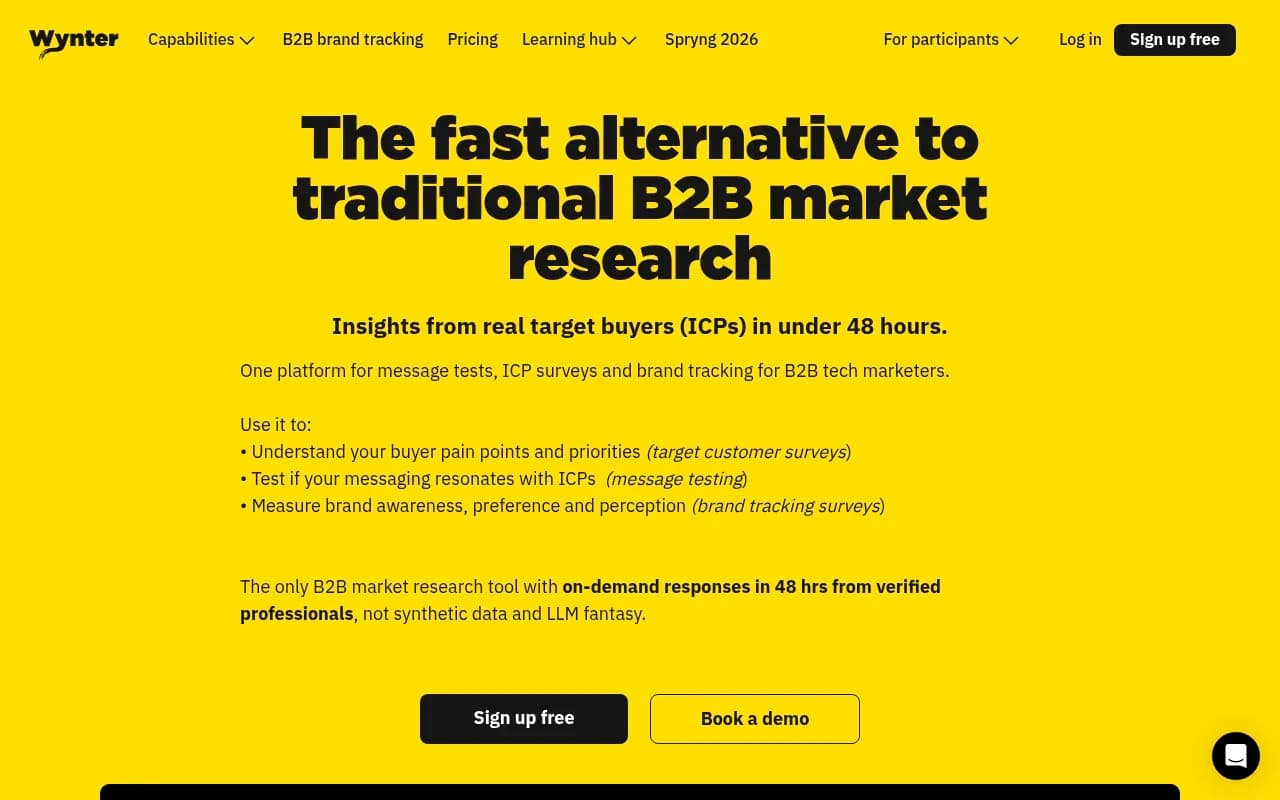
Wynter is an on-demand B2B market research platform that delivers qualitative insights from verified professionals in your target audience within 12-48 hours. Test messaging, conduct ICP surveys, track brand awareness, and validate positioning with a self-serve platform used by 1,872+ B2B SaaS compa
Key Takeaways:
• Speed meets quality: Wynter delivers verified B2B audience responses in 12-48 hours vs weeks/months with traditional research agencies, with access to 70,000+ LinkedIn-verified professionals • Action-oriented platform: Self-serve tools for message testing, ICP research, and brand tracking -- no consulting fees, survey programming costs, or mandatory sales calls • Proven results: Customers like Appcues improved conversion rates 73%, Cognism boosted demo bookings 40%+, and Databook grew inbound leads 10x using Wynter insights • Best for: B2B SaaS marketing teams, product marketers, and growth leaders who need fast, reliable customer insights to validate messaging, understand buyer pain points, and track brand perception • Limitations: Premium pricing ($798-$2,000+/month) puts it out of reach for bootstrapped startups; B2C companies and consumer-focused brands should look elsewhere
Wynter is a B2B market research platform built specifically for tech companies that need fast, reliable insights from their ideal customer profile (ICP). Founded to solve the chronic problem of slow, expensive market research, Wynter has become the go-to tool for 1,872+ B2B SaaS companies -- including recognizable names like HubSpot, Rippling, Miro, Veeam, and Paddle -- who use it to validate messaging, understand buyer needs, and track brand health.
The platform's core promise is simple but powerful: get qualitative feedback from verified professionals in your exact target audience within 12-48 hours, without the multi-month timelines and six-figure budgets of traditional research agencies. For B2B marketing teams moving at startup speed, this combination of quality and velocity is transformative.
The Core Problem Wynter Solves
Most B2B companies struggle with a fundamental disconnect: they're guessing what resonates with their target buyers. Marketing teams write homepage copy, launch campaigns, and build positioning based on internal assumptions, competitor analysis, or generic best practices -- but rarely validate whether their actual ICP cares about what they're saying. Traditional solutions are broken: market research agencies charge $80k-$250k per project and take 2+ months to deliver a PowerPoint deck. Panel companies like SurveyMonkey offer fast turnaround but lack B2B targeting precision (you get "works in IT" instead of "VP of Engineering at 500-1000 person SaaS companies"). User testing platforms like UserTesting focus on usability, not messaging validation, and don't have B2B audiences.
Wynter bridges this gap with a self-serve platform that combines agency-quality insights with panel-speed delivery, purpose-built for B2B use cases.
Who Uses Wynter
Wynter's sweet spot is B2B SaaS companies with $5M-$100M ARR, though it's used by everything from Series A startups to public companies. Primary users include:
Product marketers launching new products or repositioning existing ones who need to validate messaging before committing to a full rebrand or campaign. They use Wynter to test homepage copy, value propositions, feature descriptions, and competitive positioning.
Demand gen and growth marketers optimizing conversion funnels who want to understand why prospects aren't converting. They test landing pages, ad copy, email sequences, and pricing page messaging to identify friction points.
CMOs and VP Marketing who need to prove brand marketing ROI to the board or justify budget allocation. They use Wynter's brand tracking surveys to measure awareness, preference, and perception shifts over time.
Founders and CEOs at earlier-stage companies (Series A-B) who are still figuring out product-market fit and need direct buyer feedback to validate their positioning and category strategy.
The platform is particularly valuable for companies selling to technical buyers (developers, engineers, IT leaders), enterprise decision-makers (VPs, Directors, C-suite), or niche B2B personas that are hard to reach through traditional channels. If your ICP is "Head of Revenue Operations at mid-market B2B companies" or "Security architects at Fortune 500 enterprises," Wynter can actually deliver those people.
Core Features and How They Work
Message Testing is Wynter's flagship capability and the feature most customers start with. You upload screenshots of your homepage, landing page, ad creative, or any other marketing asset, then define your target audience (job title, industry, company size). Wynter recruits 20-100+ people matching that profile from their 70,000-person panel, shows them your messaging, and collects detailed qualitative feedback.
The platform evaluates messaging across four dimensions: Clarity (do they understand what you do?), Relevance (do they feel it's for them?), Value (do they see enough benefit to take action?), and Differentiation (why choose you vs alternatives?). Each respondent answers open-ended questions like "What is this company offering?" "Who is this for?" "What makes this different from competitors?" and "What questions do you have?"
Results come back in 12-48 hours with AI-generated summaries highlighting key themes, sentiment analysis, and specific quotes. You see exactly where messaging breaks down -- maybe 60% of respondents misunderstand your core value prop, or they can't articulate your differentiation, or they think you're for enterprises when you're targeting mid-market. This granular feedback lets you iterate fast. Appcues famously ran multiple rounds of message testing, refined their homepage based on feedback, and improved their visit-to-signup conversion rate by 73%.
ICP and Market Research Surveys let you ask your target audience anything via custom questionnaires. Common use cases include understanding buyer pain points and priorities, mapping the buyer journey and decision-making process, identifying trigger events that prompt solution searches, discovering non-obvious channels buyers use for research, and validating product roadmap priorities.
You build the survey using Wynter's template library or from scratch, define your audience, and get responses back in 12-48 hours. The platform supports multiple question types (multiple choice, rating scales, open-ended), conditional logic, and screening questions. Databook used ICP surveys to validate a major category shift, which led to 10x growth in inbound leads.
Brand Tracking Surveys measure brand awareness, preference, and perception among your ICP on a semi-annual or annual basis. This is the tool for CMOs who need to prove brand marketing works. You define your competitive set, then Wynter surveys your target audience to measure: unaided and aided brand awareness (do they know you exist?), consideration set inclusion (are you being evaluated?), brand preference (would they choose you?), brand perception (how do they see you vs how you want to be seen?), and competitive positioning (how do you stack up vs alternatives?).
Results are delivered as trend data over time, so you can show the board "our unaided awareness among VP of Sales at mid-market companies increased from 12% to 28% over the past year." This quantifiable proof of brand impact is rare in B2B and incredibly valuable for budget justification.
Preference Testing is a lightweight A/B/C testing tool for comparing messaging variants, design options, or positioning angles. Show respondents 2-3 options and ask which resonates most and why. Faster and cheaper than full message tests when you just need directional feedback.
1:1 Customer Interviews are available for deeper qualitative research. Wynter recruits participants matching your ICP, schedules interviews, and provides recordings and transcripts. Useful when you need to explore complex topics that don't fit survey formats.
Audience Quality and Targeting
Wynter's competitive moat is its proprietary panel of 70,000+ verified B2B professionals. Every participant's identity is verified through LinkedIn and their corporate email -- no bots, no fake profiles, no people gaming the system for incentive payments. Targeting options include job title (specific titles or title categories like "C-suite," "VP/Director," "Manager"), industry (SaaS, fintech, healthcare, manufacturing, etc.), company size (employee count ranges), seniority level, and geographic location.
The platform shows you exactly how many people match your criteria before you launch, so you know if your targeting is too narrow. For niche audiences (e.g. "CISO at healthcare companies with 1000+ employees"), Wynter may only have 50-100 matches, but you know they're real people, not panel company filler.
Respondents are compensated for participation (typically $50-$150 depending on seniority and test length), which ensures high-quality, thoughtful responses. The platform filters out low-effort submissions automatically.
Speed and Self-Service
Wynter's self-serve model is a major differentiator. You can launch a message test or survey in 5-10 minutes without talking to a salesperson, signing a contract, or paying "survey programming" fees. The platform handles audience recruitment, survey distribution, quality control, and results aggregation automatically. Most tests deliver results in 12-48 hours, though complex surveys or very niche audiences may take 3-5 days.
This speed enables rapid iteration. Instead of waiting 2 months for an agency to deliver one round of research, you can test 3-4 messaging variants in a week and converge on what works. Cognism ran multiple rounds of testing to optimize their homepage and demo page, ultimately boosting conversion rates over 40%.
Integrations and Workflow
Wynter is a standalone platform with no native integrations. You export results as PDFs, CSV files, or share links to results dashboards. Most teams use Wynter as a research tool that informs decisions in other platforms (CMS for website updates, Google Docs for messaging docs, Figma for design iterations, etc.) rather than as part of an automated workflow.
The platform includes collaboration features -- you can invite team members, share results internally, and add comments/annotations to specific responses. Useful for getting buy-in from stakeholders who weren't involved in the research.
Pricing and Value
Wynter offers two main pricing models:
Pay-as-you-go: Individual tests start around $500-$1,500 depending on test type, audience size, and seniority. Message tests with 50 respondents from mid-level professionals typically cost $800-$1,000. Tests targeting C-suite or very senior roles cost more due to higher incentive payments.
Subscription plans: Starter plan at $798/month (billed annually) includes 8 tests per year. Pro plan at $2,000/month (billed annually) includes 20 tests per year plus priority support and faster turnaround. Enterprise plans with custom test volumes and dedicated support are available for larger teams.
Subscription plans offer 30-50% savings vs pay-as-you-go for teams running regular research. The Pro plan works out to $100 per test vs $800-$1,000 for one-off purchases.
Compared to alternatives: Traditional market research agencies charge $80k-$250k per project. Panel companies like Qualtrics or SurveyMonkey charge $50-$200 per response plus "survey programming" fees of $2k-$10k. User testing platforms like UserTesting charge $50-$100 per video but lack B2B targeting. Wynter sits in the middle -- more expensive than DIY panels, far cheaper than agencies, with B2B targeting quality no one else matches.
For B2B SaaS companies with marketing budgets over $500k/year, Wynter is a rounding error that delivers outsize ROI. If one message test prevents a failed rebrand or improves conversion rates 10%, it pays for itself 10x over. For bootstrapped startups or companies under $2M ARR, the pricing may be prohibitive.
What Wynter Does Exceptionally Well
B2B audience quality: No other platform offers this level of verified, targeted B2B access at this speed. LinkedIn-verified identities and corporate email verification eliminate the fake respondents that plague generic panels.
Speed without sacrificing quality: 12-48 hour turnaround with thoughtful, detailed qualitative responses is genuinely unique. Agencies take months, panels deliver garbage data in days, Wynter delivers quality data in days.
Self-serve simplicity: The platform is intuitive enough that a product marketer can launch their first test in 10 minutes without training or onboarding calls. No "survey programming" fees or hidden costs.
Actionable insights: AI-generated summaries and thematic analysis save hours of manual review. You get the TL;DR upfront, then can dig into individual responses for nuance.
Proven results: The case studies are real and impressive -- 73% conversion lift for Appcues, 40%+ for Cognism, 10x lead growth for Databook. These aren't vanity metrics; they're business-moving outcomes.
Honest Limitations
Premium pricing: At $798-$2,000+/month for subscriptions or $500-$1,500 per one-off test, Wynter is expensive for early-stage startups, bootstrapped companies, or teams with limited budgets. There's no free tier or freemium option.
B2B only: If you're selling to consumers or prosumers, Wynter isn't for you. The panel is exclusively B2B professionals, and the platform is optimized for B2B use cases.
Limited quantitative capabilities: Wynter excels at qualitative insights (the "why" behind behavior) but isn't designed for large-scale quantitative research or statistical significance testing. If you need to survey 1,000+ people for statistically robust data, traditional panels are better suited.
No integrations: The lack of native integrations with CMS platforms, analytics tools, or marketing automation means you're manually exporting and applying insights. Not a dealbreaker, but it adds friction.
Panel size constraints: 70,000 people sounds like a lot, but for very niche ICPs (e.g. "CTO at Series B fintech startups in Europe"), you may only have 20-30 matches. Wynter will tell you upfront if your targeting is too narrow, but it means some audiences are hard to research.
Who Should Use Wynter
Wynter is ideal for B2B SaaS companies with $5M+ ARR, marketing teams of 5+ people, and budgets to invest in research. It's particularly valuable if you're launching a new product, repositioning an existing product, optimizing conversion funnels, validating messaging before a rebrand, or proving brand marketing ROI to executives.
You should NOT use Wynter if you're a B2C company, selling to consumers or prosumers, bootstrapped with under $1M ARR and tight budgets, need quantitative research with 1,000+ respondents, or want a free/cheap DIY survey tool.
Bottom Line
Wynter solves a real, painful problem for B2B marketers: getting fast, reliable feedback from your actual target buyers without the cost and delay of traditional research. The combination of verified B2B audiences, 12-48 hour turnaround, and self-serve simplicity is genuinely differentiated. For companies that can afford it, Wynter is a no-brainer investment that pays for itself in better messaging, higher conversion rates, and fewer expensive mistakes. Best use case in one sentence: B2B SaaS marketing teams that need to validate messaging, understand buyer pain points, and track brand perception with real target customers in days, not months.
Tags:
Similar and alternative tools to Wynter