Siftly.ai Review 2026
Smart content optimization tool that uses artificial intelligence to analyze and improve content for better search engine and AI search visibility.
Key Takeaways:
• Y Combinator-backed GEO platform focused on tracking brand visibility across ChatGPT, Claude, Gemini, and Perplexity • Provides both brand mention tracking and source citation analysis to understand AI recommendation patterns • Includes AI content generation specifically optimized for LLM visibility (GEO-ready content) • Offers experimentation framework to test content changes and measure impact on AI visibility • Best for brands that want to understand and improve how AI engines recommend them to potential customers
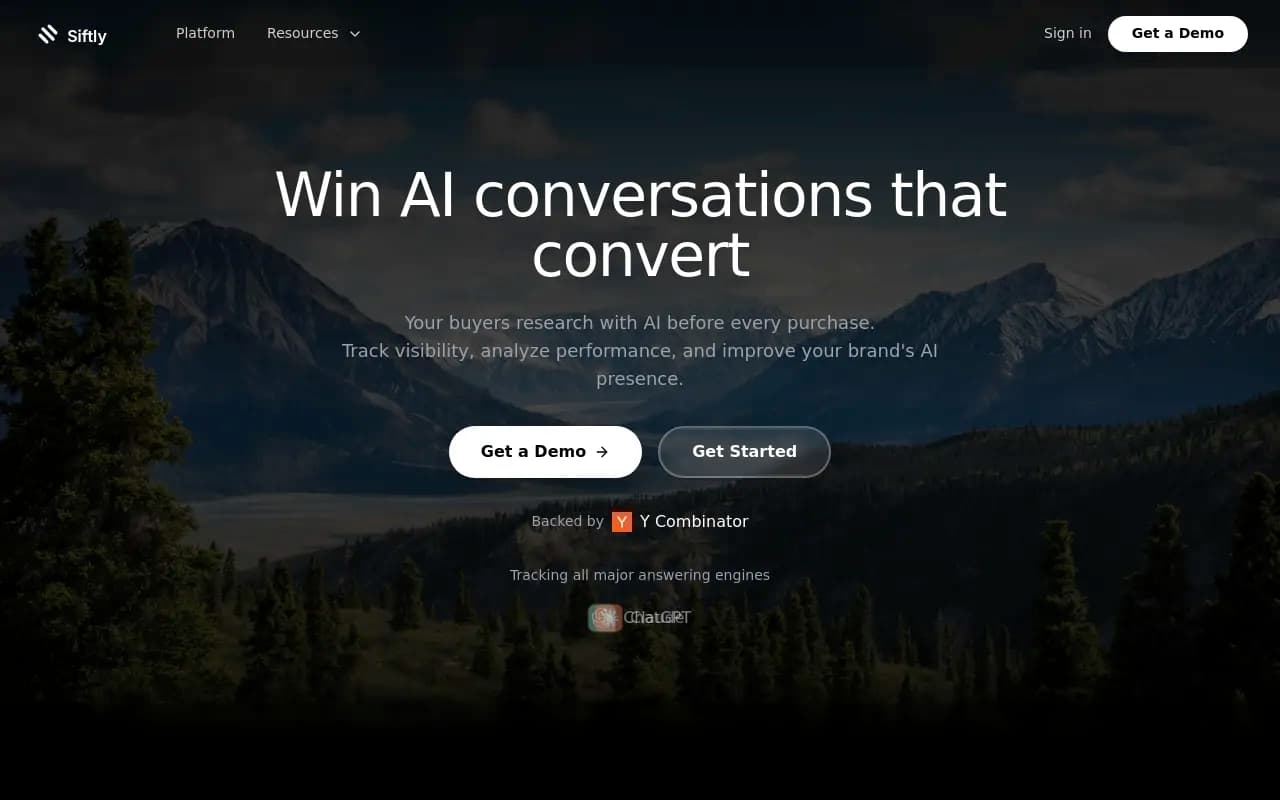
Siftly is a Generative Engine Optimization platform built for the reality that most buyers now research with AI before making purchase decisions. Instead of typing queries into Google and clicking through search results, consumers ask ChatGPT for running shoe recommendations, Claude for software comparisons, or Perplexity for local service providers. Siftly helps businesses understand how they appear in these AI-generated responses and provides tools to improve their visibility. Backed by Y Combinator, the platform targets marketing teams, SEO professionals, and agencies who recognize that traditional search optimization alone no longer captures the full customer research journey.
The platform's core insight is straightforward: if your brand isn't mentioned when AI engines answer customer questions, you're invisible during the research phase that precedes most purchases. Siftly addresses this by tracking brand mentions across the major AI platforms, analyzing competitive positioning, and helping teams create content that AI models actually cite and recommend.
Brand Visibility Tracking: Siftly monitors how often your brand appears in AI-generated responses across ChatGPT, Claude, Gemini, and Perplexity. You create prompts that reflect real customer questions ("best project management software for remote teams", "top running shoes for marathon training"), and the platform tracks whether your brand gets mentioned, how prominently, and in what context. The visibility trend dashboard shows whether your AI presence is growing or declining over time, with percentage changes and historical data. This goes beyond simple mention counting -- you see the actual AI responses, understand the context in which your brand appears, and identify patterns in how different models treat your brand.
Competitive Benchmarking: The platform ranks your brand against competitors for each prompt category. If you're tracking "best CRM software", you see your visibility percentage compared to Salesforce, HubSpot, and other competitors. The competitive distribution chart shows share of voice across all AI responses -- if competitors appear in 60% of responses and you appear in 15%, you have a clear visibility gap to address. This ranking updates as you track more prompts and as AI model behavior changes, giving you a real-time view of your competitive position in AI-powered discovery.
Source Authority Analysis: Beyond brand mentions, Siftly tracks source visibility -- when your website, blog posts, or other content gets cited as a source in AI responses. This distinction matters because being cited as an authoritative source builds credibility even when your brand isn't directly recommended. The platform identifies which of your pages AI models trust most, which external sources frequently get cited in your category, and where you should focus content creation efforts. If AI models consistently cite competitor whitepapers but never your blog, you know where to improve.
Segmentation and Filtering: Results can be filtered by AI model (compare ChatGPT vs Claude behavior), geographic location (US vs UK vs other markets), and topic categories. This segmentation reveals important patterns -- perhaps your brand performs well in ChatGPT but poorly in Perplexity, or you have strong visibility in North America but weak presence in European markets. These insights help you prioritize optimization efforts and understand which AI platforms matter most for your audience.
GEO-Ready Content Generation: Siftly includes an AI content generation tool specifically designed to create content that ranks well in LLM responses. Unlike generic AI writing tools, this analyzes what makes content get cited by AI models, then generates articles, comparisons, and guides structured for maximum AI visibility. The content workflow ensures proper formatting, citation-worthy structure, and the depth that AI models look for when selecting sources. This bridges the gap between identifying visibility problems and actually fixing them -- you're not just monitoring, you're creating content engineered to improve your AI presence.
Experimentation Framework: The platform supports controlled experiments to test content changes and measure impact. You can run A/B tests on different content approaches, compare control vs optimized versions, and track statistical significance of visibility improvements. This scientific approach helps you understand what actually works rather than guessing. If you publish a new comparison page, you can measure whether it increases your mention rate for relevant prompts and by how much.
Workspace and Prompt Management: Set up workspaces for different brands or product lines, each with its own set of tracking prompts. The platform recommends starting with 3-5 prompts that reflect real customer questions, then expanding as you identify high-value queries. Prompt management includes organizing by category, tracking performance over time, and identifying which prompts drive the most valuable visibility.
Who Is It For:
Siftly targets businesses that recognize AI-powered search as a critical customer acquisition channel. This includes B2B SaaS companies where buyers research software through ChatGPT conversations, e-commerce brands competing for product recommendations, local service businesses trying to appear in AI-generated provider lists, and enterprise companies concerned about brand perception in AI responses. The platform fits marketing teams of 5-50 people at companies with $1M-$50M revenue who have budget for specialized tools but need clear ROI. It's particularly valuable for categories where AI recommendation strongly influences purchase decisions -- software selection, product discovery, service provider research, travel planning.
SEO teams and digital marketing agencies managing multiple client brands are another core audience. Agencies can create separate workspaces for each client, track competitive positioning across portfolios, and demonstrate value through AI visibility metrics that complement traditional SEO reporting. The experimentation framework helps agencies test optimization strategies and prove impact.
Siftly is less suitable for very small businesses without dedicated marketing resources (the platform requires ongoing prompt management and content optimization), companies in highly regulated industries where AI recommendations are less relevant (certain financial services, healthcare), or brands with minimal online presence (AI models need existing content to cite). If your customers don't use AI for research in your category, the platform won't deliver value.
Integrations & Ecosystem:
The platform operates as a standalone web application accessed at app.siftly.ai. While specific integration details aren't extensively documented on the website, the platform's focus on content optimization suggests compatibility with content management workflows. The GEO content generation feature likely exports to standard formats for publishing. As a Y Combinator company, Siftly is building in a fast-moving space where integration capabilities are likely expanding -- potential connections to Google Search Console, content management systems, and analytics platforms would be logical next steps.
Pricing & Value:
Siftly's pricing isn't publicly listed on the website, following a demo-first sales model common for B2B SaaS platforms. Based on competitive analysis mentioned in their own content, similar GEO platforms range from $25-$495+ per month depending on features and scale. The "Get a Demo" and "Get Started" CTAs suggest both enterprise sales and self-service options. For businesses serious about AI visibility, the value proposition is clear: if even a small percentage of your customer acquisition comes from AI-powered research, understanding and improving that channel justifies platform investment. The combination of tracking, analysis, and content generation in one tool potentially replaces multiple point solutions.
Strengths:
• Y Combinator backing signals strong product-market fit validation and likely rapid feature development • Dual tracking of brand mentions and source citations provides complete picture of AI visibility • Built-in content generation moves beyond monitoring to actually helping improve visibility • Experimentation framework enables scientific testing rather than guesswork • Multi-model coverage across ChatGPT, Claude, Gemini, and Perplexity captures the major AI platforms
Limitations:
• No public pricing makes it difficult to evaluate affordability without sales contact • Limited integration details -- unclear how it connects to existing marketing stacks • Relatively new platform (Y Combinator backing suggests recent launch) means feature set may still be evolving • Requires ongoing management -- not a set-it-and-forget-it tool, needs regular prompt updates and content optimization
Bottom Line:
Siftly is built for marketing teams and agencies that recognize AI-powered search as a critical customer acquisition channel and want to actively manage their brand's presence in AI responses. If your customers research with ChatGPT before buying, Siftly helps you understand where you stand and what to do about it. Best use case: B2B SaaS companies and e-commerce brands with $1M+ revenue who need to track competitive positioning in AI recommendations and have resources to act on the insights through content optimization.
Similar and alternative tools to Siftly.ai