Storyblok Review 2026
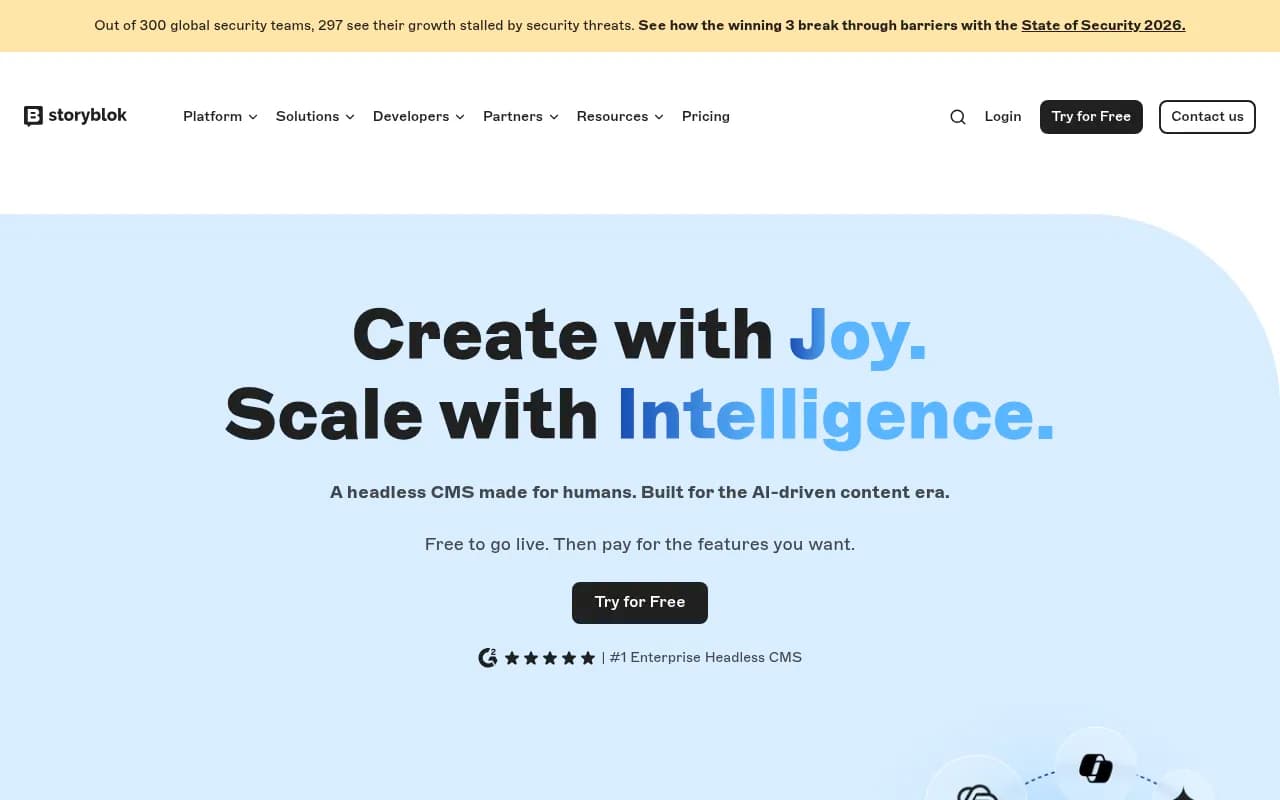
Storyblok is a component-based headless CMS that combines a visual editor for marketers with API-first flexibility for developers. Used by Disney, Netflix, and Oatly, it delivers 582% ROI with features like AI-powered workflows, Figma integration, and real-time collaboration. Free starter plan avail
Key Takeaways:
• Best for both teams: Storyblok bridges the gap between developers (API-first, component-based architecture) and marketers (visual drag-and-drop editor) better than most headless CMS platforms • Proven enterprise scale: Powers 486,000+ pages for Education First, 16 global sites for Oatly in 2 months, and delivers 582% ROI according to Forrester TEI study • AI-native features: FlowMotion automation engine, Figma-to-component conversion, and OtterlyAI integration for AI search visibility set it apart from traditional headless CMS options • Generous free tier: Starter plan is permanently free, with 45-day trial of Growth Plus plan for new projects • Minor limitations: Pricing can escalate quickly for larger teams, and some advanced features require higher-tier plans
Storyblok is a headless content management system built around a deceptively simple premise: content management shouldn't require choosing between developer flexibility and marketer usability. Founded in Austria and now trusted by Disney, Netflix, Adidas, and over 6,700 other brands, Storyblok has carved out a unique position in the crowded CMS market by refusing to compromise on either side of that equation. The platform combines a component-based architecture that developers love with a visual editor that marketers can actually use without training. In 2023, Gartner named it the only Customers' Choice CMS vendor, and a Forrester Total Economic Impact study calculated a 582% ROI over three years. Those aren't just marketing claims -- they reflect a platform that genuinely solves the coordination problems that plague most content teams.
What makes Storyblok different from competitors like Contentful, Sanity, or Strapi isn't any single feature. It's the deliberate design philosophy that every capability should serve both technical and non-technical users. Where Contentful forces marketers to work in form fields and Sanity requires developers to build custom editing interfaces, Storyblok ships with a visual editor that shows real-time previews while maintaining the structured content model developers need. This isn't a bolt-on feature -- it's the core architecture. Content is stored as JSON, delivered via REST or GraphQL APIs, but edited in a WYSIWYG interface that updates live as you drag components around. For agencies managing 20+ client sites or enterprise teams coordinating global launches, this dual nature eliminates the usual friction between "what marketing wants" and "what engineering can build."
Visual Editor with Real-Time Preview: The centerpiece of Storyblok's interface is a split-screen editor that shows your actual website on the right while you edit structured content on the left. Unlike WordPress page builders that lock you into specific themes, Storyblok's visual editor works with any frontend framework -- Next.js, Nuxt, Astro, React, Vue, even Symfony or Eleventy. You define components (hero sections, product cards, testimonial blocks) in your codebase, register them with Storyblok, and marketers can then drag those components onto pages, reorder them, edit text and images, and see changes instantly. The preview updates in real-time as you type, with no save-and-refresh cycle. For teams used to the "submit ticket to engineering, wait three days, discover it's not quite right" workflow, this is transformative. TomTom reported a 50% increase in content operations speed specifically because marketers could iterate on page layouts without developer involvement.
Component-Based Architecture: Storyblok treats everything as a component -- reusable, structured content blocks that can be nested, combined, and configured. You might have a "Product Feature" component with fields for title, description, icon, and CTA button. That component can be used standalone, nested inside a "Feature Grid" component, or referenced from multiple pages. Components can have validation rules (required fields, character limits, regex patterns), default values, and conditional logic (show field X only if field Y equals Z). This structure prevents the content chaos that plagues traditional CMSs where every page is a unique snowflake. Global components can be updated once and propagate changes across every page that uses them -- critical for maintaining brand consistency across 100+ sites. The component library becomes your design system, enforced at the content level.
FlowMotion Automation Engine: Announced at JoyConf 2026, FlowMotion is Storyblok's answer to the workflow coordination problem that every content team faces. Built on n8n's proven automation platform, FlowMotion turns content events (publish, update, delete, schedule) into triggers for multi-step workflows across your entire stack. When a product page is published, FlowMotion can automatically invalidate CDN cache, trigger a Netlify rebuild, send a Slack notification, update your PIM system, and log the change in your analytics platform -- all without custom code. You build workflows visually by connecting nodes (Storyblok events, API calls, conditional logic, data transformations) and FlowMotion handles the execution. This is fundamentally different from Contentful's webhooks (which require you to build the automation logic yourself) or Sanity's GROQ listeners (which are developer-only). FlowMotion makes automation accessible to technical content managers while giving developers the power to integrate with any API.
Figma Connect: The Figma Connect feature, also announced in 2026, addresses the perennial design-to-development handoff problem. Designers create component frames in Figma, annotate them with Storyblok metadata (field names, types, validation rules), and the Figma Connect plugin generates the corresponding Storyblok component schema automatically. Developers then implement the frontend component to match the Figma design, and marketers get a visual editor that looks exactly like what the designer intended. This closes the loop where designs get "interpreted" during development and end up looking different from the mockups. For design systems teams managing dozens of components across multiple brands, Figma Connect ensures the CMS structure matches the design source of truth.
AI-Powered Content Tools: Storyblok has integrated AI capabilities throughout the platform, not as a gimmick but as practical productivity features. The AI writing assistant can generate content variations, suggest headlines, expand bullet points into paragraphs, and translate content into multiple languages -- all within the editor interface. The AI image tagging automatically generates alt text and metadata for uploaded images, improving accessibility and SEO without manual effort. More strategically, Storyblok's partnership with OtterlyAI provides content observability for AI search engines -- tracking how your content appears in ChatGPT, Google AI Overviews, Perplexity, Copilot, and Gemini. This is forward-looking infrastructure for the AI search era, something traditional CMS vendors haven't addressed at all.
Multi-Environment Workflow: Storyblok's Environment Spaces feature provides separate content environments (dev, staging, production) with independent content datasets. You can test content changes in staging, preview them with real data, and promote to production only when ready. Each environment can have different access permissions, so junior editors work in staging while only senior team members can publish to production. This is table stakes for enterprise software but surprisingly rare in headless CMS platforms. Contentful charges extra for multiple environments, and many smaller CMSs don't support them at all.
Collaboration and Workflow: Real-time collaboration lets multiple team members edit the same content simultaneously, with live cursors showing who's working where (think Google Docs for CMS content). The workflow engine supports custom approval processes -- content can be submitted for review, approved by managers, scheduled for publication, and rolled back if needed. Comments and annotations can be attached to specific content fields, creating a discussion thread that stays with the content. For distributed teams coordinating global campaigns, these collaboration features prevent the version control chaos that happens when everyone emails Word documents around.
Performance and Delivery: Storyblok includes a global CDN (Content Delivery Network) that caches content at edge locations worldwide, ensuring fast load times regardless of where your users are. The Image Service automatically optimizes, resizes, and converts images to modern formats (WebP, AVIF) based on the requesting device. For developers, Storyblok provides both REST and GraphQL APIs, with the GraphQL API offering precise control over which fields and relationships to fetch (reducing payload size and improving performance). The Management API allows programmatic content creation and updates, enabling integrations with PIMs, DAMs, and other enterprise systems.
Integrations and Ecosystem: Storyblok integrates natively with major frontend frameworks (Next.js, Nuxt, Astro, Gatsby, SvelteKit) via official SDKs that handle preview mode, visual editing, and content fetching. The Netlify partnership provides one-click hosting and deployment, while the OtterlyAI integration tracks AI search visibility. Storyblok also connects to Algolia for search, Cloudinary for advanced image management, Shopify for e-commerce, and hundreds of other tools via Zapier or custom webhooks. The App Framework lets developers build custom plugins that extend the Storyblok interface -- adding custom field types, sidebar widgets, or integrations with proprietary systems.
Enterprise Features: For large organizations, Storyblok offers ISO 27001 certified security, SSO via SAML or OAuth, role-based access control with granular permissions, audit logs tracking every content change, and a 99.99% uptime SLA. The Enterprise Content Planner provides a calendar view of scheduled content across multiple sites, helping coordinate complex multi-brand launches. Spaces allow you to partition content by brand, region, or project while managing everything from a single account. These features position Storyblok as a genuine enterprise platform, not just a startup-friendly tool.
Who Is It For:
Storyblok's sweet spot is mid-sized to enterprise companies (50-5000 employees) that need to manage multiple websites or digital properties with both technical and non-technical teams. Marketing agencies managing 10-50 client sites love Storyblok because the visual editor reduces client training time and support requests -- clients can update their own content without breaking layouts. SaaS companies with 5-20 person marketing teams use it to maintain product marketing sites, documentation, and blog content without constant developer involvement. E-commerce brands with 100+ product pages and frequent promotional campaigns benefit from the component reusability and scheduling features. Enterprise organizations with global presence (think Oatly's 16 country sites or Education First's 486,000 pages) rely on Storyblok's multi-space architecture and enterprise workflow features.
Storyblok is particularly strong for teams transitioning from monolithic CMSs like WordPress or Drupal who want modern architecture without losing the visual editing experience. It's also ideal for companies practicing JAMstack or composable architecture -- using best-of-breed tools for each function (Storyblok for content, Shopify for commerce, Algolia for search, Netlify for hosting) rather than an all-in-one platform.
Who should NOT use Storyblok: Solo developers building simple blogs or documentation sites will find it overkill -- Markdown files in Git or a simpler CMS like Ghost makes more sense. Teams that need extremely complex content modeling with deep hierarchies and intricate relationships might prefer Sanity's more flexible schema system. Organizations with strict on-premise requirements can't use Storyblok's cloud-only architecture (though they offer private cloud for enterprise). And if your content team is entirely non-technical with no developer support, a traditional CMS like WordPress or Webflow might be easier to manage.
Pricing and Value:
Storyblok's pricing is usage-based with four main tiers. The Starter plan is free forever and includes 1 space, 25,000 content entries, 5 team members, and community support. This is genuinely usable for small projects, not a trial -- you can publish production sites on the free plan. The Growth plan starts at $90.75/month (billed annually, $99/month monthly) and adds 5 spaces, 100,000 entries, 10 team members, and email support. The Business plan (custom pricing, typically $500-1500/month) includes unlimited spaces and entries, 25+ team members, SSO, custom roles, and SLA guarantees. The Enterprise plan (custom pricing, typically $2000+/month) adds dedicated support, private cloud options, and enterprise features like the Content Planner.
Additional costs: Extra team members cost $15/month each beyond the plan limit. Additional spaces, content entries, and API requests can be purchased as add-ons. The 45-day free trial of the Growth Plus plan is a smart way to evaluate the platform with real projects before committing.
Compared to competitors, Storyblok's pricing is mid-range. Contentful's Team plan starts at $489/month (significantly more expensive), while Sanity's Team plan is $99/month (similar). Strapi is open-source and free to self-host but requires infrastructure management. For the feature set -- especially the visual editor, FlowMotion automation, and enterprise workflow tools -- Storyblok delivers strong value. The Forrester TEI study calculated 582% ROI over three years, driven primarily by reduced development time (40-50% faster content operations) and decreased reliance on engineering resources.
Strengths:
• Visual editor that actually works: Unlike competitors where visual editing is an afterthought, Storyblok's real-time preview and component-based editing is genuinely usable by non-technical marketers • Developer experience: Clean APIs, excellent documentation, official SDKs for all major frameworks, and a component architecture that maps naturally to modern frontend development • FlowMotion automation: The n8n-powered workflow engine is more powerful and accessible than webhook-based alternatives from Contentful or Sanity • Enterprise-ready: ISO 27001 certification, 99.99% uptime SLA, SSO, audit logs, and multi-space architecture make it viable for large organizations • Generous free tier: The permanently free Starter plan is rare among enterprise-grade headless CMSs
Limitations:
• Pricing complexity: Usage-based pricing with add-ons for extra seats, spaces, and API calls can make costs unpredictable as you scale • Learning curve for complex schemas: While basic components are easy, building deeply nested or conditional content models requires understanding Storyblok's schema system • Limited offline capabilities: As a cloud-only platform, you need internet connectivity to edit content (though the APIs work offline if you cache responses)
Bottom Line:
Storyblok is the headless CMS to choose when you need both developer flexibility and marketer autonomy. Marketing agencies managing multiple client sites, SaaS companies with 5-20 person marketing teams, and enterprises coordinating global content operations will find it solves the coordination problems that plague most content workflows. The visual editor eliminates the "submit ticket to engineering" bottleneck, while the component architecture prevents the content chaos that happens when marketers have too much freedom. FlowMotion automation and Figma Connect are forward-looking features that competitors haven't matched. If you're transitioning from WordPress or Drupal and want modern architecture without losing visual editing, or if you're building a JAMstack site and need a CMS that both developers and marketers will actually enjoy using, Storyblok is the best option in 2026. Best use case in one sentence: Multi-site agencies and enterprise marketing teams that need to ship content fast without constant developer involvement.
Tags:
Similar and alternative tools to Storyblok