Keyplay Review 2026
B2B marketing tool that uses AI to build and prioritize target account lists. Helps sales and marketing teams identify ideal prospects.
Summary: Key Takeaways
- What it does: Keyplay is an account scoring and intelligence platform that helps B2B sales and marketing teams identify and prioritize their best-fit accounts using AI agents, transparent fit signals, and customizable ICP models
- Best for: Series A to post-IPO B2B SaaS companies with 5+ AEs, complex/diverse markets, and sales-led motions using Salesforce or HubSpot
- Key advantage: Transparent "whitebox" scoring you can test and adjust in minutes vs. legacy ABM platforms with blackbox algorithms and annual model updates
- Pricing: Growth plan at $18K/year for up to 75K CRM records; Full-Service ICP plans from $29K/year with multi-model support and intent scoring
- Main limitation: Not ideal for small teams, simple single-segment markets, or companies without a direct sales motion
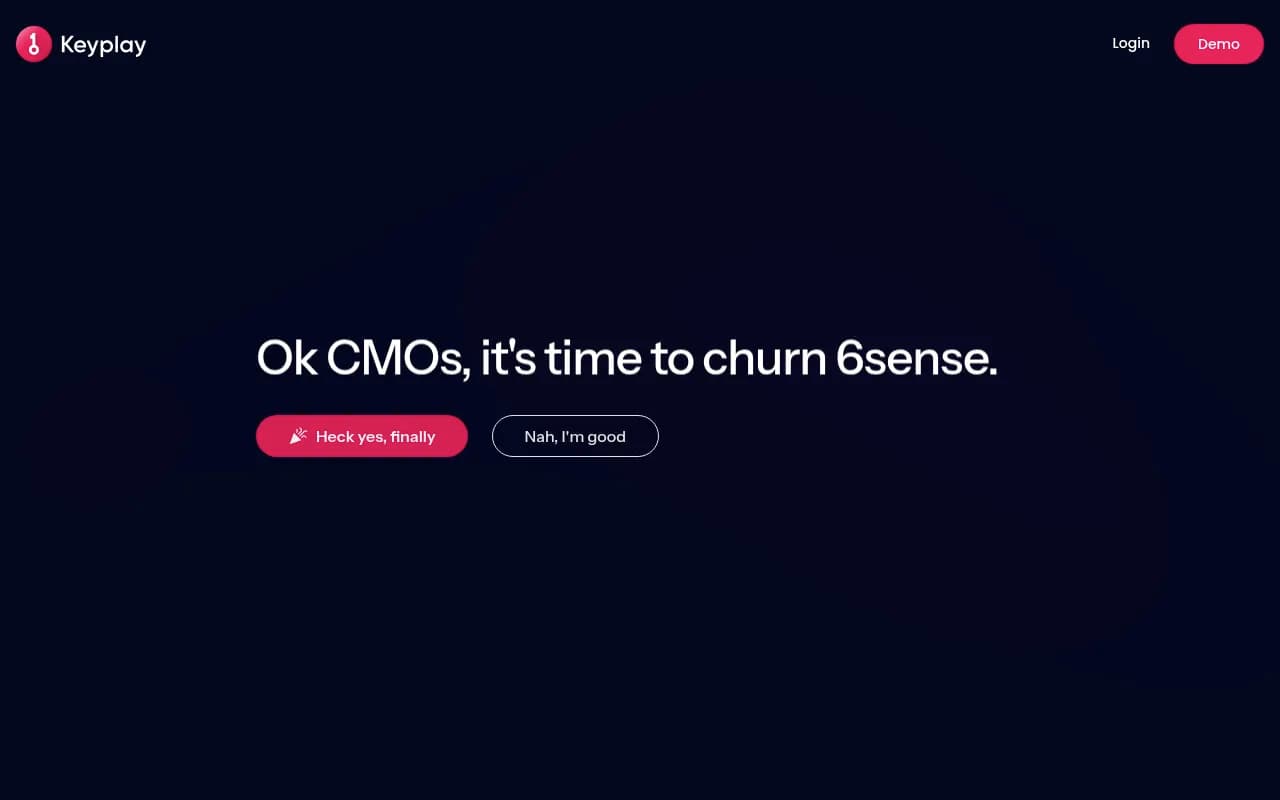
Keyplay positions itself as the modern alternative to legacy account-based marketing (ABM) platforms like 6sense and Demandbase. The company's homepage literally opens with "Ok CMOs, it's time to churn 6sense" -- a bold statement that reflects a real shift happening in B2B go-to-market strategies. Where traditional ABM platforms rely on blackbox algorithms, annual model updates, and generic firmographic filters, Keyplay offers transparent scoring, AI-driven market segmentation, and models you can test and adjust in real-time.
The platform is built for growing B2B companies (typically Series A through post-IPO) that sell into complex, diverse markets and need to prioritize accounts across multiple segments. It's used by companies like Ceros, PartnerStack, Hone, Mutiny, StrongDM, Chainguard, and Iterable -- brands that have moved away from traditional ABM platforms in favor of Keyplay's more flexible, transparent approach.
What Makes Keyplay Different: The ICP Marketing Methodology
Keyplay's core philosophy centers on "ICP Marketing" rather than traditional ABM. The difference is significant. Traditional ABM platforms use static firmographic filters (company size, industry, revenue) and blackbox intent signals to identify target accounts. Keyplay uses dynamic ICP models that incorporate nuanced business signals, AI-discovered insights, and transparent scoring you can actually understand and adjust.
The platform follows a three-step methodology: (1) Baseline your markets using AI agents to discover and segment your total addressable market, (2) Build and score ICP models using fit signals that represent your ideal customer's business situation and activities, and (3) Track intent with transparent, multi-source signals layered on top of fit scoring.
This approach means you're not just filtering companies by size and industry -- you're modeling the characteristics, behaviors, and signals that actually predict whether an account is a good fit for your product. And because the models are "whitebox" (transparent), you can see exactly why each account scored the way it did and adjust the model in minutes if something doesn't look right.
Core Features: What Keyplay Actually Does
AI Agents for Market Segmentation: Keyplay's AI agents automatically discover, research, and segment your total addressable market. Instead of manually building lists or relying on static filters, you can deploy AI agents to find companies that match specific criteria, research their business situations, and group them into meaningful segments. Each agent run consumes 1-5 credits depending on the enrichment depth. This is particularly powerful for companies entering new markets or launching new products where you don't yet have historical data to guide your ICP.
ICP Models with Transparent Fit Scoring: The heart of Keyplay is its ICP modeling capability. An ICP model in Keyplay isn't just a saved filter -- it's a dynamic scoring system that ranks every account in your CRM (and your broader TAM) based on how well they match your ideal customer profile. You define the signals that matter (company attributes, technologies used, hiring patterns, funding events, business activities), assign weights to each signal, and Keyplay scores every account accordingly. You can test different model configurations and see results instantly, not after waiting weeks for a vendor to retrain a blackbox algorithm. The platform includes standard fit signals out of the box, plus the ability to add custom signals via API or integrations.
Whitebox Intent Scoring: Unlike legacy ABM platforms where intent is a mysterious black box, Keyplay's intent scoring is completely transparent. You connect multiple intent sources -- LinkedIn Ads engagement, website visits via Snitcher or other tools, custom signals from Clay or Zapier, content downloads, event attendance, anything you can track -- through Keyplay's API. The platform aggregates all these signals and shows you exactly which activities contributed to each account's intent score. You control the scoring weights, so if you think a pricing page visit should count more than a blog read, you can adjust that in seconds. Critically, intent is layered on top of fit scoring, so you're only tracking intent for accounts that actually match your ICP -- not wasting time on bad-fit accounts that happened to stumble onto your website.
AI Lookalikes: Keyplay can analyze your best customers and use AI to find similar accounts in your TAM. This goes beyond simple firmographic matching -- the AI identifies patterns in business characteristics, technologies, growth signals, and other attributes that your best customers share, then surfaces accounts with similar profiles. It's a fast way to expand your target account list with high-confidence prospects.
CRM Integration and Operationalization: Keyplay has two-way sync with Salesforce and HubSpot via OAuth (no managed package required). It writes ICP scores, tier assignments, and intent signals directly to account records in your CRM, so your sales team can prioritize accounts without leaving Salesforce or HubSpot. You control which fields get updated and how often. The platform also enriches CRM records with fit and intent data, keeping your account intelligence up to date automatically. For the Growth plan, Keyplay handles up to 75K CRM records; Full-Service plans support higher volumes.
Account List Syncing to Clay: Keyplay integrates with Clay, the popular data enrichment and workflow platform. You can sync scored account lists from Keyplay into Clay for further enrichment, personalization research, or outbound campaign building. This is a common workflow for teams running sophisticated outbound motions.
LinkedIn Ads Integration: Keyplay has a native integration with LinkedIn Ads that serves two purposes. First, it tracks LinkedIn engagement as an intent signal (who's clicking your ads, viewing your company page, engaging with your content). Second, it lets you sync target account lists directly to LinkedIn for account-based advertising campaigns. This closed-loop integration means you can build an ICP model in Keyplay, push the account list to LinkedIn, run ads, track engagement, and feed that engagement back into Keyplay's intent scoring -- all without manual CSV uploads.
Multi-Model Support: Full-Service plans support multiple ICP models, which is critical for companies with distinct customer segments or product lines. You might have one model for mid-market SaaS companies, another for enterprise financial services, and a third for startups in specific verticals. Each model can have its own fit signals, scoring weights, and intent tracking. This lets you run targeted campaigns and territory planning for each segment without forcing everything into a single generic ICP.
Territory Planning and Account Tiering: Keyplay helps sales leaders assign accounts to territories and tier accounts (Tier 1, Tier 2, Tier 3) based on fit and intent scores. This is operationalized in your CRM, so each AE knows which accounts to prioritize. The platform also surfaces new high-fit accounts that enter your TAM over time, so territories stay fresh.
Market Segmentation and TAM Analysis: Beyond scoring individual accounts, Keyplay helps you understand your total addressable market. You can see how many accounts exist in each segment, what percentage of your TAM you're already working, and where white space opportunities exist. This is valuable for strategic planning, market entry decisions, and setting realistic pipeline targets.
Backtested Models: Keyplay lets you backtest ICP models against historical data to see how well they would have predicted your actual closed-won customers. This validation step builds confidence that your model is actually predictive, not just based on gut feel or assumptions. If a model doesn't backtest well, you can adjust the signals and weights until it does.
Who Should Use Keyplay
Keyplay is purpose-built for a specific type of B2B company. It's ideal for Series A to post-IPO B2B SaaS and AI companies with a sales-led motion, at least 5 AEs, and Salesforce or HubSpot as their CRM. The platform shines for companies that:
Sell into complex, diverse markets: If you sell across multiple verticals, company sizes, and use cases, Keyplay's multi-model support and AI segmentation help you manage that complexity. A company selling only to F500 enterprises in one vertical probably doesn't need Keyplay's flexibility.
Have relatively wide TAMs: Keyplay is built for companies with thousands or tens of thousands of potential accounts, not narrow niches with 200 total prospects. The AI agents and scoring models are most valuable when you need to prioritize within a large opportunity set.
Invest in account-based advertising: If you're running LinkedIn Ads or other account-based campaigns, Keyplay's integration and intent tracking make it much easier to target the right accounts, measure engagement, and optimize campaigns based on ICP fit.
Run a direct sales motion: Keyplay is designed for companies with AEs and SDRs working accounts, not pure product-led growth or self-serve models. The territory planning, account tiering, and CRM integration features are all built around enabling a sales team.
Need to prioritize across multiple segments: If you have one simple ICP, you might not need Keyplay's sophistication. But if you're selling different products to different segments, or moving upmarket while still serving mid-market, the multi-model support is critical.
Keyplay is used by marketing ops, revenue ops, sales ops, demand gen, and ABM teams. Typical users include CMOs, VPs of Marketing, VPs of Sales, RevOps Directors, and ABM Managers at companies with $5M+ in ARR.
Who Should NOT Use Keyplay
Keyplay is not a fit for:
- Small teams without dedicated sales: If you have fewer than 5 AEs or run a pure PLG motion, Keyplay is overkill. You don't need sophisticated account scoring if you're not doing outbound or ABM.
- Companies with simple, single-segment ICPs: If your ICP is "Series B SaaS companies with 50-200 employees in North America," you can probably just use a list provider and basic CRM filters. Keyplay's value comes from handling complexity.
- Early-stage startups still figuring out product-market fit: If you're pre-Series A and still experimenting with who your customer is, Keyplay's modeling and scoring won't help much. You need to talk to customers and iterate, not build elaborate ICP models.
- Companies not using Salesforce or HubSpot: Keyplay's CRM integrations are core to its value. If you use a different CRM or no CRM at all, the platform won't work for you.
Integrations and Ecosystem
Keyplay integrates with:
- Salesforce (two-way sync via OAuth, no managed package)
- HubSpot (two-way sync via OAuth)
- LinkedIn Ads (native integration for engagement tracking and list syncing)
- Clay (account list syncing for enrichment and outbound workflows)
- Snitcher (website visitor tracking for intent signals)
- Phantombuster (custom data enrichment)
- API access (Full-Service plans) for custom intent signals, fit signals, and integrations with tools like Zapier, Common Room, or internal data sources
The API is a key differentiator. Unlike closed platforms, Keyplay lets you bring in custom signals from anywhere -- your product usage data, support ticket patterns, community engagement, anything you can track. This makes the ICP models much more powerful and specific to your business.
Pricing and Plans
Keyplay has three main pricing tiers:
List Builder (Free): A free plan that lets you build target account lists using Keyplay's data and filters. No subscription required, just add credits for enrichments. This is a good starting point for teams exploring Keyplay or running one-off list building projects. It doesn't include CRM integration, scoring, or ongoing enrichment.
Growth Plan ($18,000/year): Includes ICP modeling with all standard fit signals, AI Lookalikes, CRM integrations (Salesforce or HubSpot), and ongoing scoring and enrichment for up to 75,000 CRM records. You can add credits for AI Agent enrichments (each agent run consumes 1-5 credits depending on depth). This plan is for teams that want to operationalize ICP scoring in their CRM but don't need multi-model support or advanced intent tracking.
Full-Service ICP Plans (from $29,000/year): Includes everything in Growth, plus API access for custom signals, multi-model support (multiple ICPs for different segments), intent scoring with multi-source aggregation, higher CRM record volumes, and additional services like model consulting and backtesting. Pricing scales based on customization needs, CRM account volume, and number of models. This is for teams running sophisticated ABM programs or managing multiple product lines and segments.
Keyplay also offers proof-of-concept (POC) engagements to help you validate the platform's impact before committing to an annual contract. This is common for larger deals where you want to test the ICP modeling approach with your actual data.
Compared to legacy ABM platforms like 6sense (which typically cost $50K-$150K+/year), Keyplay claims 67% cost savings while delivering more transparent, flexible, and actionable intelligence. The pricing is more accessible for Series A and Series B companies that can't justify six-figure ABM platform contracts.
Strengths
Transparent, adjustable models: The biggest advantage over legacy ABM platforms is that you can see exactly how scoring works and adjust models in minutes. No waiting for vendor support or annual model retraining. This transparency builds trust with sales and makes it much easier to iterate and improve your ICP over time.
AI agents for market discovery: The ability to deploy AI agents to research and segment your TAM is a genuine innovation. It saves weeks of manual research and helps you discover segments and opportunities you might have missed.
Multi-source intent aggregation: Keyplay's approach to intent -- aggregating signals from LinkedIn, website visits, custom sources, and showing exactly what contributed to each score -- is far more useful than blackbox intent from traditional platforms.
Built for complexity: If you have multiple segments, products, or go-to-market motions, Keyplay's multi-model support and flexible scoring handle that complexity better than one-size-fits-all ABM platforms.
Strong integrations: The two-way CRM sync, LinkedIn Ads integration, and Clay connection cover the core workflows for modern GTM teams. The API access (on Full-Service plans) lets you customize further.
Limitations
Not self-serve for most use cases: While there's a free List Builder plan, the real value of Keyplay (ICP modeling, scoring, CRM integration) requires at least the $18K/year Growth plan. This is not a tool you can try for $50/month and scale up gradually. You need to commit to an annual contract and likely work with their team to set up models.
Requires CRM maturity: Keyplay assumes you have clean account data in Salesforce or HubSpot and a sales process that actually uses the CRM. If your CRM is a mess or your team doesn't live in it, Keyplay won't deliver value.
Learning curve for advanced features: While the core concept is straightforward, building effective ICP models with the right signals and weights requires some expertise. Keyplay provides support and services, but you'll need someone on your team (RevOps, Marketing Ops) who can own the platform and iterate on models.
Limited data coverage for non-US markets: Like most B2B data platforms, Keyplay's data quality and signal coverage is strongest for US companies. If you sell primarily in EMEA, APAC, or other regions, you may find gaps in the data.
Bottom Line
Keyplay is the best option for B2B companies that have outgrown basic list building tools but find legacy ABM platforms too expensive, too rigid, and too opaque. If you're a Series A to post-IPO company with a sales-led motion, complex markets, and a team that wants to actually understand and control how accounts are scored, Keyplay delivers real value. The transparent modeling, AI-driven segmentation, and flexible intent tracking are genuinely better than what 6sense and Demandbase offer -- at a fraction of the cost.
Best use case in one sentence: B2B SaaS companies with 5+ AEs selling into diverse markets who need to prioritize accounts across multiple segments with transparent, adjustable ICP models and multi-source intent tracking.
Tags:
Similar and alternative tools to Keyplay