Ansehn Review 2026
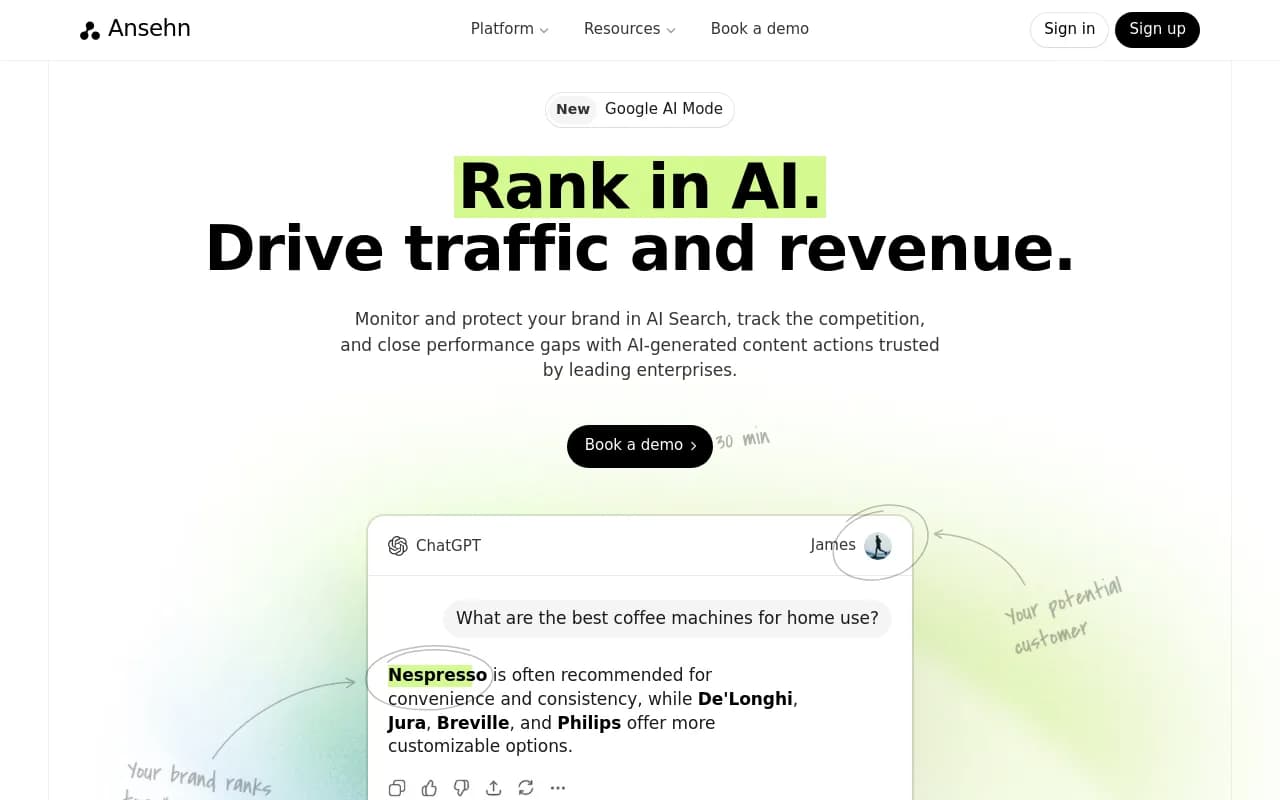
Ansehn monitors how your brand appears in AI-generated search results across ChatGPT, Perplexity, Google AI Mode, and Claude. Track rankings, benchmark competitors, and get content recommendations to improve visibility in AI answers. Built for marketing teams and agencies managing AI search optimization (GEO/AEO) for B2B and B2C brands.
Key Takeaways:
- Strong monitoring foundation with ranking metrics across ChatGPT, Perplexity, Google AI Mode, and Claude -- clear position tracking similar to traditional SEO
- Missing critical optimization features compared to Promptwatch: no AI crawler logs, no Reddit/YouTube citation tracking, no ChatGPT Shopping monitoring, no prompt volume/difficulty scoring, no query fan-outs, no built-in AI content generation, no traffic attribution
- Best for agencies and enterprises that need basic AI visibility dashboards and multi-client management, but not deep optimization workflows
- Content Actions feature provides recommendations but lacks the automated content generation and Answer Gap Analysis that Promptwatch offers
- Pricing not publicly disclosed -- requires demo booking, which may slow evaluation for smaller teams
Ansehn is an AI search visibility platform built to help brands monitor and improve how they appear in AI-generated answers from ChatGPT, Perplexity, Google AI Mode, and Claude. Founded and operated by a German company, Ansehn targets marketing teams, SEO professionals, and agencies managing brand visibility in what they call "AI Search" -- the growing channel where consumers and B2B buyers use LLMs instead of traditional Google search to discover products and services. The platform is used by enterprise clients including Bosch, Aurubis, Pixum, and Quirion, alongside smaller brands and agencies.
The core pitch is straightforward: as more than 50% of consumers now use AI-powered search, brands need to know where they rank in AI answers and how to improve those rankings. Ansehn positions itself as the tool that "brings back the clear, intuitive ranking you expect" -- essentially applying traditional SEO ranking logic to the world of LLM citations and mentions.
Ranking & Monitoring: Ansehn's primary feature is AI search ranking tracking. You add your brand and domains, define competitor brands, and the platform monitors how often and where your brand appears in AI-generated responses across ChatGPT, Perplexity, Google AI Overviews, Google AI Mode, and Claude. The dashboard displays an "Ansehn Score" (overall visibility metric) and "Position Score" (where you rank relative to competitors in AI answers). You can track ranking changes over time, see which competitors are mentioned more frequently, and get alerts when your position drops. This is conceptually similar to traditional SERP tracking but applied to LLM citations -- a useful mental model for SEO teams transitioning to AI search optimization.
The ranking view shows your brand's position in a leaderboard format (e.g. "Rank 1: De'Longhi, Rank 2: Philips, Rank 4: Nespresso") with score deltas indicating movement up or down. This makes it easy to benchmark against competitors and spot trends. However, the platform does not provide prompt-level volume estimates, difficulty scores, or query fan-outs -- features that Promptwatch offers to help prioritize which prompts are worth optimizing for. Without this data, you're tracking visibility but not necessarily focusing on high-value, winnable queries.
Content Actions & Optimization: Ansehn's "Improve" pillar promises to help you close performance gaps with "automated Content Actions." Based on the website and available information, this appears to be a recommendation engine that identifies where your brand should be mentioned but isn't, then suggests content updates or new pages to create. The exact mechanics aren't detailed publicly, but the positioning is that Ansehn "generates targeted content actions to close those gaps" -- implying some level of automated guidance.
What's notably absent here compared to Promptwatch: Ansehn does not appear to include a built-in AI writing agent that generates full articles, listicles, or comparison pages grounded in citation data. Promptwatch's AI content generator creates ready-to-publish content optimized for AI search, trained on 880M+ citations and designed to rank in LLM responses. Ansehn's Content Actions seem to stop at recommendations -- you still need to write the content yourself or use external tools. For teams that want an end-to-end workflow (find gaps → generate content → track results), this is a significant limitation.
Ansehn also lacks Answer Gap Analysis, a Promptwatch feature that shows exactly which prompts competitors are visible for but you're not, along with the specific content topics and angles your site is missing. Without this, you're left guessing which content to create based on general visibility scores rather than precise, prompt-level gaps.
AI Crawler Logs & Indexing: One of Promptwatch's standout features is real-time AI crawler logs -- showing when GPTBot, ClaudeBot, PerplexityBot, and other AI crawlers hit your site, which pages they read, errors they encounter, and how often they return. This is critical for understanding whether AI models can even discover your content in the first place. Ansehn's blog mentions server log analysis as a topic (they have educational content on how to find server logs), but there's no indication that the platform itself ingests and displays AI crawler activity in real-time. This is a major gap for technical SEO teams trying to diagnose indexing issues or optimize crawl efficiency for AI models.
Citation & Source Analysis: Ansehn tracks whether your brand is mentioned in AI answers, but the depth of citation analysis is unclear. Promptwatch provides detailed citation breakdowns -- showing exactly which pages, Reddit threads, YouTube videos, and domains AI models cite in their responses, along with citation frequency and trends. This helps you understand not just that you're visible, but why -- which content types and sources AI models trust. Ansehn's marketing materials don't highlight Reddit or YouTube tracking, and there's no mention of citation source analysis beyond brand mentions. If your competitors are getting cited via Reddit discussions or YouTube reviews, Ansehn won't surface that intelligence.
ChatGPT Shopping & E-commerce: Promptwatch tracks when brands appear in ChatGPT's product recommendations and shopping carousels -- a critical channel for e-commerce brands. Ansehn does not mention ChatGPT Shopping monitoring anywhere in its feature set. For brands selling physical products or services where ChatGPT might recommend alternatives, this is a blind spot.
Prompt Intelligence & Prioritization: Ansehn does not appear to offer prompt volume estimates, difficulty scoring, or query fan-outs. Promptwatch provides all three: you see how often a prompt is used, how hard it is to rank for, and how one prompt branches into related sub-queries. This helps you prioritize high-value, winnable prompts instead of optimizing blindly. Without this data, Ansehn users are left tracking visibility across an undefined set of prompts without knowing which ones actually drive traffic or conversions.
Traffic Attribution & ROI: Promptwatch offers three methods to connect AI visibility to actual website traffic and revenue: a code snippet for client-side tracking, Google Search Console integration, and server log analysis. This closes the loop between visibility and business outcomes. Ansehn does not mention traffic attribution or visitor analytics anywhere in its public materials. You can see your ranking improve, but you can't directly measure whether that translates to clicks, leads, or sales. For performance marketers and agencies that need to prove ROI, this is a critical missing piece.
Multi-language & Multi-region: Ansehn supports monitoring AI responses in multiple languages and regions, with customizable personas that match how your actual customers prompt. This is a strong feature for global brands. Promptwatch offers the same capability, so this is table stakes rather than a differentiator.
Agency & Multi-client Management: Ansehn is explicitly built for agencies, with Multi-Organization and Multi-Project capabilities, a Partner Portal, and dedicated Partner Success team. You can manage all client accounts from a single platform, with white-label reporting and sales/marketing resources to help close deals. This is a clear strength for agencies scaling AI search optimization across multiple clients. Promptwatch also supports agency use cases with custom pricing and multi-site plans, but Ansehn's agency-first positioning and Partner Portal give it an edge here.
Integrations & Ecosystem: Ansehn does not publicly list integrations with other tools (e.g. Google Search Console, Slack, Zapier, CMS platforms). Promptwatch integrates with Looker Studio and offers an API for custom workflows. The lack of integration details suggests Ansehn is more of a standalone dashboard rather than a platform that fits into existing marketing stacks.
Educational Resources: Ansehn provides a blog with GEO/AEO insights, documentation, a glossary, and mentions "Ansehn University" and in-house GEO experts for customer support. This is a strong value-add for teams new to AI search optimization. Promptwatch also offers educational content and expert support, so both platforms invest in customer enablement.
Who Is It For: Ansehn is best suited for agencies and enterprise marketing teams that need basic AI visibility dashboards and competitor benchmarking, especially those managing multiple clients or brands. If your primary goal is to track where you rank in AI answers and get high-level recommendations, Ansehn delivers a clean, intuitive interface with strong agency support. It's particularly appealing for teams transitioning from traditional SEO who want a familiar ranking-based mental model applied to AI search.
However, Ansehn is not ideal for teams that want to actively optimize and create content for AI search. Without AI crawler logs, Answer Gap Analysis, built-in content generation, Reddit/YouTube tracking, ChatGPT Shopping monitoring, prompt intelligence, or traffic attribution, you're limited to monitoring and basic recommendations. You'll need to supplement Ansehn with other tools (content writers, analytics platforms, crawler log analyzers) to execute a full AI search optimization strategy. For teams that want an end-to-end platform that finds gaps, generates content, and tracks results, Promptwatch is the more complete solution.
Ansehn also skews toward larger organizations with dedicated budgets -- pricing is not publicly disclosed, and the primary CTA is "Book a demo." This sales-led approach may slow evaluation for smaller teams or solo marketers who want to test the platform quickly. Promptwatch offers transparent pricing starting at $99/mo with a free trial, making it more accessible for smaller teams.
Pricing & Value: Ansehn does not publish pricing on its website. The only way to learn costs is to book a 30-minute demo with their sales team. This is common for enterprise-focused tools but creates friction for smaller teams or agencies evaluating multiple platforms. Based on the enterprise client roster (Bosch, Aurubis) and agency positioning, it's likely priced at a premium compared to monitoring-only competitors. Without public pricing, it's impossible to assess value relative to alternatives like Promptwatch ($99-579/mo with transparent tiers), Otterly.AI, or Peec.ai.
Strengths:
- Clean, intuitive ranking interface that applies familiar SEO logic to AI search -- easy for traditional SEO teams to adopt
- Strong agency support with Multi-Organization, Partner Portal, and dedicated Partner Success team
- Enterprise credibility with clients like Bosch and Aurubis, suggesting robust platform stability and support
- Multi-language and multi-region monitoring with customizable personas
- Educational resources including Ansehn University and in-house GEO experts
Limitations:
- No AI crawler logs -- can't see when or how AI models access your site, a critical gap for technical optimization
- No built-in content generation -- recommendations only, you still need to write content yourself
- No Answer Gap Analysis -- can't see exactly which prompts competitors rank for but you don't
- No Reddit or YouTube citation tracking -- misses a major source of AI model training data and citations
- No ChatGPT Shopping monitoring -- blind spot for e-commerce brands
- No prompt volume, difficulty, or query fan-outs -- can't prioritize high-value prompts
- No traffic attribution -- can't connect AI visibility to actual website traffic or revenue
- No public pricing -- requires demo booking, slows evaluation
- Limited integrations -- no mention of API, Looker Studio, GSC, or other tool connections
Bottom Line: Ansehn is a solid AI search monitoring platform for agencies and enterprises that need clean dashboards, competitor benchmarking, and multi-client management. If you're coming from traditional SEO and want a familiar ranking-based view of AI visibility, Ansehn delivers an intuitive experience with strong support. However, it's a monitoring tool, not an optimization platform. Without AI crawler logs, built-in content generation, Answer Gap Analysis, Reddit/YouTube tracking, ChatGPT Shopping, prompt intelligence, or traffic attribution, you're limited to tracking visibility and getting basic recommendations. For teams that want to actively improve AI search performance with an end-to-end workflow (find gaps → generate content → track results), Promptwatch offers a more complete solution at a transparent price point. Ansehn is best for agencies that need a polished dashboard to show clients, but not the deep optimization tools to actually move the needle.
Tags:
Similar and alternative tools to Ansehn