Amplitude Review 2026
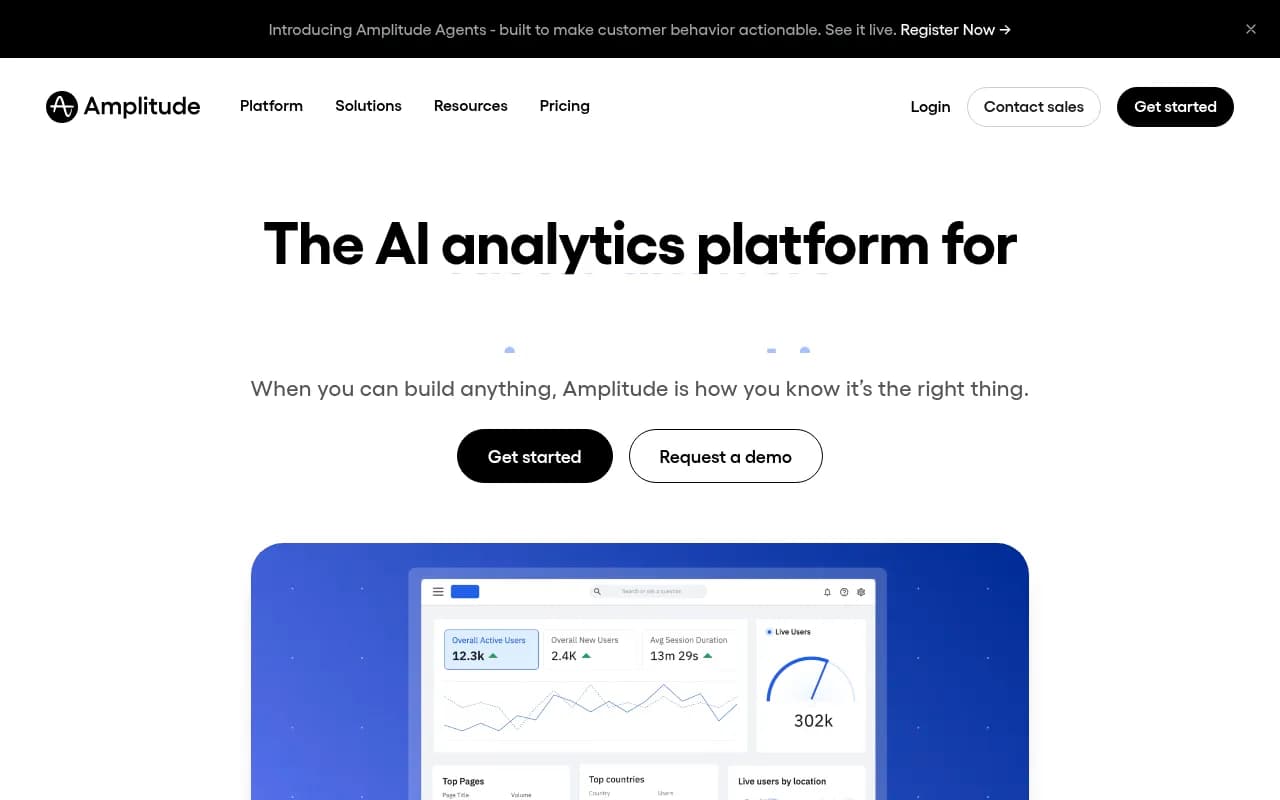
Digital analytics platform tracking user behavior and product engagement to optimize conversion rates and drive growth.
Key Takeaways:
- Comprehensive analytics suite combining product analytics, session replay, experimentation, and AI-powered insights in one platform — eliminates the need for multiple point solutions
- AI-first approach with autonomous agents that monitor metrics 24/7, MCP integration for Claude/Cursor, and AI feedback analysis that transforms qualitative data into action
- Proven ROI with 217% return over 3 years and 6-month payback period according to Forrester TEI study — customers report 27-40% conversion improvements
- Generous free tier supporting up to 10,000 monthly tracked users with no credit card required, making it accessible for startups and small teams
- Best for product teams at SaaS companies, mobile apps, and digital products who need to understand user behavior at scale and optimize based on data, not guesswork
Amplitude has evolved from a product analytics tool into a full-stack digital experience platform that helps teams understand what users actually do, test what works, and optimize continuously. Founded in 2012 and now serving over 11,000 digital products — including household names like Square, Walmart, NBC, Atlassian, and PayPal — Amplitude has become the go-to analytics platform for product-led growth companies.
What sets Amplitude apart in 2026 is its AI-first architecture. While competitors are bolting AI features onto legacy analytics platforms, Amplitude rebuilt its core around autonomous intelligence that works 24/7 to surface insights, detect anomalies, and recommend actions.
Product Analytics: Beyond Basic Event Tracking
Amplitude's core product analytics engine goes far deeper than simple pageview counting. The platform tracks granular user behavior across web, mobile, and server-side events, then connects those actions into complete user journeys. You can analyze conversion funnels with surgical precision — seeing exactly where users drop off and why. Cohort analysis lets you segment users by any combination of behaviors, properties, or demographics, then track how those cohorts perform over time.
The Pathfinder feature visualizes the actual paths users take through your product, revealing unexpected workflows and friction points you'd never spot in aggregate metrics. Retention analysis shows which features drive long-term engagement versus one-time usage. Impact analysis quantifies how specific features or changes affect your north star metrics.
Unlike Google Analytics 4 which focuses on marketing attribution, or Mixpanel which requires heavy SQL knowledge for complex queries, Amplitude is built for product teams who need to answer "why did users do that?" not just "what did they do?"
Session Replay: See What Users Actually Experience
Session replay captures pixel-perfect recordings of real user sessions, automatically linked to your analytics events. When you spot a drop-off in a funnel, you can instantly watch recordings of users who abandoned at that step. The replay engine automatically redacts sensitive data (credit cards, passwords, PII) and respects privacy regulations.
Rage clicks, error clicks, and dead clicks are automatically flagged. You can filter replays by any user property or behavior — like "show me sessions from enterprise trial users who viewed pricing but didn't convert." Replays integrate with analytics charts, so you can click any data point and watch the actual sessions behind it.
This is where Amplitude pulls ahead of pure analytics tools like Heap or Pendo. You're not just looking at numbers — you're watching the actual user experience that created those numbers.
AI Agents: Autonomous Intelligence That Never Sleeps
Amplitude's AI Agents represent a fundamental shift from reactive to proactive analytics. These autonomous agents continuously monitor your metrics, detect anomalies, identify root causes, and surface insights without anyone asking. If conversion suddenly drops 15% on mobile, the agent doesn't just alert you — it investigates which user segments are affected, what changed in their behavior, and surfaces hypotheses about why.
The agents learn your product's patterns and seasonal trends, so they don't cry wolf over expected fluctuations. They understand which metrics matter to which teams and route insights accordingly. Product managers get feature adoption alerts, growth teams get conversion anomalies, support teams get error spikes.
This is fundamentally different from traditional analytics where insights only emerge when someone thinks to ask the right question. Most teams miss critical signals because they're not monitoring the right metric at the right time. AI Agents solve that.
MCP Integration: Analytics in Your AI Workflow
Amplitude's Model Context Protocol (MCP) server lets you query your analytics data directly from Claude, Cursor, or any AI platform that supports MCP. You can ask natural language questions like "why did signup conversion drop last week?" and get answers grounded in your actual data, complete with charts and drill-downs.
This turns analytics from a separate tool you context-switch to into ambient intelligence that lives in your existing workflow. Developers can query metrics while coding, product managers can pull data while writing specs, executives can get answers in Slack without opening dashboards.
AI Feedback: Qualitative Data at Quantitative Scale
AI Feedback ingests unstructured feedback from support tickets, app reviews, NPS surveys, social media, and sales calls, then uses AI to categorize themes, extract sentiment, and link feedback to specific product areas. Instead of manually reading thousands of support tickets, you get a dashboard showing "23% of enterprise users mention slow load times in checkout" with links to the actual feedback and affected user cohorts.
You can then create targeted experiments or personalized experiences for users who mentioned specific pain points. This closes the loop between what users say and what you build.
Feature Experimentation: A/B Testing That Actually Ships
Amplitude Experiment combines feature flags with A/B testing in a single workflow. You can gradually roll out features to specific user segments, measure impact on your key metrics, and make data-driven decisions about whether to ship, iterate, or kill features.
The experimentation engine handles complex scenarios like multi-armed bandits, sequential testing, and CUPED variance reduction. Statistical significance calculations are automatic and trustworthy. You can run experiments on any metric in your analytics, not just predefined goals.
Integration with the analytics platform means you don't need separate tools for feature flags (LaunchDarkly), A/B testing (Optimizely), and analytics (Amplitude) — it's one unified workflow. When an experiment wins, you can immediately analyze which user segments benefited most and why.
Web Experimentation: No-Code Testing for Marketers
Web Experimentation brings visual A/B testing to marketing teams without requiring engineering resources. Point-and-click editor lets you test headlines, CTAs, layouts, and content variations. Tests deploy instantly via JavaScript snippet.
Unlike standalone tools like VWO or Optimizely Web, Web Experimentation shares the same user data and metrics as your product analytics. You can target experiments based on product usage behavior, not just marketing attributes. A visitor who abandoned checkout yesterday can see a different homepage than a new visitor.
Guides and Surveys: In-App Communication That Converts
Guides let you create in-app tooltips, walkthroughs, and announcements targeted to specific user segments. New users get onboarding flows, power users get feature announcements, at-risk users get retention campaigns. All without engineering work.
Surveys collect feedback at the moment of experience — NPS after key milestones, feature requests from power users, exit surveys from churning customers. Responses automatically flow into AI Feedback for analysis.
This is where Amplitude competes with dedicated tools like Pendo or Appcues, but with tighter integration to your behavioral data.
Data Governance: Enterprise-Grade Controls
Amplitude's data governance features ensure clean, trustworthy data at scale. The Data Management system provides a centralized taxonomy of events and properties with descriptions, owners, and validation rules. Blocking rules prevent bad data from entering the system. Branching lets you test schema changes before deploying to production.
Role-based access controls, GDPR/CCPA compliance tools, and SOC 2 Type II certification meet enterprise security requirements. Data residency options keep data in specific regions for regulatory compliance.
Integrations: Your Entire Stack Connected
Amplitude integrates with 100+ tools across your stack. Send behavioral cohorts to marketing platforms (Braze, Iterable, Customer.io), advertising networks (Google Ads, Facebook Ads), data warehouses (Snowflake, BigQuery, Redshift), and CDPs (Segment, mParticle, RudderStack).
Bi-directional integrations with Salesforce, HubSpot, and Zendesk enrich user profiles with CRM and support data. Reverse ETL syncs Amplitude cohorts back to your warehouse. Webhook and API access enable custom integrations.
The Amplitude SDK supports web (JavaScript), mobile (iOS, Android, React Native, Flutter), and server-side (Node, Python, Java, Go) tracking with automatic session tracking, offline queuing, and retry logic.
Who Is Amplitude For?
Amplitude is built for product-led growth companies where the product itself drives acquisition, conversion, and retention. This typically means SaaS companies with 50-500 employees, mobile apps with 100K+ MAUs, or digital products where user behavior directly impacts revenue.
Product managers use Amplitude to understand feature adoption, identify friction in user journeys, and prioritize roadmaps based on impact. Growth teams use it to optimize conversion funnels, run experiments, and personalize experiences. Data teams use it as the source of truth for product metrics without building custom dashboards.
Specific personas who thrive with Amplitude: B2B SaaS product teams tracking trial-to-paid conversion across multiple user roles, consumer mobile apps optimizing onboarding and retention, marketplace platforms balancing supply and demand dynamics, media companies personalizing content recommendations.
Amplitude is overkill for simple marketing websites, early-stage startups with <1000 users, or teams that just need basic traffic analytics. If you're not making product decisions based on user behavior data, you don't need Amplitude's depth.
Pricing and Value
Amplitude offers four pricing tiers:
Starter (Free): Up to 10,000 monthly tracked users, unlimited events, core analytics features, 12 months data retention. No credit card required. This is genuinely usable for early-stage startups and side projects — not a crippled trial.
Plus ($49/month): Starts at 300,000 MTUs with 20% discount on annual billing. Adds session replay (1,000 replays/month), behavioral cohorts, predictive analytics, and 5 years data retention. Good for growing startups and small product teams.
Growth (Custom pricing): Unlimited MTUs, advanced experimentation, AI agents, data governance, SSO, and dedicated support. Typical starting point is $2,000-5,000/month for mid-market companies.
Enterprise (Custom pricing): Everything in Growth plus data residency, custom contracts, premium support, and advanced security features. Starts around $50,000/year for large enterprises.
Compared to competitors: Mixpanel charges per event (gets expensive fast), Heap charges per session (unpredictable costs), Pendo bundles analytics with guides (forced upsell). Amplitude's MTU-based pricing is predictable and scales with your business.
The Forrester TEI study found 217% ROI over 3 years with 6-month payback, driven by faster product decisions, reduced tool sprawl, and improved conversion rates. Customers report 27-40% conversion improvements after implementing Amplitude insights.
Strengths
Unified platform eliminates tool sprawl: One platform for analytics, replay, experimentation, and engagement replaces 4-5 point solutions. Reduces costs and complexity.
AI-first architecture: Autonomous agents, MCP integration, and AI feedback analysis represent the future of analytics — proactive insights instead of reactive dashboards.
Proven at scale: 11,000+ products including Fortune 500 companies means the platform handles enterprise complexity and volume.
Best-in-class product analytics: Deeper behavioral analysis than Google Analytics, more accessible than Mixpanel, more product-focused than Adobe Analytics.
Generous free tier: 10,000 MTUs free forever makes it accessible for startups and side projects.
Limitations
Steep learning curve: The platform's depth means new users face a learning curve. Expect 2-4 weeks for teams to become proficient.
Implementation requires planning: Unlike plug-and-play tools, Amplitude requires thoughtful event taxonomy design and instrumentation. Budget time for proper setup.
Pricing jumps at scale: The gap between Plus ($49/month) and Growth (custom, typically $2,000+/month) is steep. Mid-sized companies may outgrow Plus quickly.
Mobile-first bias: While web analytics are strong, the platform's roots in mobile app analytics show. Some web-specific features (like marketing attribution) are less mature than dedicated web analytics tools.
Bottom Line
Amplitude is the best product analytics platform for teams serious about product-led growth. If your product's success depends on understanding and optimizing user behavior — not just tracking it — Amplitude gives you the depth, AI-powered insights, and experimentation tools to win. The platform's unified approach eliminates the complexity of stitching together separate analytics, replay, and testing tools.
Best use case in one sentence: B2B SaaS and mobile app product teams with 10,000+ users who need to understand why users behave the way they do, test what works, and optimize continuously based on data.
Tags:
Similar and alternative tools to Amplitude