Key Takeaways
- Completely different use cases: Authoritas tracks brand visibility in AI search engines (ChatGPT, Perplexity, Claude, etc.), while Amplitude tracks user behavior and product engagement on your website or app. They solve different problems.
- Pricing overlap but different value: Both start around £99/$49/mo, but Authoritas charges for AI search monitoring capabilities while Amplitude charges based on monthly tracked users (MTUs).
- Authoritas is for SEO/marketing teams worried about AI search visibility and brand mentions across LLMs. Amplitude is for product teams optimizing conversion funnels and user retention.
- No direct feature overlap: Authoritas doesn't do product analytics. Amplitude doesn't monitor AI search engines. You'd use them for entirely separate workflows.
- Integration potential: Some teams use both -- Amplitude to understand user behavior on-site, Authoritas to understand how AI engines surface their brand in search results.
- If you're choosing one: Pick Authoritas if your goal is AI search visibility and brand monitoring. Pick Amplitude if you need to optimize product features, funnels, and user engagement.
Overview
These two platforms operate in completely different domains, but both fall under the broad umbrella of "analytics." The comparison only makes sense if you're trying to understand which type of analytics your team actually needs.
Authoritas AI Tracker

Authoritas is an AI search visibility platform built for eCommerce brands, publishers, and agencies. It tracks how your brand appears across AI search engines -- ChatGPT, Perplexity, Claude, Gemini, DeepSeek, Google AI Overviews, Bing Copilot -- and combines that with traditional SEO monitoring. The core value: knowing when AI models mention your brand, what they say, and how you compare to competitors in AI-driven search results. Pricing starts at £99/mo (Essential) and scales to £799/mo (Expert), with custom enterprise options.
Authoritas is for teams asking: "Are we visible when people ask AI about our product category? What are AI engines saying about us vs competitors?"
Amplitude
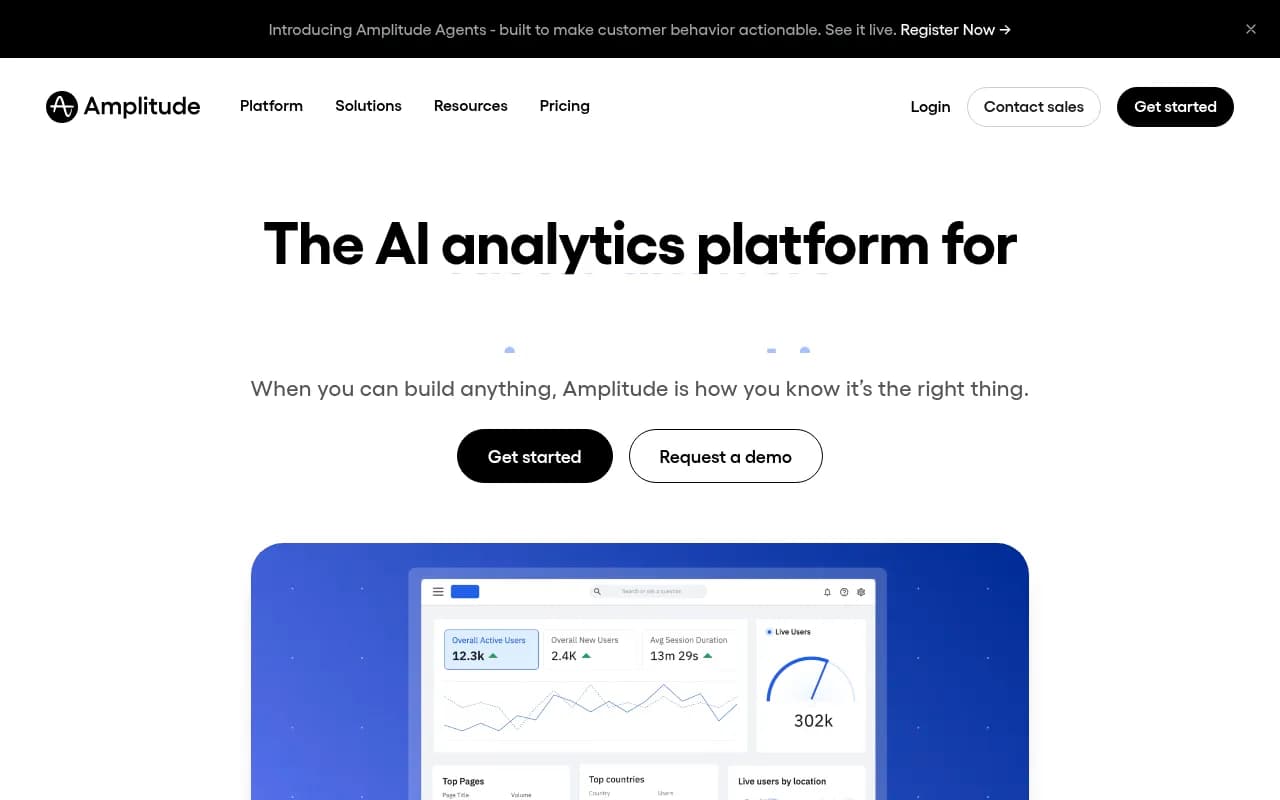
Amplitude is a product analytics platform that tracks user behavior inside your digital product -- website, mobile app, SaaS platform. It shows you how users move through your product, where they drop off, which features drive retention, and what experiments improve conversion. Used by Square, Walmart, NBC, and 11,000+ other digital products. Pricing starts free (up to 10K monthly tracked users), then Plus at $49/mo (300K MTUs), with Growth and Enterprise tiers reaching $2K-50K+/year depending on scale.
Amplitude is for teams asking: "Why are users churning? Which features should we build next? How do we optimize our signup funnel?"
Side-by-Side Comparison
| Feature | Authoritas AI Tracker | Amplitude |
|---|---|---|
| Primary use case | AI search visibility & brand monitoring | Product analytics & user behavior tracking |
| What it tracks | Brand mentions, citations, sentiment across AI engines | User actions, events, funnels, retention inside your product |
| AI engines monitored | ChatGPT, Perplexity, Claude, Gemini, DeepSeek, Google AIO, Bing Copilot | None (not an AI search tool) |
| Product analytics | No funnel/cohort/retention analysis | Core feature -- funnels, cohorts, retention, journeys |
| Free tier | No | Yes (up to 10K MTUs) |
| Starting price | £99/mo (Essential) | $49/mo (Plus, 300K MTUs) |
| Target audience | SEO teams, marketing, agencies, publishers | Product managers, growth teams, data analysts |
| Integrations | SEO tools, traditional search engines | CDPs, data warehouses, marketing automation |
| Experimentation | No A/B testing | Built-in A/B testing and feature flagging |
| AI/ML features | AI search tracking, sentiment analysis | AI-powered insights, anomaly detection, predictive analytics |
| Best for | Tracking brand visibility in AI search results | Optimizing product features and user journeys |
| Not suitable for | Understanding user behavior on your site | Monitoring AI search engine mentions |
Head-to-head feature deep-dive
Core functionality
Authoritas and Amplitude don't compete because they measure completely different things.
Authoritas monitors external visibility -- how AI search engines talk about your brand when users ask questions. You're tracking mentions, citations, share of voice, and sentiment across LLMs. The data comes from querying AI models with relevant prompts and analyzing their responses. This is outward-facing: what does the world (via AI) say about you?
Amplitude monitors internal behavior -- what users do inside your product. You're tracking events (button clicks, page views, feature usage), building funnels (signup → activation → retention), and running cohort analyses. The data comes from instrumentation in your app or website. This is inward-facing: how do people use what you built?
Verdict: No winner here. They solve different problems. If you need both types of insight, you'd run both tools in parallel.
AI search visibility
| Capability | Authoritas | Amplitude |
|---|---|---|
| Track brand mentions in ChatGPT | ✓ | ✗ |
| Monitor Perplexity citations | ✓ | ✗ |
| Google AI Overviews tracking | ✓ | ✗ |
| Claude/Gemini/DeepSeek monitoring | ✓ | ✗ |
| Sentiment analysis of AI responses | ✓ | ✗ |
| Competitor share of voice in AI | ✓ | ✗ |
Authoritas is built specifically for this. Amplitude has zero AI search monitoring capabilities -- it's not what the tool does.
Verdict: Authoritas wins by default. If AI search visibility matters to you, Amplitude can't help.
Product analytics and user behavior
| Capability | Authoritas | Amplitude |
|---|---|---|
| Event tracking | ✗ | ✓ |
| Funnel analysis | ✗ | ✓ |
| Cohort analysis | ✗ | ✓ |
| Retention tracking | ✗ | ✓ |
| User journey mapping | ✗ | ✓ |
| Session replay | ✗ | ✓ (via integrations) |
| A/B testing | ✗ | ✓ |
| Feature flagging | ✗ | ✓ |
Amplitude is a full-featured product analytics platform. Authoritas doesn't track user behavior on your site at all.
Verdict: Amplitude wins by default. If you need to understand how users interact with your product, Authoritas can't help.
Traditional SEO capabilities
Authoritas includes traditional SEO monitoring alongside its AI search features -- keyword rankings, backlinks, site audits, competitor tracking. This makes it a hybrid platform: AI search visibility + classic SEO.
Amplitude has no SEO features. It doesn't track rankings, backlinks, or search visibility. It's purely about what happens after someone lands on your site.
Verdict: Authoritas if you need SEO. Amplitude if you don't.
Data integration and activation
Amplitude integrates deeply with the modern data stack -- CDPs (Segment, mParticle), data warehouses (Snowflake, BigQuery), marketing automation (Braze, Iterable), and experimentation platforms. You can send Amplitude cohorts to ad platforms, trigger campaigns based on user behavior, and build custom dashboards in BI tools.
Authoritas integrates with SEO tools and traditional search platforms. It's less about activating data and more about monitoring and reporting.
Verdict: Amplitude has a much richer integration ecosystem for product-led workflows. Authoritas integrates where it needs to (SEO tools), but it's not built for the same level of data activation.
AI and automation
Authoritas uses AI to analyze sentiment in AI search responses and surface insights about brand positioning across LLMs. The AI features are focused on understanding what AI engines say about you.
Amplitude uses AI for anomaly detection (spotting unusual drops or spikes in metrics), predictive analytics (forecasting churn or conversion likelihood), and automated insights (surfacing patterns in user behavior). The AI features are focused on understanding what users do.
Both use AI, but for completely different purposes.
Verdict: Tie. The AI capabilities serve their respective use cases well.
Reporting and dashboards
Authoritas provides dashboards showing brand visibility trends, share of voice vs competitors, sentiment over time, and AI engine breakdowns. Reports are geared toward marketing and SEO stakeholders.
Amplitude provides dashboards showing user funnels, retention curves, feature adoption, and experiment results. Reports are geared toward product and growth teams.
Both have solid reporting. The difference is what you're reporting on.
Verdict: Tie. Both deliver the reporting their respective audiences need.
Pricing
| Plan | Authoritas | Amplitude |
|---|---|---|
| Free tier | None | Up to 10K MTUs |
| Entry tier | £99/mo (Essential) | $49/mo (Plus, 300K MTUs) |
| Mid tier | £299/mo (Advanced) | Custom (Growth) |
| High tier | £799/mo (Expert) | Custom (Enterprise, $2K-50K+/year) |
| Enterprise | Custom | Custom |
Authoritas pricing is based on feature access and scale (number of sites, keywords, AI queries). Amplitude pricing is based on monthly tracked users (MTUs) -- the number of unique users you're analyzing each month.
For a small team, Amplitude's free tier is a huge advantage. You can start tracking up to 10K users without paying anything. Authoritas requires payment from day one.
For larger teams, the pricing models diverge completely. Authoritas scales with SEO/AI monitoring needs. Amplitude scales with user volume. A high-traffic product could hit $50K+/year on Amplitude. A multi-brand agency could hit similar costs on Authoritas.
Verdict: Amplitude wins on entry cost (free tier). At scale, it depends entirely on your use case and volume.
Pros and cons
Authoritas AI Tracker
Pros:
- Tracks brand visibility across all major AI search engines (ChatGPT, Perplexity, Claude, Gemini, DeepSeek, Google AIO, Bing Copilot)
- Combines AI search monitoring with traditional SEO in one platform
- Sentiment analysis shows how AI engines position your brand
- Competitor share of voice tracking reveals positioning gaps
- Built for eCommerce, publishers, and agencies managing competitive niches
Cons:
- No free tier -- starts at £99/mo
- Doesn't track user behavior or product analytics
- Limited integration ecosystem compared to product analytics platforms
- No A/B testing or experimentation features
- Reporting is marketing/SEO-focused, not product-focused
Amplitude
Pros:
- Free tier up to 10K MTUs makes it accessible for startups
- Best-in-class product analytics -- funnels, cohorts, retention, journeys
- Built-in A/B testing and feature flagging
- Deep integrations with CDPs, data warehouses, and marketing automation
- AI-powered insights and anomaly detection
- Trusted by 11,000+ digital products including Square, Walmart, NBC
Cons:
- Zero AI search visibility monitoring
- No SEO features (rankings, backlinks, site audits)
- Pricing scales quickly with user volume -- high-traffic products pay a lot
- Requires technical setup (event instrumentation)
- Not suitable for agencies managing multiple client brands
Who should pick which tool
Pick Authoritas if:
- You're an SEO or marketing team tracking brand visibility in AI search results
- You need to know what ChatGPT, Perplexity, Claude, and other AI engines say about your brand
- You're managing eCommerce brands, publishers, or competitive niches where AI search matters
- You want traditional SEO monitoring (rankings, backlinks) alongside AI search tracking
- You're an agency managing multiple client brands and need to report on AI visibility
- You're worried about competitors dominating AI-driven search results in your category
Pick Amplitude if:
- You're a product team optimizing user funnels, retention, and feature adoption
- You need to understand why users churn or which features drive engagement
- You're running A/B tests and experiments to improve conversion rates
- You have a digital product (website, app, SaaS) and need to track user behavior
- You want to integrate analytics with your CDP, data warehouse, or marketing automation
- You're a startup or small team that can start with the free tier
Use both if:
- You're a product-led company that also cares about AI search visibility
- You want Amplitude to optimize on-site behavior and Authoritas to track how AI engines surface your brand
- You have separate product and marketing teams with different analytics needs
If you're also tracking how your brand shows up in AI search results and want to go beyond monitoring into optimization, Promptwatch offers content gap analysis and AI-powered content generation to help you rank in AI engines -- not just track where you stand.

Final verdict
This isn't a real competition. Authoritas and Amplitude solve completely different problems.
Choose Authoritas if your job is to track and improve brand visibility in AI search engines. You're monitoring what ChatGPT, Perplexity, and Claude say about your brand, analyzing competitor positioning, and reporting on AI search performance. The traditional SEO features are a bonus.
Choose Amplitude if your job is to optimize a digital product. You're analyzing user funnels, running experiments, tracking retention, and making data-driven product decisions. AI search visibility isn't on your radar.
The only scenario where you'd genuinely compare these two is if you have a limited budget and need to pick one type of analytics over the other. In that case: marketing/SEO teams pick Authoritas, product teams pick Amplitude.
For most organizations, the real question isn't "Authoritas vs Amplitude" -- it's "Do we need AI search monitoring, product analytics, or both?" Answer that, and the tool choice is obvious.