Langfuse Review 2026
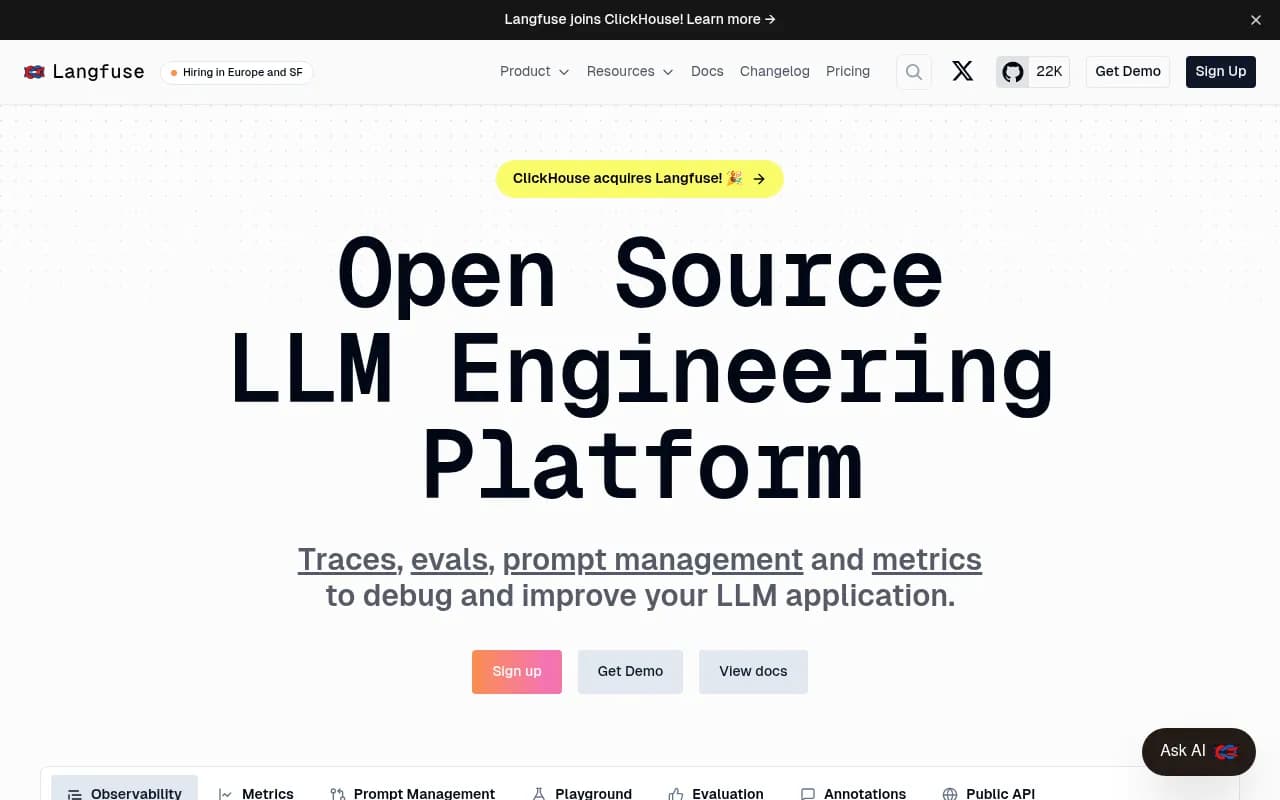
Langfuse is an open-source LLM engineering platform that provides end-to-end observability, prompt management, evaluation, and metrics for AI applications. Built for developers working with OpenAI, LangChain, LlamaIndex, and other LLM frameworks, it offers OpenTelemetry-based tracing, version-contro
Key Takeaways:
• Full-stack LLM observability: Complete OpenTelemetry-based tracing for all LLM calls, agent workflows, and nested function executions with automatic cost and latency tracking • Production-grade prompt management: Version-controlled prompts with A/B testing, rollback capabilities, and environment-specific deployments • Open source with enterprise hosting: Self-host for free or use managed cloud with generous free tier (50k traces/month) • Best for: Engineering teams building production LLM applications who need debugging tools beyond basic logging • Limitations: Steeper learning curve than simple monitoring dashboards; requires code instrumentation for full value
Langfuse is an open-source LLM engineering platform built by a team focused on solving the observability and debugging challenges that emerge when AI applications move from prototype to production. Acquired by ClickHouse in early 2026, Langfuse has become the go-to observability solution for engineering teams working with OpenAI, Anthropic, LangChain, LlamaIndex, LiteLLM, and other LLM frameworks. The platform addresses a critical gap: traditional application monitoring tools weren't designed for the unique challenges of LLM applications -- multi-step agent workflows, prompt versioning, non-deterministic outputs, and token-based cost tracking.
The target audience is software engineers and ML engineers building production LLM applications -- not marketers running ChatGPT experiments. If you're shipping AI features to real users, dealing with complex agent workflows, or managing prompts across multiple environments, Langfuse gives you the visibility and control that basic logging can't provide. It's particularly popular with startups and scale-ups building AI-native products, as well as enterprise teams integrating LLMs into existing systems.
Observability & Tracing
Langfuse's core strength is OpenTelemetry-based distributed tracing for LLM applications. The Python and TypeScript SDKs use decorators (@observe in Python, observeOpenAI in JS) to automatically capture every LLM call, function execution, and nested operation in your application. Each trace shows the complete execution flow -- which functions were called, what prompts were sent, what responses came back, how long each step took, and how much it cost. This is fundamentally different from logging individual API calls; you see the entire context of how a user request flowed through your system.
The trace detail view shows nested observations with parent-child relationships, making it easy to debug complex agent workflows where one LLM call triggers multiple sub-calls. You can see the exact input/output for each step, token counts, model parameters, and any custom metadata you've attached. For debugging production issues, you can filter traces by user ID, session, error status, or custom tags to find exactly what went wrong.
Integrations are extensive: native support for OpenAI, Anthropic, Cohere, and other LLM providers via drop-in wrappers; framework integrations for LangChain, LlamaIndex, LiteLLM, Haystack, and Vercel AI SDK; and a low-level SDK for custom instrumentation. The OpenTelemetry foundation means you can also send traces from any OpenTelemetry-compatible library.
Prompt Management
Prompt management in Langfuse treats prompts as versioned, deployable artifacts rather than hardcoded strings scattered across your codebase. You define prompts in the Langfuse UI or via API, assign them version numbers, and fetch them at runtime using the SDK. This decouples prompt iteration from code deployments -- your team can test new prompt variations without pushing code changes.
Each prompt version is immutable and can be promoted across environments (development, staging, production). You can A/B test different prompt versions by randomly selecting between them at runtime, then use Langfuse's metrics to compare performance. Rollback is instant if a new prompt version causes issues. The prompt editor supports Mustache templating for dynamic variable insertion, and you can preview how prompts render with sample data before deploying.
The playground feature lets you test prompts against different models (GPT-4, Claude, Gemini, etc.) side-by-side, comparing outputs, latency, and cost. This is invaluable for prompt engineering -- you can iterate on prompt wording, system messages, and few-shot examples while seeing real-time results from multiple models. Once you've found a winning prompt, you can save it as a new version and deploy it immediately.
Evaluation & Metrics
Langfuse provides both automated and human-in-the-loop evaluation workflows. You can define custom evaluation functions (Python or TypeScript) that run against your traces -- for example, checking if an LLM response contains specific keywords, validating JSON structure, or scoring response quality using another LLM as a judge. These evals can run in batch against historical traces or in real-time as new traces arrive.
The annotation interface lets team members manually review and score LLM outputs, which is critical for building high-quality eval datasets. You can assign traces to reviewers, define custom scoring rubrics, and export annotated data for fine-tuning or further analysis. This human feedback loop is what separates production-grade LLM systems from prototypes.
Metrics dashboards aggregate data across all traces: average latency, cost per user, error rates, token usage by model, and custom metrics you define. You can slice metrics by user, session, prompt version, or any custom dimension. The cost tracking is particularly detailed -- Langfuse knows the pricing for every major LLM provider and automatically calculates costs based on token usage. For teams managing LLM budgets, this visibility is essential.
Datasets & Testing
You can create datasets from production traces by selecting interesting examples (edge cases, failures, high-quality responses) and adding them to a named dataset. These datasets become the foundation for regression testing -- run your latest prompt version against the dataset and compare outputs to previous versions. This prevents regressions when you're iterating on prompts or switching models.
Datasets can also be used for fine-tuning preparation. Export traces in the format required by OpenAI, Anthropic, or other providers, then use them to fine-tune models on your specific use case. The ability to go from production traces to fine-tuning data in a few clicks significantly shortens the iteration cycle.
Public API & Integrations
Langfuse exposes a comprehensive REST API for programmatic access to all platform features. You can query traces, create datasets, manage prompts, run evaluations, and export data via API. This is useful for building custom dashboards, integrating with internal tools, or automating workflows. The API is well-documented with OpenAPI specs and client libraries for Python and TypeScript.
Integrations extend beyond LLM frameworks to include analytics and workflow tools. You can export data to data warehouses (BigQuery, Snowflake) for custom analysis, send alerts to Slack or PagerDuty when error rates spike, or trigger workflows in Zapier based on trace events. The platform is designed to fit into existing engineering workflows rather than requiring a complete tooling overhaul.
Self-Hosting & Deployment
As an open-source project (MIT license), Langfuse can be self-hosted on your infrastructure. The GitHub repository includes Docker Compose files and Kubernetes manifests for easy deployment. Self-hosting gives you complete control over data residency and privacy -- all trace data stays within your environment. The self-hosted version includes all core features; there's no artificial feature gating between open-source and cloud.
For teams that prefer managed hosting, Langfuse Cloud offers a generous free tier (50k observation units per month, roughly 50k LLM calls) and straightforward paid plans. The Hobby plan is free forever with 50k units/month and 30 days of data retention. The Pro plan ($59/month) includes 100k units, 90 days retention, and priority support. Enterprise plans offer custom volumes, SSO, SLAs, and dedicated support. Pricing is transparent and scales with usage rather than seats, which works well for small teams with high LLM volume.
Who Is It For
Langfuse is built for engineering teams shipping LLM-powered features to production. Specific personas include:
AI/ML Engineers at startups building AI-native products (chatbots, coding assistants, content generation tools) who need to debug complex agent workflows and optimize prompt performance. If you're using LangChain or LlamaIndex to build multi-step agents, Langfuse's tracing shows you exactly where things break.
Backend engineers at scale-ups integrating LLMs into existing products who need observability that fits into their existing monitoring stack. The OpenTelemetry foundation and API-first design make it easy to integrate with Datadog, Grafana, or custom dashboards.
DevOps/Platform teams managing LLM infrastructure across multiple teams who need centralized visibility into costs, usage patterns, and performance. The multi-project support and RBAC features let you give each team their own workspace while maintaining org-wide visibility.
Who should NOT use Langfuse: Non-technical teams looking for a no-code AI monitoring dashboard will find the setup too complex. If you're just running occasional ChatGPT queries or using pre-built AI tools, you don't need this level of instrumentation. Similarly, if you're still in the early prototype phase and not yet worried about production reliability, simpler logging might suffice.
Strengths
Open-source with no vendor lock-in: The MIT license and self-hosting option mean you're never locked into Langfuse's cloud. If you outgrow the platform or have specific requirements, you can fork the code or migrate to another OpenTelemetry-compatible tool.
Deep LLM framework integrations: The native integrations with LangChain, LlamaIndex, LiteLLM, and major LLM providers are more comprehensive than competitors. You get automatic tracing without rewriting your application code.
Production-grade prompt management: Treating prompts as versioned, deployable artifacts with A/B testing and rollback is a mature approach that most competitors lack. This alone justifies adoption for teams managing prompts across multiple environments.
Transparent pricing: The free tier is genuinely usable (50k traces/month is enough for many early-stage products), and paid pricing scales with usage rather than seats. No surprise bills or artificial limits.
Active development and community: The GitHub repository is actively maintained with frequent releases, and the Discord community is responsive. Being acquired by ClickHouse suggests long-term investment in the platform.
Limitations
Learning curve for non-engineers: Setting up tracing requires code changes (adding decorators, configuring SDKs) and understanding of distributed tracing concepts. Teams without engineering resources will struggle.
Limited out-of-the-box dashboards: While the metrics are comprehensive, you'll likely need to build custom dashboards or export data to your BI tool for executive reporting. Competitors like Helicone offer more pre-built business intelligence views.
Evaluation features require custom code: Unlike platforms with built-in LLM-as-judge evaluations, Langfuse requires you to write evaluation functions. This is more flexible but also more work upfront.
Bottom Line
Langfuse is the best choice for engineering teams building production LLM applications who need observability, prompt management, and evaluation in one platform. The open-source foundation, deep framework integrations, and production-grade prompt versioning make it a strong alternative to closed-source competitors like Helicone, LangSmith, or Weights & Biases. If you're shipping AI features to real users and need to debug complex workflows, optimize costs, and iterate on prompts without code deployments, Langfuse delivers the visibility and control you need. Best use case in one sentence: Engineering teams building multi-step LLM agents or AI-native products who need OpenTelemetry-based observability and version-controlled prompt management to debug and optimize production systems.
Tags:
Frequently asked questions
What is Langfuse and what does it do?
Is Langfuse free to use?
Who is Langfuse best for?
What are the key features of Langfuse?
Can I self-host Langfuse?
What are the limitations of Langfuse?
How much does Langfuse Pro cost?
Similar and alternative tools to Langfuse