Key takeaways
- Most AI visibility tools are monitoring-only dashboards -- they show you data but give you no path to improve your rankings in ChatGPT, Perplexity, or Google AI Overviews.
- According to Averi AI's 2026 tool review, nine out of ten teams that buy a tracking tool spend $79-$489/month watching their visibility score stagnate, then cancel after six months.
- The biggest red flag isn't a missing feature -- it's a tool that has no answer to the question "what do I do next?"
- Watch for black-box scoring, fixed prompt sets, no traffic attribution, and no content gap analysis -- these are the signs you're buying a vanity dashboard.
- A small number of platforms go beyond tracking to help you find gaps, create content, and close the loop with revenue attribution.
The AI visibility tool market has exploded. There are now dozens of platforms promising to show you how your brand appears in ChatGPT, Perplexity, Gemini, and Google AI Overviews. Some of them are genuinely useful. Many are not.
The problem isn't that these tools lie to you. It's that they tell you a partial truth -- "here's your visibility score" -- and then leave you completely alone with it. You get a number. Maybe a chart. Possibly a competitor heatmap. And then... nothing. No guidance on what's causing the gap. No content to fix it. No way to know if anything you do actually moves the needle.
Averi AI's 2026 honest tool review put it bluntly: nine out of ten teams that buy a tracking tool spend $79 to $489 a month watching their visibility score stagnate, then cancel after six months.
That's a lot of money to learn you have a problem you already suspected.
So before you hand over your credit card, here are the nine warning signs that the tool you're evaluating is going to leave you stuck.
Red flag 1: The tool can't answer "what do I do next?"
This is the most important test you can run. After the demo, after the free trial, after you've seen your visibility score -- ask the tool: "What should I do to improve this?"
If the answer is a shrug, a list of vague best practices, or a link to a blog post, you have your answer. You're looking at a monitoring dashboard, not an optimization platform.
The best tools in this space have a clear answer: here are the specific prompts where competitors are visible and you're not, here's the content gap causing it, and here's how to fix it. That's the difference between a rearview mirror and a steering wheel.
Promptwatch is one of the few platforms built around this loop -- find gaps, create content, track results. Most competitors stop at step one.

Red flag 2: It only monitors a handful of AI models
Some tools track ChatGPT and Perplexity and call it a day. That might have been acceptable in 2024. In 2026, your customers are using ChatGPT, Gemini, Claude, Perplexity, Google AI Overviews, Google AI Mode, Grok, DeepSeek, Copilot, Meta AI, and Mistral -- often interchangeably.
If a tool only covers two or three of these, you're getting a partial picture. Worse, the models you're not tracking might be the ones your actual customers use most.
Ask specifically: which models do you monitor? How often? Do you cover Google AI Overviews and Google AI Mode separately? If the answer is vague or the list is short, that's a problem.
Red flag 3: Fixed, generic prompt sets
A lot of tools come pre-loaded with a set of prompts they'll track for you. "Best CRM software." "Top project management tools." Generic category queries.
The issue: those prompts might have nothing to do with how your actual customers search. Real buyers ask specific, nuanced questions. "What's the best CRM for a 10-person B2B sales team that uses HubSpot?" is a very different prompt from "best CRM software" -- and it's probably closer to what your prospects are actually typing.
Tools with fixed prompt sets are optimizing for their own convenience, not yours. You want a platform where you can define your own prompts, test variations, and get volume estimates and difficulty scores so you can prioritize the ones worth winning.
Otterly.AI

Profound

Red flag 4: No content gap analysis
Knowing you're invisible in AI search is useful for about five minutes. After that, you need to know why you're invisible and what content would fix it.
Content gap analysis -- specifically, showing you which prompts competitors rank for that you don't, and what topics your site is missing -- is what separates a monitoring tool from an optimization tool. Without it, you're left guessing. You might publish ten articles and move the needle on none of them, simply because you didn't know which gaps actually mattered.
This is one of the most common missing features in the market. Many tools will show you a competitor comparison chart. Very few will tell you exactly what content to create to close the gap.
Red flag 5: No AI content generation (or it's bolted on as an afterthought)
Even if a tool identifies your content gaps, there's still the question of what to do about them. Writing content that gets cited by AI models isn't the same as writing content that ranks in Google. It requires understanding citation patterns, prompt volumes, the specific angles AI models prefer, and how competitors are framing their answers.
Some tools have started adding "AI writing" features, but they're often generic blog post generators with no connection to citation data. That's not content engineering -- that's a text spinner with a GEO label.
What you want is content generation that's grounded in real citation data, built around specific prompts, and designed to answer the questions AI models are actually asking. The difference in output quality is significant.
Red flag 6: No traffic attribution
This one is quietly the most damaging red flag on the list.
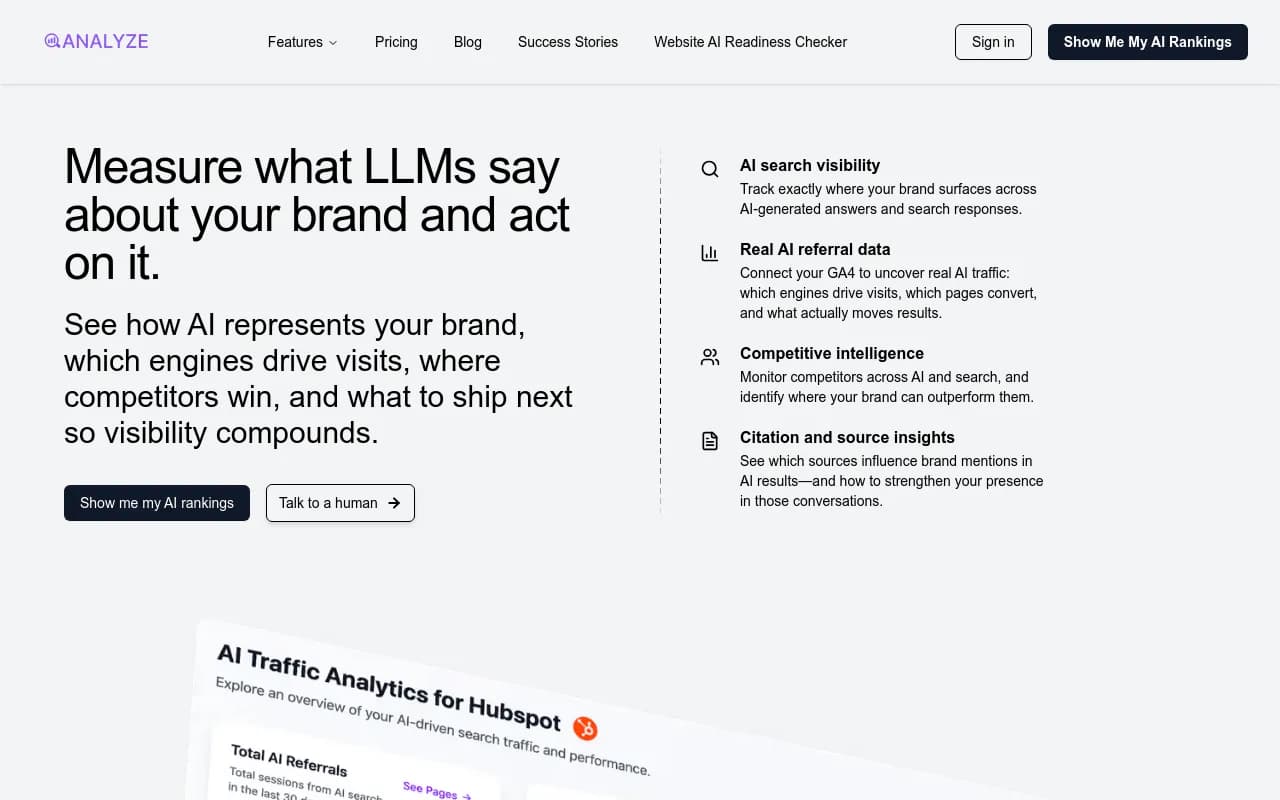
If a tool can't connect your AI visibility to actual website traffic and revenue, you have no way to know whether any of this matters. You'll spend months optimizing your "visibility score" without knowing if it's generating a single lead.
Traffic attribution for AI search is genuinely hard -- AI models don't pass referral data the way traditional search does. But the better platforms have found ways around this: code snippets that detect AI-referred sessions, Google Search Console integration, server log analysis. It's not perfect, but it's far better than nothing.
If a tool's answer to "how do I know this is driving revenue?" is "trust the visibility score," that's a red flag. Visibility scores are means, not ends.
Red flag 7: No AI crawler monitoring
This one surprises a lot of people. AI models don't just generate responses from their training data -- they actively crawl the web. ChatGPT's GPTBot, Perplexity's PerplexityBot, Claude's ClaudeBot -- these crawlers are visiting your site right now, and what they find (or fail to find) directly affects whether you get cited.
If a tool has no visibility into which AI crawlers are hitting your site, which pages they're reading, and what errors they're encountering, you're missing a critical piece of the puzzle. You might have great content that AI models simply can't access because of a crawl error or a robots.txt misconfiguration.
Most monitoring-only tools don't touch this at all. It's a feature that requires real technical infrastructure, which is why it's a good proxy for platform depth.
Red flag 8: Black-box scoring
"Your AI visibility score is 43."
Great. What does that mean? How is it calculated? Which models contribute to it? Is a 43 good or bad for your category? What would move it to 60?
Black-box scores are everywhere in this market, and they're almost always a sign that the tool is optimizing for the appearance of insight rather than actual insight. A score that you can't interrogate, decompose, or act on is just a number.
Good platforms show you the underlying data: which prompts you're visible for, which models cited you, how often, in what position, with what sentiment. The score, if there is one, should be a summary of that data -- not a replacement for it.
The vocal.media piece on AI visibility agency red flags makes a similar point about "vanity KPIs" and "black-box scoring" -- these patterns show up in agencies too, but they originate in the tools those agencies use.
Red flag 9: No Reddit or third-party source tracking
This one is less obvious but increasingly important. AI models don't just cite brand websites. They cite Reddit threads, YouTube videos, review sites, industry publications, and forum discussions. In many categories, a Reddit thread from 18 months ago is more influential on AI recommendations than your homepage.
If a tool only monitors your own domain's visibility, you're missing half the picture. You need to know which third-party sources AI models are citing in your category, what those sources are saying, and whether there are gaps you could fill by publishing in the right places.
Very few tools track this. It's a significant competitive advantage for the ones that do.
How to evaluate a tool before you buy
Here's a quick checklist to run through before committing to any AI visibility platform:
| Question | What a good answer looks like |
|---|---|
| Which AI models do you track? | 8+ models including Google AI Overviews and AI Mode |
| Can I define my own prompts? | Yes, with volume estimates and difficulty scores |
| Do you show content gaps vs competitors? | Yes, with specific missing topics identified |
| Can you generate content to fill those gaps? | Yes, grounded in citation data |
| How do I connect visibility to traffic/revenue? | Code snippet, GSC integration, or log analysis |
| Do you monitor AI crawlers on my site? | Yes, with page-level crawler logs |
| What does your visibility score actually measure? | Should be able to explain the underlying data |
| Do you track Reddit, YouTube, or third-party sources? | Yes |
If a tool can't answer most of these, you're probably buying a dashboard that will look impressive in a slide deck and do very little for your actual rankings.
A note on the broader market
The GEO and AI visibility space is genuinely useful -- tracking how your brand appears in AI-generated answers is important work, and it's only going to matter more as AI search continues to grow. The issue isn't the category. It's that a lot of tools rushed to market with monitoring features and stopped there.
The platforms worth paying for are the ones that close the loop: they show you where you're invisible, help you understand why, give you the tools to fix it, and let you measure whether it worked. That's a much harder product to build, which is why most tools don't do it.


When you're evaluating options, the single most useful question you can ask in a demo is: "Show me what happens after I see my visibility score." The answer will tell you everything.
The bottom line
Most AI visibility tools will show you a problem. Few will help you solve it. The nine red flags above -- no content gap analysis, fixed prompts, no traffic attribution, black-box scoring, limited model coverage, no crawler monitoring, no third-party source tracking, no content generation, and no clear "what next" -- are the signs you're about to pay for a dashboard that will frustrate you more than it helps you.
The market is maturing fast. The tools that survive the next 18 months will be the ones that connect visibility data to content creation to revenue attribution. Everything else is a monitoring widget dressed up as a platform.
Spend your evaluation time asking hard questions, not watching polished demos.