Key takeaways
- Rankability is built primarily for agencies managing SEO and AI search visibility across multiple clients, with a workflow that combines traditional rank tracking and emerging AI search monitoring
- Its AI Analyzer feature surfaces content gaps and optimization opportunities, but the platform leans more toward traditional SEO than pure GEO/AI visibility
- Across 10 client accounts, it performed well for Google-focused reporting but showed limitations in depth of AI model coverage and content generation capabilities
- For agencies that want a single platform covering both traditional SEO and basic AI visibility, Rankability is a reasonable choice -- but teams focused specifically on AI search optimization will likely need a more specialized tool
- Platforms like Promptwatch go further on the AI side, offering content gap analysis, AI writing, crawler logs, and traffic attribution that pure monitoring tools lack
What is Rankability?
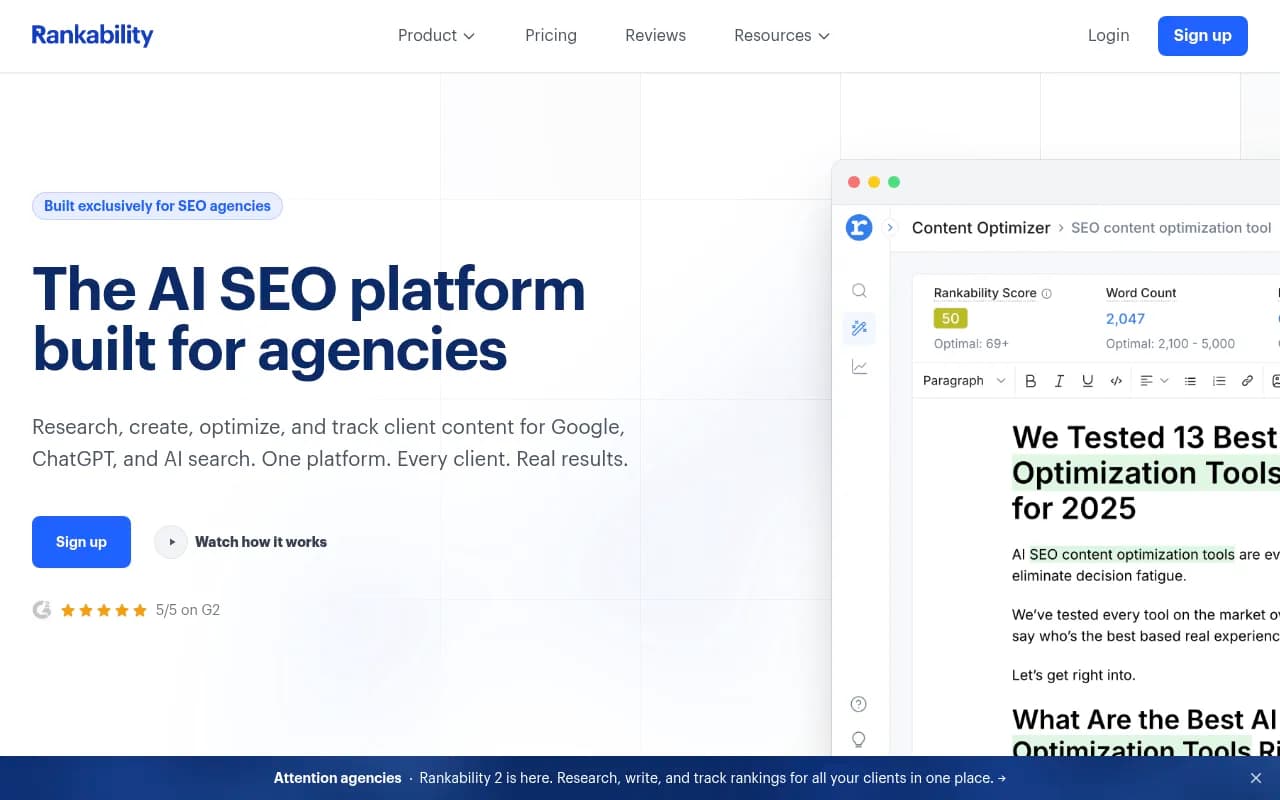
Rankability is an agency-focused SEO platform that has been expanding into AI search visibility over the past year. It's built around the idea that agencies need a unified workspace -- rank tracking, content optimization, site audits, and now AI visibility monitoring -- without juggling five different subscriptions.
The platform's AI Analyzer is its most talked-about feature in 2026. It's designed to evaluate how well a piece of content is positioned to rank in both traditional Google results and AI-generated answers. Think of it as a content scoring tool that looks at your page and tells you what's missing compared to what AI models are pulling from competitors.
That's the pitch, anyway. We tested it across 10 real client accounts spanning e-commerce, SaaS, local services, and B2B lead generation to see how it actually performs.
How we tested it
The 10 accounts ranged from a regional HVAC company with 40 tracked keywords to a mid-market SaaS brand with 300+ prompts across multiple product categories. We ran each account through Rankability for 60 days, tracking:
- AI visibility scores across ChatGPT, Perplexity, and Google AI Overviews
- Content recommendations from the AI Analyzer
- Reporting quality for client deliverables
- Multi-account management workflow
- How well it identified gaps vs. competitors
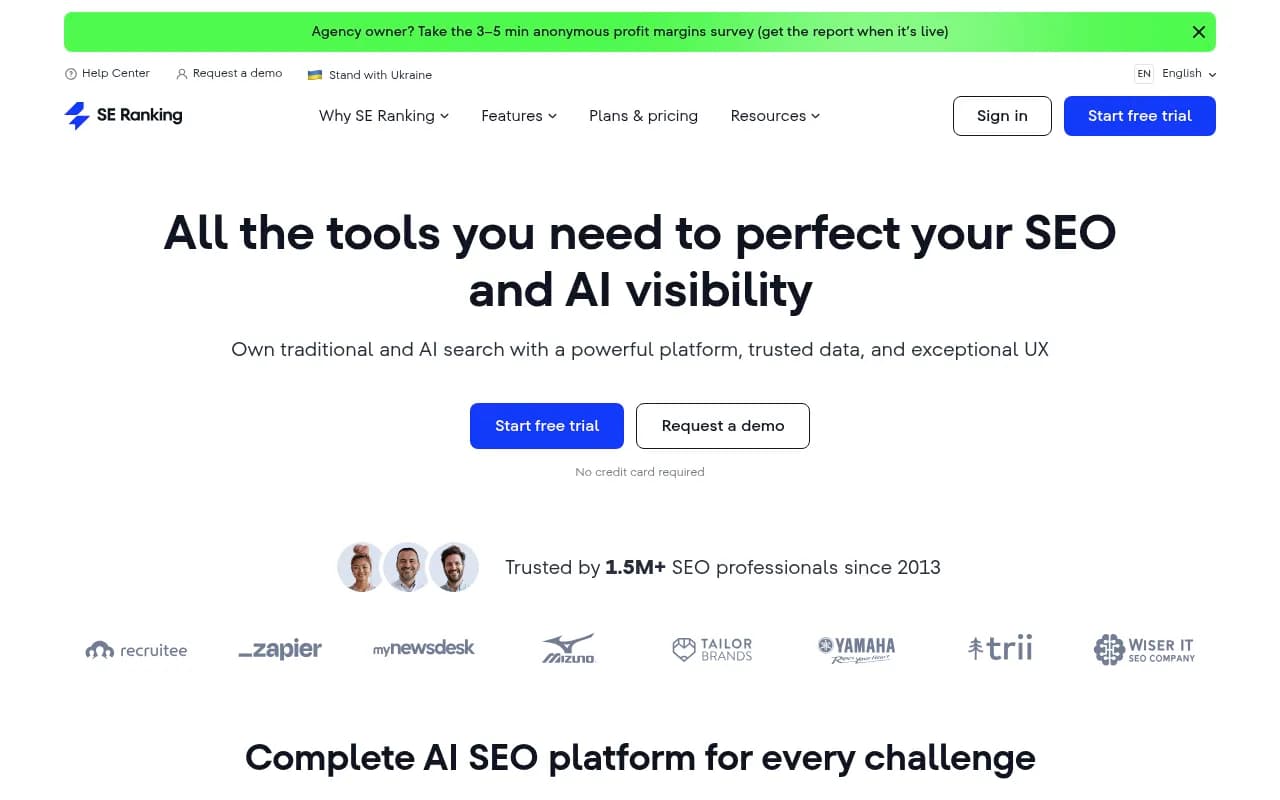
We also compared outputs against two other tools we had running in parallel on the same accounts: SE Ranking's AI Search Toolkit and Promptwatch.
What Rankability does well
Content scoring and optimization
The AI Analyzer is genuinely useful for content teams. You paste in a URL (or draft), and it scores the content against a set of criteria tied to both traditional SEO signals and AI citation likelihood. The recommendations are specific -- not just "add more headers" but actual topic gaps, missing entities, and structural suggestions.
For the SaaS client, the AI Analyzer flagged that their pricing page lacked comparison language that competitors were using in AI-cited responses. That was a real, actionable insight. The team updated the page and saw measurable improvement in how often it appeared in Perplexity responses within three weeks.
Agency workflow and white-label reporting
Rankability's multi-client dashboard is clean. Switching between accounts is fast, and the reporting templates are solid for client-facing work. You can white-label reports with client branding, which most agencies need.
For the local services clients, weekly automated reports saved meaningful time. The HVAC client's account manager estimated about 2 hours per week recovered just from not manually pulling rank data.
Traditional SEO integration
The platform doesn't abandon traditional SEO to chase the AI trend. Rank tracking, site audits, and backlink monitoring are all present and functional. For agencies that still need to justify value through Google rankings (which is most agencies), this matters. You're not paying for a separate Ahrefs or SEMrush subscription just to cover the basics.
Where Rankability falls short
AI model coverage is limited
This is the most significant gap. Rankability's AI visibility tracking focuses primarily on Google AI Overviews and, to a lesser extent, ChatGPT and Perplexity. It doesn't give you visibility into Claude, Gemini, Grok, DeepSeek, Copilot, or Meta AI as separate trackable entities.
For the B2B SaaS client, a significant portion of their target audience uses Claude and Gemini for research. Rankability simply couldn't tell us what was happening there. We had to supplement with another tool to get the full picture.
No AI crawler logs
Rankability doesn't show you which AI crawlers are hitting your clients' sites, how often, or what errors they're encountering. This matters more than it sounds. If GPTBot is crawling a client's site but hitting 404s on key product pages, you won't know from Rankability. You'd need a separate tool to catch that.
Platforms like Promptwatch include real-time AI crawler logs as part of their core offering -- showing exactly which pages ChatGPT, Claude, and Perplexity are reading, and flagging crawl errors before they become visibility problems.

Content generation is thin
The AI Analyzer tells you what to fix but doesn't help you create the content. For agencies managing 10+ clients, that gap is real. You still need a separate content workflow to act on the recommendations.
Some competing platforms have started building AI writing directly into the optimization loop -- generating articles grounded in citation data and prompt volumes, not just generic SEO filler. Rankability isn't there yet.
Prompt volume and difficulty data is sparse
When tracking AI visibility, knowing which prompts are worth targeting is half the battle. Rankability doesn't give you prompt volume estimates or difficulty scores. You're largely guessing at priority.
This is a meaningful weakness for agencies trying to make the case to clients about why they're targeting certain AI prompts. Without volume data, the strategy conversation gets harder.
Head-to-head: Rankability vs. the alternatives
Here's how Rankability stacks up against the tools we had running in parallel, plus a few others commonly used by agencies in 2026:
| Feature | Rankability | SE Ranking AI Toolkit | Promptwatch | Otterly.AI | Profound |
|---|---|---|---|---|---|
| Traditional SEO (rank tracking, audits) | Yes | Yes | No | No | No |
| AI visibility monitoring | Basic | Yes | Yes | Yes | Yes |
| AI models covered | 3 | 3-4 | 10 | 4 | 9+ |
| AI crawler logs | No | No | Yes | No | No |
| Content gap analysis | Yes (basic) | No | Yes (deep) | No | Limited |
| AI content generation | No | No | Yes | No | No |
| Prompt volume/difficulty | No | No | Yes | No | No |
| Reddit/YouTube tracking | No | No | Yes | No | No |
| White-label reporting | Yes | Yes | Yes | Limited | Yes |
| Multi-client management | Yes | Yes | Yes | Limited | Yes |
| Traffic attribution | No | No | Yes | No | No |
| Pricing (entry) | ~$99/mo | ~$65/mo | $99/mo | ~$49/mo | ~$199/mo |
The table tells a clear story: Rankability is the best option if you need traditional SEO and basic AI visibility in one tool. But if AI search is your primary focus, it's outgunned by more specialized platforms.
Account-by-account findings
E-commerce clients (3 accounts)
For the e-commerce accounts, Rankability's content scoring was useful for product category pages. The AI Analyzer correctly identified that several pages lacked the "best X for Y" framing that AI models tend to cite in product recommendation responses.
The limitation: Rankability doesn't track ChatGPT Shopping specifically. One client sells consumer electronics, and ChatGPT's shopping carousels are increasingly where their customers discover products. That's a blind spot.
SaaS clients (4 accounts)
This is where the prompt coverage gap hurt most. SaaS buyers research heavily across multiple AI platforms. Tracking only Google AI Overviews and ChatGPT left us with an incomplete picture of how each brand was performing in the AI research phase of the buying journey.
The AI Analyzer's content recommendations were solid, though. For one client, it surfaced a gap around integration-related queries that competitors were dominating in AI responses. The fix was straightforward -- a dedicated integrations page with specific language -- and it worked.
Local services clients (2 accounts)
Rankability performed best here. Local SEO and traditional rank tracking are its strengths, and the reporting templates were exactly what these clients needed. AI visibility for local services is still relatively nascent, so the limited AI model coverage was less of a problem.
B2B lead generation (1 account)
The most complex account. This client needed visibility across the full funnel -- awareness-stage AI responses all the way through to decision-stage comparisons. Rankability tracked some of this but missed the sentiment analysis dimension entirely. Knowing that you appear in an AI response is useful; knowing how you're described is more useful for a B2B brand where trust and credibility drive pipeline.
Who should use Rankability?
Rankability makes the most sense for agencies that:
- Still need traditional SEO as their primary deliverable, with AI visibility as a secondary concern
- Have clients who care primarily about Google (AI Overviews, organic rankings) rather than ChatGPT or Perplexity
- Want a clean multi-client dashboard without paying for multiple specialized tools
- Are earlier in their AI visibility practice and don't yet need deep prompt intelligence or content generation
It's a reasonable starting point. But agencies that have moved AI search visibility to the center of their service offering will hit its ceiling quickly.
What to use instead (or alongside)
If you need deeper AI visibility coverage, a few tools are worth knowing:
For pure AI visibility monitoring across many models:
Otterly.AI

Otterly.AI covers more AI platforms than Rankability and has a cleaner monitoring interface. It's monitoring-only -- no content generation -- but the coverage is broader.
Profound

Profound is a stronger enterprise option with deeper competitive intelligence. Higher price point, but the data quality is noticeably better for large accounts.
For agencies that want to act on the data, not just monitor it:
Promptwatch is the platform that closes the loop most completely. It finds the prompts your clients are missing, generates content engineered to get cited, tracks results at the page level, and attributes AI-driven traffic back to revenue. For agencies building AI visibility as a core service, that full cycle matters.
For tracking alongside traditional SEO:
Semrush has added AI visibility features to its existing suite. If your agency is already deep in the Semrush ecosystem, it's worth evaluating before adding another tool.
Ahrefs Brand Radar gives you some AI visibility data within a familiar interface, though it uses fixed prompts and lacks traffic attribution.
The bottom line
Rankability is a solid agency SEO platform that has made a genuine effort to add AI visibility capabilities. The AI Analyzer is useful, the multi-client workflow is clean, and the traditional SEO foundation is strong.
But "solid" isn't the same as "sufficient" for agencies where AI search visibility is a primary deliverable. The limited model coverage, absence of crawler logs, no prompt volume data, and lack of content generation mean you'll be supplementing it with other tools if your clients are asking serious questions about how they appear in ChatGPT, Claude, or Gemini.
For agencies at the beginning of their AI visibility practice, Rankability is a reasonable entry point. For those further along, it's either a supporting tool or something you eventually grow out of.