SE Ranking Review 2026
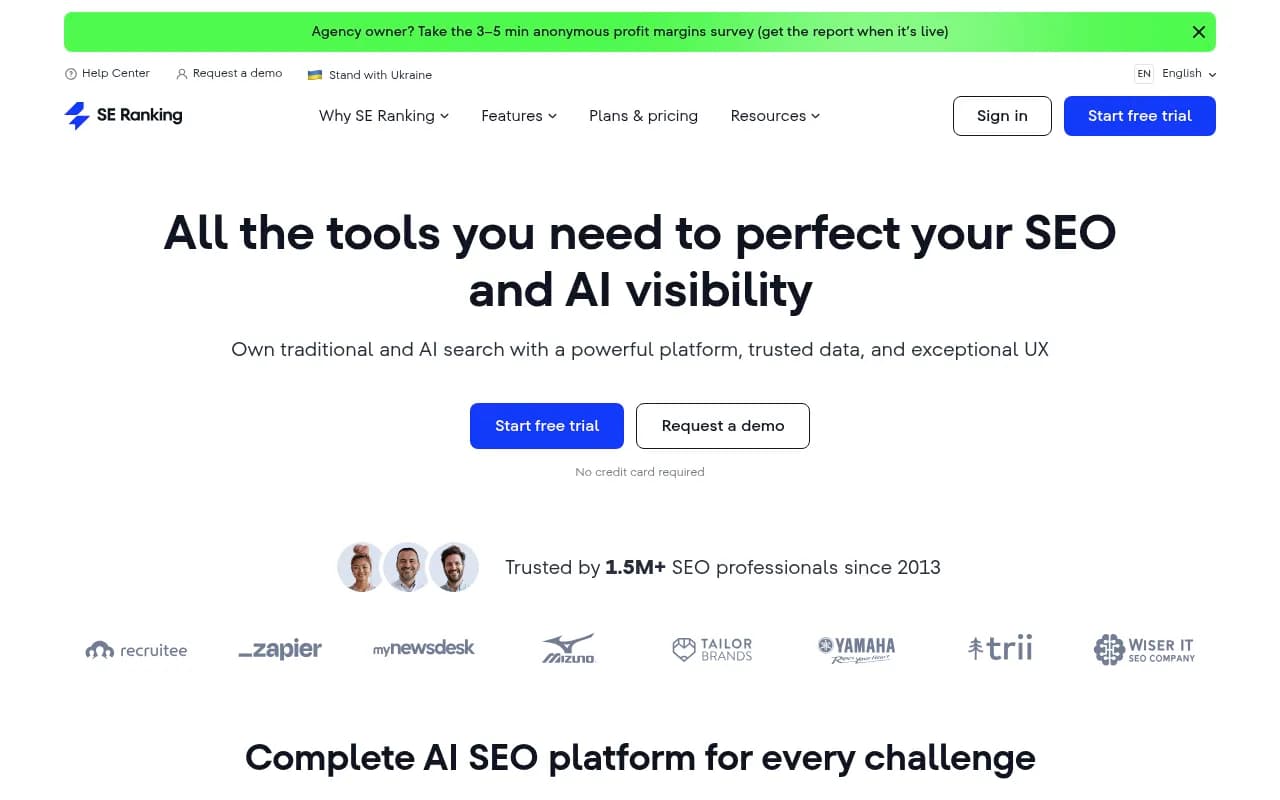
SE Ranking is a comprehensive SEO platform trusted by 1.5M+ professionals since 2013. It combines rank tracking, keyword research, site audits, backlink monitoring, and content optimization tools with white-label reporting for agencies. The platform covers 188 countries with a 5.4B keyword database and offers AI-powered insights, local SEO tools, and automated client reporting for teams managing multiple sites.
Summary: Key Takeaways
- Comprehensive all-in-one platform: SE Ranking bundles rank tracking, site audits, keyword research, backlink monitoring, content optimization, and local SEO into one interface, eliminating the need for multiple subscriptions
- Strong agency features: White-label reporting, client seats, lead generation widgets, and an agency directory make it particularly well-suited for SEO agencies managing 5-50 client accounts
- Massive data coverage: 188 country databases, 5.4B keywords, and 2.2B domain profiles provide deep research capabilities across global markets
- Honest limitations: AI visibility tracking is basic compared to specialized tools like Promptwatch (which monitors real LLM responses across ChatGPT, Claude, Perplexity, and others), and the interface can feel dated compared to newer competitors
- Best for: Mid-sized agencies and in-house SEO teams who need a reliable workhorse platform with strong fundamentals at a reasonable price point
SE Ranking has been a fixture in the SEO software market since 2013, building a user base of over 1.5 million professionals across 150+ countries. Founded as an affordable alternative to enterprise platforms like Ahrefs and SEMrush, it positions itself as the practical choice for agencies and businesses that need comprehensive SEO capabilities without the premium price tag. The company has steadily expanded from basic rank tracking into a full-featured platform covering research, monitoring, content, local SEO, and agency management tools.
The platform targets a broad audience: freelance SEO consultants managing 3-10 client sites, digital marketing agencies with 10-50 employees handling multiple accounts, in-house marketing teams at mid-market companies (50-500 employees), and local businesses focused on regional visibility. It's particularly popular among agencies in Europe and Latin America where its multi-language support and regional pricing make it more accessible than US-focused competitors.
Rank Tracking & SERP Monitoring
SE Ranking's core strength is its Rank Tracker, which monitors keyword positions across Google, Bing, Yahoo, YouTube, and 188 country-specific search engines. You can track desktop and mobile rankings separately, set custom check frequencies (daily, every 3 days, weekly), and monitor local rankings down to zip code level. The tracker supports unlimited keywords across projects, though your plan determines how many keywords you can check per day (ranging from 250 to 5,000+ depending on tier).
The platform claims 100% ranking accuracy by using real browser environments rather than API calls, which helps avoid personalization and caching issues. In practice, rankings match Google Search Console data closely, though occasional discrepancies appear for highly volatile keywords. Historical data is preserved for the lifetime of your project on Growth plans and above, letting you analyze ranking trends over months or years.
The SERP Checker tool analyzes the top 100 results for any keyword, showing domain authority, page authority, backlink counts, social signals, and on-page factors for each ranking page. You can compare your page against competitors to identify gaps in content depth, backlinks, or technical optimization. The SERP history feature tracks how the top 10 results change over time, useful for understanding algorithm updates or seasonal shifts.
One limitation: SE Ranking's SERP features tracking (featured snippets, People Also Ask, local packs, etc.) is less granular than Semrush or Ahrefs. You can see which SERP features appear for a keyword, but you don't get detailed tracking of your own feature appearances over time.
Keyword Research & Competitive Intelligence
The Keyword Suggestion Tool taps into SE Ranking's 5.4 billion keyword database to generate related keywords, questions, and long-tail variations. Enter a seed keyword and get search volume, CPC, competition level, and trend data for 188 countries. The tool groups keywords by topic clusters and shows which SERP features trigger for each term, helping you prioritize opportunities.
Keyword difficulty scores (0-100) estimate ranking difficulty based on domain authority of current top 10 results, backlink profiles, and content quality. These scores tend to be slightly more optimistic than Ahrefs' Keyword Difficulty, making some terms appear easier to rank for than they actually are. Cross-reference with the SERP Checker to see actual competition.
The Competitive Research module analyzes any domain's organic traffic, top keywords, traffic sources, and paid search activity. You can see which keywords drive the most traffic to competitors, identify content gaps where they rank but you don't, and discover new keyword opportunities they're targeting. The traffic estimates are directional rather than precise—expect 20-30% variance from actual Google Analytics data—but they're useful for relative comparisons.
SE Ranking's competitive data is strongest for English-language markets (US, UK, Canada, Australia) and major European languages. Coverage for Asian markets, particularly Chinese and Japanese, is thinner than Ahrefs or SEMrush.
Site Audits & Technical SEO
The Website Audit tool crawls your site to identify technical issues, on-page problems, and optimization opportunities. It checks 120+ factors including broken links, duplicate content, missing meta tags, page speed issues, mobile usability, structured data errors, and security problems. Audits run on a schedule you set (daily, weekly, monthly) and track issue resolution over time.
The audit interface categorizes issues by severity (critical, warnings, notices) and provides specific recommendations for each problem. For example, rather than just flagging "slow page speed," it identifies which images need compression, which scripts are render-blocking, and which server response times are lagging. The explanations are clear enough for junior SEOs to understand and action.
One nice feature: the audit tool integrates with Google Search Console and Google Analytics, pulling in real traffic and indexing data to prioritize fixes based on actual impact. You can filter issues to show only problems affecting high-traffic pages, making it easier to focus on what matters.
The On-Page SEO Checker analyzes individual pages against top-ranking competitors for your target keyword. It evaluates content length, keyword usage, readability, internal linking, meta tags, and technical factors, then provides a scored checklist of optimizations. This is particularly useful for content teams who need specific guidance on how to improve underperforming pages.
Limitations: The crawler can struggle with JavaScript-heavy sites (React, Vue, Angular) compared to Screaming Frog or Sitebulb. It renders JavaScript, but complex single-page applications sometimes produce incomplete crawls. Also, the audit doesn't check Core Web Vitals as thoroughly as Google's PageSpeed Insights or Lighthouse.
Backlink Analysis & Monitoring
SE Ranking's Backlink Checker analyzes any domain's backlink profile, showing total backlinks, referring domains, anchor text distribution, and link quality metrics. The index contains 2.2 billion domain profiles, though it's smaller than Ahrefs' 43 trillion link index or Majestic's historical data. For most sites, you'll see 60-80% of the backlinks that Ahrefs shows, with the gap widest for very large sites or obscure domains.
The tool calculates a proprietary Domain Trust score (0-100) based on backlink quality, domain age, and traffic signals. It's similar to Moz's Domain Authority but tends to weight recent backlink velocity more heavily. You can filter backlinks by dofollow/nofollow, anchor text, link type (text, image, redirect), and first-seen date.
The Backlink Monitor tracks your own backlink profile over time, alerting you to new backlinks gained and lost. You can mark links as valuable or spam, and the tool will notify you if important links disappear. This is useful for catching negative SEO attacks or identifying when outreach campaigns start generating links.
One gap: SE Ranking doesn't offer a dedicated link prospecting tool like Ahrefs' Content Explorer or SEMrush's Link Building Tool. You can analyze competitor backlinks to find prospects, but there's no built-in way to filter for linkable assets or contact information.
Content Marketing & Optimization
The Content Marketing Tool helps you plan, create, and optimize content at scale. It starts with topic research: enter a seed keyword and get a list of related topics, questions, and content angles based on what's ranking and what people are searching for. The tool analyzes top-ranking content to identify common themes, word counts, and content structures.
The Content Editor is where you actually write and optimize content. It provides real-time recommendations as you type: target word count based on top competitors, keyword density suggestions, readability scores (Flesch-Kincaid), related terms to include, and questions to answer. The interface feels like a simplified version of Clearscope or Surfer SEO, with a content score (0-100) that updates as you make changes.
You can import existing content from your CMS or Google Docs, get optimization suggestions, and export the improved version. The editor supports multiple languages and can analyze content in 20+ languages including Spanish, French, German, Italian, and Portuguese.
The AI Writer generates content outlines, introductions, and full drafts based on your target keyword and competitor analysis. It uses GPT-4 under the hood and produces decent first drafts that need editing but save time on initial research and structure. The AI-generated content tends to be generic and requires significant human editing to add unique insights, examples, and brand voice. Think of it as a research assistant rather than a replacement for a skilled writer.
One limitation: The content tools lack the depth of dedicated platforms like Clearscope, MarketMuse, or Frase. The keyword recommendations are less nuanced, the readability analysis is basic, and there's no content decay monitoring or automatic refresh suggestions for aging content.
Local SEO & Business Listings
The Local Marketing Tool helps businesses manage their presence across Google Business Profile, Bing Places, Apple Maps, and 70+ other directories and review sites. You can update business information (name, address, phone, hours, photos) across all platforms from one dashboard, monitor and respond to reviews, track local rankings, and analyze competitor local visibility.
The Local Rank Tracker monitors keyword rankings for specific locations down to zip code or street address level. This is crucial for businesses with multiple locations or service areas, letting you track visibility in each market separately. You can compare rankings across locations to identify which areas need more local SEO work.
The tool also generates local citation reports showing where your business is listed, where listings are incomplete or inconsistent, and where competitors have citations you're missing. NAP (Name, Address, Phone) consistency is critical for local SEO, and this feature helps you maintain it.
Limitations: The local tools are solid but not as comprehensive as dedicated local SEO platforms like BrightLocal or Whitespark. The review monitoring doesn't aggregate sentiment analysis or automate response suggestions, and the citation building is manual—you get a list of opportunities but have to submit listings yourself.
Agency Features & White Label
SE Ranking's Agency Pack is designed for agencies managing multiple client accounts. It includes:
- White Label: Rebrand the entire platform with your logo, colors, and custom domain (e.g., seo.youragency.com). Clients log in to your branded portal and never see SE Ranking's branding.
- Automated Reports: Create custom SEO reports with your branding, schedule them to send automatically (daily, weekly, monthly), and choose which metrics to include. Reports can be PDF, CSV, or live dashboards.
- Client Seats: Give clients read-only access to specific projects and tools. You control what they can see and do, preventing them from messing up settings or seeing other clients' data.
- Lead Generator: Embed SEO audit widgets on your website that capture leads by offering free site audits. The widget is customizable and generates qualified leads interested in SEO services.
- Agency Directory: Get listed in SE Ranking's agency directory, which connects businesses looking for SEO help with vetted agencies. This generates inbound leads at no extra cost.
The white-label implementation is thorough—clients see your branding everywhere, including email notifications and report footers. The custom domain setup is straightforward (CNAME record), and SSL certificates are included.
The automated reporting is particularly strong. You can create templates for different client types (local business, e-commerce, SaaS) and reuse them across accounts. Reports pull data from rank tracking, site audits, backlinks, traffic (via Google Analytics integration), and custom metrics. The PDF reports are professional-looking and client-ready without additional design work.
One limitation: The client seat permissions are somewhat rigid. You can't create custom roles with granular permissions—it's either full access or read-only. Some agencies want to give clients limited editing access (e.g., they can add keywords but not change audit settings), which isn't possible.
AI Visibility Tracking
SE Ranking recently added AI Visibility Tracker, AI Overviews Tracker, ChatGPT Tracker, and AI Mode Tracker to monitor brand mentions in AI-generated search results. These tools track when your brand appears in Google's AI Overviews, ChatGPT responses, and Bing's AI Mode, and measure visibility share compared to competitors.
However, this functionality is quite basic compared to specialized AI visibility platforms. SE Ranking's AI tracking appears to use API simulations rather than monitoring real user prompts, which means you're seeing what the AI might say in theory, not what it's actually telling users in practice. The data is limited to a predefined set of prompts rather than tracking the full universe of queries where your brand could appear.
For serious AI visibility monitoring—tracking real LLM responses across ChatGPT, Claude, Perplexity, Gemini, and other AI search engines, seeing actual citation sources, and monitoring prompt volumes—tools like Promptwatch provide far more comprehensive coverage. Promptwatch monitors real user prompts and real AI responses (not API simulations), tracks crawler logs to see which pages AI engines are reading, and provides actionable recommendations for optimizing content to get cited by AI. SE Ranking's AI features are a nice addition for basic awareness, but they're not a replacement for dedicated AI visibility platforms if that's a priority for your brand.
Integrations & API
SE Ranking integrates with Google Search Console, Google Analytics, Google My Business, Looker Studio (formerly Data Studio), and Matomo. The GSC integration pulls in real search query data, impressions, and clicks to enrich your rank tracking. The GA integration adds traffic and conversion data to reports.
The API (available on Growth plans and above) provides programmatic access to rank tracking, keyword research, backlink data, and site audit results. It uses RESTful endpoints with JSON responses and includes 300,000 API credits per month on the base Growth plan (additional credits available as an add-on). The API documentation is clear with code examples in Python, PHP, and JavaScript.
Agencies use the API to build custom dashboards, automate reporting workflows, and integrate SE Ranking data into their own client portals or internal tools. The API is rate-limited but generous enough for most agency use cases.
Missing integrations: No native Slack notifications, no Zapier integration, no direct CMS plugins for WordPress or Shopify. You can work around these with the API, but built-in integrations would be more convenient.
Pricing & Value
SE Ranking uses a flexible pricing model based on the number of keywords you track, how often you check them, and which add-ons you need. The base plans are:
- Core: From $103.20/mo (with annual billing, $129/mo monthly). Includes rank tracking, unlimited keyword research, site audits, backlink monitoring, and basic reporting. Good for freelancers or small agencies managing 5-10 client sites.
- Growth: From $223.20/mo (with annual billing, $279/mo monthly). Adds project lifetime historical data, API access with 300k credits, and priority support. Best for agencies managing 10-30 client accounts.
Add-ons:
- Agency Pack: From $69/mo. Includes white label, client seats, lead generator, and agency directory listing.
- AI Search: From $71.20/mo. Adds AI visibility tracking features.
- API: From $149/mo for additional API credits beyond the base Growth plan allocation.
You can customize limits for keywords tracked, projects, and check frequency, so pricing scales with your needs. A typical agency setup (Growth plan + Agency Pack + 1,000 keywords checked daily) runs around $350-400/mo.
Compared to competitors:
- Ahrefs: Starts at $129/mo but limited to 500 keywords tracked. More expensive for agencies needing thousands of keywords.
- SEMrush: Starts at $139.95/mo with 500 keywords. Agency plans run $449+/mo.
- Moz Pro: Starts at $99/mo but very limited features. Premium plan is $299/mo.
SE Ranking is typically 30-40% cheaper than Ahrefs or SEMrush for equivalent keyword tracking volume, making it attractive for cost-conscious agencies. The trade-off is a smaller backlink index and less polished interface.
The 14-day free trial includes full access to all features (no credit card required), so you can thoroughly test the platform before committing. Annual billing saves 20% compared to monthly.
Strengths
- Comprehensive feature set: Covers rank tracking, research, audits, backlinks, content, local SEO, and agency tools in one platform, reducing the need for multiple subscriptions
- Strong agency features: White-label reporting, client seats, and lead generation tools are well-executed and genuinely useful for agencies
- Flexible pricing: Customizable limits and pay-for-what-you-need pricing makes it accessible for small agencies and scalable for larger ones
- Massive keyword database: 5.4B keywords across 188 countries provides excellent coverage for international SEO
- Reliable rank tracking: 100% accurate rankings with historical data preservation and flexible check frequencies
Limitations
- Smaller backlink index: 2.2B domain profiles vs. Ahrefs' 43T links means you'll miss some backlinks, especially for large sites
- Basic AI visibility tracking: The AI search monitoring features are rudimentary compared to specialized tools like Promptwatch that track real LLM responses and provide actionable citation optimization
- Dated interface: The UI is functional but feels older than competitors like Ahrefs or Semrush, with more clicks required to complete common tasks
- Weaker content tools: The content editor and AI writer are decent but lack the depth of dedicated platforms like Clearscope or Surfer SEO
Bottom Line
SE Ranking is the practical workhorse choice for mid-sized agencies and in-house SEO teams who need comprehensive capabilities without enterprise pricing. It excels at the fundamentals—rank tracking, keyword research, site audits, and client reporting—and provides solid agency features like white-label branding and automated reports. The flexible pricing makes it accessible for growing agencies, and the feature breadth means you can consolidate multiple tools into one platform.
It's best for: SEO agencies managing 10-50 client accounts who need reliable rank tracking, white-label reporting, and solid research tools at a reasonable price point. Also great for in-house teams at mid-market companies (50-500 employees) who need to track rankings across multiple regions and languages.
Skip it if: You need the deepest possible backlink data (go with Ahrefs), the most advanced content optimization (try Clearscope or Surfer), or comprehensive AI visibility monitoring across real LLM responses (Promptwatch is purpose-built for that). Also not ideal for enterprise teams who need highly customized workflows or advanced API integrations—the platform is built for the mid-market and doesn't have the flexibility of enterprise tools.
Tags:
Similar and alternative tools to SE Ranking