Dashword Review 2026
Dashword is a content optimization platform designed for SEO teams and content marketers. It streamlines the content creation process by generating data-driven content briefs, providing real-time optimization feedback as you write, and monitoring published content for performance drops. The tool ana
Key Takeaways:
• Best for: SEO teams and content agencies creating 10+ optimized articles per month who need to scale content production without sacrificing quality • Standout feature: Three-stage workflow (brief creation → optimization → monitoring) that covers the entire content lifecycle, not just the writing phase • Pricing: Starts at $39/month, making it one of the more affordable content optimization tools compared to Clearscope ($170/mo) or MarketMuse (custom pricing) • Limitation: Focused purely on traditional SEO and Google rankings -- does not track or optimize for AI search engines like ChatGPT, Perplexity, or Google AI Overviews • Bottom line: Solid choice for teams prioritizing Google SEO on a budget, but lacks the AI visibility features needed for 2026's evolving search landscape
Dashword is a content optimization platform built specifically for SEO teams, content marketers, and agencies that need to produce search-optimized content at scale. The tool tackles three distinct phases of content production: creating detailed content briefs based on competitor analysis, optimizing drafts in real-time with keyword and topic suggestions, and monitoring published content for performance issues. It's designed to reduce the research burden on writers while maintaining consistent quality across all content pieces. The platform has been around since at least 2020 and serves customers ranging from small content teams to agencies managing multiple client sites.
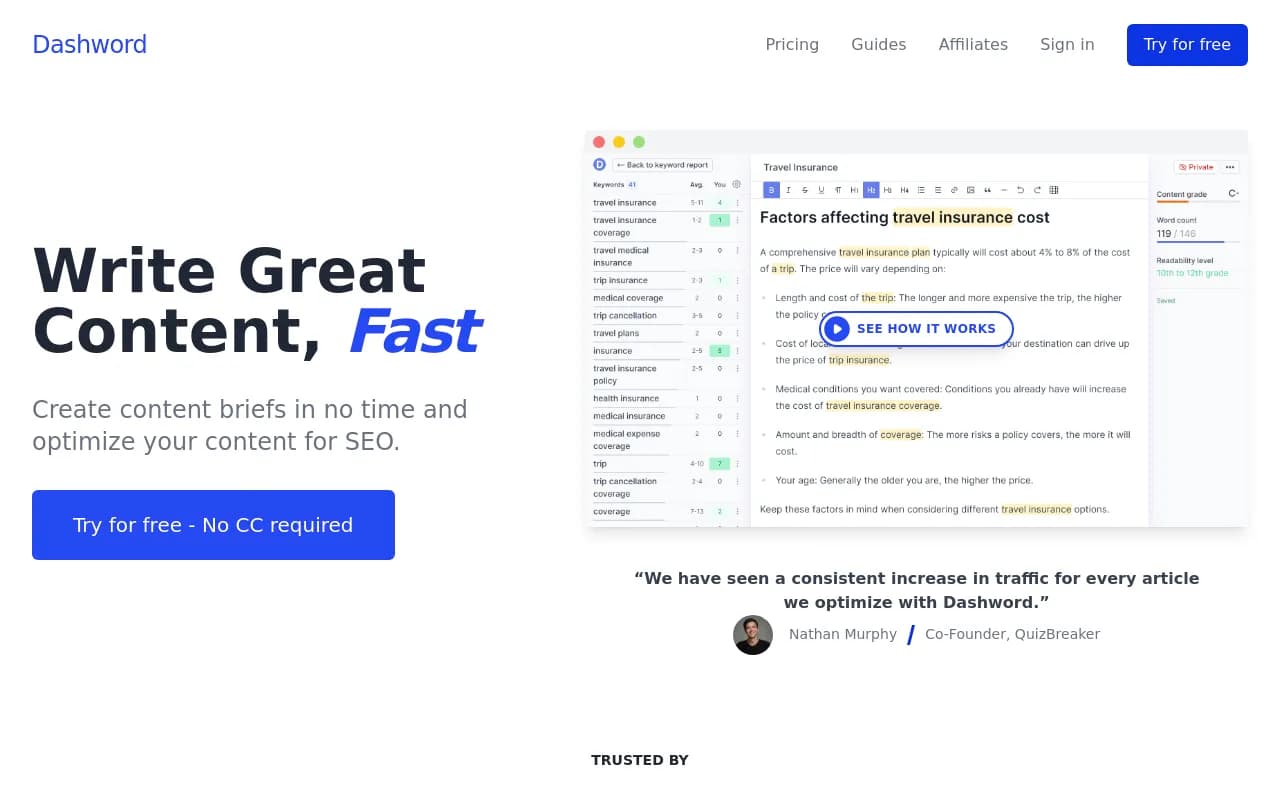
The target audience is primarily SEO-focused content teams at startups, SaaS companies, and digital marketing agencies. QuizBreaker, one of their case study customers, reported consistent traffic increases for every article optimized through the platform. The tool is particularly well-suited for teams producing 10-50 articles per month who need a systematic approach to content optimization but don't have the budget for enterprise-level platforms like MarketMuse or Clearscope.
Content Brief Builder
The brief creation module is where Dashword aims to cut research time in half. When you enter a target keyword, the platform analyzes the top-ranking pages in Google and compiles their outlines, headings, and content structures into a single view. You can see what topics competitors are covering, which questions they're answering, and how they're structuring their content. The builder lets you drag-and-drop sections, add notes for writers, and specify which keywords and topics must be included. The interface is designed for speed -- you can assemble a comprehensive brief in 10-15 minutes rather than spending an hour manually reviewing competitor pages.
Content ideas brought to you: The tool surfaces content angles by showing you what's working for competitors. If five out of ten top-ranking pages include a section on "common mistakes," Dashword will flag that as a recommended topic to cover.
Organize with ease: The interactive builder lets you reorder sections, add custom instructions, and attach reference links without switching between tabs or documents. Everything lives in one workspace.
Share with one click: Once your brief is complete, you can share it via a link with writers or export it. Writers get access to all the research, keyword targets, and structural guidance in a clean, readable format -- no need to parse through spreadsheets or messy Google Docs.
Content Optimization Editor
This is the core optimization engine. As you write (or paste in existing content), Dashword analyzes your draft in real-time and provides a content score based on how well it covers the necessary topics, keywords, and semantic concepts. The scoring system is similar to Surfer SEO or Clearscope -- it's not just about keyword density, but about topical relevance and comprehensiveness.
Do not miss a single topic: The sidebar shows you a checklist of keywords, related terms, and frequently asked questions that should appear in your content. As you include them, they get checked off. The tool also surfaces "People Also Ask" questions from Google, so you can address common user queries directly in your content.
Get real-time feedback: The content score updates as you type, giving you immediate feedback on whether you're on track. A score of 70+ typically indicates the content is well-optimized and ready for review. This removes the guesswork and helps writers understand exactly what's missing.
Consistent level of quality: By using the same optimization criteria across all content pieces, teams can maintain a baseline quality standard. New writers can produce optimized content without needing deep SEO expertise, because the tool guides them through what to include.
The editor integrates with Google Docs via an add-on, so writers can optimize content directly in their preferred writing environment. This is a significant workflow advantage over tools that require you to write in a proprietary editor.
Content Monitoring
After publication, Dashword continues to track your content's performance. The monitoring module automatically imports pages from your site via a web crawler and tracks their rankings, traffic trends, and keyword performance over time.
Identify underperforming pages: The platform monitors traffic patterns and alerts you when a page starts losing traffic or isn't receiving any visitors. This helps you prioritize which content needs updating or optimization.
Automated keyword reports: Every week, Dashword regenerates keyword reports for your published content based on the latest search results. If competitors have updated their content or new ranking factors have emerged, you'll see updated recommendations for what to add or change.
Keyword rank tracker: Built-in rank tracking shows you where your pages rank for target keywords. You can quickly identify "low-hanging fruit" -- pages ranking on page 2 or 3 that could jump to page 1 with minor optimizations.
Automated page import: The web crawler monitors your site and automatically adds new pages to the monitoring dashboard. You don't need to manually import URLs or maintain a spreadsheet of published content.
Who Is It For
Dashword is best suited for SEO-focused content teams at startups, SaaS companies, and digital marketing agencies producing 10-50 articles per month. Specific personas include:
In-house content teams at SaaS companies: If you're a content marketer or SEO manager responsible for growing organic traffic through blog content, Dashword gives you a systematic process for briefing, optimizing, and monitoring content. It's particularly useful if you're working with freelance writers who need clear guidance on what to write.
Digital marketing agencies: Agencies managing content for multiple clients benefit from the brief-sharing workflow and consistent optimization standards. You can create briefs for clients or writers, track content performance across different domains, and demonstrate ROI with traffic and ranking data.
Solo content creators and freelancers: If you're a freelance writer or consultant producing SEO content for clients, Dashword helps you deliver optimized content without spending hours on manual research. The $39/month entry price point is accessible for individuals.
Dashword is NOT ideal for:
Enterprise teams needing advanced content strategy: If you need content gap analysis, topic clustering, or sophisticated content planning features, MarketMuse or Clearscope offer more robust strategy tools. Dashword is focused on execution (briefs and optimization), not high-level planning.
Teams prioritizing AI search visibility: Dashword optimizes exclusively for traditional Google search. It does not track or optimize for AI search engines like ChatGPT, Perplexity, Claude, or Google AI Overviews. If you need to monitor how your brand appears in AI-generated responses or optimize content for AI citations, you'll need a platform like Promptwatch that specializes in AI visibility and Generative Engine Optimization (GEO).
Large publishers producing 100+ articles per month: At that scale, you likely need more sophisticated workflow automation, multi-user collaboration features, and custom integrations that Dashword doesn't currently offer.
Integrations & Ecosystem
Dashword offers a Google Docs add-on that lets writers optimize content directly in Google Docs without switching to the Dashword editor. This is a major workflow advantage for teams already using Google Workspace.
The platform provides an API for custom integrations, though documentation is limited compared to more developer-focused tools. There's no mention of integrations with content management systems like WordPress, project management tools like Asana or Trello, or analytics platforms beyond basic Google Search Console connectivity.
The web crawler automatically imports pages from your site for monitoring, but there's no mention of integrations with tools like Ahrefs, Semrush, or Google Analytics for deeper performance tracking.
Pricing & Value
Dashword starts at $39/month, making it one of the most affordable content optimization platforms on the market. For comparison, Clearscope starts at $170/month and MarketMuse requires custom enterprise pricing (typically $600+/month). Surfer SEO, a direct competitor, starts at $89/month.
The entry-level plan includes access to all three core features: content briefs, content optimization, and content monitoring. There's a free trial available with no credit card required, so you can test the platform before committing.
Higher-tier plans (pricing not publicly listed on the main site, but mentioned as $99/month in some sources) likely include additional content reports, more keyword tracking, or team collaboration features. The lack of transparent pricing tiers on the website is a minor friction point -- you need to sign up or contact sales to see the full pricing structure.
Value assessment: At $39-99/month, Dashword offers strong value for small teams and agencies on a budget. You're getting brief creation, real-time optimization, and ongoing monitoring in one platform. Competitors like Clearscope charge 2-4x more for similar functionality. However, the lower price point comes with trade-offs: fewer integrations, less sophisticated content strategy features, and no AI search optimization capabilities.
Strengths & Limitations
Strengths:
• Affordable pricing: At $39/month entry point, it's accessible for small teams and freelancers who can't justify $170+/month for Clearscope • End-to-end workflow: Covers brief creation, optimization, and monitoring in one platform -- most competitors focus on just one phase • Google Docs integration: The add-on lets writers optimize content in their preferred environment, reducing friction • Real-time content scoring: Immediate feedback helps writers understand exactly what's missing without waiting for a manual review • Automated monitoring: The web crawler and weekly keyword reports reduce manual maintenance work
Limitations:
• No AI search optimization: Dashword only optimizes for traditional Google search. It doesn't track or optimize for AI search engines like ChatGPT, Perplexity, or Google AI Overviews -- a significant gap in 2026 when AI search is rapidly growing • Limited integrations: No native integrations with WordPress, Ahrefs, Semrush, or project management tools. The API exists but isn't well-documented • Basic content strategy features: Lacks advanced topic clustering, content gap analysis, or competitive intelligence features found in MarketMuse or Clearscope • Unclear pricing tiers: The website doesn't clearly show all pricing tiers or feature differences between plans, requiring you to sign up or contact sales
Bottom Line
Dashword is a solid, budget-friendly content optimization platform for SEO teams focused on traditional Google search. It excels at streamlining the content creation workflow -- from brief creation to optimization to monitoring -- and does so at a price point that's accessible for small teams and agencies. The Google Docs integration and real-time content scoring make it easy for writers to produce optimized content without deep SEO expertise.
However, in 2026, the platform's exclusive focus on traditional SEO is a notable limitation. With AI search engines like ChatGPT, Perplexity, and Google AI Overviews rapidly gaining market share, brands need to optimize for both traditional search and AI-generated responses. Dashword doesn't address this at all -- it won't tell you if your content is being cited by AI models, which prompts you're invisible for, or how to optimize for AI search.
Best use case in one sentence: Dashword is best for SEO-focused content teams and agencies producing 10-50 articles per month who need an affordable, end-to-end optimization workflow for traditional Google search, but don't yet need AI visibility tracking.
Tags:
Similar and alternative tools to Dashword