Ryte Review 2026
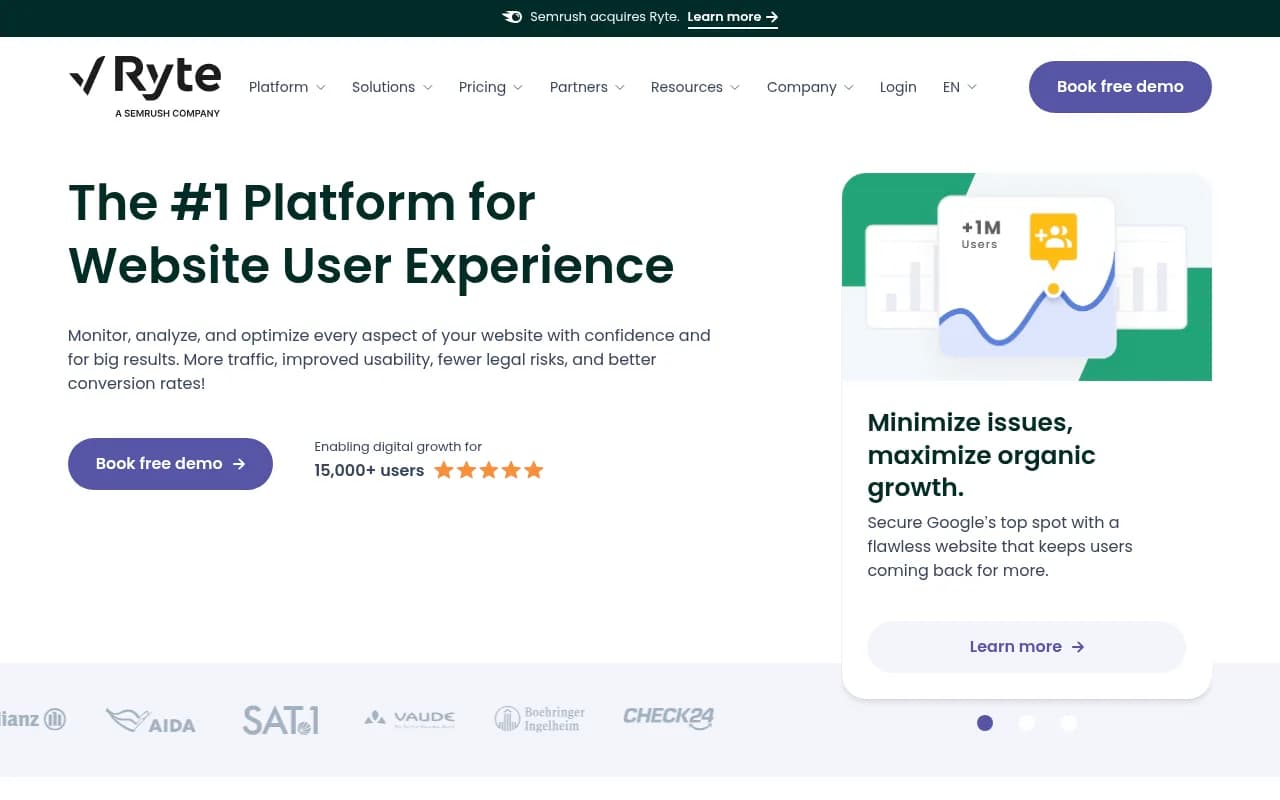
Ryte is a comprehensive website optimization platform that helps marketing teams, SEO professionals, and agencies improve technical SEO, performance, accessibility, and compliance. Acquired by Semrush in 2024, it offers automated site audits, real-time monitoring, and actionable recommendations acro
Summary
- Strong technical SEO auditing: Deep crawling and analysis across 7 optimization pillars (SEO, performance, quality, sustainability, accessibility, compliance, content) with automated issue detection
- Enterprise-grade monitoring: Real-time alerts and continuous tracking for large websites with up to millions of URLs
- Acquired by Semrush (2024): Now part of the Semrush ecosystem, which may affect future development direction and pricing
- Steep learning curve: Feature-rich interface can overwhelm new users; best suited for experienced SEO teams
- Limited content creation: Focuses on technical optimization and auditing rather than content generation or gap analysis
Ryte is a technical SEO and website optimization platform built for teams managing large, complex websites. Founded in Germany and acquired by Semrush in July 2024, it serves over 15,000 users including enterprise brands like Allianz, Boehringer Ingelheim, and HomeToGo. The platform positions itself around "Website User Experience" (WUX) -- a framework that breaks holistic website optimization into seven interconnected pillars.
The acquisition by Semrush marks a significant shift. While Ryte continues to operate as a standalone product, the long-term roadmap and pricing structure will likely evolve as it integrates into Semrush's broader suite. For now, it remains a distinct platform with its own pricing and feature set.
Core Capabilities: The Seven Pillars of WUX
Ryte organizes its features around seven optimization areas, each with dedicated modules and automated checks:
Search Engine Optimization: The foundational pillar. Ryte crawls your site (up to millions of URLs depending on plan) and identifies technical SEO issues -- broken links, missing meta tags, duplicate content, canonicalization problems, XML sitemap errors, robots.txt issues, hreflang mistakes, and indexability blocks. The crawler respects JavaScript rendering and can analyze single-page applications. You get a prioritized list of issues with severity ratings and fix recommendations. Integration with Google Search Console pulls in real performance data (impressions, clicks, CTR, position) so you can correlate technical issues with actual ranking drops.
Web Performance: Measures page load times, Core Web Vitals (LCP, FID, CLS), and resource optimization. Ryte runs Lighthouse-style audits on sampled pages and flags slow-loading assets, render-blocking scripts, oversized images, and server response delays. You can track performance trends over time and set alerts when metrics degrade. This is particularly useful for e-commerce sites where every 100ms of load time impacts conversion rates.
Quality Assurance: Monitors for broken pages, 404 errors, server errors (5xx), redirect chains, and other usability blockers. You can set up custom alerts for specific URL patterns or page types (e.g. product pages, checkout flows) so you're notified immediately when something breaks. The platform also checks for mixed content warnings, expired SSL certificates, and other trust signals.
Sustainability: A newer addition that calculates your website's carbon footprint based on page weight, server efficiency, and traffic volume. Ryte estimates CO2 emissions per page view and suggests optimizations (image compression, code minification, CDN usage) to reduce environmental impact. This pillar appeals to brands with ESG commitments but is less critical for pure performance optimization.
Accessibility: Audits WCAG 2.1 compliance (A, AA, AAA levels) by checking for missing alt text, insufficient color contrast, keyboard navigation issues, ARIA label problems, and screen reader compatibility. Each issue includes remediation guidance and links to WCAG documentation. This is essential for public sector sites, financial services, and any brand facing legal accessibility requirements.
Compliance: Focuses on GDPR and cookie consent. Ryte scans for tracking scripts, third-party cookies, and data collection mechanisms, then flags potential violations. It checks if your cookie banner meets legal standards (opt-in vs opt-out, granular controls, clear language). This pillar is most relevant for EU-based companies or those serving EU users.
Content: A content brief and optimization module. You input a target keyword, and Ryte analyzes top-ranking competitors to suggest topics, headings, word count, and semantic keywords. The interface includes a WYSIWYG editor for drafting content directly in the platform. However, this feature is basic compared to dedicated content tools like Clearscope or Surfer SEO -- it lacks AI writing assistance, real-time optimization scoring, or content gap analysis across your entire site.
Data Layering and Reporting
Ryte's strength is connecting multiple data sources. You can overlay Google Search Console data, Google Analytics traffic, and internal crawl data to see how technical issues correlate with performance drops. For example, if a batch of product pages suddenly loses rankings, you can check if they share a common technical issue (missing schema, slow load times, indexation block).
The platform offers pre-built dashboards for each pillar, plus custom report builders. You can export data to CSV or integrate with Looker Studio (formerly Data Studio) for client reporting. Alerts can be sent via email or Slack when critical issues are detected.
Who Should Use Ryte
Ryte is built for experienced SEO teams and agencies managing large, technically complex websites. Ideal users include:
- Enterprise SEO teams at e-commerce companies, publishers, or SaaS platforms with 10,000+ pages. Ryte excels at crawling and monitoring massive sites where manual audits are impossible.
- Digital agencies managing multiple client sites. The platform supports multi-project setups with separate dashboards and user permissions per client.
- In-house SEO managers at mid-to-large companies (500+ employees) who need continuous monitoring rather than one-off audits. Ryte's real-time alerts catch issues before they impact rankings.
- Technical SEO specialists who need granular control over crawl settings, custom checks, and API access for automation.
Ryte is NOT ideal for:
- Small businesses or solopreneurs with simple websites (under 1,000 pages). The platform is overkill and the pricing reflects enterprise needs.
- Content-first marketers who prioritize keyword research, content creation, and competitor content analysis. Ryte's content module is weak compared to alternatives.
- Teams seeking AI-driven optimization. Ryte provides recommendations but doesn't automate fixes or generate optimized content.
Integrations and Workflow
Ryte integrates with Google Search Console (required for ranking data), Google Analytics (for traffic correlation), and Looker Studio (for custom reporting). API access is available on higher-tier plans, allowing you to pull crawl data into your own dashboards or trigger alerts in external systems.
The platform lacks native integrations with project management tools (Asana, Jira, Monday.com), so you'll need to manually export issues or use Zapier to bridge the gap. There's no Slack app beyond basic webhook alerts.
Pricing and Plans
Ryte's pricing is based on monthly sessions (website visitors) and crawl depth:
- Basic Plan: $100/month. Crawls up to 50,000 URLs, supports up to 100,000 monthly sessions. Includes core SEO auditing, performance monitoring, and quality assurance. No accessibility or compliance modules.
- Business Plan: $400/month. Crawls up to 100,000 URLs, supports up to 500,000 monthly sessions. Adds accessibility and compliance audits, custom alerts, and API access.
- Enterprise Plan: Custom pricing. Unlimited URLs and sessions, dedicated account manager, priority support, and advanced features like white-label reporting.
Pricing is higher than competitors like Screaming Frog (one-time $259/year) or Sitebulb ($35-$115/month), but Ryte offers continuous monitoring rather than on-demand crawls. The value proposition is ongoing vigilance -- catching issues as they happen rather than during quarterly audits.
No free trial is advertised on the pricing page, but you can book a demo to see the platform in action.
Strengths
- Comprehensive technical auditing: Few tools match Ryte's depth across seven optimization pillars. The crawl engine handles JavaScript-heavy sites and massive URL counts.
- Real-time monitoring and alerts: Continuous tracking catches issues immediately, reducing the window between problem and fix.
- Enterprise-grade scalability: Built for large organizations with complex sites, multiple domains, and high traffic volumes.
- GDPR and accessibility focus: Rare among SEO tools to include dedicated compliance and accessibility modules with actionable guidance.
- Strong case study results: Clients like Personio (55% increase in organic impressions), HomeToGo (improved CTR and restored rankings), and Chefkoch (5M Google impressions) demonstrate measurable impact.
Limitations
- Steep learning curve: The interface is dense with features and data. New users often feel overwhelmed. Onboarding requires significant time investment.
- Weak content optimization: The content module is basic -- no AI writing, no real-time scoring, no content gap analysis. Tools like Clearscope, Surfer SEO, or Frase are far superior for content creation.
- No AI-driven automation: Ryte identifies issues but doesn't fix them. You still need developers or SEO specialists to implement recommendations.
- Uncertain post-acquisition roadmap: The Semrush acquisition raises questions about future development. Will Ryte's features be absorbed into Semrush, or will it remain standalone? Pricing and feature parity with Semrush's existing tools are unclear.
- Limited integrations: No native connections to project management tools, CMS platforms, or marketing automation systems beyond Google products.
- High cost for small teams: At $100/month minimum, Ryte is expensive for small businesses or individual consultants who don't need continuous monitoring.
How It Compares
Vs Screaming Frog: Screaming Frog is a one-time crawl tool ($259/year) that requires manual execution. Ryte offers continuous monitoring and real-time alerts but costs significantly more. Choose Screaming Frog for on-demand audits, Ryte for ongoing vigilance.
Vs Sitebulb: Sitebulb ($35-$115/month) provides beautiful visualizations and detailed audit reports but lacks real-time monitoring and multi-pillar optimization (no compliance or sustainability modules). Ryte is more comprehensive but harder to use.
Vs Semrush Site Audit: Now that Semrush owns Ryte, the overlap is significant. Semrush Site Audit is included in Semrush subscriptions ($139.95/month and up) and covers technical SEO, but Ryte offers deeper crawling, more granular checks, and dedicated modules for accessibility and compliance. Expect feature consolidation over time.
Vs Ahrefs Site Audit: Ahrefs ($129/month and up) includes site auditing as part of a broader SEO suite (keyword research, backlink analysis, rank tracking). Ryte is more focused on technical optimization and monitoring but lacks Ahrefs' content and link-building tools.
Bottom Line
Ryte is a powerful technical SEO and website optimization platform for enterprise teams and agencies managing large, complex sites. Its seven-pillar WUX framework provides comprehensive auditing across SEO, performance, accessibility, compliance, and more -- with real-time monitoring that catches issues before they impact rankings. The platform shines for organizations that need continuous vigilance and granular technical insights.
However, the steep learning curve, weak content optimization, and uncertain post-acquisition roadmap (following the Semrush buyout) make it less appealing for small teams or content-focused marketers. At $100/month minimum, it's a significant investment that only pays off if you're managing thousands of pages and need enterprise-grade monitoring.
Best use case in one sentence: Enterprise SEO teams and agencies managing 10,000+ page websites who need continuous technical monitoring and multi-pillar optimization with real-time alerts.
Tags:
Frequently asked questions
What is Ryte and what does it do?
How much does Ryte cost?
Does Ryte have a free plan or free trial?
Who is Ryte best suited for?
What are the main features of Ryte?
Was Ryte acquired by Semrush?
What is the difference between Ryte and other SEO tools?
Can Ryte handle large enterprise websites?
Similar and alternative tools to Ryte