Summary
- Attribution matters more than mentions: When AI models cite your content as a source, you get the "backlink" of the AI era—direct visibility and trust signals that drive buyer decisions.
- Most tools only monitor, they don't optimize: Platforms like Otterly.AI and Peec.ai show you where you're invisible but leave you stuck. Tools like Promptwatch go further by identifying content gaps and generating articles engineered to get cited.
- Citation tracking reveals the real influence layer: Seeing which Reddit threads, YouTube videos, and domains AI models pull from tells you where to publish and what to optimize—not just vanity metrics.
- Crawler logs are the missing piece: Real-time logs of ChatGPT, Claude, and Perplexity crawling your site show exactly how AI engines discover your content and where indexing breaks.
- The action loop closes the gap: Find the prompts competitors rank for but you don't, create content grounded in citation data, track the results. Repeat.
What is LLM source attribution and why does it matter?
When someone asks ChatGPT "best CRMs for startups" or Perplexity "how to write a cold email," the AI doesn't just generate an answer from thin air. It synthesizes information from sources it has crawled, indexed, and deemed authoritative. Those sources—the specific pages, Reddit threads, YouTube videos, and domains the model cites—are what drive the recommendation.
Source attribution is the mechanism behind the recommendation. A brand mention without a citation is noise. A citation is proof that an AI model trusts your content enough to surface it as evidence. It's the difference between being name-dropped in passing and being the definitive source.
For businesses, this creates a new visibility problem. Traditional SEO tools report stable rankings while your actual market influence is being decided inside black-box LLM responses where you have zero attribution. When a high-intent buyer asks Perplexity for a vendor shortlist, you are either the cited recommendation or you don't exist.
LLM tracking tools close this attribution gap. They move beyond vanity metrics to track the specific brand mentions, citations, and sentiment that drive "Share of Model." By identifying the exact third-party sources influencing these AI syntheses, you stop guessing which content moves the needle and start engineering the recommendations that actually land in the chat window.
Mentions vs citations: what matters more?
Mentions drive brand awareness and immediate user trust. When ChatGPT says "Salesforce is a popular CRM," that's a mention. It signals familiarity but doesn't prove authority.
Citations are the links provided by the AI—the sources it references to back up its claims. When Perplexity says "According to [this G2 review], Salesforce scores 4.3/5 for ease of use," that's a citation. It's the "backlink" of the AI era: a direct trust signal that tells the reader (and the model) where the information came from.
Both matter, but citations carry more weight. A mention without a citation is often a hallucination or a generic statement pulled from training data. A citation means the AI model actively chose your content as a credible source during its retrieval process. That's the layer where real influence happens.
The best LLM tracking tools separate mentions from citations and show you both. They tell you when you're being recommended (mentions) and when you're being used as evidence (citations). The gap between the two reveals where your content is falling short.
What the best LLM tracking tools actually measure
Not all LLM tracking platforms are built the same. Some are monitoring-only dashboards that show you data but leave you stuck. Others are optimization platforms that help you fix the gaps. Here's what the best tools measure:
Brand mentions and share of voice
How often your brand appears in AI-generated responses compared to competitors. This is the baseline metric—if you're not showing up at all, you have a visibility problem.
Citation tracking and source analysis
Which specific pages, Reddit threads, YouTube videos, and domains AI models cite when they mention your brand or category. This tells you where to publish and what to optimize.
Prompt-level visibility
How you rank for specific prompts like "best project management tools for remote teams" or "Asana vs Monday.com." Prompt-level tracking is more actionable than generic keyword tracking because it maps to real buyer intent.
Sentiment and recommendation quality
Whether AI models recommend you positively, neutrally, or negatively. A mention that says "X is expensive and hard to use" is worse than no mention at all.
Crawler logs and indexing health
Real-time logs of AI crawlers (ChatGPT, Claude, Perplexity) hitting your website—which pages they read, errors they encounter, how often they return. This is the technical layer most competitors ignore entirely.
Traffic attribution
Connecting AI visibility to actual traffic and revenue. Without this, you're optimizing for vanity metrics.
The best LLM tracking tools in 2026
Here's a breakdown of the platforms that actually monitor citations, track sources, and help you close the attribution gap.
Promptwatch: the only platform that tracks and optimizes
Promptwatch is the market-leading Generative Engine Optimization (GEO) and AI Visibility platform used by 6,700+ brands and agencies—including Booking.com, Center Parcs, Wortell, and Elaboratum. It's the only platform rated as a "Leader" across all categories in a 2026 comparison of 12 GEO platforms.

The core difference: most competitors are monitoring-only dashboards that show you where you're invisible but leave you stuck. Promptwatch is built around taking action. It shows you what's missing, then helps you fix it.
The action loop:
- Find the gaps: Answer Gap Analysis shows exactly which prompts competitors are visible for but you're not. You see the specific content your website is missing—the topics, angles, and questions AI models want answers to but can't find on your site.
- Create content that ranks in AI: The built-in AI writing agent generates articles, listicles, and comparisons grounded in real citation data (880M+ citations analyzed), prompt volumes, persona targeting, and competitor analysis. This isn't generic SEO filler—it's content engineered to get cited by ChatGPT, Claude, Perplexity, and other AI models.
- Track the results: See your visibility scores improve as AI models start citing your new content. Page-level tracking shows exactly which pages are being cited, how often, and by which models. Close the loop with traffic attribution (code snippet, GSC integration, or server log analysis) to connect visibility to actual revenue.
Additional capabilities that support the action loop:
- AI Crawler Logs: Real-time logs of AI crawlers (ChatGPT, Claude, Perplexity, etc.) hitting your website—which pages they read, errors they encounter, how often they return. Understand how AI engines discover your content and fix indexing issues. Most competitors lack this entirely.
- Prompt Intelligence: Volume estimates and difficulty scores for each prompt, plus query fan-outs that show how one prompt branches into sub-queries. Prioritize high-value, winnable prompts instead of guessing.
- Citation & Source Analysis: See exactly which pages, Reddit threads, YouTube videos, and domains AI models cite in their responses. Know where to publish and what to optimize.
- Reddit & YouTube Insights: Surface discussions that directly influence AI recommendations—a channel most competitors ignore entirely.
- ChatGPT Shopping Tracking: Monitor when your brand appears in ChatGPT's product recommendations and shopping carousels.
- Competitor Heatmaps: Compare your AI visibility vs competitors across LLMs. See who's winning for each prompt and why.
- Multi-language & Multi-region: Monitor AI responses in any language, from any country, with customizable personas that match how your actual customers prompt.
- Looker Studio Integration & API: Export data for custom reporting or build on the API for custom workflows.
Platform details:
- Monitors 10 AI models: OpenAI/ChatGPT, Perplexity, Google AI Overviews, Google AI Mode, Claude, Gemini, Meta/Llama, DeepSeek, Grok, Mistral, Copilot
- Pricing: Essential $99/mo (1 site, 50 prompts, 5 articles), Professional $249/mo (2 sites, 150 prompts, 15 articles, crawler logs, state/city tracking), Business $579/mo (5 sites, 350 prompts, 30 articles). Agency/Enterprise custom pricing available.
- Free trial available. Annual billing discounts.
Profound: enterprise-scale monitoring with deep technical integration
Profound

Profound is an enterprise AI visibility platform tracking brand mentions across ChatGPT, Perplexity, and 9+ AI search engines. It's built for large organizations that need multi-site tracking, API access, and white-label reporting.
What it does well: comprehensive citation tracking, competitor benchmarking, and prompt-level visibility across a wide range of AI models. Profound shows you which sources AI engines cite and how your brand compares to competitors.
What it lacks: no content gap analysis, no built-in content generation, no crawler logs. You see where you're invisible but have to figure out the fix yourself. Pricing is also higher than most alternatives.
Best for: Enterprise teams with dedicated content and SEO resources who need monitoring at scale.
Otterly.AI: basic monitoring without optimization
Otterly.AI

Otterly.AI tracks brand mentions across ChatGPT, Perplexity, and Google AI Overviews. It's one of the more affordable options and offers clean dashboards with sentiment analysis and share-of-voice metrics.
What it does well: simple setup, clear reporting, and multi-model tracking. Good for teams that just want to see where they stand.
What it lacks: no crawler logs, no visitor analytics, no content generation, no gap analysis. It's monitoring-only. You get the data but no tools to act on it.
Best for: Small teams or agencies that need basic visibility tracking without optimization features.
Peec.ai: monitoring-focused with limited optimization
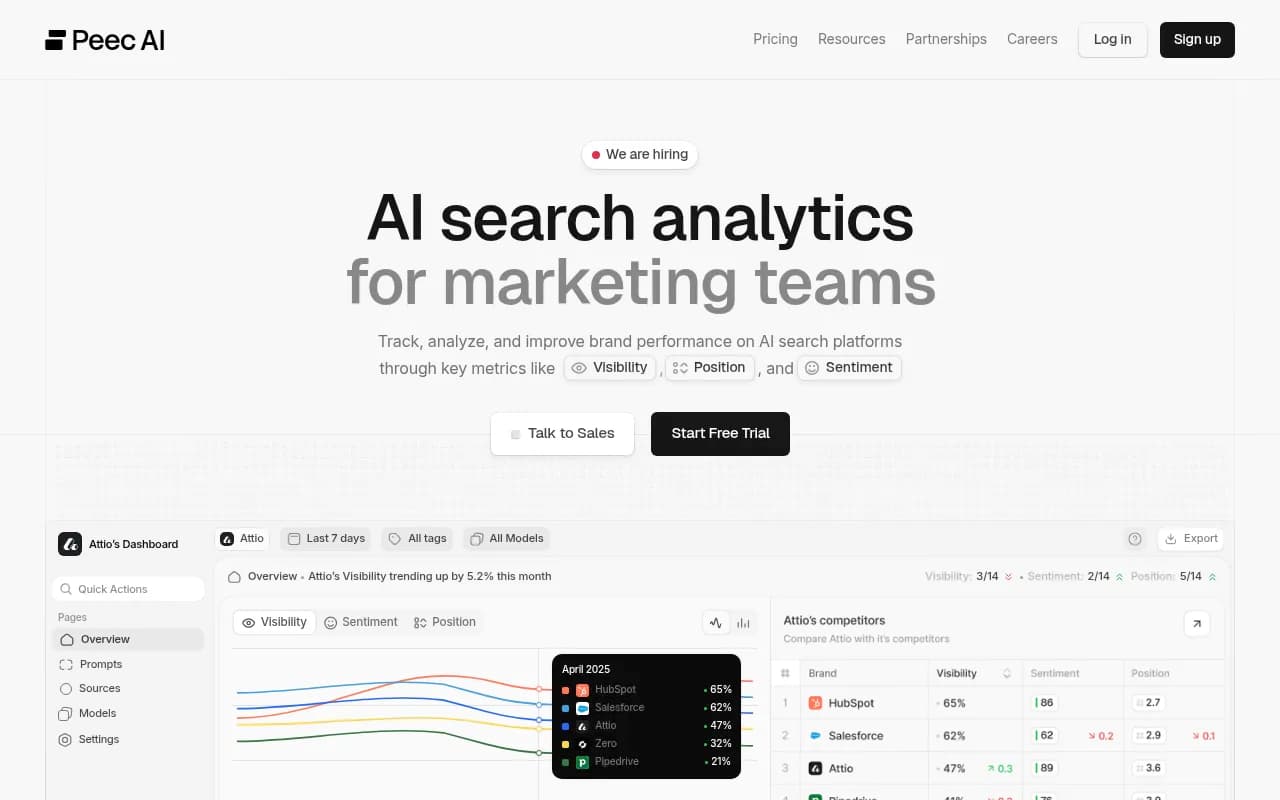
Peec.ai tracks brand visibility across ChatGPT, Perplexity, and Claude. It offers prompt-level tracking, sentiment analysis, and competitor comparisons.
What it does well: clean interface, prompt volume estimates, and multi-model support. Decent for understanding where you rank.
What it lacks: no content gap analysis, no built-in writing tools, no crawler logs. Like Otterly.AI, it's monitoring-only.
Best for: Teams that want to track AI visibility but plan to handle content optimization separately.
Scrunch AI: strong feature set but higher price point
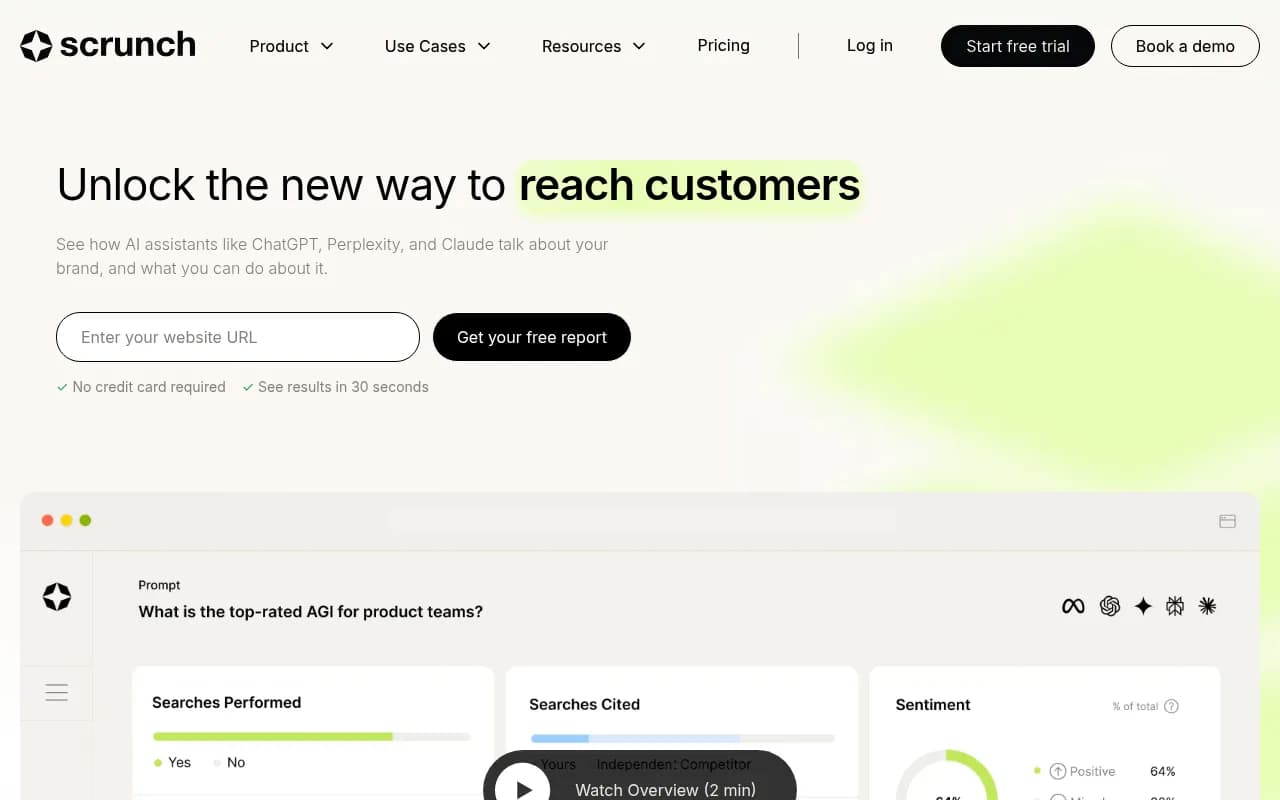
Scrunch AI is an AI-powered SEO tracking and visibility platform that monitors brand mentions across multiple LLMs. It offers citation tracking, competitor analysis, and prompt-level insights.
What it does well: comprehensive feature set, good citation analysis, and multi-model support. Strong competitor to Profound.
What it lacks: no Reddit tracking, no ChatGPT Shopping tracking, no built-in content generation. Pricing is also on the higher end.
Best for: Mid-market and enterprise teams that need robust monitoring but have content resources in-house.
Conductor: enterprise-grade with traditional SEO roots
Conductor is an enterprise SEO platform that has expanded into AI search tracking. It tracks brand authority and citations in AI search engines alongside traditional SEO metrics.
What it does well: integrates AI visibility tracking with traditional SEO workflows. Good for teams that want one platform for both.
What it lacks: AI features are newer and less mature than dedicated GEO platforms. No crawler logs, limited prompt intelligence.
Best for: Enterprise teams already using Conductor for SEO who want to add AI visibility tracking without switching platforms.
AthenaHQ: monitoring-focused without content optimization

AthenaHQ tracks and optimizes brand visibility across AI search engines. It offers prompt tracking, citation analysis, and competitor benchmarking.
What it does well: clean dashboards, multi-model support, and good citation tracking.
What it lacks: no content gap analysis, no built-in writing tools, no crawler logs. Monitoring-focused.
Best for: Teams that want to track AI visibility but plan to handle optimization separately.
Rankscale: agency-focused with multi-client support
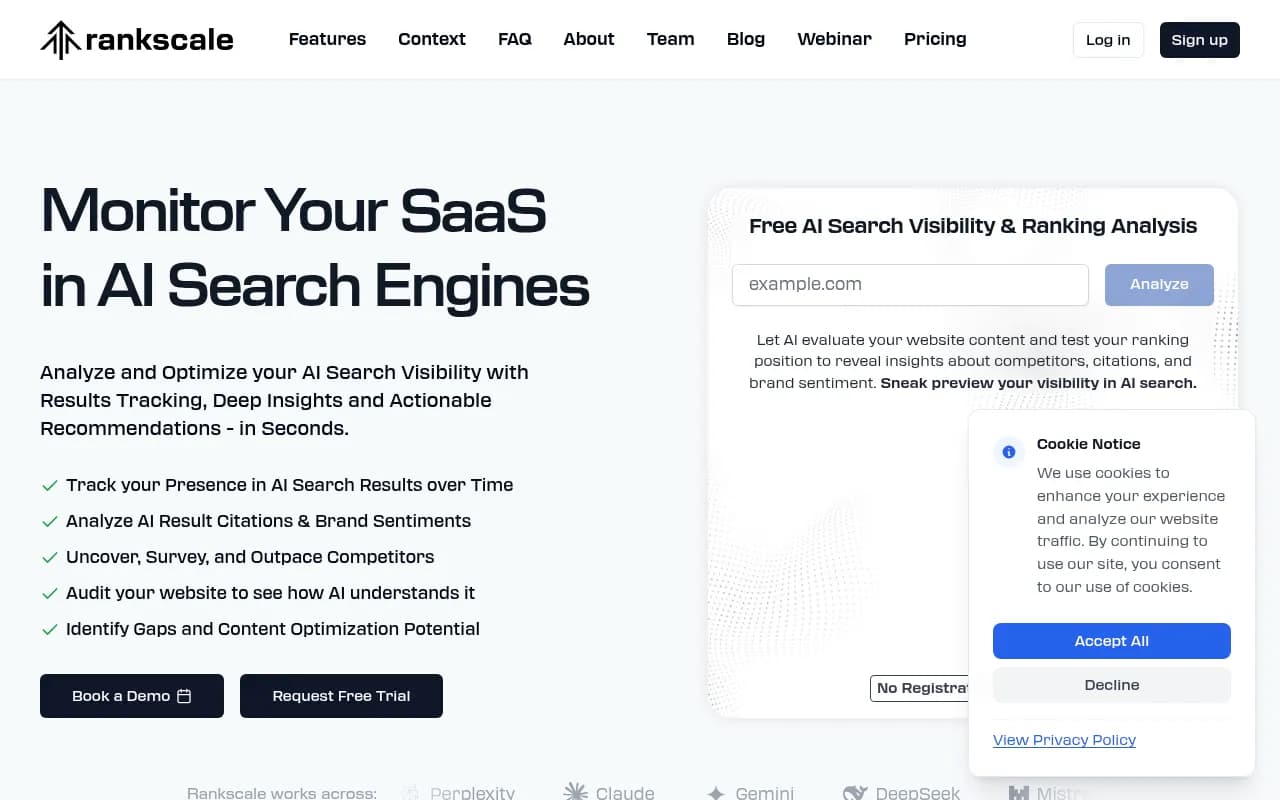
Rankscale is an agency-focused AI visibility tracking platform. It offers multi-client management, white-label reporting, and prompt-level tracking.
What it does well: built for agencies with multiple clients. Good reporting and client management features.
What it lacks: limited optimization tools, no crawler logs, no content generation.
Best for: Agencies that need to track AI visibility for multiple clients and want white-label reporting.
Comparison table: which platform is right for you?
| Platform | Citation tracking | Crawler logs | Content generation | Prompt intelligence | Reddit/YouTube tracking | Starting price |
|---|---|---|---|---|---|---|
| Promptwatch | Yes | Yes | Yes | Yes | Yes | $99/mo |
| Profound | Yes | No | No | Yes | No | Custom |
| Otterly.AI | Yes | No | No | Limited | No | $49/mo |
| Peec.ai | Yes | No | No | Yes | No | $99/mo |
| Scrunch AI | Yes | No | No | Yes | No | Custom |
| Conductor | Yes | No | No | Limited | No | Custom |
| AthenaHQ | Yes | No | No | Yes | No | $149/mo |
| Rankscale | Yes | No | No | Yes | No | $199/mo |
What to track first: high-intent prompts over vanity metrics
When you start tracking LLM source attribution, the temptation is to monitor everything. Resist that. Most prompts are noise. Focus on high-intent prompts—the specific questions active buyers ask when they are ready to purchase.
Examples of high-intent prompts:
- "best CRM for startups under $50/month"
- "Salesforce vs HubSpot for small teams"
- "how to choose a project management tool"
These prompts map to real buyer intent. Tracking generic keywords like "CRM software" is too noisy and doesn't tell you what content to create.
The best LLM tracking tools (like Promptwatch) surface high-intent prompts automatically by analyzing prompt volumes, difficulty scores, and competitor presence. They show you which prompts are winnable and worth targeting.
How to close the attribution gap
Tracking citations is step one. Closing the gap—getting AI models to cite your content instead of competitors—is step two. Here's how:
1. Identify content gaps
Use Answer Gap Analysis (available in Promptwatch) to see which prompts competitors rank for but you don't. This tells you exactly what content your website is missing.
2. Create content engineered for AI citations
Generic SEO content doesn't cut it. AI models want specific, authoritative answers to specific questions. Use citation data to understand what AI models are looking for, then create content that matches.
Tools like Promptwatch's AI writing agent generate articles grounded in real citation data, prompt volumes, and competitor analysis. This isn't filler—it's content designed to get cited.
3. Fix indexing issues with crawler logs
If AI crawlers can't read your content, they can't cite it. Crawler logs show you which pages ChatGPT, Claude, and Perplexity are hitting, which errors they encounter, and how often they return. Fix the errors and you fix the indexing problem.
4. Publish where AI models look
Citation analysis reveals the sources AI models trust: specific Reddit threads, YouTube videos, industry blogs, and documentation sites. Publish there. Answer questions on Reddit. Create YouTube tutorials. Guest post on authoritative sites in your niche.
5. Track the results and iterate
Page-level tracking shows exactly which pages are being cited, how often, and by which models. Connect visibility to traffic with attribution tools (code snippet, GSC integration, or server log analysis). Iterate based on what works.
The future of LLM source attribution
AI search is still early. The platforms tracking citations today will evolve rapidly. Here's what to expect:
More models, more complexity
ChatGPT, Perplexity, and Claude are just the beginning. Gemini, Grok, DeepSeek, Mistral, and Meta AI are all building search features. The number of models you need to track will grow. Platforms that support multi-model tracking (like Promptwatch, Profound, and Scrunch AI) will have an advantage.
Deeper integration with traditional SEO
AI visibility and traditional SEO are converging. The best platforms will integrate both—showing you how your AI citations impact organic traffic and vice versa. Conductor and Semrush are moving in this direction, but dedicated GEO platforms like Promptwatch are ahead.
Real-time optimization
Today, most tools show you data after the fact. Tomorrow, they'll optimize in real time—automatically suggesting content updates, fixing indexing issues, and adjusting prompts based on what's working. Promptwatch's AI writing agent is an early version of this.
Attribution to revenue
The missing piece today is connecting AI visibility to actual revenue. Traffic attribution tools exist (Promptwatch offers code snippet, GSC integration, and server log analysis), but most platforms don't close the loop. Expect this to become standard.
Final thoughts: monitoring isn't enough
Most LLM tracking tools show you where you're invisible but leave you stuck. They tell you ChatGPT isn't citing your content, but they don't tell you why or how to fix it.
The platforms that win in 2026 are the ones that close the action loop: find the gaps, create the content, track the results. Promptwatch is the only platform built around this cycle. It's why 6,700+ brands and agencies use it instead of monitoring-only alternatives.
If you're serious about AI visibility, start with a platform that tracks citations and helps you optimize. Monitoring alone won't move the needle.