Rankscale Review 2026
Designed for agencies to monitor client brand visibility across AI search engines with comprehensive tracking and reporting tools.
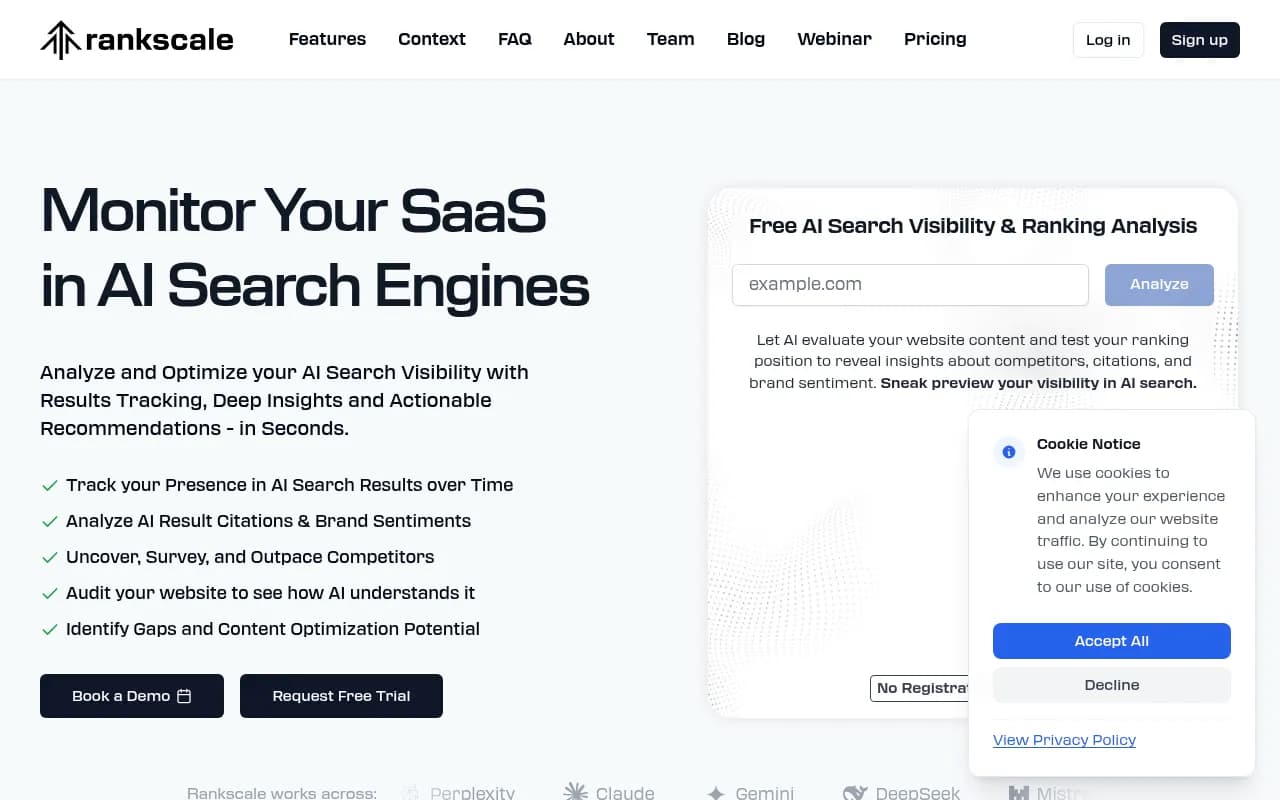
Key Takeaways:
- Rankscale is a specialized GEO platform for tracking brand visibility across 10+ AI search engines including ChatGPT, Perplexity, Gemini, Claude, DeepSeek, and Google AI Overviews
- Built specifically for agencies managing multiple clients with flexible credit-based pricing and white-label options
- Goes beyond basic tracking with deep citation analysis, sentiment scoring, competitor benchmarking, and AI-powered website audits
- Offers granular control over tracking frequency, AI engines, regions, and languages—pay only for what you use
- Over 700 active users including major brands like Canva, Uber, Spotify, and agencies worldwide
Rankscale launched in early 2025 as one of the first dedicated platforms for Generative Engine Optimization, a new discipline focused on how brands appear in AI-generated answers rather than traditional search results. Founded by Mathias Ptacek after years in corporate tech and marketing roles, the platform emerged from the recognition that traditional SEO tools don't address how ChatGPT, Perplexity, and other AI engines surface and recommend brands. By April 2025, Mathias had gone full-time on Rankscale and brought on Patrick as CMO to accelerate growth. The platform now serves over 700 users ranging from solo consultants to enterprise teams at companies like Bayer, L'Oréal, and Decathlon.
The core insight behind Rankscale is that AI search engines use fundamentally different ranking signals than Google. They synthesize answers from multiple sources, cite specific URLs, and apply sentiment analysis to brand mentions. Traditional SEO tools track keyword rankings and backlinks, but they can't tell you whether ChatGPT recommends your product when someone asks for alternatives, or which competitor is dominating Perplexity results in your category. Rankscale fills that gap with real-time tracking across all major AI platforms.
Brand Dashboard & Centralized Command Center
The Brand Dashboard serves as mission control for all your AI visibility efforts. Unlike tools that force you to jump between different views, Rankscale aggregates performance metrics, competitor insights, citation data, and sentiment analysis in a single dynamic interface. Agencies managing multiple client brands can switch between properties instantly from one central hub. The dashboard supports slicing data by AI engine, topic, custom timeframes, and period-over-period comparisons. You can drill down from high-level summaries showing overall visibility scores to granular details on individual search terms and how each AI engine responded. The interface is designed for both quick executive overviews and deep analytical dives—perfect for client reporting or internal strategy sessions.
Performance Tracking Across AI Engines
Rankscale monitors your brand's presence across ChatGPT (GPT-4o), Google AI Overviews, Google AI Mode, Perplexity, Claude, Gemini, DeepSeek, Mistral, Grok, and Microsoft Copilot. For each tracked search term, the platform measures Visibility Score (how prominently you appear), Sentiment (positive/neutral/negative tone), Mentions (frequency of brand references), Citations (which URLs are being referenced), Average Position (ranking in lists), and Detection Rate (percentage of queries where you appear). Interactive graphs show trends over time with clear indicators for improving or declining metrics. Unlike competitors that rely on API simulations, Rankscale queries real AI engines to capture actual user-facing results. You can configure tracking frequency from hourly to weekly depending on how closely you need to monitor changes, and choose specific AI engines and regions relevant to your audience.
Competitor Benchmarking & Intelligence
The platform automatically identifies competitors appearing in AI search results for your tracked terms and industry topics. You don't need to manually specify competitors—Rankscale discovers them by analyzing who else AI engines recommend alongside your brand. For each competitor, you see the full suite of KPIs: Visibility Score, Rank, Sentiment, and Citations. A clear ranking table shows how competitors stack up based on overall visibility and performance. The direct comparison view lets you benchmark your brand against specific competitors on key metrics to uncover strategic advantages and weaknesses. This is particularly valuable for understanding why a competitor is winning certain prompts—you can see exactly which sources AI engines are citing for them and what sentiment keywords are associated with their brand.
Citation Analysis & Source Discovery
One of Rankscale's standout features is deep citation analysis. The platform identifies all sources AI engines reference when answering queries—websites, articles, Reddit threads, YouTube videos, and other content. You can monitor citation frequency and unique counts to understand which domains are most influential. The domain-level view pinpoints key websites driving AI answers, analyzes their overall impact, and reveals which brands they feature. URL-level analysis connects specific pages to the brands they mention and the search terms that surfaced them, giving you a clear picture of content impact. Filtering by category, region, or search term lets you export data for strategic planning. This is critical for PR and content strategy—if you see that AI engines heavily cite a particular industry publication or Reddit community, you know where to focus your outreach and content distribution efforts.
Sentiment Analysis & Brand Perception
Rankscale tracks detailed sentiment scores for your brand and competitors, helping you identify reputation strengths and areas for improvement. The platform visualizes positive, neutral, and negative keywords associated with each brand in interactive word clouds, making it easy to spot patterns at a glance. A unique capability is distinguishing between sentiment from web grounding (current online content) versus training data (what the AI learned during pre-training). This helps you understand whether negative sentiment is coming from recent articles you can address or from older perceptions baked into the model. You can analyze individual keywords to see exact contexts and citations where they appeared, revealing the specific drivers of sentiment. For brands managing reputation, this is invaluable—you can track whether recent PR efforts are shifting AI-generated sentiment or if old controversies still dominate AI recommendations.
Website Audits & AI Readiness
The Website Audit feature performs in-depth AI audits of your site to uncover how AI search engines perceive your content. You get an overall AI readiness score (0-100%) with detailed breakdowns across Content, Authority, SEO, and Engagement dimensions. Each dimension includes specific findings and actionable recommendations. The platform shows current versus improved content side-by-side so you can visualize exactly how to enhance your AI visibility. You can choose between analyzing a single landing page or performing a multi-page crawl for a complete site audit. The audit identifies content gaps, structural issues, and optimization opportunities that traditional SEO audits miss—like whether your content is formatted in a way AI engines can easily parse and cite, or if your brand messaging is clear enough for AI to accurately represent you.
Who Rankscale Is For
Rankscale is explicitly designed for two primary audiences: agencies managing multiple client brands and in-house marketing teams at mid-to-large companies. For agencies, the platform offers multi-brand management from a single account, flexible credit allocation across clients, white-label reporting options, and team collaboration features (on Pro and Enterprise plans). Agencies like Digimentals, OMcollective, and Propeller use Rankscale to deliver AI visibility reporting as a new service line, differentiating themselves from competitors still focused solely on traditional SEO. For in-house teams, Rankscale provides the depth needed to track brand visibility across all relevant AI platforms, benchmark against competitors, and justify content and PR investments with concrete AI visibility metrics. Companies like SiteGround, O2, Facile.it, and Cloudbeds use the platform to monitor how AI engines recommend their products and services.
The platform is particularly valuable for brands in competitive categories where AI recommendations directly influence purchase decisions—SaaS tools, financial services, travel and hospitality, e-commerce, B2B software, and professional services. If your customers are asking ChatGPT or Perplexity for product recommendations in your category, you need to know where you rank and why. Rankscale is also ideal for SEO consultants and GEO specialists who want to offer AI visibility optimization as a service. The platform's granular data and export capabilities make it easy to build client reports and demonstrate ROI.
Who should NOT use Rankscale: If you're a very small business with minimal online presence or a local service business where customers aren't using AI search to find providers, the platform may be overkill. It's also not the right fit if you're looking for a simple, set-it-and-forget-it monitoring tool—Rankscale is built for users who want to actively analyze and optimize their AI visibility, not just passively track it.
Integrations & Ecosystem
Rankscale currently operates as a standalone platform without native integrations to other marketing tools. Data can be exported for use in reporting dashboards or client presentations. The platform is web-based with no mobile app, though the responsive interface works on tablets. The team has indicated that API access and integrations are on the roadmap based on user feedback. The active Slack community (mentioned frequently in testimonials) serves as an unofficial integration point where users share strategies, ask questions, and influence product development. This founder-led, community-driven approach means feature requests from active users often get implemented quickly.
Pricing & Value
Rankscale uses a credit-based pricing model that offers unusual flexibility compared to competitors with rigid tier structures. Credits are consumed when you run prompts across AI engines—the cost varies by engine, tracking frequency, and whether you're doing single-page or multi-page audits. Plans start with an Essentials tier for smaller needs, scaling up through Pro and Enterprise levels. The exact pricing isn't publicly listed on the site (you need to request a demo or trial), but testimonials and third-party reviews suggest plans start around $75-150/month for basic tracking, with agency and enterprise pricing negotiated based on volume. The credit system means you're not locked into tracking a fixed number of keywords or brands—you can allocate credits where they matter most. For agencies, this is a major advantage: you can give high-priority clients daily tracking across all AI engines while monitoring lower-priority clients weekly on just ChatGPT and Perplexity. A free trial is available, and the team offers personalized demos to help you understand credit consumption for your specific use case.
Compared to competitors, Rankscale sits in the mid-to-premium range but offers significantly more depth. Basic AI tracking tools might cost $20-50/month but only monitor a handful of prompts with limited analysis. Enterprise platforms can run $500-2000+/month but often bundle AI tracking with traditional SEO features you may not need. Rankscale focuses exclusively on AI visibility with best-in-class citation and sentiment analysis, making it a strong value for agencies and brands serious about GEO.
Strengths & Limitations
What Rankscale does exceptionally well: (1) Depth of citation analysis—the ability to see exactly which URLs, domains, and content types AI engines cite is unmatched by competitors. (2) Multi-engine coverage—tracking 10+ AI platforms from a single dashboard saves enormous time versus manually querying each one. (3) Sentiment granularity—distinguishing between web grounding and training data sentiment is a unique insight. (4) Flexible credit model—agencies love the ability to allocate tracking budgets dynamically across clients. (5) Responsive founder-led development—the team ships features fast based on user feedback, and the Slack community provides direct access to the founders.
Honest limitations: (1) No native integrations—you can't automatically push data to Google Data Studio, Looker, or client reporting tools yet. (2) Learning curve—the platform's depth means there's more to learn than simpler tracking tools; new users benefit from the demo. (3) Pricing transparency—the lack of public pricing can be frustrating for users who want to self-serve and compare costs. (4) Limited historical data—as a newer platform, you won't have years of historical AI visibility trends like you might with traditional SEO tools.
Bottom Line
Rankscale is the best choice for agencies and in-house teams that need serious, actionable intelligence on how their brands appear in AI search results. If you're managing multiple clients, competing in a category where AI recommendations matter, or building a GEO practice, Rankscale delivers the depth and flexibility you need. The platform's citation analysis, sentiment tracking, and competitor benchmarking go far beyond basic "does my brand get mentioned" tracking. Best use case in one sentence: Agencies and brands that need to prove ROI on content and PR investments by tracking exactly how AI engines discover, cite, and recommend them across all major platforms.
Tags:
Similar and alternative tools to Rankscale