Hyros Review 2026
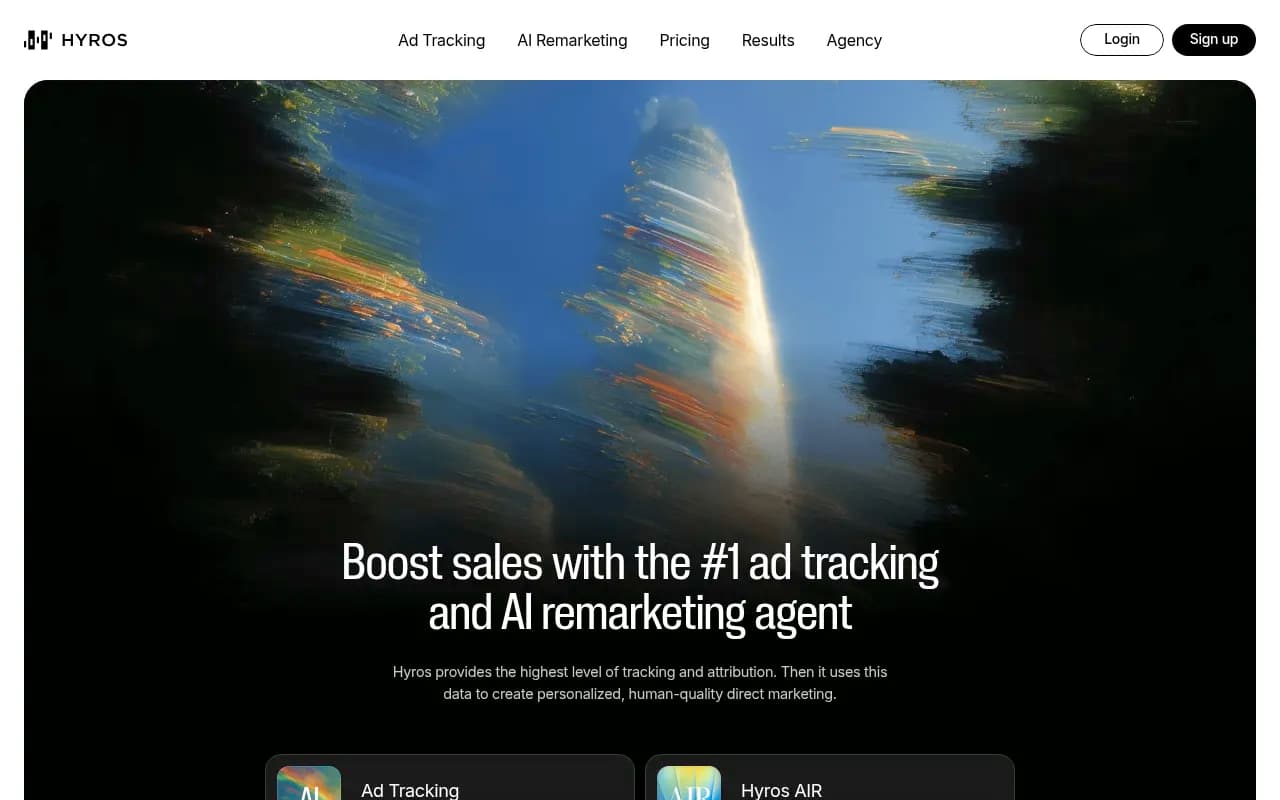
Hyros is an advanced ad tracking and attribution platform that shows exactly which ads drive revenue across Meta, Google, and other channels. Unlike standard pixels that miss conversions, Hyros uses AI attribution to track every sale back to first click, then feeds accurate data back to ad platforms
Key Takeaways:
• Best for: E-commerce brands, info product sellers, and agencies spending $50k+/month on ads who need accurate multi-touch attribution • Core strength: AI-powered tracking that catches conversions standard pixels miss, with average 15%+ revenue lift from better ad optimization • Standout feature: AIR agent system that automates personalized remarketing to every visitor, adding 3-7% more sales on average • Limitation: Premium pricing ($379+/month) makes it overkill for small businesses spending under $20k/month on ads • Bottom line: The most accurate ad attribution system available, but you need serious ad spend to justify the cost
Hyros is an AI-powered ad tracking and attribution platform built for businesses that need to know exactly which ads drive revenue. Founded by Alex Becker (serial entrepreneur who previously built marketing software companies), Hyros has become the go-to attribution solution for high-spending advertisers who can't afford to waste budget on guessing. The platform is used by over 100,000 active businesses including Tony Robbins' companies, Playboy, Dan Bilzerian's brands, and Whop (which reports that most of their 7-figure+ education businesses rely on Hyros). The core problem Hyros solves: standard tracking pixels from Meta, Google, and TikTok routinely miss 20-40% of conversions due to iOS privacy changes, ad blockers, and cross-device customer journeys. When your pixel only sees 60-70% of sales, you're optimizing ads based on incomplete data -- which means you're scaling the wrong campaigns and killing winners. Hyros fixes this with server-side tracking, AI attribution modeling, and persistent visitor identification that catches conversions other systems drop.
AI Attribution & Multi-Touch Tracking
The foundation of Hyros is its attribution engine, which tracks every customer touchpoint from first click through final purchase. Unlike last-click attribution (which only credits the final ad someone clicked) or platform-reported conversions (which miss sales due to tracking limitations), Hyros uses AI modeling to attribute revenue across the entire customer journey. The system tracks visitors across devices, browsers, and sessions using a combination of first-party cookies, server-side tracking, and probabilistic matching. When someone clicks your ad on mobile, browses on desktop, then buys on tablet three days later, Hyros connects all three touchpoints and attributes the sale correctly. The AI attribution model weighs each touchpoint based on its influence on the final conversion -- so you see which ads are actually driving sales vs just getting credit for being the last click. This is critical for businesses with longer sales cycles or multi-step funnels (webinars, lead magnets, email sequences, sales calls). You can view attribution by campaign, ad set, individual ad, creative, keyword, landing page, or any custom parameter you track. The platform supports Meta (Facebook/Instagram), Google Ads, TikTok, YouTube, Snapchat, Pinterest, Twitter/X, LinkedIn, native ads, affiliate traffic, influencer campaigns, and any other paid or organic source.
Server-Side Tracking & Conversion Recovery
Hyros uses server-side tracking to catch conversions that client-side pixels miss. When someone makes a purchase, Hyros receives the conversion data directly from your server (via API, webhook, or integration with your e-commerce platform) rather than relying solely on browser-based tracking. This bypasses iOS privacy restrictions, ad blockers, and cookie deletion that cause standard pixels to lose 20-40% of conversions. The system also includes "print tracking" -- a method that identifies visitors even when they block cookies or use privacy browsers. When Hyros catches a conversion that Meta's pixel missed, it can feed that data back to Meta's Conversions API so the ad platform's algorithm learns from complete data instead of partial data. This improves Meta's targeting and optimization, which typically results in 15-30% better ad performance according to Hyros case studies. The platform tracks not just purchases but also leads, calls, form submissions, email signups, webinar registrations, trial starts, and any custom conversion event you define. You can assign different revenue values to different conversion types (e.g. a sales call is worth $500 in expected revenue even if it doesn't close immediately).
AIR Agent: Automated Personalized Remarketing
Hyros AIR (AI Remarketing) is an AI agent system that automates 1-to-1 personalized marketing to every website visitor. Here's how it works: AIR recognizes visitors using your existing customer data (email lists, CRM records, purchase history, ad click data) and matches them to current website sessions. When it identifies a visitor, it obtains their contact information (email, phone, social profiles) through data enrichment and reverse lookup. Then the AI agent reaches out with personalized messages via email, SMS, direct mail, or retargeting ads. The messages are customized based on what the visitor viewed, their past purchase history, where they are in your funnel, and their behavior patterns. For example: if someone who bought Product A six months ago visits your site and views Product B, AIR can automatically send them an email with a personalized offer for Product B plus a discount code. Or if a visitor abandons cart, AIR can send a text message with their specific cart items and a limited-time discount. The AI handles the entire interaction -- it writes the messages (using your brand voice and guidelines you set), determines optimal send times, follows up based on responses, and escalates to human sales reps when appropriate. Hyros reports that brands adding AIR see 3-7% revenue increases on average because it monetizes traffic that would otherwise leave without converting. The system learns over time which messages, offers, and timing work best for different customer segments.
Real-Time Dashboards & Reporting
Hyros provides real-time dashboards that show exactly which ads are profitable and which are losing money. The main dashboard displays total ad spend, total revenue, overall ROAS (return on ad spend), and profit/loss across all campaigns. You can drill down to see performance by traffic source, campaign, ad set, individual ad, creative, landing page, or any custom dimension. Each view shows impressions, clicks, cost, conversions, revenue, ROAS, cost per acquisition, and profit. The platform includes cohort analysis so you can see how customers acquired in different time periods perform over their lifetime (critical for subscription businesses or products with repeat purchases). There's also a "Print Tracking" report that shows which ads are driving the most valuable customers based on lifetime value, not just initial purchase. The mobile app (iOS and Android) gives you full access to dashboards and reports so you can monitor performance and make optimization decisions from anywhere. All reports can be exported to CSV or accessed via API for custom analysis or integration with other tools.
Ad Platform Integrations & Conversion Feedback
Hyros integrates directly with Meta Ads Manager, Google Ads, TikTok Ads, and other platforms to both pull ad performance data and push conversion data back. The "Conversions API" integration sends accurate conversion data from Hyros back to Meta and Google so their algorithms can optimize based on complete information instead of the partial data their pixels capture. This typically improves campaign performance by 15-30% because the ad platforms' AI targeting works better when it knows which ads actually drive sales. Hyros also integrates with e-commerce platforms (Shopify, WooCommerce, BigCommerce, Magento, custom carts), CRMs (Salesforce, HubSpot, Pipedrive, GoHighLevel), email platforms (Klaviyo, ActiveCampaign, Mailchimp), webinar tools (WebinarJam, Demio), course platforms (Kajabi, Teachable, Thinkific), and payment processors (Stripe, PayPal). The integrations are mostly plug-and-play -- you connect your accounts and Hyros automatically starts tracking conversions and attributing them to ad sources.
Call Tracking & Offline Conversions
For businesses that generate leads via phone calls (local services, B2B, high-ticket offers), Hyros includes call tracking. You get dynamic phone numbers that change based on which ad or campaign the visitor came from, so every call is automatically attributed to the correct traffic source. The system records calls, transcribes them, and uses AI to determine if the call resulted in a sale or qualified lead. You can set rules like "calls over 3 minutes count as qualified leads" or "calls containing keywords 'book appointment' count as conversions." Hyros also tracks offline conversions -- if someone clicks your ad, then later buys in-store or over the phone, you can feed that sale back to Hyros (via CSV upload, API, or CRM integration) and it will attribute the revenue to the original ad click. This is critical for businesses with omnichannel sales (online ads driving in-store purchases, or ads driving calls that close offline).
AI Forecasting & Budget Recommendations
Hyros includes AI-powered forecasting that predicts future performance based on current trends. The system analyzes your historical data and current campaign performance to project revenue, ROAS, and profit over the next 7, 30, or 90 days. It also provides budget recommendations -- suggesting which campaigns to scale up, which to scale down, and optimal daily budgets for each. The AI considers factors like audience saturation, creative fatigue, seasonal trends, and diminishing returns at higher spend levels. For example, it might recommend increasing budget on Campaign A by 50% because it's still performing well at current spend, while suggesting you cut Campaign B by 30% because ROAS is declining as you scale. The forecasting helps you plan cash flow and inventory (if you know you'll do $500k in sales next month, you can order inventory accordingly).
Who Is Hyros For
Hyros is built for businesses spending serious money on paid ads -- typically $50,000+ per month across Meta, Google, TikTok, or other platforms. The ideal customer is an e-commerce brand doing $2M+ in annual revenue, an info product seller with high-ticket offers ($500+ products or courses), or a digital agency managing ad spend for multiple clients. Specific use cases where Hyros excels: supplement brands running Meta ads with complex funnels (advertorial -> quiz -> checkout), course creators with webinar funnels (ad -> webinar registration -> email sequence -> sales call -> purchase), SaaS companies with free trial funnels, local service businesses generating leads via Google Ads and Facebook, and B2B companies with long sales cycles (ad -> lead magnet -> nurture sequence -> demo -> close). The platform is particularly valuable for businesses with multi-step funnels, repeat purchases, or high lifetime value customers -- because standard attribution tools only track the initial conversion and miss the full customer value. Hyros is also popular with agencies because it provides white-label reporting and multi-client management (you can track dozens of client accounts from one dashboard). Who should NOT use Hyros: small businesses spending under $20k/month on ads (the cost doesn't justify the benefit at that scale), businesses with simple one-step funnels where Meta's pixel works fine, or anyone who isn't actively optimizing their ads based on data (if you're not making decisions based on attribution reports, you won't get value from better attribution).
Integrations & Ecosystem
Hyros integrates with 50+ platforms across e-commerce, CRM, email, webinars, courses, payments, and ads. Key integrations: Shopify, WooCommerce, BigCommerce, Magento, Salesforce, HubSpot, Pipedrive, GoHighLevel, Klaviyo, ActiveCampaign, Mailchimp, WebinarJam, Demio, Kajabi, Teachable, Thinkific, ClickFunnels, Stripe, PayPal, Meta Ads, Google Ads, TikTok Ads, Snapchat Ads, Pinterest Ads, LinkedIn Ads. The platform offers a full API for custom integrations and data export. There's also a Zapier integration for connecting to 1000+ other tools. Hyros provides webhooks so you can push conversion data to other systems in real-time. The mobile app (iOS and Android) gives full access to dashboards and reports. There's a browser extension for Chrome that shows Hyros attribution data directly in Meta Ads Manager and Google Ads (so you can see true ROAS next to platform-reported ROAS without switching tabs).
Pricing & Value
Hyros pricing starts at $379/month for the base plan, which includes tracking for one domain, up to $50k/month in tracked ad spend, and core attribution features. The mid-tier plan is $799/month (up to $150k/month ad spend, multiple domains, advanced features like call tracking and AIR agent). Enterprise pricing is custom based on ad spend volume and feature requirements. All plans include VIP support (dedicated account manager, onboarding, and ongoing optimization help). There's no free trial, but Hyros offers a 30-day money-back guarantee. Compared to competitors: Hyros is more expensive than basic attribution tools like TripleWhale ($129/mo) or Northbeam ($500/mo), but it provides significantly more accurate tracking and includes the AIR agent for automated remarketing (which competitors lack). For businesses spending $100k+/month on ads, the 15-30% improvement in ad performance typically pays for Hyros many times over. The ROI calculation: if you're spending $100k/month on ads at 3x ROAS ($300k revenue), and Hyros helps you improve to 3.5x ROAS ($350k revenue), that's $50k extra revenue per month -- which easily justifies the $799/month cost. However, for smaller businesses spending $10-20k/month on ads, the cost is harder to justify unless they have very high margins or complex funnels where attribution is critical.
Strengths & Limitations
Strengths: (1) Most accurate ad attribution available -- catches conversions other systems miss due to iOS privacy, ad blockers, and cross-device journeys. (2) AIR agent system is unique -- no other attribution platform includes automated AI remarketing that personalizes messages to every visitor. (3) Feeds accurate conversion data back to Meta/Google via Conversions API, which improves ad platform targeting and typically boosts performance 15-30%. (4) Tracks offline conversions (phone calls, in-store purchases) and attributes them to online ads. (5) White-label reporting and multi-client management make it ideal for agencies. Limitations: (1) Premium pricing ($379+/month) makes it cost-prohibitive for small businesses spending under $20k/month on ads. (2) Setup requires technical knowledge -- you need to install tracking scripts, configure integrations, and set up conversion events (though VIP support helps with this). (3) The platform is complex with dozens of reports and features -- there's a learning curve to understand all the data and make optimal decisions. (4) AIR agent requires existing customer data to work well -- if you're a brand new business with no email list or CRM data, AIR won't have much to work with initially.
Bottom Line
Hyros is the best ad attribution platform for businesses spending $50k+/month on paid ads who need to know exactly which campaigns drive revenue. The AI-powered tracking catches conversions that standard pixels miss, the AIR agent automates personalized remarketing to every visitor, and the Conversions API integration improves ad platform targeting. If you're scaling ad spend and can't afford to waste budget on guessing, Hyros pays for itself many times over. However, the premium pricing and complexity make it overkill for small businesses or anyone not actively optimizing ads based on data. Best use case in one sentence: E-commerce brands and info product sellers spending $100k+/month on Meta/Google ads who need accurate multi-touch attribution and automated remarketing to maximize ROAS.
Tags:
Similar and alternative tools to Hyros