Apollo.io Review 2026
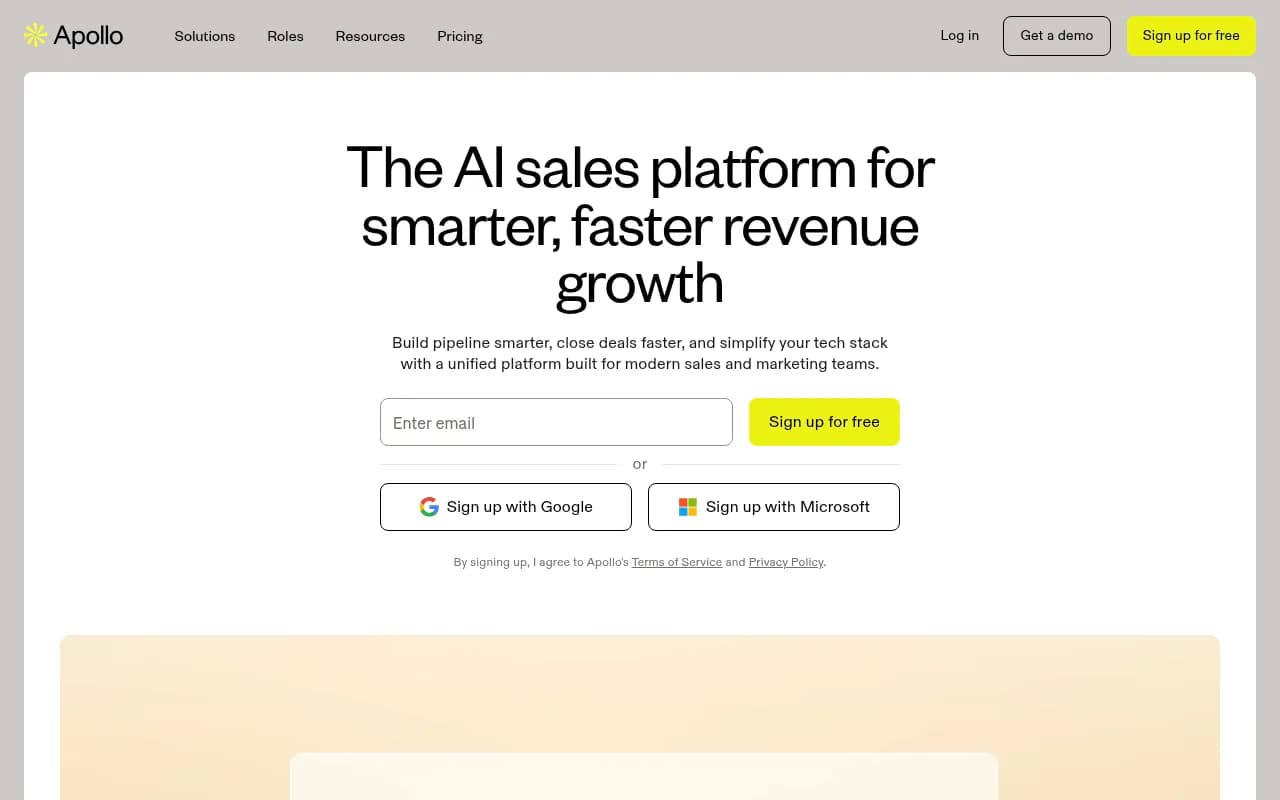
Provides B2B contact data, prospecting tools, and sales engagement features for outbound sales teams to find leads and automate outreach at scale.
Key Takeaways
• Comprehensive sales platform: Apollo.io combines B2B contact data (210M+ contacts, 30M+ companies), outreach automation, inbound lead capture, and deal execution in one platform—replacing 5+ separate tools • Strong data accuracy: Verified emails and phone numbers with built-in deliverability guardrails help teams achieve 36% connection rates and 75% more booked meetings • Best for outbound-focused teams: Ideal for SDRs, BDRs, and sales teams at B2B companies (SaaS, agencies, tech) running high-volume prospecting campaigns • Pricing starts at $49/user/month: More expensive than pure data providers but competitive when replacing multiple tools. Free plan available with limited credits • Honest limitation: While feature-rich, the platform can feel overwhelming for small teams or solo users who only need basic contact data
Apollo.io has become one of the most widely adopted sales intelligence platforms in B2B sales, used by over 500,000 companies ranging from early-stage startups to enterprises like Kinsta, Census, and Built In. Launched as a contact database, Apollo has evolved into a full sales execution platform that handles everything from finding leads to closing deals. The company has raised significant funding and continues to expand its data network and AI capabilities, positioning itself as a direct competitor to tools like ZoomInfo, Outreach, and SalesLoft combined.
The platform targets B2B sales teams—particularly SDRs, BDRs, account executives, and revenue operations teams—who need both accurate contact data and the automation tools to act on it. Apollo is especially popular among SaaS companies, agencies, and tech firms running outbound prospecting motions at scale. It's designed for teams that want to consolidate their tech stack rather than juggling separate tools for data, sequencing, enrichment, and dialing.
Core Features Breakdown
B2B Contact & Company Database: Apollo's foundation is its massive database of 210 million contacts and 30 million companies. Unlike some competitors that rely purely on web scraping, Apollo combines multiple data sources with community verification (users contribute data when they interact with contacts). The database includes verified email addresses, direct dial phone numbers, job titles, company information, technographics, and firmographics. Search filters are exceptionally granular—you can target by job title, seniority level, department, company size, revenue range, industry, location, technologies used, funding stage, and even buyer intent signals. The data quality is generally strong, with email verification built in, though accuracy varies by region (US and Western Europe data is most reliable). Apollo claims 65%+ email accuracy rates, which is competitive with ZoomInfo and better than most pure scraping tools.
Outbound Sales Automation: This is where Apollo shines for prospecting teams. The platform includes full email sequencing with multichannel touchpoints (email, LinkedIn, phone calls). You can build sequences with multiple steps, A/B test subject lines and messaging, and set up conditional logic (if prospect opens but doesn't reply, send X; if no open, send Y). The AI-powered sequence builder can generate entire campaigns based on your target persona and value proposition. Built-in email deliverability features include spam score checking, send time optimization, and automatic throttling to protect your domain reputation. The dialer is integrated directly into sequences, so reps can make calls without switching tools. Task prioritization automatically surfaces the hottest leads based on engagement signals. One standout feature: workflow automations that let you trigger actions based on prospect behavior (e.g., if someone visits your pricing page, automatically add them to a high-intent sequence).
Inbound Lead Conversion: Apollo's inbound capabilities help marketing and sales teams capture and act on website visitors and form fills instantly. Anonymous visitor identification reveals which companies are browsing your site, even if they don't fill out a form. Real-time form enrichment automatically appends missing data (job title, phone number, company size) when someone submits a lead form. Instant routing uses built-in round-robin logic and calendar scheduling to book meetings immediately—no back-and-forth emails. Automated nurture sequences can engage leads who aren't ready to buy yet. This module essentially replaces tools like Clearbit Reveal, Chili Piper, and basic marketing automation platforms.
Data Enrichment: Apollo continuously enriches your existing CRM and marketing automation data. It can automatically fill in missing fields on contacts and accounts, update job changes, and append new data points. The enrichment runs in the background via native integrations with Salesforce, HubSpot, Pipedrive, and others, or through API and CSV uploads. This keeps your database clean without manual work. Apollo also offers reverse enrichment—if you have an email address, it can find the associated LinkedIn profile, phone number, and company details. The enrichment credits are separate from export credits, which is important for pricing considerations.
Deal Execution & Meeting Intelligence: Apollo's newer deal execution features help reps prepare for and follow up on sales conversations. Pre-meeting insights pull relevant data about the prospect and their company so reps can prep in seconds. The AI meeting assistant records calls (with consent), generates summaries, extracts action items, and automatically creates follow-up tasks in your CRM. Pipeline boards provide a visual view of deals with drag-and-drop stage management. Real-time deal alerts notify reps when key actions happen (contract viewed, pricing page visited). Conversation intelligence analyzes call recordings to surface coaching opportunities and track talk-to-listen ratios, competitor mentions, and objection patterns. This competes directly with Gong and Chorus.ai, though Apollo's conversation intelligence is less mature than those dedicated platforms.
Integrations & Ecosystem: Apollo integrates natively with major CRMs (Salesforce, HubSpot, Pipedrive, Zoho, Microsoft Dynamics), syncing contacts, activities, and pipeline data bidirectionally. It also connects with LinkedIn Sales Navigator (you can import leads directly), Slack (for notifications), Zapier (for custom workflows), and calendar tools (Google Calendar, Outlook). The Chrome extension lets you find contact info and add prospects to sequences while browsing LinkedIn or company websites. Apollo offers a robust API for custom integrations and data syncing. Mobile apps for iOS and Android allow reps to manage tasks and make calls on the go. The platform also has a Salesforce-native version that runs entirely within Salesforce for teams that want a unified interface.
AI-Powered Features: Apollo has been aggressively adding AI capabilities. The AI sequence generator creates personalized email copy based on your ICP and value prop. AI-powered lead scoring predicts which prospects are most likely to convert based on engagement patterns and firmographic fit. The AI meeting assistant handles call transcription and summarization. AI recommendations suggest which contacts to prioritize and what actions to take next. While these features are useful, they're not as sophisticated as dedicated AI sales tools—think of them as solid productivity boosters rather than game-changing intelligence.
Who Is It For
Apollo is best suited for B2B sales teams at companies with $1M+ in revenue running structured outbound prospecting motions. The sweet spot is sales teams of 5-50 reps at SaaS companies, agencies, and tech firms selling to mid-market and enterprise accounts. SDRs and BDRs get the most value—teams like Cyera's BDR org increased meetings booked by 75% after switching to Apollo. Account executives benefit from the enrichment and deal execution features. Revenue operations teams love Apollo for consolidating their tech stack and maintaining clean CRM data.
Specific personas who thrive with Apollo: SaaS sales teams prospecting into specific verticals (e.g., targeting HR directors at 500-2000 employee companies in healthcare), agencies building client lists, recruiting firms sourcing candidates, and marketing teams running ABM campaigns. Companies doing high-volume cold outreach (50+ emails per day per rep) see the biggest ROI because they're maximizing the data and automation.
Who should NOT use Apollo: Solo consultants or freelancers who only need occasional contact lookups (the pricing doesn't make sense for low-volume use—stick with Hunter.io or RocketReach). Teams selling to consumers or small local businesses (Apollo's database focuses on B2B companies with 10+ employees). Companies in highly regulated industries that prohibit automated outreach. Sales teams that only do inbound or partner-led sales won't use most of Apollo's features. If you're just looking for a contact database without automation, you're overpaying—use a cheaper data-only tool.
Integrations & Ecosystem
Apollo's integration ecosystem is mature and well-documented. Native CRM integrations with Salesforce, HubSpot, Pipedrive, Zoho CRM, and Microsoft Dynamics 365 sync contacts, accounts, opportunities, and activities bidirectionally. The Salesforce integration is particularly deep, with a native app that embeds Apollo directly in Salesforce layouts. HubSpot users can enrich contacts automatically and sync sequence activity to contact timelines.
The Chrome extension is essential for most users—it overlays contact data on LinkedIn profiles, company websites, and Gmail, letting you add prospects to sequences without leaving your browser. LinkedIn Sales Navigator integration allows direct import of saved leads. Calendar integrations (Google Calendar, Outlook, Calendly) enable instant meeting booking from sequences.
Zapier connectivity opens up thousands of workflow possibilities (e.g., add new Typeform submissions to Apollo sequences, create Slack alerts for high-intent prospects). The API is RESTful and well-documented, used by technical teams to build custom data pipelines and sync Apollo with internal tools. Webhooks allow real-time event notifications.
Mobile apps for iOS and Android provide core functionality—viewing tasks, making calls, updating contact info—though the mobile experience is more limited than desktop. No dedicated iPad app. The platform also offers CSV import/export for bulk operations, useful for data migrations or offline analysis.
One notable gap: Apollo doesn't integrate natively with some newer sales tools like Clay or Instantly.ai, requiring Zapier or API workarounds. The conversation intelligence features don't integrate with Zoom or Microsoft Teams recordings—you need to use Apollo's dialer to capture calls.
Pricing & Value
Apollo offers four pricing tiers plus custom enterprise plans. The Free plan includes unlimited email finder credits (with verification), 60 mobile phone credits per year, 120 export credits per year, and 10 contact exports per month. It's genuinely useful for very light prospecting but too limited for regular use.
Paid plans start at $49 per user per month (billed annually) or $59/month (billed monthly) for the Basic plan. This includes unlimited email credits, 900 mobile phone credits per year, 12,000 export credits per year, email sequences, and basic integrations. The Professional plan costs $99/user/month (annual) or $119/month (monthly), adding advanced filters, A/B testing, call recording, and API access. The Organization plan at $149/user/month (annual) or $179/month (monthly) includes team analytics, advanced permissions, and priority support.
Enterprise pricing is custom and includes dedicated support, custom data requests, advanced security features, and higher credit limits. Most mid-sized sales teams (10-30 reps) end up on Professional or Organization plans, putting total costs at $12,000-$54,000 annually.
Credit system nuances: Export credits are separate from email finder credits. Exporting a contact with email + phone uses more credits than email alone. Mobile phone credits are more limited than email credits. Enrichment credits are separate and consumed when auto-enriching CRM records. Heavy users can burn through credits quickly, requiring add-on purchases.
Value assessment: Apollo is expensive compared to pure data providers like Hunter.io ($49/month for unlimited searches) or RocketReach ($39/month for 170 lookups). However, when you consider it replaces Outreach ($100+/user/month), ZoomInfo ($15,000+/year), a dialer ($30+/user/month), and enrichment tools ($50+/month), the consolidated pricing becomes competitive. Census cut their tech stack costs by 64% by switching to Apollo. Predictable Revenue saved 50% on tools.
The free trial is limited but functional—you can test core features before committing. No credit card required for the free plan. Annual billing saves 17% vs monthly.
Strengths & Limitations
What Apollo does exceptionally well:
• All-in-one consolidation: Genuinely replaces 5+ tools (data provider, sequencer, dialer, enrichment, basic CRM) with one platform, simplifying workflows and reducing costs for teams willing to go all-in • Data quality and coverage: 210M+ contacts with verified emails and direct dials, particularly strong in US/Canada/UK markets. The community verification model improves accuracy over time • Outbound automation depth: Sequence builder is powerful with conditional logic, A/B testing, and multichannel touchpoints. Built-in deliverability features protect sender reputation • Ease of use: Interface is intuitive for sales reps (not overly technical). Onboarding is smooth with templates and tutorials. Chrome extension makes prospecting seamless • Integration quality: Native CRM syncs are reliable and bidirectional. Salesforce integration is particularly robust
Honest limitations:
• Credit system complexity: The multiple credit types (email, phone, export, enrichment) are confusing and easy to burn through. Heavy users hit limits quickly and face unexpected overage costs • International data gaps: Data quality drops significantly outside North America and Western Europe. APAC and LATAM coverage is weak compared to ZoomInfo • Feature overload for small teams: Solo users or small teams (1-3 people) don't need most features and would be better served by simpler, cheaper tools. The platform can feel overwhelming • Conversation intelligence is basic: The meeting assistant and call analytics are useful but not as sophisticated as Gong or Chorus.ai. If conversation intelligence is critical, you'll still need a dedicated tool • Compliance concerns: Automated outreach at scale requires careful GDPR/CAN-SPAM compliance. Apollo provides tools but doesn't prevent misuse. Some users have reported deliverability issues from over-aggressive sending
Bottom Line
Apollo.io is the best all-in-one sales intelligence platform for B2B teams that want to consolidate their prospecting, outreach, and data enrichment tools into one system. It's particularly strong for outbound-focused sales teams at SaaS companies, agencies, and tech firms with 5-50 reps who need both high-quality contact data and the automation to act on it at scale. Teams like Cyera, Kinsta, and Census have seen 36-75% improvements in key metrics after switching to Apollo.
Buy Apollo if you're currently paying for separate tools for contact data, email sequencing, dialing, and enrichment—the consolidation will likely save money and simplify workflows. It's also ideal if you're scaling an SDR or BDR team and need a platform that can grow with you.
Skip Apollo if you're a solo seller or very small team (1-3 people) who only needs occasional contact lookups—the pricing and feature set are overkill. Also skip it if you're selling outside North America/Europe (weak data coverage), only do inbound sales (won't use most features), or need best-in-class conversation intelligence (Gong is better).
Best use case in one sentence: High-growth B2B sales teams running structured outbound prospecting at scale who want to replace 5+ tools with one unified platform for finding leads, automating outreach, and closing deals faster.
Tags:
Similar and alternative tools to Apollo.io