Summary
- Citation source analysis tracks which websites, tools, and platforms AI models cite when answering prompts related to your product category -- revealing untapped partnership and integration opportunities
- SaaS companies use citation data to identify which complementary tools their target customers already use, then prioritize integrations that increase product stickiness and reduce churn
- Tracking competitor citations shows which partnerships are driving their AI visibility, helping you spot gaps in your own integration strategy
- Reddit threads, YouTube videos, and community discussions that AI models cite frequently signal high-value content partnerships and co-marketing opportunities
- Tools like Promptwatch provide citation-level tracking across ChatGPT, Perplexity, Claude, and other AI search engines, making it possible to analyze citation sources at scale

What is citation source analysis and why does it matter for SaaS?
Citation source analysis is the process of tracking which URLs, domains, and content sources AI models reference when generating answers. When ChatGPT recommends a project management tool or Perplexity suggests a CRM integration, it's citing specific sources -- documentation pages, comparison articles, Reddit threads, YouTube reviews. Those citations are data.
For SaaS companies, this data reveals something traditional market research can't: which tools, platforms, and content ecosystems AI models trust when making recommendations in your category. That trust translates into visibility. If AI models consistently cite Zapier's integration directory when users ask about workflow automation, that's a signal. If they reference a specific Slack community when discussing customer support tools, that's another signal.
The shift to AI search changes how buyers discover and evaluate software. According to 2026 SaaS marketing research, over 60% of B2B software buyers now start their research with AI assistants instead of Google. They're asking ChatGPT "What CRM integrates with HubSpot?" or Perplexity "Best alternatives to Salesforce for small teams." The tools that get cited in those answers win the deal.
Citation source analysis turns that dynamic into a strategic advantage. Instead of guessing which partnerships matter, you see exactly which integrations, platforms, and content sources are driving recommendations in your space.
How citation data reveals integration opportunities
When you analyze citation sources across hundreds or thousands of AI-generated answers, patterns emerge. You start to see which tools appear together, which platforms AI models treat as complementary, and which integrations users are actively asking about.
Here's what that looks like in practice. A marketing automation SaaS runs citation analysis for prompts like "best email marketing tools for e-commerce" and "how to automate abandoned cart emails." They notice that Shopify documentation pages get cited in 40% of responses. WooCommerce appears in another 25%. Stripe's API docs show up when users ask about payment-triggered email flows.
Those citations aren't random. They reflect what AI models learned from training data -- which tools are discussed together, which integrations solve real problems, which platforms have strong developer ecosystems. The marketing automation company now knows: if we don't have native Shopify and WooCommerce integrations, we're invisible in the most common AI-generated recommendations for our category.
Citation analysis also surfaces non-obvious opportunities. Maybe you discover that YouTube videos from a specific creator get cited frequently when users ask about your product category. That's a co-marketing opportunity -- sponsor their content, collaborate on a tutorial, or build a case study together. Or you find that a niche Slack community's public discussions appear in citations. Join that community, contribute value, and your brand becomes part of the citation loop.
The key insight: AI models cite sources that users trust and that provide clear, actionable information. If your integration documentation is thin or your API guides are hard to follow, you won't get cited -- even if the integration exists. Citation analysis shows you where to invest in content and partnerships that actually move the needle.
Using competitor citation data to find partnership gaps
Your competitors' citations are a roadmap. When AI models cite a competitor's integration page or partnership announcement, they're signaling which relationships drive visibility in your category.
Start by tracking prompts where competitors rank but you don't. Tools like Promptwatch let you monitor competitor mentions across AI engines and drill down into the specific sources being cited. You'll see patterns: Competitor A gets cited because they have a detailed Zapier integration page. Competitor B appears in answers because they published a joint case study with Salesforce. Competitor C shows up because their founder did a podcast interview that's now indexed and cited by AI models.
Those citations tell you what's missing from your own strategy. If competitors are getting cited for integrations you don't have, that's a prioritization signal. If they're benefiting from content partnerships you haven't pursued, you know where to focus outreach efforts.
Here's a concrete example from a B2B SaaS company in the sales intelligence space. They ran citation analysis and found that ZoomInfo and Apollo.io were consistently cited in answers about "sales prospecting tools with CRM integration." Digging into the citation sources, they discovered both competitors had published detailed integration guides for HubSpot, Salesforce, and Pipedrive -- and those guides were being cited by ChatGPT and Perplexity.
The company didn't have comparable documentation. They had the integrations, but the content explaining how to use them was buried in a generic help center. They rewrote their integration docs, published use-case-specific guides, and added video walkthroughs. Within six weeks, their citation rate for CRM-related prompts increased by 35%.
Reddit, YouTube, and community citations: the hidden partnership layer
AI models don't just cite official documentation and SaaS landing pages. They cite Reddit threads, YouTube videos, Quora answers, and community forum discussions. These sources carry weight because they reflect real user experiences and unfiltered opinions.
For SaaS companies, this creates a new category of partnership opportunity: content and community partnerships. If a specific subreddit or YouTube channel gets cited frequently in your category, that's a signal to engage with that community or creator.
Example: A project management SaaS notices that r/productivity threads comparing Notion, ClickUp, and Asana get cited in 20% of AI-generated answers about project management tools. They also see that a YouTube channel called "Tool Finder" has multiple videos cited when users ask about project management software.
The company reaches out to the YouTube creator for a sponsored deep-dive video. They also start participating authentically in r/productivity, answering questions and sharing use cases without being promotional. Over time, their brand starts appearing in those community discussions -- and those discussions start getting cited by AI models.
This isn't traditional influencer marketing. It's strategic visibility engineering. You're not just buying reach; you're embedding your brand in the content ecosystems that AI models trust and cite.
Promptwatch tracks Reddit and YouTube citations alongside traditional web sources, making it easier to identify these community-driven opportunities. You can see which subreddits, channels, and forum threads are driving citations in your category, then prioritize partnerships accordingly.
Building an integration roadmap from citation insights
Citation data should inform your product roadmap, not just your marketing strategy. When you see consistent citation patterns around specific integrations or platforms, that's a product signal.
Here's a framework for turning citation analysis into an integration roadmap:
1. Identify high-citation platforms in your category. Run citation analysis for your top 50-100 prompts (the queries where you want to rank in AI search). Track which platforms, tools, and APIs get cited most frequently. Create a ranked list.
2. Cross-reference with customer data. Pull usage data from your CRM and product analytics. Which of the high-citation platforms do your existing customers already use? Prioritize integrations that overlap -- these are table-stakes integrations you need to have.
3. Spot the gaps. Look for platforms that get cited frequently but that your customers aren't using yet. These represent expansion opportunities -- integrations that could help you reach new customer segments or use cases.
4. Evaluate integration depth. Not all integrations are equal. A basic Zapier connection might get you cited, but a native two-way sync with rich functionality will get you cited more often and in more valuable contexts. Citation analysis shows you which integrations need deeper investment.
5. Document and promote. Build the integration, then create the content that gets cited: detailed setup guides, use-case tutorials, video walkthroughs, and API documentation. Publish this content on your site, in your help center, and on the partner's platform (if they have a marketplace or integration directory).
This process turns citation analysis into a repeatable system for identifying and prioritizing partnerships that actually drive AI visibility and customer acquisition.
Tracking citation sources at scale: tools and workflows
Manual citation analysis doesn't scale. If you're tracking 100+ prompts across multiple AI engines, you need automation.
Most AI visibility platforms provide basic citation tracking, but the depth varies. Here's what to look for:
| Feature | Why it matters | Tools that have it |
|---|---|---|
| Citation-level tracking | See the exact URLs AI models cite, not just whether your brand was mentioned | Promptwatch, Profound, Otterly.AI |
| Reddit & YouTube citations | Identify community and content partnership opportunities | Promptwatch, Profound |
| Competitor citation analysis | Understand which sources drive your competitors' visibility | Promptwatch, Profound, Scrunch |
| Citation frequency over time | Track whether your content is gaining or losing citation share | Promptwatch, Profound |
| Multi-engine coverage | Citations vary by AI model; track ChatGPT, Perplexity, Claude, Gemini, etc. | Promptwatch, Profound, Otterly.AI |
Promptwatch stands out because it combines citation tracking with content gap analysis and an AI writing agent. You can see which citations you're missing, then generate the content that fills those gaps -- all in one platform. Most competitors (Otterly.AI, Peec.ai, AthenaHQ) stop at monitoring. Promptwatch helps you take action.
Other tools worth considering:
Profound

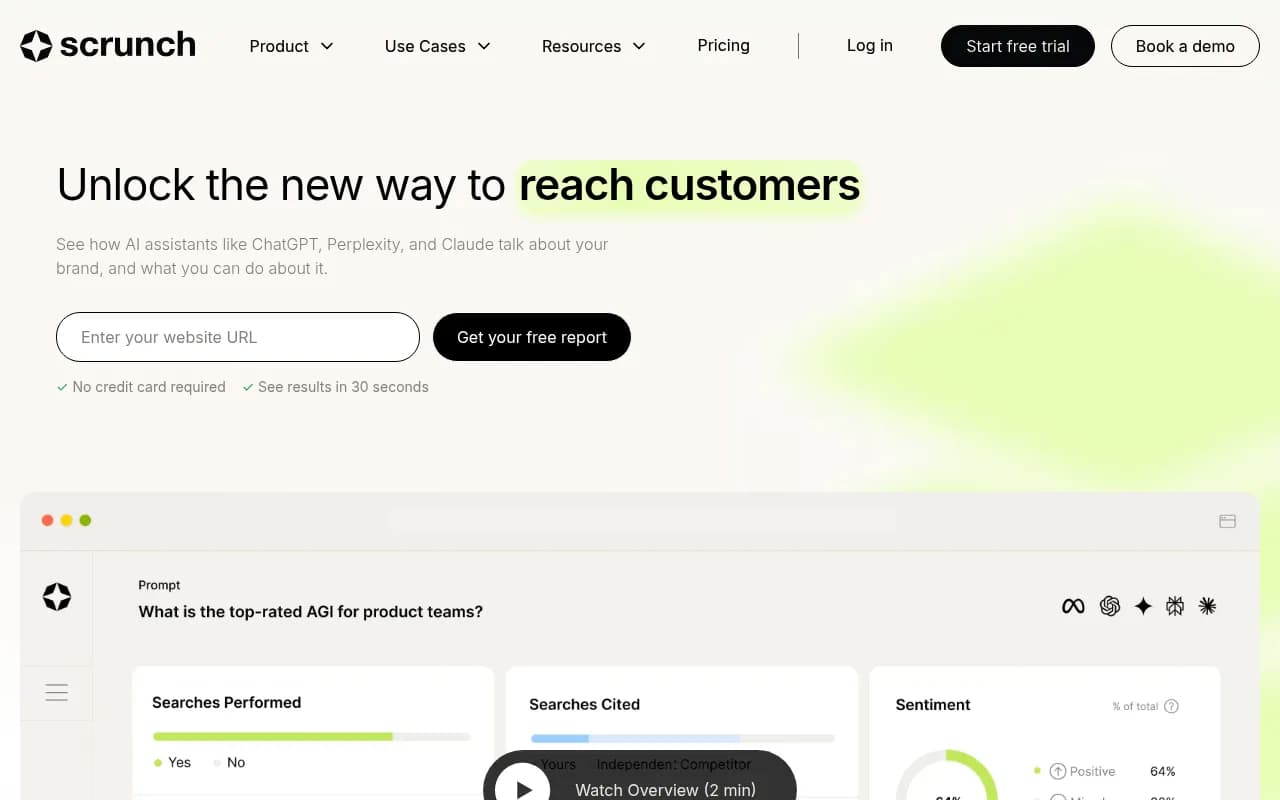
Otterly.AI

For teams that want to build custom citation analysis workflows, the process looks like this:
- Collect AI responses at scale. Use an AI visibility platform or build a scraper that queries AI engines with your target prompts.
- Extract citation URLs. Parse the responses to pull out cited sources (most AI models include clickable citations or footnotes).
- Categorize citations. Tag each URL by type (competitor site, documentation, Reddit, YouTube, news article, etc.) and by domain.
- Analyze patterns. Aggregate the data to see which domains, platforms, and content types get cited most often.
- Act on insights. Use the data to prioritize integrations, content partnerships, and documentation improvements.
This workflow is time-consuming if you're doing it manually, which is why most SaaS companies use a platform like Promptwatch to automate it.
Real-world example: how a SaaS company used citation analysis to double integration-driven signups
A B2B marketing automation platform was struggling with churn. Customers who integrated the platform with their CRM stayed longer and spent more, but only 30% of new signups were completing integrations within the first 30 days.
The team ran citation analysis to understand which integrations mattered most. They tracked prompts like "best marketing automation for HubSpot users" and "how to sync email campaigns with Salesforce." The data showed that HubSpot and Salesforce integrations were cited in 65% of relevant AI-generated answers -- but the company's integration documentation was thin and hard to find.
They made three changes:
- Rewrote integration guides. Created step-by-step setup tutorials with screenshots, video walkthroughs, and troubleshooting sections for HubSpot and Salesforce.
- Published use-case content. Wrote articles like "How to automate lead scoring between [Platform] and HubSpot" and "5 ways to sync email performance data with Salesforce." These articles targeted the exact prompts where they wanted to rank.
- Partnered with HubSpot and Salesforce. Got their integration listed in both partners' marketplaces and co-published a case study with a mutual customer.
Results after 90 days:
- Citation rate for integration-related prompts increased from 12% to 34%
- Integration completion rate among new signups jumped from 30% to 52%
- Churn among integrated customers dropped by 18%
The key insight: citation analysis didn't just improve AI visibility. It revealed which integrations drove retention, then helped the team build the content and partnerships that made those integrations more discoverable.
Common mistakes SaaS companies make with citation analysis
Citation analysis is powerful, but easy to mess up. Here are the mistakes we see most often:
Tracking vanity metrics instead of actionable data. Counting total citations doesn't matter if you're not analyzing which sources are being cited and why. Focus on citation sources, not citation volume.
Ignoring community and user-generated content. Reddit threads and YouTube videos often carry more weight with AI models than official marketing pages. If you're only tracking citations from competitor websites and documentation, you're missing half the picture.
Not connecting citation data to product decisions. Citation analysis should inform your integration roadmap, not just your content calendar. If you're seeing consistent citation patterns around a specific platform, that's a product signal.
Treating citation analysis as a one-time project. Citation patterns shift as AI models retrain and as new content gets published. Set up ongoing monitoring so you can spot trends early.
Focusing only on your own citations. Competitor citation analysis is just as valuable. If your competitors are getting cited for integrations or partnerships you don't have, that's a gap you need to close.
The future of citation-driven partnerships
AI search is still evolving. As models get better at understanding context and user intent, citation patterns will shift. But the core dynamic won't change: AI models will continue to cite sources they trust, and SaaS companies that understand those citation patterns will have a strategic advantage.
We're already seeing early signals of what's next:
AI agents as integration partners. As AI agents become more autonomous, they'll need to connect with SaaS tools to complete tasks. Citation analysis will help SaaS companies understand which agents are recommending their platform and which integrations those agents need.
Citation-based attribution. SaaS companies will start tracking not just whether they're cited, but whether those citations drive signups and revenue. Platforms like Promptwatch are already building traffic attribution features that connect AI visibility to actual conversions.
Partnership marketplaces optimized for AI visibility. Integration marketplaces (like Zapier, HubSpot's App Marketplace, and Salesforce AppExchange) will start optimizing their listings for AI citations. SaaS companies will need to treat these marketplaces as citation sources, not just distribution channels.
The companies that figure this out early will have a compounding advantage. Every integration you build, every partnership you form, and every piece of documentation you publish becomes a potential citation source. Over time, those citations accumulate -- and your AI visibility grows.
Getting started with citation source analysis
If you're new to citation analysis, start small. Pick 10-20 high-value prompts where you want to rank in AI search. Use a tool like Promptwatch to track which sources get cited when AI models answer those prompts. Look for patterns: which platforms appear most often? Which competitors are getting cited? Which types of content (documentation, Reddit threads, YouTube videos) show up?
Once you have that baseline data, prioritize one or two actions:
- If you're missing citations for an integration you already have, improve your documentation and publish use-case content.
- If competitors are getting cited for partnerships you don't have, evaluate whether those partnerships are worth pursuing.
- If community content (Reddit, YouTube) is driving citations, engage with those communities or partner with those creators.
Citation analysis isn't a magic bullet. But it's one of the few ways to see, with data, which partnerships and integrations actually matter for AI visibility. And in 2026, AI visibility is the new SEO.
Frequently asked questions
How often should I run citation analysis?
Run it monthly at minimum. Citation patterns shift as AI models retrain and as new content gets published. If you're in a fast-moving category, consider weekly tracking.
Can I do citation analysis manually?
Yes, but it doesn't scale. You can query AI engines manually and note which sources they cite, but if you're tracking more than 10-20 prompts, you'll want automation. Tools like Promptwatch handle this at scale.
What's the difference between citation tracking and brand monitoring?
Brand monitoring tells you whether your brand was mentioned. Citation tracking tells you which sources AI models used to generate that mention. Citation data is more actionable because it shows you what content and partnerships drive visibility.
Do all AI models cite sources the same way?
No. ChatGPT, Perplexity, Claude, and Gemini all have different citation behaviors. Perplexity tends to cite more sources per answer. ChatGPT is more selective. Track multiple models to get a complete picture.
How do I know if a citation source is worth partnering with?
Look at citation frequency (how often it appears), citation context (is it cited for high-value prompts?), and audience overlap (do your target customers engage with this source?). A Reddit thread cited once isn't worth much. A YouTube channel cited in 20% of your category's prompts is worth reaching out to.
Can citation analysis help with churn reduction?
Yes. If you track which integrations are cited most often and prioritize those in your product roadmap, you'll build the integrations that keep customers sticky. Integrated customers churn less -- citation analysis helps you figure out which integrations matter most.