Gumshoe AI Review 2026
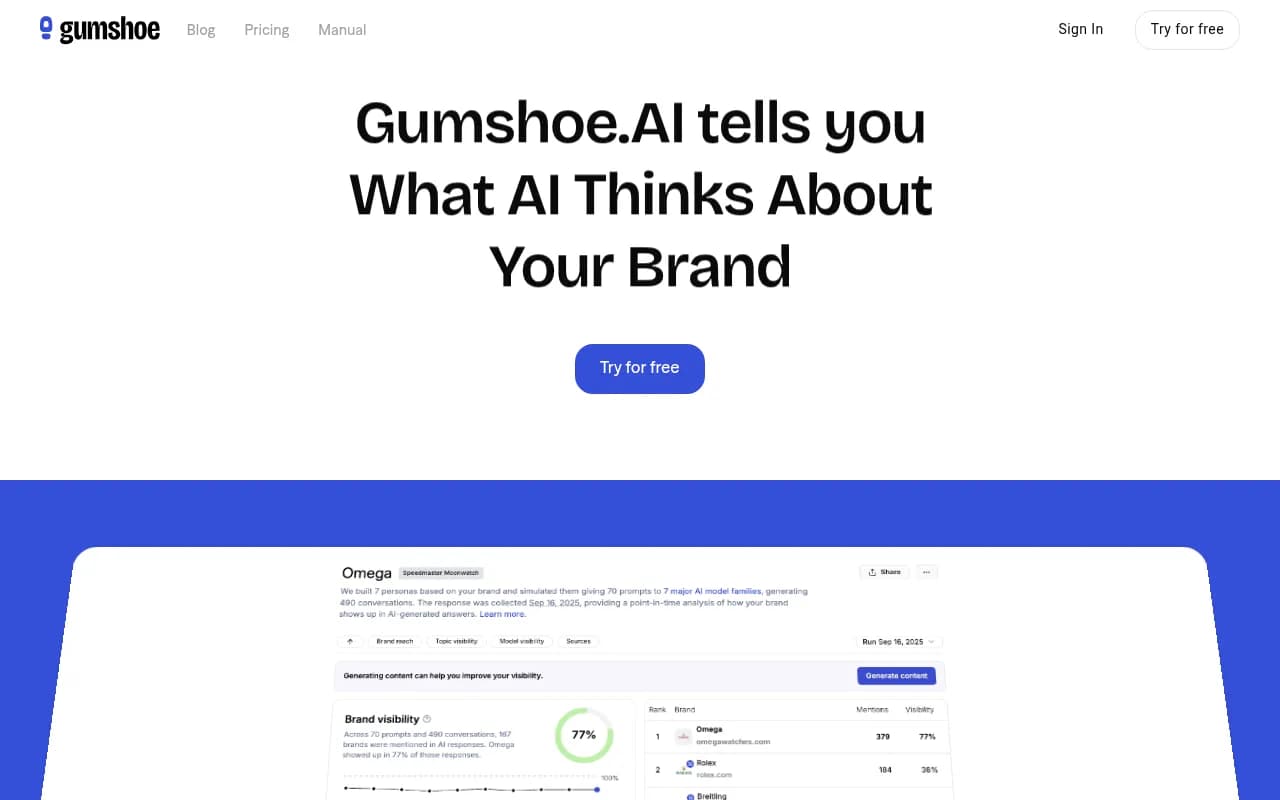
Gumshoe AI is a basic AI search monitoring tool that tracks how often your brand appears in responses from ChatGPT, Gemini, and Perplexity. Designed for marketers and brand managers who want visibility into AI-generated recommendations, it offers persona-based tracking and competitive benchmarking with pay-per-report pricing starting at $0.10 per conversation.
Key Takeaways:
• Gumshoe AI is a monitoring-only platform that tracks brand mentions in AI search results across ChatGPT, Gemini, and Perplexity -- but lacks the optimization and content generation features found in more comprehensive platforms • Pay-per-report pricing ($0.10/conversation after 3 free reports) makes it accessible for small teams testing AI visibility, though costs can add up quickly for regular monitoring • Best suited for brand managers and small marketing teams who need basic AI mention tracking without the complexity of full-featured GEO platforms • Missing critical capabilities like content gap analysis, AI crawler logs, and content generation tools that competitors offer -- you'll see where you're invisible but won't get help fixing it • Limited to 3 AI models (ChatGPT, Gemini, Perplexity) while leading platforms monitor 10+ models including Claude, Grok, DeepSeek, and Google AI Overviews
Gumshoe AI is a straightforward brand monitoring tool built around a single question: what are AI search engines saying about your brand? Launched as an entry-level solution for companies exploring AI visibility, it focuses on tracking brand mentions across three major AI models -- OpenAI's ChatGPT, Google Gemini, and Perplexity. The platform targets marketing teams and brand managers who want to understand their presence in AI-generated responses without committing to enterprise-level GEO platforms.
The core value proposition is simplicity: you define your brand, select relevant topics and buyer personas, then Gumshoe runs queries across the supported AI models to see how often your brand appears. It's designed for teams who are just starting to think about AI search visibility and want a low-commitment way to establish a baseline. The pay-per-report pricing model (more on that below) reflects this positioning -- you're not paying for a full monitoring suite, just spot checks when you need them.
That said, Gumshoe sits at the basic end of the AI visibility spectrum. It's a monitoring dashboard, not an optimization platform. You'll see where your brand shows up (or doesn't), but the platform won't tell you why you're invisible or help you create content to fix it. For teams that need actionable insights and content recommendations, more comprehensive platforms like Promptwatch, Profound, or Otterly.AI offer significantly deeper capabilities.
Brand Visibility Tracking The core feature is straightforward brand mention tracking. You input your brand name and Gumshoe queries ChatGPT, Gemini, and Perplexity with prompts related to your industry and target topics. The platform then reports back on how frequently your brand appears in AI responses, giving you a percentage-based visibility score. This is useful for establishing a baseline -- if you're mentioned in 15% of relevant AI responses, you know you have work to do.
The limitation here is depth. You'll see that your brand was mentioned, but not the context of that mention (positive, negative, neutral), the specific language used, or which pages were cited as sources. Competitors like Promptwatch provide full citation analysis showing exactly which URLs AI models reference, while Gumshoe only surfaces high-level mention frequency.
Competitive Benchmarking Gumshoe allows you to add competitor brands and compare visibility scores side-by-side. You can see that Competitor A appears in 40% of AI responses while you're at 15%, broken down by topic area and AI model. This is genuinely useful for understanding your relative position in AI search results.
However, the competitive analysis stops at the scoreboard level. You won't get insights into why competitors are outperforming you -- which content they have that you don't, which prompts they're winning for, or what citation sources they've secured. Platforms like Promptwatch offer Answer Gap Analysis that shows the specific content gaps between you and competitors, while Gumshoe just shows you the score.
Persona-Based Tracking One of Gumshoe's more interesting features is persona-based visibility tracking. You can define different buyer personas (e.g., "enterprise IT decision maker" vs. "small business owner") and see how your brand performs when AI models are prompted from those perspectives. This helps you understand whether your visibility varies by audience segment.
In practice, this means Gumshoe adjusts the phrasing and context of its queries to match different user types. If you're a B2B SaaS company, you might discover you have strong visibility for technical personas but weak visibility for executive-level decision makers. That's actionable information, though again, the platform won't tell you how to fix the gap.
Topic Coverage You can track visibility across multiple topic areas relevant to your business. For a marketing automation company, you might track topics like "email marketing tools," "lead scoring software," and "marketing analytics platforms." Gumshoe shows your visibility score for each topic and which AI models mention you most often in that category.
The topic tracking is limited by the platform's fixed query approach. You're not seeing real user prompts or search volumes -- just Gumshoe's predefined queries for each topic. Competitors like Promptwatch and Profound offer prompt intelligence with actual volume estimates and difficulty scores, helping you prioritize high-value topics. Gumshoe's topic tracking is more of a directional indicator than a strategic planning tool.
Model-Specific Insights Gumshoe breaks down visibility by AI model, so you can see that you're mentioned frequently in ChatGPT responses but rarely in Gemini. This helps identify which models to prioritize for optimization efforts. The platform currently supports three models: ChatGPT (OpenAI), Google Gemini, and Perplexity.
The three-model limitation is a significant gap compared to comprehensive platforms. As of 2026, leading GEO tools monitor 10+ AI models including Claude, Grok, DeepSeek, Meta AI, Mistral, Microsoft Copilot, and Google AI Overviews. If you're only tracking three models, you're missing a large portion of the AI search landscape. For brands with international audiences or technical users, missing Claude and DeepSeek visibility is a real blind spot.
Cited Sources View Gumshoe surfaces the top sources that AI models cite when mentioning your brand. This is useful for understanding which of your web pages, blog posts, or external mentions are driving AI visibility. If your pricing page is frequently cited, you know that content is working. If AI models are citing third-party reviews instead of your own site, you know you need stronger owned content.
The cited sources feature is fairly basic -- you get a list of URLs and mention counts, but not the full context of how those sources were used in AI responses. Platforms like Promptwatch provide detailed citation analysis showing the exact passages AI models extract, how often each source appears across different prompts, and whether citations come from your site, Reddit, YouTube, or other channels. Gumshoe's source view is more of a starting point than a deep analysis tool.
Scheduled Reports and Trend Tracking On the pay-as-you-go plan, you can schedule recurring reports to track visibility changes over time. This is essential for measuring the impact of content updates or PR campaigns. Gumshoe shows trend lines for your visibility scores, making it easy to see whether you're improving or declining in AI search results.
The trend tracking is straightforward but lacks the granularity of more advanced platforms. You'll see overall visibility trends, but not page-level tracking that shows which specific content pieces are gaining or losing citations. For teams running active AI optimization campaigns, this lack of detail makes it harder to connect specific actions to results.
Optimization Recommendations Gumshoe promises "optimization recommendations" on the pay-as-you-go plan, but based on the platform's feature set, these appear to be fairly generic suggestions rather than specific, actionable guidance. You might get recommendations like "create more content about Topic X" or "improve your presence in Gemini," but not the detailed content gap analysis or specific prompt targets that would make those recommendations actionable.
This is where the monitoring-only nature of the platform becomes a real limitation. Comprehensive GEO platforms like Promptwatch show you exactly which prompts competitors rank for that you don't, then help you generate content to fill those gaps. Gumshoe tells you there's a problem but leaves you to figure out the solution on your own.
AI-Assisted Content Generation The platform mentions "AI-assisted content generation" as a feature on the pay-as-you-go plan, but details are sparse. This appears to be a basic content suggestion tool rather than a full-featured AI writing agent. You won't get the kind of citation-grounded, prompt-optimized content generation that platforms like Promptwatch offer (where the AI writer is trained on 880M+ citations and generates articles specifically designed to rank in AI search results).
For teams that need to produce content at scale to improve AI visibility, Gumshoe's content generation capabilities are likely insufficient. You'll still need to do the heavy lifting of content creation yourself or use a separate tool.
Storage Integrations Gumshoe offers integrations with storage platforms, presumably for exporting report data. This is useful for teams that want to analyze visibility data in their own BI tools or combine it with other marketing metrics. However, the platform doesn't appear to offer the kind of deep integrations (Google Search Console, Looker Studio, custom APIs) that enterprise teams typically need.
Who Is Gumshoe AI For?
Gumshoe AI is best suited for small marketing teams and brand managers who are just beginning to explore AI search visibility. If you're a startup or SMB with a limited budget and you want to understand whether AI models are mentioning your brand at all, Gumshoe provides an affordable entry point. The pay-per-report pricing means you can run occasional spot checks without committing to a monthly subscription.
It's also a reasonable fit for agencies managing multiple small clients who need basic AI visibility reporting but don't require deep optimization capabilities. You can run quarterly reports for each client to show AI mention trends and competitive positioning without a large platform investment.
However, Gumshoe is NOT the right choice for teams that need to actively improve their AI visibility. If you're running an AI SEO strategy, managing content at scale, or competing in a crowded market where AI search visibility directly impacts revenue, you need a platform that goes beyond monitoring. SEO teams, content marketing teams, and digital agencies running active GEO campaigns will quickly outgrow Gumshoe's capabilities.
It's also not ideal for enterprise brands or companies with international audiences. The three-model limitation means you're missing critical AI platforms like Claude (popular with technical users), Grok (growing fast on X/Twitter), and DeepSeek (dominant in Asia). If your customers are using AI models that Gumshoe doesn't track, you're flying blind.
Integrations & Ecosystem
Gumshoe's integration ecosystem is minimal. The platform mentions storage integrations for exporting data, but doesn't specify which platforms are supported. There's no mention of API access (except potentially on the Enterprise plan), browser extensions, mobile apps, or integrations with common marketing tools like Google Search Console, Slack, or Zapier.
For teams that need to incorporate AI visibility data into existing workflows or dashboards, this lack of integrations is a significant limitation. Competitors like Promptwatch offer Looker Studio integration, full API access, and Google Search Console integration for traffic attribution -- capabilities that are essential for connecting AI visibility to actual business outcomes.
Pricing & Value
Gumshoe uses a unique pay-per-report pricing model that's quite different from the typical SaaS subscription approach:
Free Tier: Your first 3 report runs are completely free. This gives you a chance to test the platform and establish a baseline for your brand's AI visibility. You get access to all core features: brand visibility tracking, persona insights, topic tracking, model-specific visibility, and cited sources. You can also share reports with your team.
Pay as You Go: After your free reports, you pay $0.10 per conversation (essentially per query run across the AI models). This includes everything from the free plan plus scheduled reports, trend tracking, optimization recommendations, and AI-assisted content generation. There's no monthly minimum, so you only pay when you actually run reports.
Enterprise: Custom pricing for teams with complex needs. This tier includes volume discounts, a dedicated success manager, custom integrations and APIs, and expert implementation support.
The pay-per-report model is genuinely innovative and makes Gumshoe accessible for small teams with limited budgets. If you only need to check your AI visibility once a month, you're spending a few dollars instead of $99-249/month for a full platform subscription. For occasional monitoring, this is excellent value.
However, the pricing becomes less attractive if you need regular, comprehensive monitoring. Let's say you're tracking 5 topics across 3 personas -- that's 15 queries per report run. At $0.10 per conversation, that's $1.50 per report. If you're running weekly reports, you're at $6/week or roughly $25/month. For monthly reports, it's very affordable. For daily or weekly monitoring at scale, you'd quickly exceed the cost of a full-featured platform subscription.
Compare this to competitors:
- Promptwatch Essential ($99/mo): 1 site, 50 prompts, 5 AI-generated articles, crawler logs, page-level tracking, 10 AI models
- Otterly.AI ($99/mo): Basic monitoring across multiple models, more comprehensive than Gumshoe but still monitoring-only
- Profound ($199/mo starting): Advanced monitoring with deeper analytics but no content generation
For basic monitoring, Gumshoe's pricing is competitive. But when you factor in the missing features (content gap analysis, crawler logs, 10+ model coverage, content generation, traffic attribution), the value proposition weakens. You're paying less, but you're also getting significantly less.
Strengths & Limitations
Strengths:
- Accessible pricing model: Pay-per-report pricing with 3 free reports makes it easy to test AI visibility without financial commitment
- Persona-based tracking: The ability to see visibility differences across buyer personas is genuinely useful for understanding audience-specific gaps
- Simple, focused interface: The platform does one thing (brand mention tracking) and does it in a straightforward way without overwhelming users
- Competitive benchmarking: Side-by-side comparison with competitors provides useful context for your visibility scores
Limitations:
- Monitoring-only platform: You'll see where you're invisible but get no help fixing it -- no content gap analysis, no specific prompt targets, no detailed optimization guidance
- Limited model coverage: Only 3 AI models (ChatGPT, Gemini, Perplexity) vs. 10+ models in comprehensive platforms. Missing Claude, Grok, DeepSeek, Meta AI, Copilot, and others
- No AI crawler logs: Can't see which AI models are actually crawling your website, how often, or what errors they encounter
- Basic content generation: The AI-assisted content feature appears to be suggestion-based rather than a full writing agent that generates citation-optimized articles
- Shallow citation analysis: You see which sources are cited but not the full context, specific passages, or cross-model citation patterns
- No traffic attribution: Can't connect AI visibility to actual website traffic or revenue, making ROI measurement difficult
- Limited integrations: No API access (except Enterprise), no Google Search Console integration, no Looker Studio connector
- Fixed query approach: You're not seeing real user prompts or search volumes, just Gumshoe's predefined queries for each topic
Bottom Line
Gumshoe AI is a basic brand monitoring tool that answers a simple question: are AI search engines mentioning your brand? For small teams with limited budgets who just want to establish a baseline and track high-level trends, the pay-per-report pricing and straightforward interface make it an accessible entry point into AI visibility monitoring.
However, it's a monitoring dashboard, not an optimization platform. You'll see the scoreboard but won't get the playbook. If your goal is to actually improve your AI search visibility -- to understand why you're invisible, create content that gets cited, and measure the traffic impact -- you need a more comprehensive solution. Platforms like Promptwatch, Profound, or even Otterly.AI offer significantly deeper capabilities for teams running active GEO strategies.
Best use case in one sentence: Gumshoe AI is ideal for small marketing teams who need affordable, occasional spot checks of their brand's AI visibility without the complexity or cost of full-featured GEO platforms.
Tags:
Similar and alternative tools to Gumshoe AI