Synup Review 2026
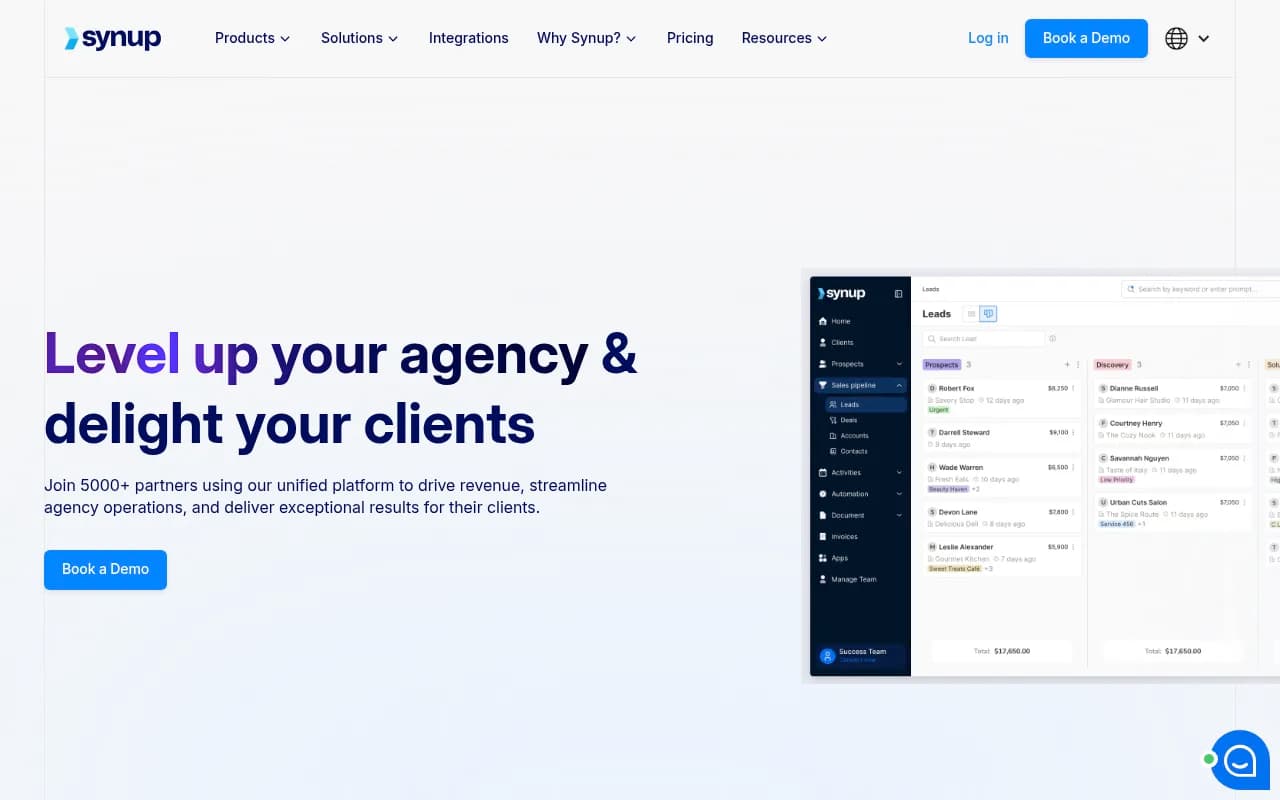
Synup is an all-in-one agency operating system combining CRM, listing management, reputation monitoring, social media scheduling, and SEO tools in a white-labeled platform. Designed for digital marketing agencies managing 10-500+ clients, it consolidates lead generation, sales pipeline management, a
Key Takeaways:
• Best for agencies: Purpose-built for digital marketing agencies and resellers managing multiple clients, not individual businesses • True all-in-one platform: Combines CRM, listings, reviews, social media, SEO, invoicing, and project management in one system • White label ready: Full branding customization with custom URLs, logos, and client portals that launch in minutes • AI automation throughout: Sales AI for prospecting, Marketing AI for review responses and content creation, Client AI for data analysis • Pricing starts at $79/mo: Base plan includes core features; agency-focused plans from $199/mo with volume discounts
Synup positions itself as an "operating system" for digital marketing agencies -- a bold claim, but one that makes sense when you see the breadth of what's included. This isn't just another listing management tool or review platform. It's a full agency management suite that handles everything from finding leads to getting paid, with marketing execution tools for clients built in. The company serves 5,000+ agency partners including recognizable brands like Broadridge and has carved out a specific niche: agencies that want to offer local SEO and reputation management services without building their own tech stack.
The platform launched as a listings management tool but has evolved into something much broader. In 2026, Synup competes directly with platforms like Vendasta, SOCi, and BrightLocal, but differentiates by bundling agency operations (CRM, invoicing, project management) with client marketing tools (listings, reviews, social) in a single white-labeled system. Most competitors force you to stitch together multiple tools or focus purely on marketing execution without the business management layer.
Synup OS: The Agency Management Core
The foundation of Synup is what they call "Synup OS" -- the business operations layer that agencies use internally. This includes four main modules that handle the full client lifecycle:
Pre-Sales & Lead Generation: Built-in lead finder that identifies potential clients based on targeting criteria like industry, location, and online presence gaps. You can run prospecting campaigns, track outreach activities, and score leads based on fit. The system integrates with common data sources to surface businesses with poor online visibility -- ideal prospects for local SEO services. Unlike generic CRMs, this is purpose-built for agencies selling local marketing services, so the lead scoring considers factors like missing listings, low review counts, and inconsistent NAP data.
Sales Pipeline Management: Customizable deal stages, activity tracking, meeting scheduling, and proposal generation all live here. You can create templated proposals with pricing tables, service descriptions, and e-signature capabilities. The pipeline view shows all deals in progress with filters for stage, value, close date, and assigned rep. Calendar integration keeps meetings synced, and automated reminders ensure follow-ups don't slip through the cracks. The e-signature feature is particularly useful -- you can send contracts directly from Synup and track when clients view and sign them, eliminating the need for DocuSign or similar tools.
Project & Activity Management: Once a client signs, this module tracks all ongoing work. Create tasks, assign them to team members, set deadlines, and link activities to specific clients or campaigns. The activity feed shows a chronological view of everything happening across your client base -- new reviews posted, listings updated, social posts published, invoices sent. This centralized activity log is valuable for account managers juggling multiple clients, giving them a single place to see what needs attention. You can also set up automated workflows that trigger tasks based on events (e.g., "Send review request 7 days after service completion").
Invoicing & Payments: Recurring billing automation, payment reminders, and invoice tracking built in. Create invoice templates with your branding, set up monthly or annual billing cycles, and send payment links via email. The system tracks payment status and can automatically send reminders for overdue invoices. This eliminates the need for separate billing software like FreshBooks or QuickBooks for many agencies. The e-signature module extends here too -- you can attach contracts or service agreements to invoices and require signature before payment.
AI Throughout the Platform
Synup has embedded AI capabilities across three main areas, which they brand as Sales AI, Client AI, and Marketing AI:
Sales AI: Helps with prospecting and communication. It can generate personalized outreach emails based on a prospect's business type and online presence gaps, create pitch decks highlighting specific issues found during prospecting, and suggest talking points for sales calls. The AI analyzes a prospect's current listings, reviews, and social presence to identify weaknesses your agency can fix -- essentially automating the audit process that agencies typically do manually.
Client AI: Acts as a research assistant and reporting tool. You can ask questions like "Which clients have the lowest review ratings?" or "Show me all clients with duplicate listings" and get instant answers pulled from your client database. It also generates executive summary reports that synthesize client performance data into digestible insights. This is particularly useful for account managers preparing for client calls or executives reviewing portfolio health.
Marketing AI: Powers review response generation, social media content creation, and sentiment analysis. The review response AI reads incoming reviews and drafts contextually appropriate replies in your brand voice (you can train it on examples). For social media, it can generate post ideas, write captions, and suggest hashtags based on the client's industry and audience. The sentiment analysis scans reviews and social comments to flag potential reputation issues before they escalate.
These AI features aren't revolutionary -- competitors like Vendasta and BrightLocal have similar capabilities -- but having them integrated across the entire platform rather than siloed in individual tools is the advantage. The AI learns from your agency's data over time, so responses and content become more aligned with your style.
Client Marketing Apps: The Service Delivery Layer
While Synup OS handles agency operations, the marketing apps are what you actually deliver to clients. These are the tools that improve their online presence:
Listing Management: Synup distributes business information (name, address, phone, hours, categories, photos, etc.) to 100+ directories and platforms including Google Business Profile, Facebook, Yelp, Apple Maps, Bing, and industry-specific directories. The system monitors for duplicate listings, inconsistent data, and listing suppression issues. You can manage hundreds of locations from a single dashboard with bulk editing, location groups, and custom fields. The "Share of Voice" metric shows how completely a business is listed across the network compared to competitors -- useful for demonstrating value to clients. Synup also tracks listing indexation (whether directories are actually showing the updated data) and alerts you to issues.
Review Management: Aggregates reviews from 50+ platforms into one inbox. You can respond directly from Synup (with AI-suggested replies), set up automated review request campaigns via email or SMS, and monitor review velocity and sentiment trends. The review generation feature is particularly strong -- it integrates with CRMs and point-of-sale systems to automatically trigger review requests after transactions. You can customize request timing, messaging, and follow-up sequences. The platform also offers review widgets that clients can embed on their websites to display recent reviews.
Social Media Management: Schedule and publish posts to Facebook, Instagram, Twitter, LinkedIn, and Google Business Profile. The content calendar shows all scheduled posts across clients, and you can bulk-schedule campaigns. The AI content generator suggests post ideas based on holidays, industry trends, and past performance. You can create post templates and reuse them across similar clients. Analytics show engagement metrics, follower growth, and best-performing content types. This isn't as robust as dedicated social tools like Hootsuite or Sprout Social -- it lacks advanced listening features and detailed audience analytics -- but it covers the basics most local businesses need.
SEO Tools: Rank tracking for target keywords, on-page SEO audits, backlink monitoring, and competitor analysis. You can track rankings across locations and devices, generate white-labeled SEO reports, and get recommendations for optimization. The SEO module integrates with Google Search Console and Google Analytics for more comprehensive data. This is more of a reporting and monitoring tool than a full SEO platform -- it won't replace Ahrefs or Semrush for agencies doing deep technical SEO, but it's sufficient for local SEO reporting and basic optimization tracking.
White Label & Client Portal
Synup's white labeling is comprehensive. You can customize the platform with your logo, color scheme, and custom domain (e.g., platform.youragency.com). All client-facing emails, reports, and notifications carry your branding. The client portal is a separate login where clients can view their listings, reviews, social posts, and performance reports without seeing the backend agency tools. You control what each client can access -- some might only see reports, while others can respond to reviews or approve social posts.
The portal setup is genuinely fast. You can launch a branded instance in under an hour by uploading your logo, setting colors, and configuring the domain. This is much quicker than platforms like Vendasta, which require more extensive configuration. The trade-off is less customization depth -- you can't rebuild the UI or add custom modules, but most agencies don't need that level of control.
Who Is Synup For?
Synup is purpose-built for digital marketing agencies and resellers, specifically those focused on local businesses. The ideal user is:
• Small to mid-sized agencies (5-50 employees) managing 20-500 clients across industries like restaurants, retail, healthcare, professional services, and home services. Agencies with fewer than 10 clients will find the pricing steep for the value; those with 500+ clients might need more enterprise-grade features.
• White label resellers who want to offer local SEO and reputation management under their own brand without building proprietary software. The fast white label setup and client portal make this use case particularly strong.
• Marketing agencies expanding service offerings: If you currently offer web design, PPC, or content marketing and want to add local SEO and reputation management without hiring specialists or learning new tools, Synup provides a turnkey solution.
• Franchise marketing teams managing multiple locations under a single brand. The bulk editing, location groups, and centralized reporting work well for franchise systems.
Synup is NOT ideal for:
• Individual businesses managing their own presence. The platform is priced and designed for agencies managing multiple clients. A single-location restaurant or law firm should use BrightLocal, Yext, or Birdeye instead.
• Enterprise agencies (100+ employees) needing advanced workflow automation, custom integrations, or dedicated account management. Synup lacks the enterprise features of Vendasta or SOCi.
• Agencies focused on enterprise clients: The tools are optimized for small and mid-sized local businesses, not national brands or complex multi-location enterprises.
Integrations & Ecosystem
Synup integrates with common tools agencies already use:
• CRM integrations: Salesforce, HubSpot, Zoho CRM for syncing contacts and deals • Payment processors: Stripe for invoice payments • Google tools: Google Business Profile API (for direct listing management), Google Search Console, Google Analytics • Review platforms: Direct API connections to Google, Facebook, Yelp, Trustpilot, and 50+ other review sites • Social platforms: Facebook, Instagram, Twitter, LinkedIn, Google Business Profile for publishing • Zapier: For connecting to 3,000+ other apps
The platform offers an API for custom integrations, though documentation is limited compared to more developer-focused platforms. There's no mobile app, which is a notable gap -- account managers can't easily check client activity or respond to reviews on the go. The web interface is mobile-responsive but not optimized for mobile workflows.
Pricing & Value
Synup uses tiered pricing based on features and client count:
• Synup OS Base: $79/month (billed annually, $99 month-to-month). Includes CRM, basic listing management, review monitoring, and social scheduling for a limited number of clients. Best for agencies just starting out or testing the platform.
• Synup OS Agency: $199/month (billed annually, $249 month-to-month). Adds advanced features like AI tools, white labeling, client portal, and higher client limits. This is the sweet spot for most agencies.
• Synup OS Scale: $799/month (billed annually, $999 month-to-month). For larger agencies with hundreds of clients, includes priority support and higher usage limits.
• Enterprise: Custom pricing for agencies with 500+ clients or specific needs like custom integrations or dedicated account management.
All plans include the core OS features (CRM, invoicing, project management). The main differences are client limits, white label capabilities, and AI features. There's a free trial available, though the duration isn't specified on the website.
Compared to competitors:
• BrightLocal (starting at $39/month) is cheaper but lacks the agency operations tools (CRM, invoicing, project management) and is more focused on SEO reporting. • Vendasta (starting around $500/month) is more expensive and targets larger agencies with more complex needs. • SOCi (custom pricing, typically $1,000+/month) is enterprise-focused and overkill for small agencies. • Yext (starting at $199/month per location) is prohibitively expensive for agencies managing many clients.
Synup's pricing is competitive for the breadth of features included. The value proposition is strongest for agencies that would otherwise need to pay for separate CRM, invoicing, listing management, review monitoring, and social scheduling tools. Bundling everything into one platform at $199-$799/month is cheaper than stitching together Salesforce ($25/user), QuickBooks ($30/month), BrightLocal ($99/month), and Hootsuite ($99/month).
Strengths
• True all-in-one platform: The combination of agency operations (CRM, invoicing, project management) and client marketing tools (listings, reviews, social, SEO) in one system is rare. Most competitors focus on one or the other.
• Fast white label setup: You can launch a fully branded platform in under an hour, much faster than Vendasta or similar tools.
• AI integration across the platform: Sales AI, Client AI, and Marketing AI provide practical automation for prospecting, reporting, and content creation.
• Strong listing distribution network: 100+ directories and platforms covered, with good monitoring for duplicates and inconsistencies.
• Competitive pricing: $199/month for the Agency plan is reasonable for the feature set, especially compared to enterprise platforms.
Limitations
• No mobile app: The lack of a native mobile app is a significant gap for account managers who need to check client activity or respond to reviews on the go. The mobile web interface works but isn't optimized.
• Social media features are basic: The social scheduling and analytics are sufficient for local businesses but lack the advanced features (listening, audience segmentation, A/B testing) that dedicated social tools offer. Agencies managing social for larger clients will need to supplement with Hootsuite or Sprout Social.
• SEO tools are reporting-focused: The SEO module is good for rank tracking and basic audits but won't replace Ahrefs, Semrush, or Moz for agencies doing technical SEO or link building. It's more of a client reporting tool than a research platform.
• Limited customization for enterprise: While white labeling is strong, you can't customize the UI deeply or add custom modules. Enterprise agencies with specific workflow needs might find it restrictive.
• API documentation is sparse: Developers looking to build custom integrations will find the API documentation lacking compared to more developer-friendly platforms.
Bottom Line
Synup is best for small to mid-sized digital marketing agencies (5-50 employees) managing 20-500 local business clients who want a single platform for both agency operations and client service delivery. The combination of CRM, invoicing, project management, and marketing tools (listings, reviews, social, SEO) in one white-labeled system is compelling, especially at $199/month for the Agency plan. The AI features add practical automation for prospecting, reporting, and content creation, though they're not groundbreaking. The fast white label setup and client portal make it easy to launch a branded platform quickly.
However, agencies focused on enterprise clients, those needing advanced social media or SEO capabilities, or teams that require mobile access for account managers should look elsewhere. Synup is optimized for the local business market and agencies that want a turnkey solution rather than best-in-class tools for each function.
Best use case in one sentence: A 20-person digital marketing agency managing 100 local business clients (restaurants, retailers, service providers) who wants to consolidate CRM, invoicing, listings, reviews, and social media into one white-labeled platform without stitching together five separate tools.
Tags:
Similar and alternative tools to Synup