Key Takeaways
- Yext leads in AI search visibility and structured data management, making it the strongest choice for brands prioritizing discovery across ChatGPT, Google AI Overviews, and traditional search engines
- Uberall offers intuitive local presence management with strong directory sync capabilities, ideal for brands focused on core local SEO fundamentals
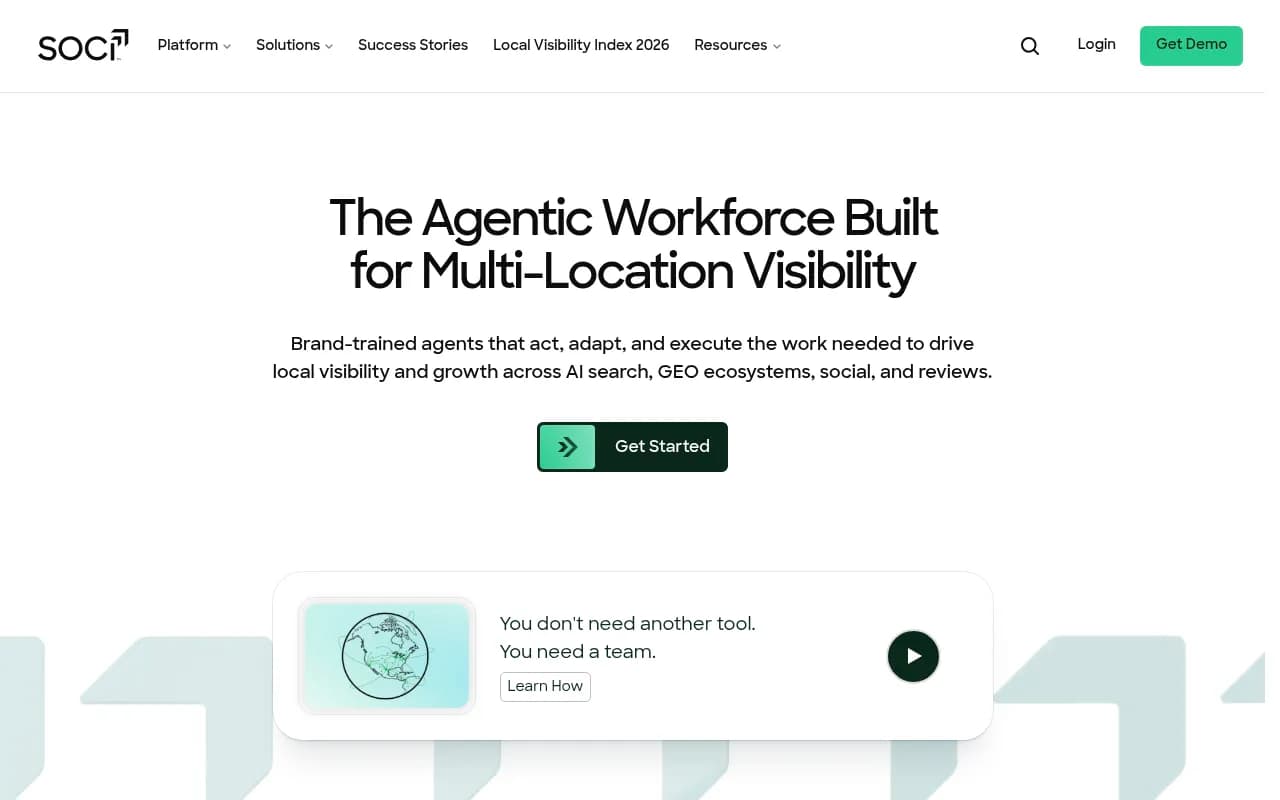
- SOCi excels at social media automation and distributed content publishing, best suited for brands with social-first strategies and field teams that need simple tools
- All three platforms address multi-location challenges, but differ significantly in AI readiness, competitive intelligence, and automation capabilities
- The right choice depends on whether your priority is being found in AI search (Yext), managing local listings efficiently (Uberall), or empowering local teams with social tools (SOCi)
The Multi-Location Discovery Challenge in 2026
Managing a multi-location brand in 2026 means navigating a fundamentally different discovery landscape than just two years ago. Customers no longer start with a simple Google search and click through to your website. Instead, they ask conversational questions to AI assistants and expect instant, accurate answers.
"Is the clinic near me open right now?" "Which location accepts my insurance?" "Where can I book an appointment today?"
These questions get answered by ChatGPT, Google AI Overviews, Perplexity, Apple Intelligence, and a dozen other AI engines — often without the customer ever visiting your website. When your business information is wrong, incomplete, or simply invisible to these AI models, you lose customers before they even know you exist.
This is where multi-location marketing platforms come in. Yext, Uberall, and SOCi all promise to help you manage the digital details that shape every customer's first impression. But they take very different approaches to the problem.
What Multi-Location Brands Actually Need
Before comparing specific platforms, it's worth understanding what actually matters for multi-location success in 2026:
-
Structured, centralized data: AI models consume machine-readable information. Scattered spreadsheets and manual updates don't cut it anymore.
-
Real-time accuracy everywhere: From Google and Apple to ChatGPT, Yelp, and vertical-specific directories, every platform demands consistent, up-to-date facts.
-
Competitive visibility: Discovery today is comparative. You need to know how you stack up against competitors across rankings, sentiment, and AI citations.
-
Local content tools: Field teams need simple, compliant ways to publish content, respond to reviews, and engage local audiences.
-
Automation that scales: Manual processes break down at 50+ locations. AI agents and workflow automation become essential.
Yext: Built for AI Search Visibility
Core Strengths
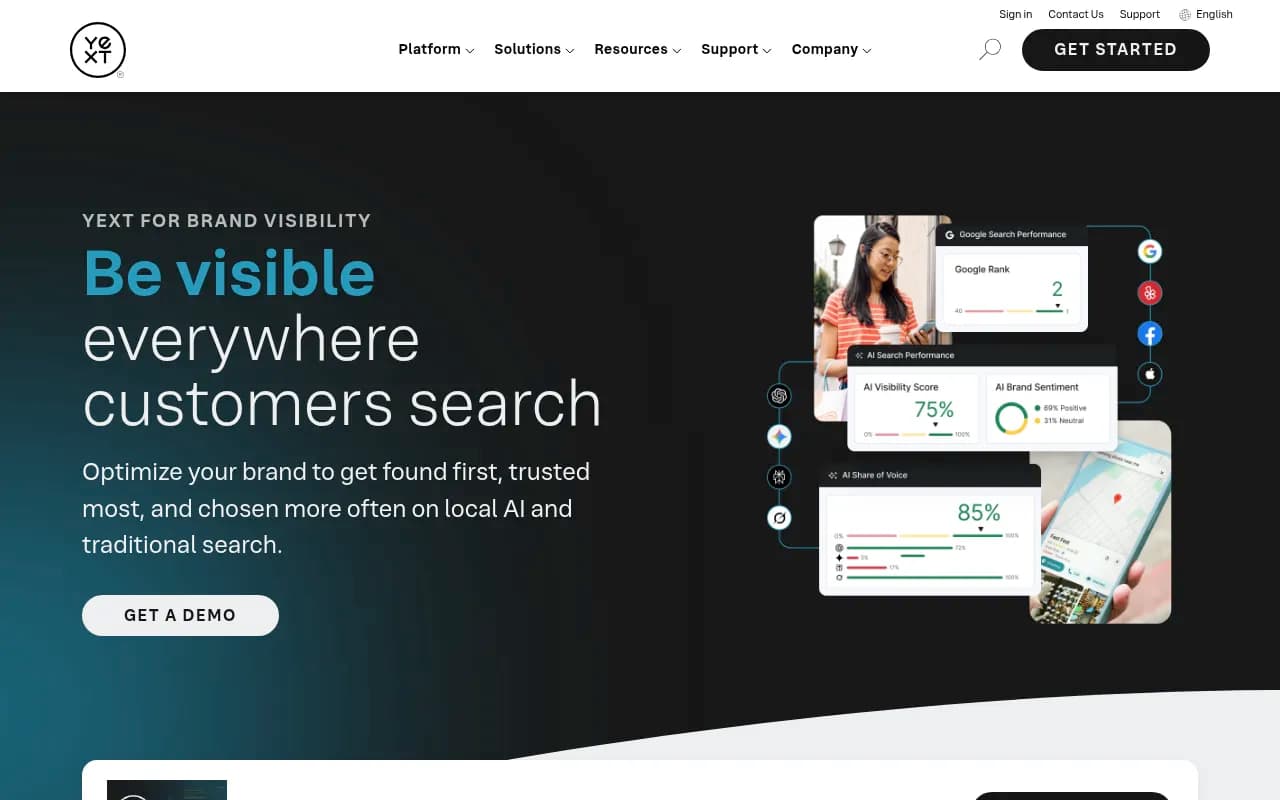
Yext positions itself as the platform for brands that need to be found — not just in traditional search, but across the entire AI-powered discovery landscape. The platform's foundation is a centralized knowledge graph that structures your business data in a way AI models can actually understand and cite.
What sets Yext apart is its focus on AI search visibility. The platform actively monitors how your brand appears in ChatGPT, Google AI Overviews, Perplexity, and other AI engines. You can see which locations are being cited, which aren't, and why. This goes beyond simple listing management — it's about understanding how AI models discover and recommend your business.
Key Capabilities
Knowledge Graph: Yext's structured data approach means your business information lives in a single source of truth. Hours, services, insurance accepted, parking availability — everything is connected and machine-readable. When you update one field, it propagates everywhere instantly.
AI Search Monitoring: Track your visibility across ChatGPT, Google AI Overviews, and other AI engines. See which prompts trigger citations to your locations and which don't. This competitive intelligence is critical for understanding where you're winning and where you're invisible.
Pages Platform: Generate location pages, service pages, and landing pages at scale using templates and structured data. These pages are optimized for both traditional SEO and AI discovery.
Reviews Management: Centralized review monitoring and response workflows across Google, Facebook, Yelp, and 100+ other sites. AI-powered response suggestions help teams reply faster.
Analytics & Reporting: Detailed visibility into search performance, AI citations, customer actions (calls, directions, bookings), and competitive benchmarking.
Best For
Yext is the strongest choice for brands where being found matters most. If your customers are asking AI assistants for recommendations, if you're in a competitive vertical where discovery drives revenue, or if you need to prove ROI from your digital presence investments, Yext delivers the data and tools to act on it.
Typical customers include healthcare systems, financial services, retail chains, and hospitality brands with 50+ locations.
Pricing
Yext pricing is custom and typically starts around $5,000-$10,000+ annually depending on location count and features. The platform targets mid-market to enterprise brands.
Uberall: Intuitive Local Presence Management
Core Strengths
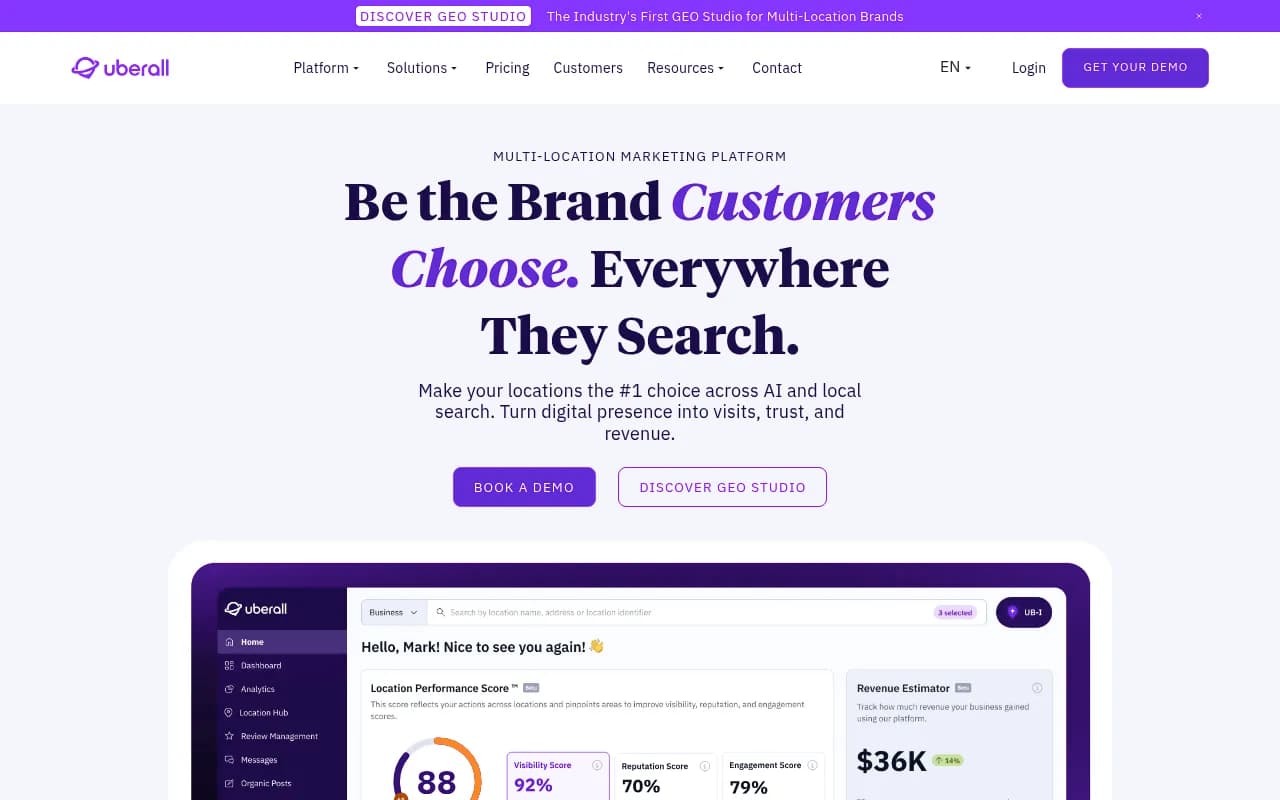
Uberall focuses on making local presence management simple and intuitive. The platform excels at the fundamentals: syncing your business information across directories, managing reviews, and tracking local search performance. Where Yext emphasizes AI visibility and structured data, Uberall prioritizes ease of use and reliable directory distribution.
Key Capabilities
Listings Management: Push updates to 100+ directories and platforms including Google, Apple, Facebook, Yelp, and vertical-specific sites. Uberall's directory network is comprehensive and reliable.
Review Monitoring: Aggregate reviews from multiple platforms into a single dashboard. Respond directly from the platform with workflow tools for routing and approval.
Social Media Publishing: Schedule and publish posts to Facebook, Instagram, and Google Business Profile. Basic social tools for maintaining local presence.
Local Pages: Generate location pages with templates and customization options. Less sophisticated than Yext's Pages platform but functional for most use cases.
Reporting: Standard local search metrics including visibility scores, review ratings, and customer actions. Less depth than Yext on competitive intelligence and AI visibility.
Best For
Uberall works well for brands that need reliable local SEO fundamentals without the complexity of enterprise platforms. If your primary concern is keeping Google Business Profile and other directories accurate, and you want an interface that's easy for non-technical teams to use, Uberall delivers.
Typical customers include retail chains, restaurants, service businesses, and franchises with 20-500 locations.
Pricing
Uberall pricing is also custom but generally more accessible than Yext, often starting around $3,000-$6,000 annually for smaller location counts.
SOCi: Social-First Multi-Location Marketing
Core Strengths
SOCi takes a different approach entirely. While Yext and Uberall focus on search visibility and listings management, SOCi is built around social media automation and local content distribution. The platform helps field teams publish content, engage with customers, and maintain brand consistency across hundreds of local social profiles.
Key Capabilities
Social Media Management: Publish to Facebook, Instagram, Twitter, LinkedIn, and Google Business Profile from a unified calendar. Localized content with brand approval workflows.
Localized Campaigns: Create campaign templates that local teams can customize with their own images, offers, and messaging. Maintain brand consistency while enabling local relevance.
Reputation Management: Monitor and respond to reviews across platforms. AI-suggested responses and workflow routing.
Listings Management: Basic directory sync to keep NAP (name, address, phone) consistent. Less comprehensive than Yext or Uberall's directory networks.
Local Pages: Generate location landing pages with basic SEO optimization. Not as robust as Yext's structured data approach.
Best For
SOCi is ideal for brands that lead with social and need to empower distributed teams to create and publish local content. If your marketing strategy relies heavily on Facebook and Instagram engagement, local promotions, and community building, SOCi's workflow tools are purpose-built for that use case.
Typical customers include QSR (quick service restaurants), retail, automotive dealerships, and hospitality brands where social engagement drives foot traffic.
Pricing
SOCi pricing is custom and varies widely based on location count and feature set. Generally comparable to Uberall in the mid-market.
Head-to-Head Comparison
AI Search Visibility
Winner: Yext
Yext is the only platform with dedicated AI search monitoring and optimization. You can track citations in ChatGPT, Google AI Overviews, Perplexity, and other AI engines. The platform shows you which prompts trigger visibility, which competitors are winning, and what content gaps exist.
Uberall and SOCi have minimal AI search capabilities. They focus on traditional local search and social media, which means you're flying blind when it comes to how AI models discover and recommend your brand.
For brands serious about AI visibility, Promptwatch offers a complementary solution — it tracks your brand mentions across 10+ AI engines, analyzes content gaps, and generates optimized content that gets cited by ChatGPT and Claude.

Listings & Directory Management
Winner: Tie (Yext/Uberall)
Both Yext and Uberall offer comprehensive directory distribution networks. Yext's structured data approach means updates propagate instantly and consistently. Uberall's interface is more intuitive for non-technical users.
SOCi's listings management is functional but less robust. The directory network is smaller and the platform doesn't emphasize this capability.
Social Media Automation
Winner: SOCi
SOCi is purpose-built for social media management at scale. The localized campaign tools, approval workflows, and content calendar are more sophisticated than what Yext or Uberall offer.
Yext and Uberall both have basic social publishing features, but they're clearly secondary to search visibility and listings management.
Competitive Intelligence
Winner: Yext
Yext's competitive benchmarking shows how you stack up against competitors across search visibility, AI citations, review ratings, and customer actions. You can see which competitors are winning for specific prompts and why.
Uberall and SOCi offer basic competitive data but lack the depth and AI focus that Yext provides.
Ease of Use
Winner: Uberall
Uberall's interface is the most intuitive of the three. Non-technical teams can navigate the platform and complete common tasks without extensive training.
Yext's power comes with complexity. The knowledge graph and structured data approach requires more setup and ongoing management. SOCi's social tools are user-friendly, but the platform as a whole is more complex than Uberall.
Pricing & Value
Winner: Depends on Use Case
Uberall generally offers the most accessible pricing for small to mid-market brands focused on local SEO fundamentals. Yext commands premium pricing but delivers unique AI visibility capabilities that justify the cost for brands where discovery drives revenue. SOCi pricing is competitive for social-first brands.
Platform Comparison Table
| Feature | Yext | Uberall | SOCi |
|---|---|---|---|
| AI Search Monitoring | Comprehensive (ChatGPT, Perplexity, AI Overviews) | Minimal | Minimal |
| Structured Data/Knowledge Graph | Advanced | Basic | Basic |
| Directory Network | 200+ publishers | 100+ publishers | 50+ publishers |
| Social Media Tools | Basic publishing | Basic publishing | Advanced automation |
| Review Management | Comprehensive | Comprehensive | Comprehensive |
| Competitive Intelligence | Advanced AI + search | Basic search metrics | Basic social metrics |
| Local Pages Platform | Advanced with SEO + AI optimization | Standard templates | Basic templates |
| Ease of Use | Moderate (powerful but complex) | High (intuitive interface) | Moderate (social-focused) |
| Best For | AI visibility + search dominance | Local SEO fundamentals | Social-first marketing |
| Typical Customer | Enterprise, healthcare, finance | Mid-market retail, services | QSR, automotive, hospitality |
| Pricing | Premium ($5K-$10K+ annually) | Mid-range ($3K-$6K+ annually) | Mid-range (custom) |
Making the Right Choice for Your Brand
Choose Yext If:
- AI search visibility is a strategic priority
- You need detailed competitive intelligence and benchmarking
- Your brand operates in a vertical where discovery drives revenue (healthcare, finance, professional services)
- You have the budget and resources to leverage a sophisticated platform
- Structured data and knowledge graph management align with your technical capabilities
Choose Uberall If:
- You need reliable local SEO fundamentals without complexity
- Ease of use and intuitive interface matter more than advanced features
- Your primary concern is keeping Google Business Profile and directories accurate
- You want a mid-market solution that's easier to implement than enterprise platforms
- Budget is a constraint and you don't need AI visibility features
Choose SOCi If:
- Social media is your primary customer acquisition channel
- You need to empower distributed field teams to create and publish local content
- Brand consistency with local customization is critical
- Your marketing strategy relies on Facebook, Instagram, and community engagement
- Listings management and search visibility are secondary to social presence
The AI Visibility Gap
Here's the reality: none of these platforms fully solve the AI visibility challenge. Yext comes closest with its AI search monitoring, but even that is primarily tracking and reporting — it doesn't help you understand why you're invisible or how to fix it.
This is where specialized AI visibility platforms like Promptwatch become essential. Promptwatch tracks your brand across 10+ AI engines (ChatGPT, Claude, Perplexity, Gemini, and more), identifies content gaps through Answer Gap Analysis, and generates optimized content that actually gets cited by AI models. It's the action layer that sits on top of your multi-location platform.
The workflow looks like this:
- Use Yext/Uberall/SOCi to manage your core business data, listings, and local presence
- Use Promptwatch to track AI visibility, identify gaps, and generate content that ranks in AI search
- Publish optimized content back through your multi-location platform or directly to your website
- Track results as AI models start citing your brand more frequently
This combination — operational platform + AI visibility optimization — is how leading brands are winning in 2026.
Beyond the Big Three
While Yext, Uberall, and SOCi dominate the multi-location platform market, several alternatives deserve consideration:
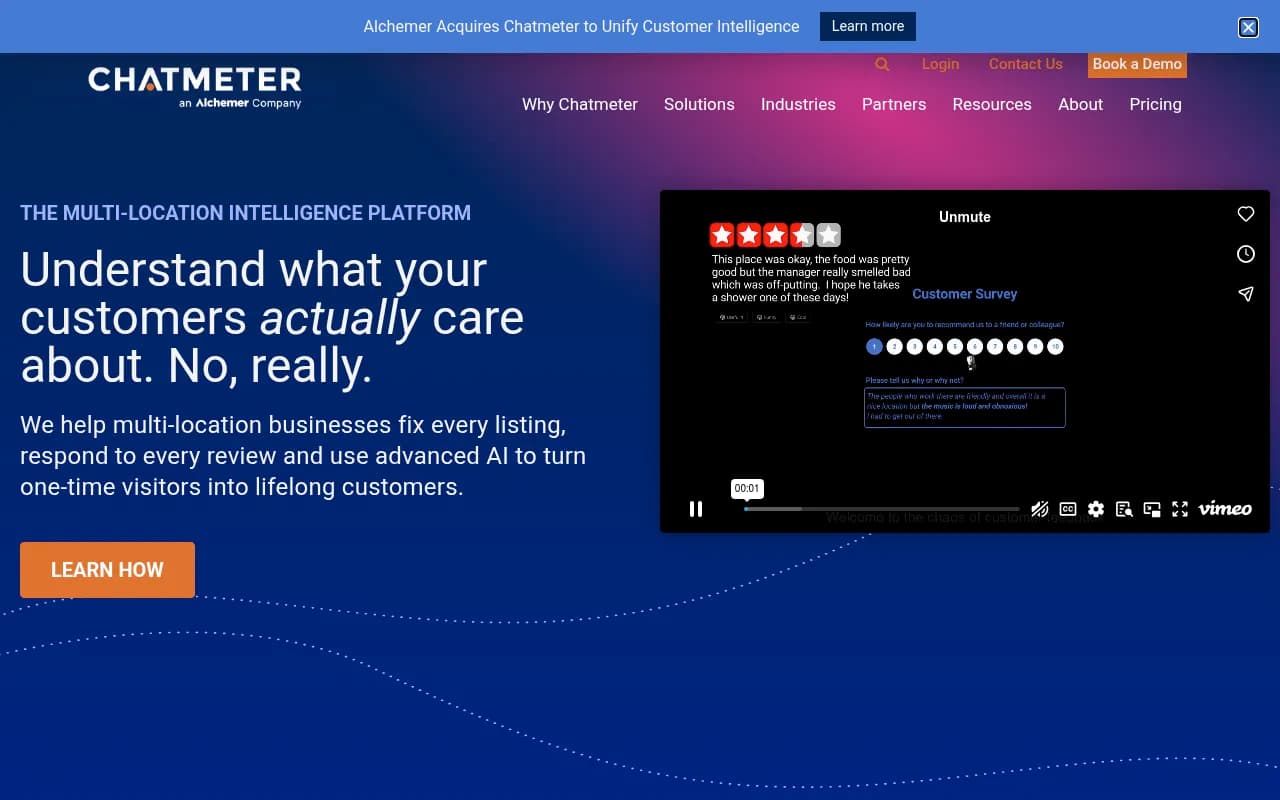
Chatmeter: Strong local SEO and reputation management with competitive pricing. Less sophisticated than Yext on AI visibility but more accessible than Uberall.
Rio SEO: Enterprise-focused with strong analytics and reporting. Better suited for large brands with complex organizational structures.
Synup: Agency-oriented platform with white-label capabilities. Good fit for marketing agencies managing multiple clients.
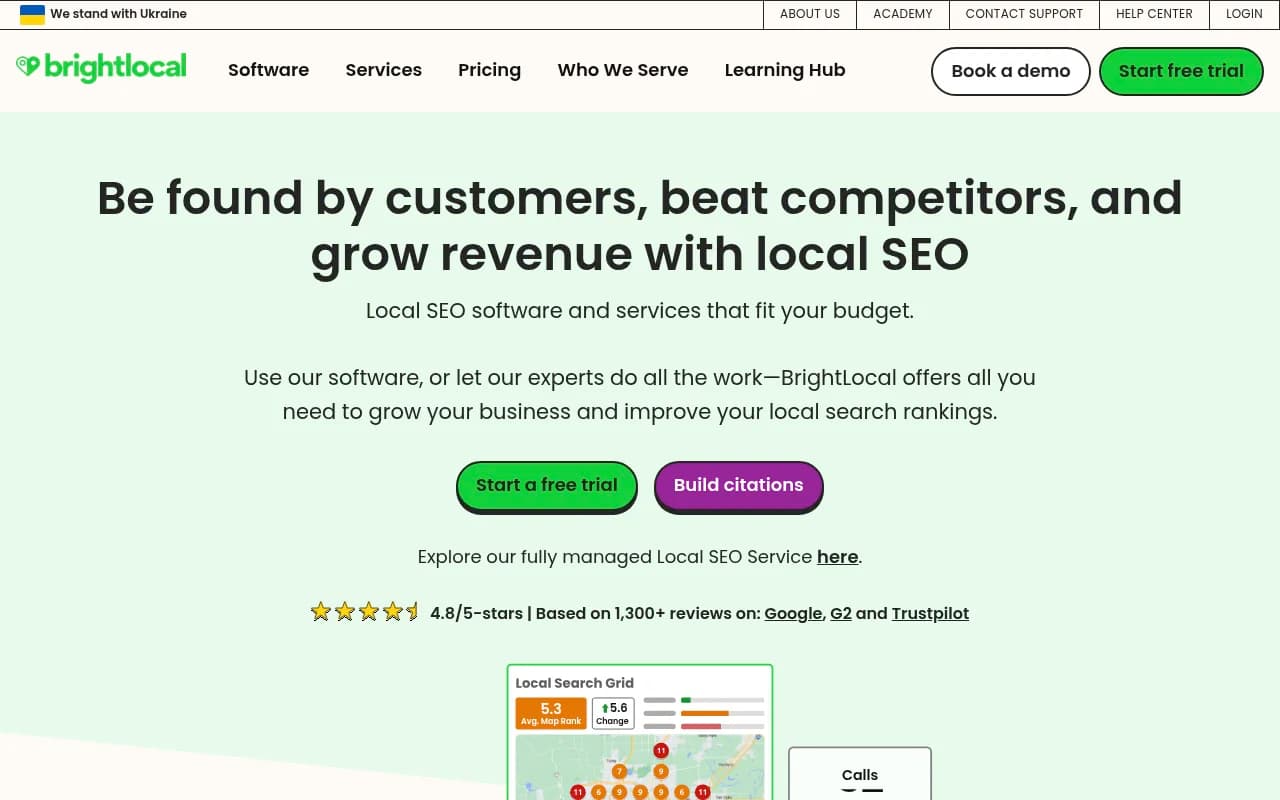
BrightLocal: Affordable local SEO toolkit for smaller brands and agencies. Lacks multi-location automation but covers the basics well.
Implementation Considerations
Data Migration
Moving to any multi-location platform requires clean, structured data. Expect to spend significant time auditing and cleaning your location data before migration. Yext's knowledge graph approach requires the most upfront work but delivers the most long-term value.
Team Training
Yext has the steepest learning curve. Plan for dedicated training and ongoing support. Uberall is the easiest to onboard. SOCi requires training for social media workflows and approval processes.
Integration Requirements
All three platforms integrate with major CRMs, analytics tools, and marketing automation platforms. Yext has the most extensive integration ecosystem. Check that your existing tech stack is supported before committing.
Ongoing Management
Multi-location platforms require ongoing management — updating business information, responding to reviews, publishing content, and monitoring performance. Factor in the internal resources needed to maintain the platform, not just the software cost.
The Future of Multi-Location Marketing
AI search is only going to become more important. By 2027, analysts predict that 50%+ of local discovery will happen through AI assistants rather than traditional search engines. Brands that invest in AI visibility today will have a massive advantage over those that wait.
The platforms that win will be those that combine:
- Structured data that AI models can consume
- Real-time monitoring across AI engines and traditional search
- Content optimization that generates citations and recommendations
- Automation that scales without breaking
- Attribution that connects visibility to revenue
Yext is furthest along this path, but even they have gaps. The smart play is to combine a solid operational platform (Yext, Uberall, or SOCi depending on your needs) with specialized AI visibility tools like Promptwatch that fill the optimization gaps.
Final Recommendations
For enterprise brands prioritizing AI visibility: Yext + Promptwatch is the strongest combination. Yext handles operational data management and traditional search, while Promptwatch optimizes for AI citations and content gaps.
For mid-market brands focused on local SEO fundamentals: Uberall offers the best balance of capability and ease of use. Add Promptwatch if AI visibility becomes a priority.
For social-first brands with distributed teams: SOCi's workflow tools are unmatched for social automation. Pair it with BrightLocal for local SEO fundamentals and Promptwatch for AI visibility.
The multi-location landscape is more complex than ever, but the opportunity is also bigger. Brands that master AI visibility alongside traditional local search will dominate their markets in 2026 and beyond.