Yext Review 2026
Yext is an enterprise digital presence platform for multi-location brands managing 50+ locations. It centralizes local listings, reviews, pages, and social content while providing competitive intelligence and AI search optimization. Used by McDonald's, IHG, Samsung, and 2M+ locations to ensure accur
Key Takeaways:
• Enterprise-grade platform built for brands with 50-500+ locations (retail, hospitality, healthcare, financial services) • Combines local listings management, review monitoring, local page generation, and social posting in one system • Scout AI agent provides competitive benchmarking and actionable recommendations for improving local search visibility • Strong AI search focus with optimization for ChatGPT, Perplexity, Google AI Overviews, and other LLMs • Premium pricing (typically $10K-$100K+ annually) reflects enterprise feature set and white-glove service
Yext is a digital presence platform designed for multi-location brands that need to manage hundreds or thousands of business listings, local pages, reviews, and social profiles at scale. Founded in 2006 and publicly traded since 2017 (NYSE: YEXT), the company serves over 2 million locations globally including household names like McDonald's, IHG Hotels & Resorts, Samsung, FedEx, Subway, and Best Western. The platform's core value proposition: ensure your brand information is accurate, consistent, and optimized everywhere customers search -- from Google Maps and Apple Maps to ChatGPT and Perplexity.
Unlike point solutions that handle only listings or only reviews, Yext operates as a central knowledge hub (they call it a Knowledge Graph) where you manage all location data once, then push it to 200+ directories, search engines, maps, voice assistants, and AI platforms. This architecture solves the nightmare scenario where a brand's hours, phone numbers, or services are inconsistent across dozens of platforms -- a problem that directly impacts local search rankings, customer trust, and revenue.
Scout: AI-Powered Competitive Intelligence
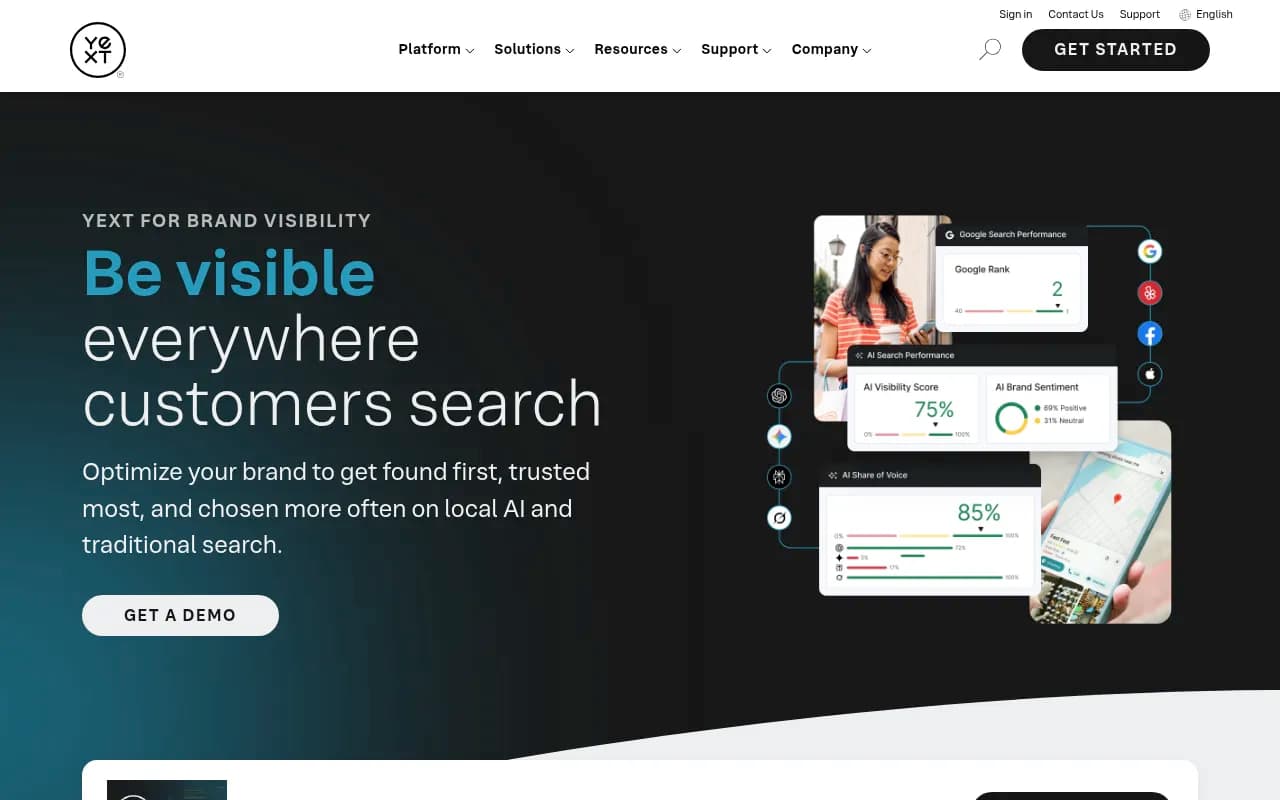
Yext's newest product, Scout, is an AI agent that continuously monitors how your locations perform in both traditional search (Google, Bing) and AI search (ChatGPT, Perplexity, Google AI Overviews, Gemini). It benchmarks your visibility against local competitors at the location level -- not just brand-wide averages -- and provides specific recommendations on what to fix. For example, Scout might flag that your downtown Seattle location is losing to a competitor in AI search because your menu data is incomplete, or that your Chicago store's reviews are 0.3 stars lower than the category average. This hyper-local competitive analysis is rare; most local SEO tools give you brand-level metrics that hide individual location problems. Scout surfaces the exact stores underperforming and tells you why, then links directly to the fix (update your menu in the Knowledge Graph, respond to negative reviews, add missing photos).
The AI search tracking is particularly relevant in 2026 as ChatGPT, Perplexity, and Google AI Overviews increasingly answer local queries ("best Italian restaurant near me", "urgent care open now") without sending users to traditional search results. Yext tracks whether your locations appear in these AI-generated answers and which competitors are being recommended instead. This visibility is critical for brands trying to understand the shift from traditional SEO to what the industry calls Generative Engine Optimization (GEO) or AI Search Optimization (AEO). Tools like Promptwatch specialize in tracking AI search visibility and content optimization for these new channels, while Yext approaches it from the local listings and structured data angle.
Knowledge Graph: The Central Data Hub
The Knowledge Graph is Yext's term for its centralized database where you store all location information: addresses, hours, phone numbers, services, menus, staff bios, photos, FAQs, and custom attributes. You manage this data once in Yext, then the platform syncs it to Google Business Profile, Apple Maps, Bing Places, Yelp, Facebook, TripAdvisor, Foursquare, Waze, and 200+ other endpoints. Updates propagate in near real-time (often within minutes), eliminating the manual work of logging into each platform separately.
The Knowledge Graph also structures data in schema markup formats (JSON-LD) that AI engines and search crawlers can easily parse. This machine-readable structure is essential for AI search visibility -- LLMs need clean, structured data to understand what your business offers and when to recommend it. Yext automatically generates and maintains this markup across all your location pages, a technical detail that most marketing teams lack the resources to handle manually.
Bulk editing tools let you update hundreds of locations at once (e.g., holiday hours for all stores, new COVID policies, menu changes). Role-based permissions ensure regional managers can only edit their assigned locations while corporate retains control over brand-level fields. The system also flags inconsistencies (e.g., a location's phone number differs from what's on your website) and duplicate listings that could dilute your search presence.
Listings Management: 200+ Publisher Network
Yext's publisher network includes the major platforms (Google, Apple, Bing, Facebook) plus hundreds of niche directories, GPS systems, voice assistants (Alexa, Siri, Google Assistant), and AI engines. The platform monitors each listing for accuracy and alerts you when third parties make unauthorized changes (e.g., a competitor edits your Google listing, a customer suggests incorrect hours). You can accept or reject these suggestions directly from Yext's dashboard.
The system also scans for duplicate listings -- a common problem where multiple Google Business Profiles exist for the same location, splitting reviews and confusing customers. Yext identifies duplicates and helps you merge or suppress them. This cleanup work is tedious but critical for local SEO; Google's algorithm penalizes businesses with inconsistent or duplicate listings.
For franchises and multi-brand organizations, Yext supports hierarchical structures where corporate sets mandatory fields (logo, brand colors, core services) and franchisees can customize local details (manager name, store-specific promotions). This balance between brand consistency and local flexibility is difficult to achieve with manual processes or simpler tools.
Reviews Management: Monitoring and Response at Scale
Yext aggregates reviews from Google, Facebook, Yelp, TripAdvisor, Healthgrades, and 50+ other platforms into a single inbox. You can filter by location, star rating, keyword, or sentiment, then respond directly through Yext (responses post back to the original platform). The system flags reviews that need urgent attention (1-star, mentions of safety issues, competitor comparisons) and routes them to the appropriate manager based on location or keyword triggers.
AI-powered response suggestions generate draft replies based on the review content and your brand voice guidelines. These drafts aren't perfect but save time on routine responses ("Thank you for the 5-star review!"). For negative reviews, the system suggests empathetic language and offers to take the conversation offline. Review response rates and average response times are tracked per location, with benchmarks showing how you compare to competitors.
Review generation tools let you send SMS or email requests to customers after a purchase or visit. You can customize the timing (e.g., 24 hours after checkout) and the message, with A/B testing to optimize response rates. The system also monitors review velocity (sudden spikes or drops) which can indicate operational issues or review fraud.
Pages: AI-Optimized Local Landing Pages
Yext Pages is a local landing page builder that generates SEO-optimized pages for each location, pulling data from the Knowledge Graph. These pages are designed to rank for high-intent local searches ("dentist in Brooklyn", "hotel near Times Square") and convert visitors with clear CTAs (book appointment, get directions, call now). The pages are mobile-responsive, load quickly (important for local search rankings), and include structured data markup that helps AI engines understand the content.
Templates are customizable but maintain brand consistency across locations. You can add location-specific content (staff bios, local promotions, neighborhood guides) without rebuilding each page from scratch. The system also generates localized FAQ sections based on common customer questions, which helps with voice search and AI search visibility (LLMs often pull FAQ content for answers).
Pages integrates with Google Analytics, Google Tag Manager, and marketing automation platforms (HubSpot, Marketo) for conversion tracking. You can see which pages drive the most calls, direction requests, or form submissions, then optimize underperforming locations. The platform also supports A/B testing of headlines, CTAs, and layouts to improve conversion rates.
Social: Localized Social Media Management
Yext Social lets you publish posts to Facebook, Instagram, Twitter, and Google Business Profile from a single dashboard. You can create posts at the corporate level and push them to all locations, or let local managers create their own content (with approval workflows if needed). The system supports bulk scheduling, so you can plan a month of posts across hundreds of locations in one session.
Localized content is key here -- a promotion for a Seattle store shouldn't appear on the Miami store's Facebook page. Yext handles this with location targeting and dynamic content insertion (e.g., "Visit us at [location address]" automatically populates the correct address for each store). The platform also tracks engagement metrics (likes, comments, shares) per location and flags posts that are underperforming or generating negative sentiment.
For compliance-sensitive industries (healthcare, financial services), Yext includes approval workflows where corporate reviews posts before they go live. This prevents local managers from posting content that violates regulations or brand guidelines.
Search: Internal Site Search for Location Finders
Yext Search powers the location finder on your website, providing fast, accurate results when customers search for nearby stores. The search engine understands natural language queries ("open late near me", "locations with drive-thru") and returns relevant results with filters for services, hours, and amenities. This is particularly useful for brands with complex location networks (e.g., banks with branches, ATMs, and financial advisors all in different places).
The search results page is customizable and can include maps, directions, appointment booking, and live chat. The system also tracks what customers are searching for, revealing gaps in your location data (e.g., many searches for "wheelchair accessible" but that attribute isn't populated for most locations).
Relate: Compliant 1:1 Messaging
Yext Relate is a text messaging platform for customer communication, designed for industries with strict compliance requirements (healthcare, financial services). It lets staff send appointment reminders, answer questions, and follow up with customers via SMS, while automatically logging all conversations for compliance audits. The system enforces opt-in/opt-out rules, blocks messages outside business hours, and flags potentially non-compliant language.
This is a niche feature but critical for healthcare providers (HIPAA compliance) and financial advisors (FINRA regulations) who need a paper trail for every customer interaction. Most SMS marketing tools don't handle these requirements, making Relate a differentiator for Yext in regulated industries.
Integrations and Ecosystem
Yext integrates with major marketing platforms including Salesforce, HubSpot, Marketo, Google Analytics, Google Tag Manager, Adobe Analytics, Looker, Tableau, and Zapier. The API is well-documented and supports custom integrations for enterprise workflows. Many brands use Yext as the source of truth for location data, syncing it to their CRM, marketing automation, and analytics tools.
The platform also connects to POS systems (Square, Toast, Clover) to pull real-time data like menu items, pricing, and inventory. This ensures your online listings reflect what's actually available in-store, reducing customer frustration and wasted trips.
Who Is Yext For?
Yext is built for enterprise and mid-market brands with 50-500+ locations. Primary verticals include retail chains, restaurant groups, hotel brands, healthcare systems, financial services (banks, credit unions, insurance), automotive dealerships, and fitness franchises. The platform is overkill for single-location businesses or small chains (under 10 locations) -- those brands are better served by simpler tools like BrightLocal, Moz Local, or even managing listings manually.
The ideal Yext customer has a centralized marketing team managing location data for dozens or hundreds of franchisees, regional managers, or local operators. They need brand consistency, compliance controls, and the ability to update information at scale. They're also dealing with the complexity of multiple brands (e.g., a hotel group with 5 different brands), multiple location types (stores, kiosks, ATMs), or highly regulated industries where every customer interaction must be documented.
Yext is not a fit for brands that need deep SEO capabilities beyond local search (no keyword research, backlink analysis, or content optimization for blog posts). It's also not ideal for brands that primarily need social media management or paid advertising -- those require dedicated tools like Hootsuite, Sprout Social, or Google Ads. Yext's strength is local presence management, not broader digital marketing.
Pricing and Value
Yext does not publish pricing publicly, but industry reports and user reviews indicate annual contracts typically range from $10,000 to $100,000+ depending on the number of locations, products included (Listings, Reviews, Pages, Social, Scout), and level of service. Pricing is generally per location per year, with volume discounts for larger deployments. A 100-location retail chain might pay $20K-$40K annually for Listings and Reviews, while a 500-location healthcare system with the full suite (Listings, Reviews, Pages, Social, Scout, Relate) could pay $80K-$150K.
This pricing reflects Yext's enterprise positioning and white-glove service (dedicated account managers, onboarding support, custom integrations). For brands with hundreds of locations, the ROI is clear: eliminating manual listing updates, preventing lost customers due to incorrect information, and improving local search rankings can easily justify the cost. For smaller brands, the price is prohibitive -- tools like BrightLocal ($29-$249/mo), Moz Local ($14-$99/mo per location), or Synup ($30-$150/mo) offer similar core features at a fraction of the cost.
Yext offers a free trial (typically 14-30 days) and demos are available through their sales team. The trial includes a limited number of locations and features, enough to evaluate the platform but not to run a full production deployment.
Strengths and Limitations
Strengths: • Comprehensive platform covering listings, reviews, pages, social, and messaging in one system -- reduces tool sprawl • Scout's hyper-local competitive intelligence and AI search tracking are ahead of most competitors • 200+ publisher network is one of the largest in the industry, ensuring broad coverage • Strong compliance features (approval workflows, audit logs, HIPAA/FINRA support) for regulated industries • Excellent for franchises and multi-brand organizations with complex hierarchies and permissions
Limitations: • Premium pricing makes it inaccessible for small businesses and single-location brands • Steep learning curve -- the platform is powerful but complex, requiring training and dedicated staff • Limited SEO capabilities beyond local search (no keyword research, backlink analysis, or content optimization for non-local pages) • Social media features are basic compared to dedicated tools like Hootsuite or Sprout Social • AI search optimization is still evolving -- while Scout tracks visibility, it doesn't offer the depth of content gap analysis or optimization tools found in specialized GEO platforms like Promptwatch
Bottom Line
Yext is the right choice for enterprise and mid-market brands with 50+ locations that need a centralized system to manage local listings, reviews, pages, and social content at scale. It's particularly strong for franchises, multi-brand organizations, and regulated industries (healthcare, financial services) that require compliance controls and audit trails. Scout's competitive intelligence and AI search tracking add significant value in 2026 as brands navigate the shift from traditional search to AI-powered answers. However, the premium pricing and complexity make it a poor fit for small businesses or brands that need broader SEO and content marketing capabilities. For those use cases, simpler and more affordable alternatives like BrightLocal, Moz Local, or Synup are better options. Best use case in one sentence: Multi-location retail, hospitality, or healthcare brands with 100+ locations that need enterprise-grade local presence management and AI search visibility.
Tags:
Similar and alternative tools to Yext