xSeek Review 2026
Specialized ChatGPT rank tracking tool with GPTBot crawler monitoring, citation tracking, and AEO optimization insights.
Key Takeaways:
• xSeek specializes in tracking brand visibility across 6+ AI search engines (ChatGPT, Claude, Perplexity, Gemini, DeepSeek, Grok) with side-by-side comparison to traditional Google Search metrics • Monitors AI crawler activity (GPTBot, ClaudeBot, etc.) to see which pages AI engines are reading and how often they return to your site • Integrates with Google Analytics and Search Console to attribute actual traffic and conversions from AI referrals, not just visibility scores • Pricing starts at $99.99/mo for 1 website and 10 prompts, with Growth plan at $249.99/mo covering 3 websites and 30 prompts across 6 AI models • Best for ecommerce brands, SaaS companies, and agencies who want to understand how AI search is shifting their discovery traffic away from Google
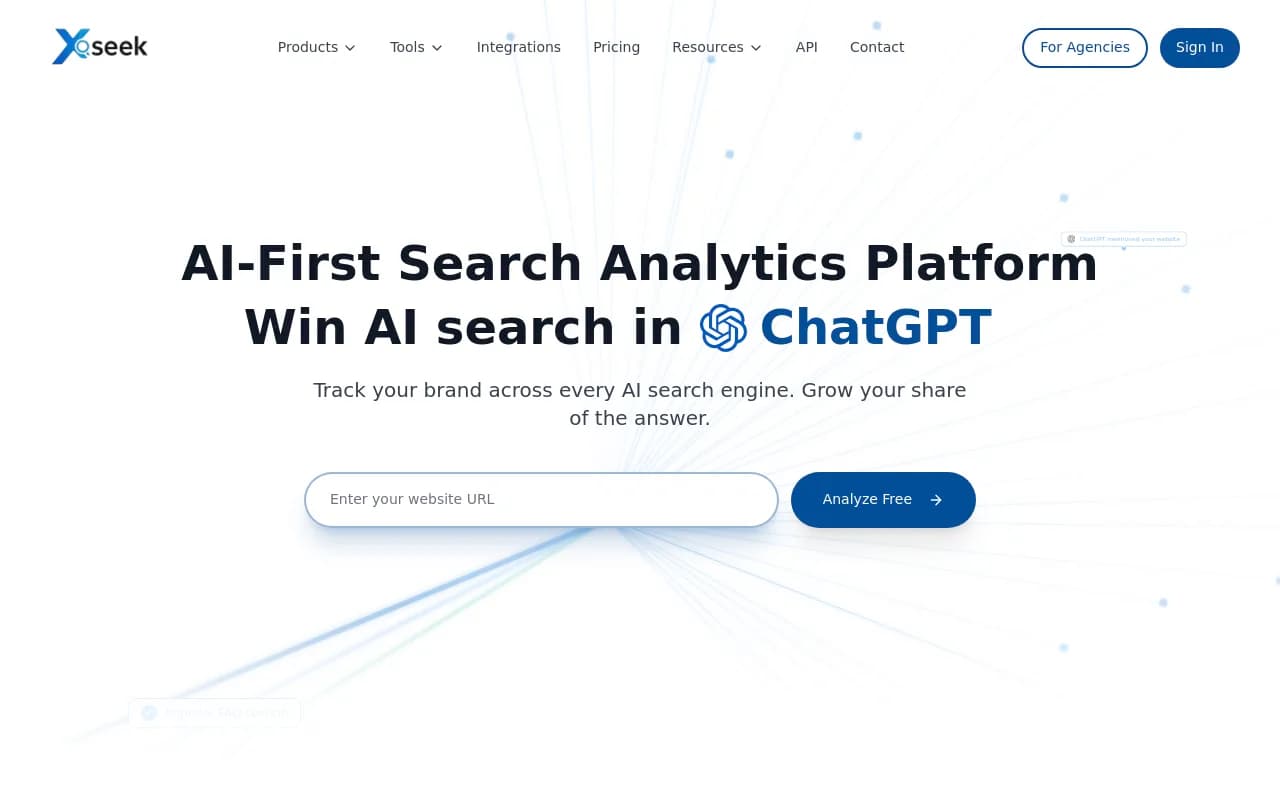
xSeek positions itself as an "AI-First Search Analytics Platform" built specifically for the shift from traditional search to AI-powered answer engines. Founded to help businesses track and optimize their presence in ChatGPT, Claude, Perplexity, and other large language models, xSeek focuses on a core insight: millions of users are now discovering products and brands by asking AI assistants instead of typing queries into Google. The platform launched in 2024 as AI search adoption accelerated, and it's designed for marketing teams who need to understand this traffic shift before it's too late.
The target audience is broad but specific: ecommerce brands watching Google traffic decline, SaaS companies trying to get recommended by ChatGPT, marketing agencies managing multiple client sites, and any business that relies on discovery traffic. xSeek claims to be operating "18 months ahead of where the market is headed" -- positioning early adoption as a competitive advantage. The platform has tracked over 50,000 prompt runs and 1 million AI crawler events across 100+ active websites.
Performance Dashboard (Core Feature)
The Performance Dashboard is xSeek's flagship feature and what sets it apart from pure monitoring tools. It displays Google Search Console impressions and clicks side-by-side with AI impressions and clicks from ChatGPT, Perplexity, and Claude. You see exactly how much of your discovery traffic is coming from traditional search versus AI search, and you can watch the shift happen month over month. This isn't just visibility scoring -- xSeek integrates with Google Analytics to track actual referral traffic from AI engines, so you can connect AI citations to real sessions, conversions, and revenue. Most competitors stop at showing you whether you're mentioned; xSeek goes further by measuring the business impact. The dashboard also breaks down performance by individual AI model, so you can see if you're strong in ChatGPT but invisible in Claude, for example.
AI Crawler Monitoring (GPTBot, ClaudeBot, etc.)
xSeek tracks which pages on your website AI crawlers are reading, how often they return, and whether they're encountering errors. This is critical because AI engines need to crawl your content before they can cite it. The platform monitors GPTBot (OpenAI), ClaudeBot (Anthropic), PerplexityBot, GoogleOther (Gemini), and other AI user agents. You get real-time logs showing crawler activity, which pages they accessed, response codes, and crawl frequency. If GPTBot is hitting 404s or getting blocked by robots.txt, you'll see it immediately. This feature is similar to what Promptwatch offers with its AI Crawler Logs, but xSeek's implementation is more focused on crawler health monitoring rather than deep indexing analysis. It's a solid diagnostic tool for ensuring AI engines can actually access your content.
Prompt Tracking & Citation Analysis
You can track up to 10 prompts (Visibility plan) or 30 prompts (Growth plan) to see where your brand appears in AI responses. xSeek runs these prompts across multiple AI models and tracks whether you're cited, how prominently you're featured, and which competitors appear alongside you. The platform shows you the exact sources AI models are pulling from -- your own pages, competitor pages, Reddit threads, YouTube videos, or third-party review sites. This helps you understand why you're getting cited (or not). For example, if ChatGPT is recommending competitors because they have strong Reddit discussions, you know where to focus your efforts. The citation tracking is straightforward but lacks the depth of platforms like Promptwatch, which analyze 880M+ citations and provide difficulty scores or query fan-outs to help prioritize which prompts to target.
AEO Copilot (Optimization Recommendations)
The AEO Copilot feature provides automated recommendations for improving your AI visibility. It analyzes your site structure, schema markup, content quality, and authority signals, then suggests specific changes to increase your chances of being cited. Recommendations might include adding structured data, optimizing for featured snippet formats, building presence on platforms like Reddit or Quora, or improving crawlability for AI agents. This is available on the Growth plan and above. The recommendations are helpful but fairly high-level -- you get guidance on what to fix, but you're still responsible for creating the content or making the technical changes. Unlike platforms that include AI content generation (like Promptwatch's built-in writing agent), xSeek focuses on diagnostics and recommendations rather than execution.
Brand Radar (Competitor Comparison)
Brand Radar lets you compare your AI visibility against competitors across different AI models. You can see which brands are being recommended for the same prompts, how often they appear, and which AI engines favor them. This is useful for benchmarking and identifying gaps -- if a competitor is dominating ChatGPT but you're stronger in Perplexity, you can adjust your strategy accordingly. The feature provides heatmaps showing relative visibility across models, making it easy to spot patterns. However, it doesn't offer the granular prompt-level comparison or content gap analysis that some competitors provide.
Page Analytics & LLM Queries
Page Analytics shows which specific pages on your site are being cited by AI models, how often, and in response to which prompts. This is valuable for understanding what content is working and what's being ignored. LLM Queries tracks the actual questions users are asking AI engines that result in your brand being mentioned. This gives you insight into user intent and helps you create content that aligns with how people are actually prompting AI assistants. The data is useful for content strategy, but the volume and depth of prompt intelligence is limited compared to platforms that specialize in prompt research.
Sources Tracking
xSeek identifies which external sources (Reddit, Quora, YouTube, review sites, news articles) are influencing AI recommendations about your brand. If a Reddit thread is driving negative sentiment or a competitor's YouTube review is getting cited more often than your own content, you'll see it. This helps you understand the broader ecosystem that AI models are drawing from when they form opinions about your brand. It's a solid feature for reputation management and content strategy, though it doesn't provide the same depth of Reddit or YouTube analysis as platforms that specialize in those channels.
Integrations & Ecosystem
xSeek integrates with Google Search Console, Google Analytics, and Bing Webmaster Tools to pull in traditional search data and attribute AI referral traffic. It also supports WordPress, Next.js, Cloudflare, AWS, Fastly, and Akamai for easier implementation of tracking scripts and schema markup. The platform offers an API for custom integrations and data exports, though this is limited to Enterprise plans. There's no mention of Looker Studio, Slack, or Zapier integrations, which some competitors offer. The integration setup is straightforward for common platforms, but more technical implementations (like server log analysis) require developer involvement.
Who Is xSeek For?
xSeek is best suited for ecommerce brands and SaaS companies with 5-50 person marketing teams who are starting to see Google traffic decline and want to understand where that traffic is going. It's particularly useful for businesses in competitive verticals (software, consumer products, professional services) where AI recommendations can make or break discovery. Agencies managing 3-10 client sites will find the Growth plan workable, though larger agencies will need Enterprise pricing. The platform is also a good fit for companies that already have strong SEO foundations and want to layer on AI visibility without starting from scratch.
xSeek is NOT ideal for solo founders or very small teams on tight budgets -- the $99.99/mo entry point is higher than some competitors, and the 10-prompt limit on the Visibility plan is restrictive. It's also not the best choice for teams that need hands-on content creation help or deep prompt research capabilities. If you're looking for a platform that not only shows you gaps but also helps you create content to fill them, you'll need to supplement xSeek with other tools or upgrade to a platform with built-in content generation.
Pricing & Value
xSeek offers three tiers: Visibility ($99.99/mo for 1 website, 10 prompts, 3 AI models), Growth ($249.99/mo for 3 websites, 30 prompts, 6 AI models, automated recommendations), and Enterprise (custom pricing for unlimited websites, hundreds of prompts, API access, dedicated strategist). Annual billing saves 20%, and there's a 7-day free trial. The pricing is competitive with mid-tier GEO platforms but higher than monitoring-only tools like Otterly.AI or Peec.ai. The Growth plan is the sweet spot for most businesses -- it covers the major AI models (ChatGPT, Claude, Perplexity, Gemini, DeepSeek, Grok), includes Google Analytics integration for traffic attribution, and provides automated recommendations. Enterprise pricing is opaque, which is standard for this category but frustrating for agencies trying to budget.
Compared to Promptwatch ($99/mo Essential, $249/mo Professional, $579/mo Business), xSeek is priced similarly but offers fewer prompts and no content generation capabilities. Promptwatch's Professional plan includes 150 prompts and 15 AI-generated articles per month, while xSeek's Growth plan caps at 30 prompts with no content creation. For pure monitoring and traffic attribution, xSeek is competitive. For optimization and content creation, it falls short.
Strengths
• Side-by-side Google vs AI comparison: The Performance Dashboard makes it easy to see the traffic shift happening in real-time, which is valuable for executive reporting and budget justification. • AI traffic attribution via Google Analytics: Unlike monitoring-only tools, xSeek connects AI visibility to actual sessions and conversions, so you can measure ROI. • Crawler monitoring: Real-time logs of AI bot activity help you diagnose indexing issues before they hurt your visibility. • Clean, focused interface: The platform is easy to navigate and doesn't overwhelm you with data you don't need. • Integration with existing tools: Google Search Console and Analytics integration means you don't have to abandon your current workflow.
Limitations
• Limited prompt tracking: 10 prompts on the Visibility plan and 30 on Growth is restrictive compared to competitors offering 50-350 prompts at similar price points. • No content creation tools: xSeek tells you what's missing but doesn't help you create content to fill the gaps. You're on your own for execution. • Shallow prompt intelligence: No difficulty scores, volume estimates, or query fan-outs to help prioritize which prompts to target. You're guessing at which opportunities are worth pursuing. • Opaque Enterprise pricing: Agencies and larger teams can't self-serve pricing, which slows down decision-making. • Limited competitor analysis: Brand Radar shows relative visibility but doesn't provide the granular content gap analysis or citation breakdowns that platforms like Promptwatch offer.
Bottom Line
xSeek is a solid AI visibility platform for businesses that want to track the shift from Google to AI search and measure the impact on their traffic. It's particularly strong at traffic attribution and crawler monitoring, making it a good choice for teams that need to prove ROI to executives or diagnose technical issues. However, it's a monitoring and diagnostics tool, not an optimization platform. If you need help creating content, prioritizing prompts, or closing visibility gaps, you'll need to supplement xSeek with other tools or choose a more comprehensive platform. Best use case: ecommerce or SaaS marketing teams with 5-20 people who want a clean dashboard to track AI visibility alongside Google metrics and have the resources to act on the insights themselves.
Tags:
Similar and alternative tools to xSeek