SEOTalos Review 2026
Focuses on tracking AI Overview performance and Google AI Mode visibility to optimize content for generative search experiences.
Key Takeaways:
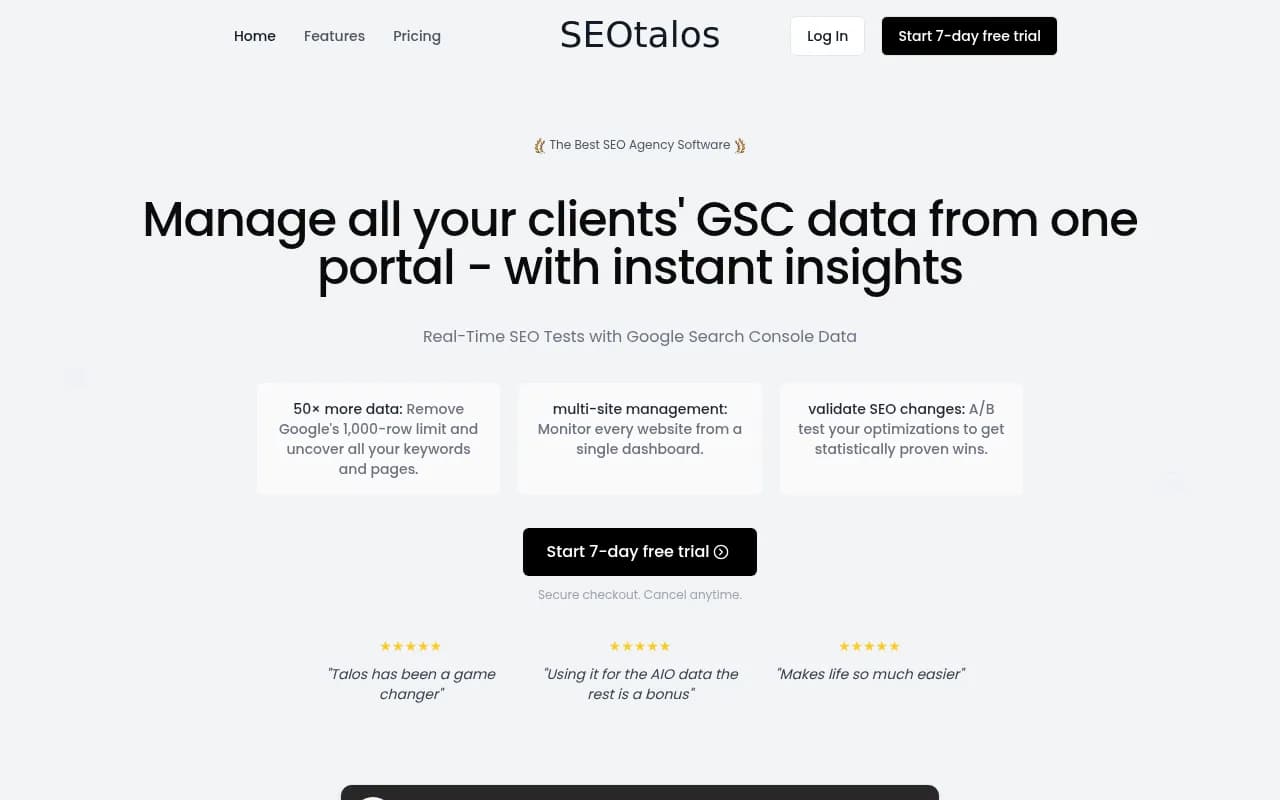
• Built for agencies: Multi-site GSC management with unlimited properties, team permissions, and privacy blur for client reporting • 50× more data than GSC: Removes Google's 1,000-row limit to show all keywords and pages, not just the top slice • Statistical SEO testing: A/B test title tags, content changes, and link additions with proven results, not guesswork • AI Overview tracking: Monitors Google AI Mode and AI Overview visibility with dedicated credit-based tracking • Limitations: Newer platform with fewer integrations than established tools; AIO credits are capped per plan tier
SEOTalos is an SEO analytics platform designed specifically for agencies and teams managing multiple client websites. Built by a team frustrated with Google Search Console's limitations, it solves the core problem of multi-site SEO management: you can't scale when you're logging into 20+ GSC properties, manually exporting data, and losing hours to basic checks. SEOTalos consolidates everything into a single dashboard where you can see traffic, rankings, algorithm updates, and test results across every site you manage. The platform launched in 2024 and has quickly gained traction among agencies looking for a GSC alternative that actually supports their workflow.
The target audience is clear: SEO agencies, in-house teams managing multiple properties, and consultants who need to track performance across client portfolios without drowning in spreadsheets. If you're a solo blogger or managing just one site, this is overkill—stick with free GSC. But if you're an agency with 10+ clients, or an in-house team managing regional sites, e-commerce categories, or brand portfolios, SEOTalos is built for exactly that use case.
50× More Data Than Google Search Console Google Search Console caps data exports at 1,000 rows. For most sites, that means you're only seeing the top-performing keywords and pages—the rest is invisible. SEOTalos removes that limit entirely. You get access to all your keyword and page data, no matter how deep the long tail goes. This is critical for agencies because the wins are often hiding in rows 1,001 through 10,000: low-competition keywords, content gaps, and pages that are almost ranking but need a nudge. The platform pulls this data directly from GSC via API, so it's not scraped or estimated—it's the real thing, just unfiltered.
Master SEO Monitoring Dashboard The core interface is a unified dashboard that shows clicks, impressions, PageSpeed scores, Google algorithm updates, tags, and performance insights across all connected sites. You can see everything in one place: which sites are trending up, which took a hit from a core update, which tests are running, and which clients need attention. This is the command center view that GSC never built. You can filter by date range, compare periods, and drill into individual properties without logging out and back in. For agencies juggling 20+ clients, this alone saves hours every week.
Statistical SEO Testing This is where SEOTalos differentiates itself from basic GSC wrappers. The platform includes built-in A/B testing for SEO changes. You can test whether changing title tags, adding internal links, or rewriting meta descriptions actually moves the needle—and get statistically significant results, not just "traffic went up, maybe it worked." The testing engine compares a control group of pages against a variant group and measures the impact over time. This is the same methodology used by platforms like SearchPilot and SEOTesting.com, but integrated directly into the SEOTalos workflow. You're not guessing anymore—you're proving what works before rolling changes out site-wide.
Annotations & Core Updates Every traffic spike or drop gets context. The platform overlays Google algorithm updates (core updates, helpful content updates, spam updates) directly on your traffic charts, and you can add your own annotations for site changes, content launches, or client requests. This makes it trivial to answer "what happened on June 15th?" without digging through Slack threads or trying to remember if that was the day you published 50 new blog posts. The timeline view shows cause and effect in one glance.
Combined Portfolio Metrics You can roll up performance across all properties—or group them by client, vertical, or campaign. See total clicks, impressions, and rankings for your entire portfolio, or filter down to just e-commerce clients, or just sites in a specific niche. This is essential for agency reporting: instead of exporting 15 separate GSC reports and stitching them together in Google Sheets, you get one unified view. You can also compare performance across clients to spot trends or identify which accounts need more attention.
Organization & Tagging System Label and tag everything. Group sites by client, by team member, by vertical, by campaign—whatever structure makes sense for your agency. Tags make it easy to filter the dashboard and find exactly what you need without scrolling through an endless list of properties. You can also set up custom views so each team member only sees the sites they're responsible for.
Privacy Blur When you're sharing screenshots or reports with clients, you don't always want to expose every keyword or URL. The privacy blur feature lets you obscure sensitive data with one click—perfect for client presentations, case studies, or internal reviews where you need to show results without revealing proprietary information. This is a small but critical feature for agencies that handle competitive or confidential accounts.
Keyword & Content Groups Group related keywords and pages to track performance by topic, theme, or intent. For example, you could create a group for "product category X" that includes all related keywords and landing pages, then track how that entire content cluster performs over time. This is more useful than tracking individual keywords in isolation—you're measuring the success of a content strategy, not just a single page.
Branded vs. Non-Branded Tracking Separate traffic that comes from people searching for your brand name versus traffic from generic, non-branded queries. This distinction matters because branded traffic is demand you've already created (through ads, PR, word of mouth), while non-branded traffic is true SEO growth—people finding you because you rank for their problem, not because they already know your name. Most GSC dashboards lump these together, which inflates SEO performance when brand awareness campaigns are running.
Google AI Overview (AIO) Tracking SEOTalos includes dedicated tracking for Google AI Overviews (formerly SGE) and Google AI Mode. This is the generative search optimization (GEO) piece: you can monitor when your content appears in AI-generated answers, track visibility over time, and see which pages are being cited. The platform uses a credit-based system for AIO tracking—Starter gets 1,000 credits/month, Pro gets 5,000. Each query consumes credits, so you're not running unlimited checks, but it's enough to track key queries and monitor trends. This feature is still relatively new (Google AI Overviews only rolled out widely in 2024), so the dataset and insights are evolving. Compared to dedicated GEO platforms like Promptwatch, SEOTalos offers basic visibility tracking but lacks the depth of citation analysis, content gap identification, or AI-specific optimization tools. If GEO is your primary focus, you'll want a specialized platform. If you're an SEO agency that wants to keep an eye on AI visibility alongside traditional rankings, SEOTalos covers the basics.
Team Collaboration & Permissions Invite unlimited team members (on Pro plan), set role-based permissions, and collaborate across all your SEO projects. You can control who sees which sites, who can run tests, and who can edit settings. This is table stakes for agency software, and SEOTalos handles it cleanly.
Who Is It For
SEOTalos is purpose-built for SEO agencies managing 10-50+ client sites, in-house teams overseeing multiple properties (regional sites, brand portfolios, e-commerce categories), and consultants who need a scalable alternative to logging into GSC 20 times a day. The sweet spot is agencies with 5-15 team members who are tired of manual GSC exports, spreadsheet hell, and clients asking "why did traffic drop?" without any good way to answer. If you're running SEO tests, managing multiple clients, or need to prove ROI with data (not opinions), this is the platform.
It's also a fit for teams that want to dip their toes into GEO/AI visibility tracking without committing to a full-fledged platform. The AIO tracking gives you enough data to monitor trends and report on AI Overview appearances, even if it's not as deep as what you'd get from a dedicated GEO tool.
Who should NOT use this: Solo bloggers, single-site owners, or anyone who doesn't need multi-site management. If you're just tracking one website, GSC is free and perfectly adequate. SEOTalos is overkill unless you're managing scale. Also, if your primary goal is GEO and you need advanced AI visibility features (citation tracking, content gap analysis, prompt intelligence), you'll want a specialized platform like Promptwatch instead.
Integrations & Ecosystem
SEOTalos integrates directly with Google Search Console via API—that's the core data source. Beyond that, the platform is relatively self-contained. There's no mention of integrations with Google Analytics, Ahrefs, Semrush, Slack, Zapier, or other common SEO tools. This is a limitation compared to more established platforms, but it also keeps the product focused. You're not juggling 15 integrations—you're getting clean GSC data with built-in testing and AI tracking. The platform does include KPI overlays (search volume, CPC) on the Pro plan, which suggests some level of keyword data integration, but specifics aren't detailed.
No API is mentioned, so custom integrations or data exports beyond the platform's built-in features aren't currently available. This is fine for most agencies, but if you need to pipe SEO data into a custom BI tool or client dashboard, you'll be limited to manual exports.
Pricing & Value
SEOTalos offers two main plans:
• Starter: $29/month – 10 sites, 2 seats, 1,000 AIO credits. Good for small agencies or consultants just getting started with multi-site management.
• Pro: $59/month – Unlimited sites, unlimited seats, 5,000 AIO credits, KPI overlays (search volume, CPC). This is the plan most agencies will want—unlimited sites and team members for less than the cost of a single Ahrefs or Semrush subscription.
Both plans include a 7-day free trial and a 7-day no-questions-asked refund policy. You can cancel anytime. Annual billing saves 20%.
Compared to competitors: SEOTesting.com charges $49-$129/month for similar testing features but with site limits. SearchPilot is enterprise-only and costs thousands per month. Ahrefs and Semrush are $100-$400/month but don't include multi-site GSC management or statistical testing. SEOTalos is competitively priced for what it offers—especially the Pro plan, which removes all site and seat limits.
The value proposition is clear: if you're an agency spending 5-10 hours a week on manual GSC exports and client reporting, SEOTalos pays for itself immediately. The SEO testing alone can generate wins that justify the cost in a single month.
Strengths & Limitations
Strengths: • Removes GSC's 1,000-row limit – finally see all your keyword and page data, not just the top slice • Statistical SEO testing – prove what works before rolling changes out site-wide • Unlimited sites and seats on Pro plan – no artificial caps, scale as much as you need • Built for agencies – multi-site dashboard, team permissions, privacy blur, and portfolio rollups • AI Overview tracking included – basic GEO visibility without needing a separate tool
Limitations: • Limited integrations – no GA, Ahrefs, Semrush, Slack, or Zapier connections; it's a standalone tool • AIO credits are capped – 1,000-5,000 credits/month depending on plan; not unlimited AI tracking • Newer platform – fewer features and less ecosystem maturity than established tools like Ahrefs or Semrush • No API – can't build custom integrations or pipe data into external dashboards
Bottom Line
SEOTalos is the best multi-site GSC management platform for agencies that need to scale beyond Google's limitations. If you're managing 10+ client sites, running SEO tests, and want to track AI Overview visibility without juggling multiple tools, this is the platform to use. The Pro plan ($59/month) is a no-brainer for agencies—unlimited sites, unlimited seats, and statistical testing for less than a single Ahrefs subscription. Best use case in one sentence: SEO agencies managing 10-50 client sites who need a unified dashboard, proven testing, and basic AI visibility tracking without the complexity of enterprise tools.
Tags:
Similar and alternative tools to SEOTalos