seoClarity Review 2026
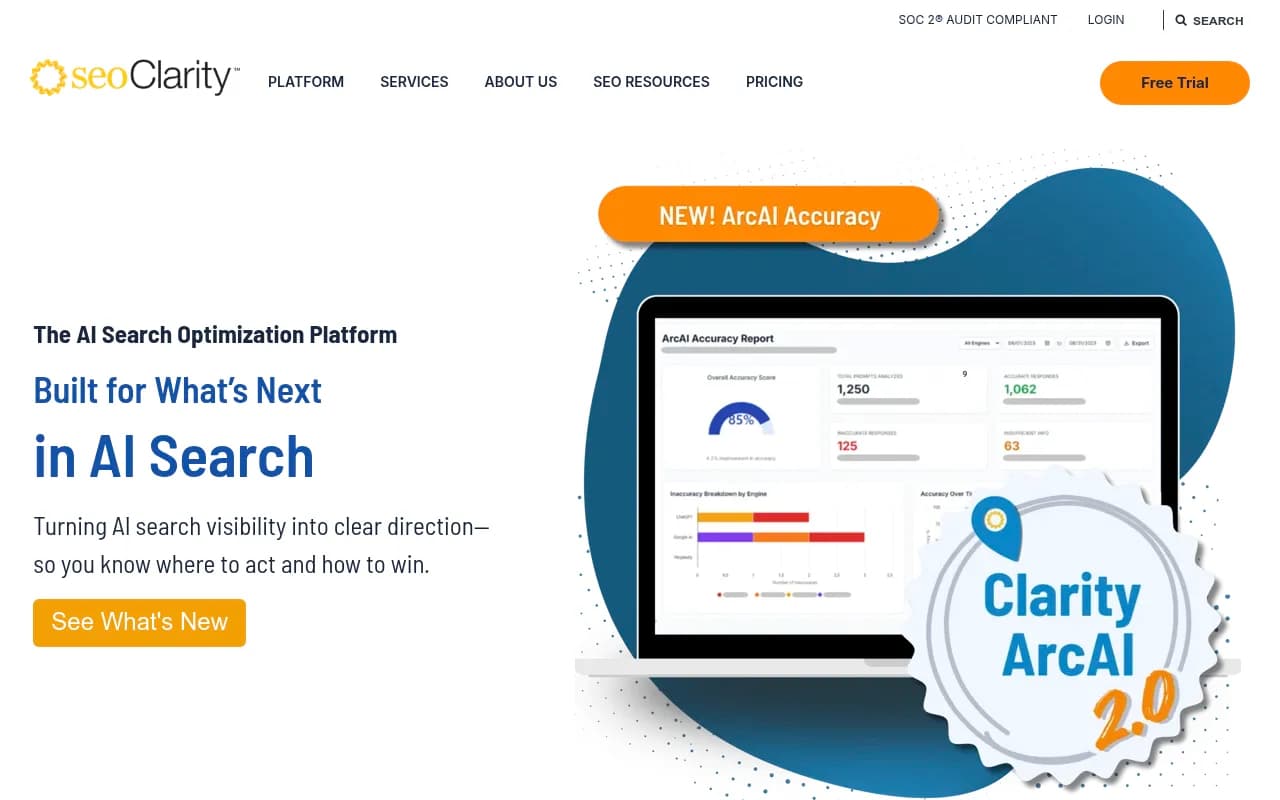
seoClarity is an all-in-one enterprise SEO platform that tracks AI search visibility across ChatGPT, Perplexity, and Google AI Overviews while providing comprehensive keyword tracking, technical audits, content optimization, and competitive analysis. Trusted by 3,500+ brands including Samsung, Marri
Key Takeaways:
• Enterprise-grade SEO platform built for large brands and agencies managing complex, multi-site SEO programs with unlimited keyword tracking and competitive analysis • Clarity ArcAI module tracks brand visibility across 10+ AI search engines (ChatGPT, Perplexity, Google AI Overviews, Claude, Gemini, etc.) with bot activity monitoring and sentiment analysis • Comprehensive feature set spans rank tracking, technical SEO, content optimization, AI content generation, and SEO automation tools -- reducing the need for multiple point solutions • Custom pricing model (no public rates) targets enterprise budgets, typically starting around $2,000/month for large-scale deployments • Strong for enterprises needing scale and depth, but potentially overkill for small businesses or solo practitioners who may find better value in simpler, lower-cost alternatives
seoClarity positions itself as the comprehensive SEO platform for enterprises and agencies that need to manage large-scale search optimization programs across traditional Google search and the emerging AI search landscape. Founded as a traditional enterprise SEO platform, the company has evolved to address the shift toward AI-powered search experiences with its Clarity ArcAI module, which monitors brand visibility across ChatGPT, Perplexity, Google AI Overviews, Claude, Gemini, and other AI engines. The platform serves over 3,500 brands including recognizable names like Samsung, Marriott, Expedia, Orbitz, and Zapier -- companies managing hundreds of thousands to millions of pages and tracking tens of thousands of keywords.
The core value proposition is consolidation: seoClarity aims to replace the typical enterprise SEO stack (separate tools for rank tracking, technical audits, content optimization, competitive analysis, and now AI search monitoring) with a single integrated platform. For large SEO teams juggling Semrush, Ahrefs, Screaming Frog, Clearscope, and various AI monitoring tools, this consolidation can significantly reduce tool sprawl, data silos, and workflow friction.
Rank Tracking & SERP Analysis
seoClarity's rank tracking engine is built for scale. Unlike consumer-focused tools that cap keyword tracking at a few thousand keywords, seoClarity offers unlimited keyword tracking across unlimited competitors. This matters for enterprises managing large product catalogs, multi-location businesses, or agencies handling dozens of client sites. The platform tracks rankings daily across desktop and mobile, with support for local SEO tracking at the city and state level.
Rank Intelligence surfaces ranking opportunities by analyzing SERP features (featured snippets, People Also Ask boxes, local packs, video carousels, shopping results) and identifying where competitors rank but you don't. The Visual Rank Tracking feature (called Share of Visibility) shows your brand's presence across the entire SERP, not just traditional blue-link rankings -- critical as Google increasingly prioritizes SERP features over organic results.
Video Rank Tracking monitors YouTube rankings, useful for brands investing in video content. The platform also provides a Ranking Data API for feeding rank data into custom dashboards or business intelligence tools like Looker Studio, Tableau, or Power BI.
Content Marketing & Optimization
The content suite addresses the full content lifecycle: research, creation, optimization, and gap analysis.
SEO Topic Research identifies content opportunities by analyzing search volume, keyword difficulty, and topical clusters. It groups related keywords into topics, helping content teams prioritize what to write about rather than chasing individual keywords.
AI Content Writer generates SEO-optimized articles, product descriptions, and landing page copy using generative AI. The tool creates SEO Content Briefs that outline target keywords, recommended word count, semantic terms to include, competitor analysis, and content structure. These briefs can be handed off to writers or used to guide the AI writer.
Content Gaps compares your content footprint against competitors to reveal topics and keywords they rank for but you don't. This competitive intelligence helps prioritize content creation based on proven demand rather than guesswork.
Content Ideas surfaces trending topics and questions from Google autocomplete, People Also Ask, and related searches. Answer Box Opportunity specifically targets featured snippet opportunities by identifying queries where competitors hold the snippet but you rank on page one -- low-hanging fruit for quick wins.
Technical SEO & Site Audits
The technical SEO module is designed for large, complex websites with hundreds of thousands or millions of pages.
SEO Crawler performs comprehensive site crawls to identify technical issues: broken links, redirect chains, duplicate content, missing meta tags, canonicalization problems, and crawl budget waste. The crawler handles JavaScript rendering, making it suitable for modern single-page applications and React/Angular sites.
Site Audits provide prioritized issue lists with severity scoring, helping technical SEO teams focus on high-impact fixes first. The platform tracks issue resolution over time, useful for demonstrating progress to stakeholders.
Page Speed monitoring tracks Core Web Vitals (LCP, FID, CLS) at scale, identifying slow pages that hurt user experience and rankings. SEO Segmentation allows you to analyze technical health by page type (product pages, blog posts, category pages), template, or custom segments -- critical for large sites where issues often cluster around specific templates or sections.
Internal Link Analysis maps your site's link structure, identifies orphaned pages (pages with no internal links), and surfaces opportunities to strengthen internal linking for better crawlability and PageRank flow.
Log File Analysis ingests server logs to show exactly which pages Googlebot and other crawlers are accessing, how often, and where they're encountering errors. This is essential for large sites where crawl budget optimization can significantly impact indexation.
Keyword Research & Competitive Intelligence
The Research Grid is seoClarity's competitive intelligence engine. It allows you to compare your domain against unlimited competitors across any keyword set, showing share of voice, ranking distribution, keyword overlap, and content gaps. You can drill down to see exactly which keywords each competitor ranks for, their estimated traffic, and SERP feature ownership.
Keyword Difficulty scoring helps prioritize which keywords to target based on competition level and your domain's authority. Google Trends integration shows search volume trends over time, useful for identifying seasonal patterns or emerging topics.
The competitive analysis extends to backlinks with Link Gaps, which identifies domains linking to competitors but not to you -- potential outreach targets. Link Management tools help track link building campaigns, monitor new and lost backlinks, and measure link velocity.
SEO Analytics & Reporting
The analytics suite connects SEO data to business outcomes.
Search Analytics integrates Google Search Console data directly into the platform, combining impressions, clicks, and CTR data with rank tracking and technical metrics for a unified view. Site Analytics layers in Google Analytics data to show how organic traffic converts into leads, sales, or other business goals.
Customizable Dashboards let you build client-facing or executive reports with drag-and-drop widgets, scheduled email delivery, and white-label branding (important for agencies). Actionable Insights uses machine learning to automatically surface significant changes in rankings, traffic, or technical health, reducing the time spent manually analyzing data.
SEO Forecasting models the potential traffic and revenue impact of ranking improvements, useful for building business cases for SEO investment. PPC and SEO Integration combines paid and organic search data to identify opportunities for keyword arbitrage (shifting budget from PPC to SEO for keywords you can rank for organically).
Clarity ArcAI: AI Search Visibility Tracking
This is seoClarity's answer to the AI search revolution. As ChatGPT, Perplexity, Google AI Overviews, and other AI engines increasingly answer user queries directly (rather than sending them to websites), brands need to understand where and how they're being mentioned in AI responses.
AI Search Visibility Tracking monitors your brand's presence across 10+ AI engines: OpenAI/ChatGPT, Perplexity, Google AI Overviews, Google AI Mode, Claude, Gemini, Meta/Llama, DeepSeek, Grok, Mistral, and Copilot. You define a set of prompts or queries relevant to your business, and the platform tracks whether your brand appears in AI responses, how often, in what context, and compared to competitors.
AI Overviews Tracking specifically monitors Google's AI-generated answer boxes at the top of search results, showing when your content is cited as a source.
AI Bot Activity Tracking analyzes server logs to show which AI crawlers (GPTBot, ClaudeBot, PerplexityBot, etc.) are accessing your site, which pages they're reading, and how often. This helps you understand whether AI engines are even discovering your content -- a prerequisite for being cited in their responses.
Research Prompts provides volume estimates and difficulty scores for prompts and questions, similar to traditional keyword research but focused on how users query AI engines (typically longer, more conversational queries).
Sentiment Analysis evaluates the tone of AI responses mentioning your brand -- positive, negative, or neutral. This is critical for brand reputation management as AI engines increasingly shape public perception.
Content Optimizer for AI Search suggests changes to make your content more likely to be cited by AI engines, based on analysis of what content currently gets cited.
AI Search Traffic Attribution tracks visitors arriving from AI search engines via code snippet, Google Search Console integration, or server log analysis, connecting AI visibility to actual traffic and conversions.
Accuracy Monitoring detects hallucinations or factual errors in AI responses about your brand, allowing you to take corrective action (contacting the AI provider, updating your content, etc.).
ClarityAutomate: SEO Execution Tools
Beyond analysis, seoClarity offers automation tools to implement SEO changes at scale.
Page Optimizer identifies on-page issues (missing H1s, thin content, keyword stuffing, etc.) and can automatically deploy fixes via integrations with content management systems like WordPress, Drupal, or headless CMS platforms.
SEO Split Tester runs controlled experiments to measure the impact of SEO changes before rolling them out site-wide. You can test title tag changes, content updates, schema markup, or internal linking strategies on a subset of pages and measure the ranking and traffic impact.
Schema Optimizer helps build, test, and implement structured data markup (JSON-LD) for rich snippets, knowledge panels, and enhanced SERP features. It validates schema against Google's guidelines and can push markup to your CMS.
Link Seeker (also called Link Optimizer) automatically identifies internal linking opportunities based on keyword relevance and site structure, then can implement those links programmatically.
Bot Optimizer ensures AI crawlers can access your full site content by identifying and fixing robots.txt issues, crawl blocks, or JavaScript rendering problems that prevent AI bots from reading your pages.
Data Services & APIs
For enterprises with custom reporting needs or data science teams, seoClarity offers several APIs:
Domain Research API provides programmatic access to competitive intelligence data across domains and keywords.
Ranking Data API feeds rank tracking data into external systems.
Keyword Research API delivers bulk keyword metrics (volume, difficulty, CPC, trends) for custom analysis.
Content Analysis API integrates content optimization recommendations into your existing content workflow or CMS.
Integrations & Ecosystem
seoClarity integrates with Google Search Console, Google Analytics, Google Ads, Looker Studio (formerly Data Studio), Slack (for alerts), WordPress, Drupal, Contentful, and various marketing automation platforms. The platform is SOC 2 Type II compliant, important for enterprises with strict data security requirements.
Who Is It For
seoClarity is purpose-built for three primary audiences:
Enterprise SEO teams at large brands (e-commerce sites with 100K+ products, travel/hospitality companies with thousands of location pages, SaaS companies with extensive documentation and blog content, publishers with millions of articles). These teams typically have 5-20+ SEO specialists, developers, and content creators managing complex, multi-site programs. They need unlimited keyword tracking, advanced segmentation, and the ability to manage SEO at scale without hitting tool limitations.
Digital marketing agencies managing 10-50+ client sites. The white-label reporting, multi-site management, and ability to track unlimited competitors make seoClarity attractive for agencies that need to demonstrate ROI across diverse client portfolios. The platform's breadth reduces the need to subscribe to multiple tools per client.
In-house SEO teams at mid-to-large companies (typically 500+ employees) with significant organic search revenue. These teams have the budget for enterprise software and need the depth of features to justify the investment. They're often replacing a patchwork of 5-10 different SEO tools.
seoClarity is not ideal for small businesses, solopreneurs, or early-stage startups. The pricing (custom quotes, typically starting around $2,000/month based on industry reports) and feature complexity are overkill for someone managing a single small site with a few hundred pages. Tools like Ahrefs, Semrush, or Moz offer better value at that scale. Similarly, freelance SEO consultants managing a handful of small client sites will find the platform's enterprise focus and pricing mismatched to their needs.
Pricing & Value
seoClarity does not publish pricing publicly. All plans are custom-quoted based on the number of sites, keywords tracked, pages crawled, and features included. Based on industry discussions and competitor comparisons, enterprise plans typically start around $2,000-$3,000/month and can exceed $10,000/month for large deployments with multiple sites, hundreds of thousands of keywords, and full feature access including Clarity ArcAI and ClarityAutomate.
This pricing model is standard for enterprise SEO platforms (BrightEdge and Conductor use similar approaches) but can be frustrating for buyers who want transparent pricing. The lack of a self-service trial or freemium tier means you must go through a sales process to evaluate the platform.
For enterprises already spending $5,000-$15,000/month across multiple SEO tools (Semrush, Ahrefs, Screaming Frog, Clearscope, Surfer SEO, plus emerging AI search monitoring tools), consolidating into seoClarity can provide cost savings and workflow efficiency. For smaller organizations, the pricing is prohibitive compared to all-in-one tools like Semrush ($229-$449/month) or Ahrefs ($129-$449/month).
Strengths
Unlimited keyword tracking and competitors -- no artificial caps that force you to choose which keywords or competitors to monitor. This is a major differentiator from consumer-focused tools.
True enterprise scale -- handles sites with millions of pages, tens of thousands of keywords, and complex multi-site/multi-brand structures without performance degradation.
AI search visibility tracking -- Clarity ArcAI addresses a genuine gap in the market as brands scramble to understand their presence in ChatGPT, Perplexity, and Google AI Overviews. Most traditional SEO platforms (Semrush, Ahrefs, Moz) have limited or no AI search monitoring.
Comprehensive feature breadth -- reduces tool sprawl by covering rank tracking, technical SEO, content optimization, competitive analysis, and AI search in one platform. This consolidation simplifies workflows and data integration.
Advanced segmentation and filtering -- allows technical SEO teams to analyze large sites by template, page type, or custom segments, making it easier to diagnose and fix issues at scale.
Limitations
No transparent pricing -- the custom quote model makes it difficult to evaluate cost-effectiveness without going through a sales process. This is a barrier for smaller teams or those used to self-service SaaS tools.
Steep learning curve -- the platform's depth and complexity require significant onboarding and training. Smaller teams may struggle to utilize the full feature set effectively.
AI search tracking still maturing -- while Clarity ArcAI is ahead of most traditional SEO platforms, dedicated AI search monitoring tools like Promptwatch offer deeper capabilities (content gap analysis, AI content generation specifically for AI search, more granular prompt intelligence). seoClarity's AI features feel like an add-on to a traditional SEO platform rather than a ground-up AI search solution.
Limited content creation capabilities -- the AI Content Writer is functional but not as sophisticated as dedicated content optimization tools like Clearscope, Surfer SEO, or Frase. Teams serious about content may still need a separate tool.
Overkill for small sites -- if you're managing a single site with under 10,000 pages and tracking fewer than 5,000 keywords, you're paying for scale and features you don't need. Semrush, Ahrefs, or Moz provide better value.
Bottom Line
seoClarity is a strong choice for enterprise SEO teams and agencies managing large, complex SEO programs who need unlimited scale, comprehensive features, and are willing to invest in an enterprise-grade platform. The addition of Clarity ArcAI positions the platform to address the shift toward AI search, though dedicated AI search monitoring tools currently offer more depth in that specific area. For smaller businesses or solo practitioners, the pricing and complexity make it a poor fit -- simpler, lower-cost alternatives deliver better value at that scale. Best use case: Enterprise brands with 100K+ pages, 10K+ tracked keywords, and a dedicated SEO team of 5+ people looking to consolidate their SEO stack into a single platform.
Tags:
Similar and alternative tools to seoClarity