Qualtrics Review 2026
Collect feedback, analyze sentiment, and improve experiences across touchpoints. Enterprise survey and research platform with advanced analytics.
Key Takeaways:
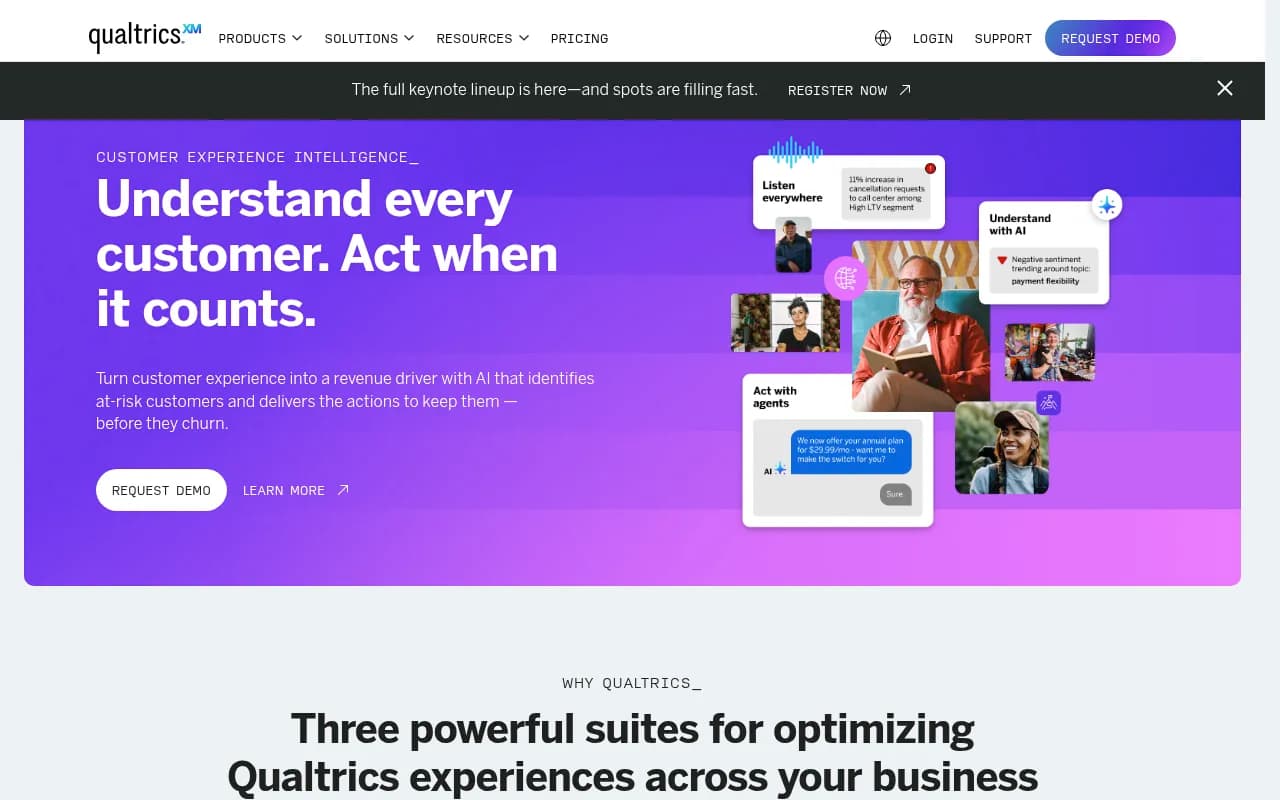
• Enterprise-grade XM platform used by 20,000+ organizations across 100+ countries, processing 2 billion conversations annually with AI-powered analytics that identify at-risk customers and deliver actionable insights • Three integrated suites (Customer Experience, Employee Experience, Strategy & Research) cover the full spectrum of experience management from frontline feedback to strategic market research • AI-first approach with features like Conversational Feedback, Manager Assist, and Text Analytics Insights that automate analysis and recommend specific actions to improve experiences • Best for large enterprises and agencies managing complex, multi-touchpoint experience programs -- pricing starts at $420/month but most organizations need custom enterprise plans • Limitations include steep learning curve and pricing that puts it out of reach for small businesses and startups; competitors like SurveyMonkey and Typeform offer simpler, more affordable alternatives for basic survey needs
Qualtrics has established itself as the dominant player in enterprise experience management since its founding in 2002. Acquired by SAP in 2018 for $8 billion, then taken private again by Silver Lake and the Qatar Investment Authority in 2023, the company has consistently evolved from a survey tool into a comprehensive experience intelligence platform. Today, it serves over 20,000 customers including major brands like Porsche, JetBlue, and healthcare systems managing patient feedback at scale.
The platform targets large enterprises, digital agencies managing multiple client programs, and organizations with complex experience management needs across customer service, employee engagement, and market research. If you're a Fortune 500 company trying to understand why customers churn, a healthcare system tracking patient satisfaction across hundreds of locations, or a global brand measuring employee engagement in 50+ countries, Qualtrics is built for you. Small businesses and startups will find the pricing and complexity overwhelming.
Customer Experience Intelligence
The Customer Experience suite is Qualtrics' flagship offering, designed to capture feedback across every digital and physical touchpoint. The platform monitors customer interactions through surveys, web intercepts, mobile app feedback, contact center integrations, and social listening. What sets it apart from basic survey tools is the AI layer that processes this data in real-time to identify patterns and predict outcomes.
Frontline Locations Assist uses AI to analyze feedback from physical locations (retail stores, bank branches, restaurant locations) and automatically surfaces issues that need immediate attention. Store managers receive specific recommendations on what to fix, not just raw survey scores. This is particularly powerful for brands with hundreds or thousands of locations where manual review is impossible.
Customer Care Assist integrates with contact center platforms to analyze support interactions, identify common pain points, and recommend process improvements. It goes beyond traditional quality monitoring by connecting individual support cases to broader experience trends. If customers are repeatedly calling about a specific product issue, the system flags it and suggests content updates, product fixes, or proactive outreach campaigns.
Text Analytics Insights & Recommendations processes open-ended feedback using natural language processing to identify themes, sentiment, and urgency. Unlike basic sentiment analysis tools, it provides specific action recommendations based on what it finds. If customers mention long wait times, it doesn't just tag it as negative -- it calculates the impact on NPS, identifies which locations are worst, and suggests staffing changes or process improvements.
Conversational Feedback replaces traditional static surveys with AI-powered conversational interfaces that adapt based on responses. Instead of forcing customers through a rigid 20-question survey, it asks follow-up questions dynamically, making the experience feel more natural and increasing completion rates. This is particularly effective for mobile feedback where attention spans are short.
Journey Analytics maps the entire customer journey across touchpoints and identifies where experiences break down. It connects survey responses to behavioral data (website visits, purchases, support tickets) to show not just what customers say, but what they actually do. This helps prioritize which experience improvements will have the biggest business impact.
Employee Experience Suite
The Employee Experience suite helps organizations measure and improve engagement, manager effectiveness, and retention. It's used by HR teams at enterprise companies to run pulse surveys, onboarding feedback, exit interviews, and continuous listening programs.
Manager Assist is an AI-powered coaching tool that analyzes team feedback and provides managers with specific recommendations on how to improve. If engagement scores drop in a particular team, it doesn't just alert the manager -- it suggests conversation starters, training resources, and action plans based on what's worked in similar situations. This democratizes people management expertise across the organization.
Pulse Surveys enable continuous listening with short, frequent check-ins rather than annual engagement surveys. The platform automatically adjusts question frequency and content based on response patterns and organizational events (post-merger, during restructuring, etc.). It also benchmarks results against industry standards and similar companies.
360 Feedback & Performance Management integrates with HRIS systems to collect multi-rater feedback and connect it to performance reviews. The AI identifies patterns in feedback (e.g., "this person is great at execution but struggles with communication") and suggests development plans.
Strategy & Research Suite
The Strategy & Research suite is designed for product teams, market researchers, and strategists conducting concept testing, brand tracking, and market segmentation studies. This is where Qualtrics competes with traditional market research platforms and DIY survey tools.
Concept Testing allows product teams to test ideas, prototypes, and messaging with target audiences before launch. The platform includes MaxDiff analysis, conjoint analysis, and other advanced research methodologies that help prioritize features and optimize pricing. Integration with design tools like Figma means you can test prototypes directly without exporting screenshots.
Brand Tracking monitors brand health metrics over time with automated reporting and competitive benchmarking. It tracks awareness, consideration, preference, and loyalty across segments and geographies. The AI identifies when metrics shift significantly and suggests potential causes based on market events, campaign timing, and competitive activity.
Panel Management provides access to Qualtrics' research panel network for recruiting survey respondents. You can target specific demographics, firmographics, or behavioral segments. Pricing is per-response, with costs varying based on audience difficulty (reaching C-suite executives costs more than general consumers).
Advanced Analytics includes statistical tools like regression analysis, driver analysis, and predictive modeling. This is overkill for most survey use cases but essential for research teams conducting rigorous quantitative studies.
Integrations & Ecosystem
Qualtrics integrates with major enterprise platforms including Salesforce, Microsoft Dynamics, Adobe Experience Cloud, Tableau, Power BI, Slack, Microsoft Teams, ServiceNow, Zendesk, and most major HRIS systems (Workday, SAP SuccessFactors, Oracle HCM). The API is well-documented and supports both data import and export, making it possible to build custom workflows.
The platform includes pre-built connectors for web analytics tools (Google Analytics, Adobe Analytics), marketing automation platforms (Marketo, HubSpot), and data warehouses (Snowflake, BigQuery). This allows you to enrich survey responses with behavioral data and push insights back into operational systems.
Browser extensions and mobile SDKs enable in-app feedback collection for web and mobile applications. The mobile SDK supports iOS and Android with customizable survey triggers based on user behavior, session length, or specific events.
Pricing & Value
Qualtrics pricing is complex and varies significantly based on use case, company size, and feature requirements. The only publicly listed price is the online research suite at $420/month (billed annually) for 1,000 responses shared across all users. This includes basic survey creation, distribution, and reporting but lacks the advanced AI features, integrations, and multi-suite capabilities that define the platform.
For the full Customer Experience, Employee Experience, or Strategy & Research suites, pricing is custom and typically starts in the tens of thousands per year for mid-market companies. Enterprise contracts for large organizations with complex needs can reach hundreds of thousands or millions annually. Pricing is based on factors like number of users, response volume, number of touchpoints monitored, and which AI features are enabled.
A free account is available with basic survey functionality (10 questions, 100 responses per survey, limited question types) suitable for students or very small projects. This is essentially a trial tier -- serious business use requires a paid plan.
Compared to competitors, Qualtrics is at the premium end of the market. SurveyMonkey and Typeform offer simpler tools at $25-$75/month for small teams. Medallia and InMoment compete at the enterprise level with similar pricing. Qualtrics' value proposition is the breadth of capabilities across customer, employee, and research use cases, plus the AI-powered action recommendations that go beyond basic reporting.
Who Is It For
Qualtrics is purpose-built for large enterprises and agencies managing complex experience programs. Specific personas who benefit most:
Enterprise CX Leaders at companies with 1,000+ employees managing customer feedback across multiple channels (web, mobile, contact center, physical locations). You need to connect feedback to business outcomes, predict churn, and automate action workflows. Qualtrics provides the infrastructure to do this at scale.
HR Teams at Global Companies running employee engagement programs across regions, languages, and business units. You need pulse surveys, manager dashboards, and benchmarking against industry standards. The Manager Assist feature is particularly valuable for organizations trying to improve manager effectiveness without hiring an army of HR business partners.
Market Research Teams conducting regular brand tracking, concept testing, and segmentation studies. You need advanced analytics, panel access, and the ability to run complex research methodologies. The Strategy & Research suite replaces multiple point solutions.
Digital Agencies managing experience programs for multiple clients. You need white-label capabilities, multi-tenant architecture, and the ability to spin up new programs quickly. Qualtrics offers agency-specific packaging and support.
Who Should NOT Use Qualtrics: Small businesses and startups with simple survey needs will find the platform overwhelming and overpriced. If you just need to send occasional customer satisfaction surveys or collect event feedback, tools like Typeform, Google Forms, or SurveyMonkey are better fits. Solo consultants and freelancers won't get value from enterprise features. Academic researchers on tight budgets should explore Qualtrics' free academic licenses or use open-source alternatives like LimeSurvey.
Strengths
Comprehensive AI-Powered Analytics: The platform doesn't just collect feedback -- it analyzes it, identifies patterns, predicts outcomes, and recommends specific actions. This is the core differentiator vs. basic survey tools that dump data into dashboards and leave you to figure out what it means.
Enterprise-Grade Scale & Security: Handles billions of responses annually with SOC 2, ISO 27001, HIPAA, and GDPR compliance. This matters for healthcare, financial services, and other regulated industries where data security is non-negotiable.
Unified Platform Across Use Cases: Instead of buying separate tools for customer surveys, employee engagement, and market research, you get one platform with shared infrastructure, consistent reporting, and the ability to connect insights across domains. This reduces vendor sprawl and makes it easier to see holistic patterns.
Deep Integration Ecosystem: Pre-built connectors for major enterprise systems mean you can operationalize insights without custom development. Feedback flows into CRM systems, support tickets trigger surveys automatically, and insights appear in executive dashboards.
Advanced Research Methodologies: Support for conjoint analysis, MaxDiff, TURF analysis, and other techniques that basic survey tools don't offer. This is essential for product teams and researchers conducting rigorous quantitative studies.
Limitations
Steep Learning Curve: The platform is powerful but complex. New users face a significant ramp-up period to understand the interface, configure workflows, and leverage advanced features. Smaller teams without dedicated XM specialists may struggle.
Pricing Opacity: The lack of transparent pricing makes it difficult to evaluate cost vs. alternatives. The sales process is lengthy, and you'll need to go through multiple discovery calls before getting a quote. This is frustrating for mid-market companies that want to self-serve.
Overkill for Simple Use Cases: If you just need basic surveys, Qualtrics is like buying a commercial airliner when you need a bicycle. The feature set is impressive but most small businesses will never use 90% of it. Simpler tools like Typeform or Google Forms are faster to set up and easier to use for straightforward feedback collection.
Bottom Line
Qualtrics is the gold standard for enterprise experience management when you need to collect, analyze, and act on feedback at scale across customer, employee, and market research use cases. The AI-powered analytics and action recommendations set it apart from basic survey tools and justify the premium pricing for large organizations. Best use case in one sentence: Enterprise CX or HR teams managing complex, multi-touchpoint experience programs who need AI-powered insights and automated workflows to turn feedback into measurable business outcomes.
For small businesses, startups, or teams with simple survey needs, the complexity and cost make it a poor fit -- stick with Typeform, SurveyMonkey, or Google Forms. For mid-market companies growing into enterprise-grade experience management, Qualtrics is worth evaluating once you have dedicated resources to manage the platform and a clear ROI case for the investment.
Tags:
Similar and alternative tools to Qualtrics