Key Takeaways
- Synthetic audiences are AI-generated consumer panels that mimic real audience behavior and preferences, letting you test concepts and messaging without recruiting live participants
- Use them to accelerate hypothesis testing — validate content angles, messaging frameworks, and positioning in hours instead of waiting weeks for fieldwork
- Always validate with real humans — synthetic audiences surface blind spots and reduce obvious misfires, but human research remains the benchmark for final decisions
- Build on quality data — the best synthetic audiences are trained on proprietary research (surveys, interviews, behavioral data), not just generic LLM knowledge
- Governance matters — implement bias checks, clear provenance tracking, and privacy guardrails to ensure synthetic insights are ethical and defensible
You need answers fast. Your stakeholders expect rigor. Synthetic audiences help you move with both.
By Q2 2026, most major brands have synthetic audience capabilities integrated into research workflows. Those without face slower iteration cycles, higher creative waste, and weaker positioning in competitive markets. Synthetic audiences — AI-generated consumer panels that emulate the attitudes and behaviors of target segments — let you explore ideas, surface blind spots, and draft hypotheses in hours by synthesizing world knowledge, web data, and your own research with large language models.
This guide shows you how to use synthetic audiences for market research before building content. You'll learn when to deploy them, how to build them on quality data, and how to validate outputs with human evidence so your insights are both fast and defensible.
What Synthetic Audiences Are (and What They're Not)
Synthetic audiences are AI-generated, probabilistic profiles that emulate the attitudes and behaviors of a target segment using modeled data. They're designed to help you create diverse synthetic data and explore scenarios without waiting weeks for fieldwork.
What They Are
Virtual consumer panels built from patterns in real data. A synthetic audience represents segments or archetypes (e.g. "urban Gen Z tech enthusiasts" or "budget-conscious parents shopping for groceries") rather than specific identifiable individuals. You feed existing audience data — demographics, purchase history, survey responses, behavioral logs, interview transcripts — into an AI system, which then generates stand-in respondents who behave statistically like the real audience.
On-demand research accelerators. These synthetic personas can be queried as if they were real consumers, providing instant answers to questions about product concepts, messaging, creative direction, or "what if" scenarios. Instead of recruiting a focus group or survey panel, you simulate reactions across dozens of personas in minutes.
Hypothesis generators, not decision-makers. Synthetic audiences help you pressure-test ideas across various scenarios, identify obvious misfires, and prioritize which concepts deserve real-world validation. They augment human research — they don't replace it.
What They're Not
Not a replacement for human research. Real participants, real contexts, and real trade-offs remain the benchmark for discovery, validation, and decision-making. Synthetic audiences can be assembled from the same sources (interviews, surveys, transcripts, behavioral data) and can replace manually assembled persona documents. What they cannot replace is human-to-human research for final decisions.
Not synthetic personalization. Synthetic personalization in media or communications is a tactic for addressing a mass audience as if they were individuals (e.g. "Dear valued customer"). That's a messaging technique. Synthetic audiences are research tools — they help you understand how different segments might respond before you craft the message.
Not generic LLM outputs. A well-built synthetic audience is grounded in proprietary data with strict guardrails to prevent the LLM from relying on its own training knowledge. Generic ChatGPT responses about "what millennials want" are not synthetic audiences — they're educated guesses.
Why Synthetic Audiences Matter in 2026
The research landscape has shifted. Traditional methods — focus groups, surveys, ethnography — remain essential for validation, but they're too slow for early-stage exploration. Synthetic audiences fill the gap between "we have an idea" and "we're ready to test with real people."
Speed Without Sacrificing Rigor
Synthetic audiences let you iterate on positioning, messaging, and content angles in hours instead of weeks. You can test 20 variations of a headline, explore how different personas respond to a product concept, or simulate reactions across markets and channels before committing budget to production.
Wider Scenario Coverage
Real research is constrained by logistics, budget, and participant availability. Synthetic audiences let you explore edge cases, niche segments, and hypothetical scenarios that would be impractical to test with live participants. You can simulate reactions from personas in different regions, income brackets, life stages, and psychographic profiles simultaneously.
Reduced Creative Waste
By surfacing obvious misfires early, synthetic audiences help you avoid investing in concepts that won't resonate. You identify weak angles, confusing messaging, and positioning gaps before you brief designers, writers, or production teams.
Better Human Research
Synthetic audiences don't replace human research — they make it better. By using synthetic personas to draft hypotheses, identify blind spots, and prioritize concepts, you enter human research with sharper questions, more focused stimuli, and a clearer sense of what you're testing. Your fieldwork becomes more efficient and more insightful.
How to Build Synthetic Audiences That Actually Work
The quality of your synthetic audience depends on the quality of the data you feed it. Generic LLM outputs are not synthetic audiences. Well-built synthetic audiences are grounded in proprietary research with strict guardrails to prevent the model from relying on its own training knowledge.
Start with Quality Proprietary Data
The best synthetic audiences are trained on real research assets:
- Survey responses — quantitative data on preferences, behaviors, and attitudes
- Interview transcripts — qualitative insights on motivations, pain points, and decision-making processes
- Behavioral logs — purchase history, browsing patterns, engagement metrics
- Segmentation studies — existing persona frameworks, customer journey maps, and psychographic profiles
- Social listening data — Reddit threads, YouTube comments, forum discussions, and social media conversations that reveal how real people talk about your category
The more specific and proprietary your data, the more accurate and defensible your synthetic audience.
Implement Strict Guardrails
When building synthetic audiences, a key step is putting strict guardrails in place to stop the LLM from using its own knowledge rather than the structured data you've fed it. Without guardrails, you get generic LLM behavior — educated guesses based on training data, not insights grounded in your actual audience.
How to implement guardrails:
- Constrain the model's context window to only the data you've provided
- Use system prompts that explicitly instruct the model to ignore its training knowledge and only respond based on the input data
- Test for hallucinations by asking the synthetic audience questions you know the answer to — if responses diverge from your source data, your guardrails are too loose
- Version and document your prompts so you can trace outputs back to specific configurations
Refine Before Release
Before you deploy a synthetic audience for research, validate it against known benchmarks:
- Compare synthetic responses to real survey data — do the patterns match?
- Test edge cases — how does the synthetic audience respond to unusual or contradictory prompts?
- Check for bias — are certain demographics, perspectives, or behaviors over- or under-represented?
- Iterate on prompts and data inputs until the synthetic audience behaves consistently and predictably
Practical Use Cases for Synthetic Audiences
Synthetic audiences shine in early-stage research where speed and scenario coverage matter more than statistical precision. Here's where they add the most value.
1. Pressure-Test Content Angles Before Writing
Before you brief writers or commission content, use synthetic audiences to test which angles resonate. Feed your synthetic personas a list of potential topics, headlines, or content frameworks and ask:
- Which angle feels most relevant to your needs?
- What questions does this headline raise?
- What would make you click on this vs. competitors?
You'll surface weak angles, confusing framing, and positioning gaps before you invest in production.
2. Validate Messaging Frameworks Across Segments
Different personas respond to different value propositions. Use synthetic audiences to test how messaging lands with each segment:
- Does "save time" resonate more than "reduce costs" with this persona?
- How does this persona prioritize features vs. benefits?
- What objections does this messaging raise?
You can iterate on messaging in hours instead of waiting for survey results or focus group transcripts.
3. Simulate Reactions to Creative Concepts
Synthetic audiences can quickly simulate reactions to ad concepts, landing page designs, or product positioning. Show your synthetic personas mockups, wireframes, or creative briefs and ask:
- What's your first impression?
- What stands out as most valuable?
- What's confusing or unclear?
- How does this compare to competitors?
This helps you identify obvious misfires and prioritize concepts for real-world testing.
4. Explore Cross-Market and Cross-Channel Scenarios
Synthetic audiences let you simulate reactions across markets, languages, and channels without recruiting participants in each region. You can test:
- How does this concept land in the US vs. UK vs. Germany?
- How do Gen Z personas respond vs. Boomers?
- Does this messaging work better in email vs. social vs. search?
This scenario coverage helps you prioritize where to focus real research and production resources.
5. Generate Hypotheses for Human Research
Use synthetic audiences to draft hypotheses before you enter fieldwork. Ask your synthetic personas open-ended questions about motivations, pain points, and decision-making processes. Use their responses to identify patterns, surface blind spots, and formulate sharper questions for real participants.
Your human research becomes more focused and more efficient because you've already explored the obvious territory with synthetic personas.
How to Validate Synthetic Insights with Human Evidence
Synthetic audiences are hypothesis generators, not decision-makers. Every insight from a synthetic audience should be validated with human evidence before you make strategic decisions.
Link Synthetic Outputs to Real Research
When you use synthetic audiences, always tie outputs back to the source data:
- Cite the research assets that informed the synthetic audience (e.g. "This synthetic persona is based on 500 survey responses from Q4 2025")
- Compare synthetic responses to real survey data — do the patterns match?
- Flag assumptions — where is the synthetic audience extrapolating vs. reflecting known data?
This provenance tracking ensures synthetic insights are defensible and grounded in reality.
Use Synthetic Audiences to Prioritize, Not Decide
Synthetic audiences help you narrow the field. Use them to:
- Eliminate obvious misfires — concepts that clearly won't resonate
- Prioritize concepts for real-world testing — which ideas deserve human validation?
- Identify blind spots — what questions or scenarios did we miss?
But don't make strategic decisions based on synthetic data alone. Always validate with real participants before you commit budget to production.
Validate High-Stakes Decisions with Human Research
For decisions that involve significant budget, brand risk, or strategic direction, synthetic audiences are a starting point — not the finish line. Use them to draft hypotheses and prioritize concepts, then validate with:
- Quantitative surveys for statistical confidence
- Qualitative interviews for depth and nuance
- A/B tests for real-world performance data
Synthetic audiences accelerate the research process, but human evidence remains the benchmark for final decisions.
Governance and Ethics: How to Use Synthetic Audiences Responsibly
Synthetic audiences raise important questions about bias, privacy, and transparency. Good governance ensures your synthetic insights are ethical and defensible.
Implement Bias Checks
Synthetic audiences can amplify biases in your source data or the LLM's training data. To mitigate this:
- Audit your source data for demographic, geographic, and psychographic representation
- Test for bias by asking synthetic personas questions about sensitive topics — do responses reflect stereotypes or real data?
- Use inclusive language in prompts and persona descriptions
- Document known limitations — where is your synthetic audience less representative?
Maintain Clear Provenance
Every synthetic audience should have a clear audit trail:
- Document the data sources used to build the synthetic audience
- Version your prompts and configurations so you can trace outputs to specific inputs
- Tag synthetic insights as synthetic — never present them as real human responses
- Store synthetic personas in a centralized hub where teams can see the source data, compare deltas, and share decision-ready insights
Respect Privacy and Consent
Synthetic audiences should never expose identifiable individuals. Ensure:
- Aggregated data only — synthetic personas represent segments, not individuals
- Anonymized source data — no PII in training data
- Clear consent — if you're using survey or interview data, ensure participants consented to secondary use
Be Transparent About Limitations
Synthetic audiences are not perfect. Be transparent about:
- Where synthetic data is extrapolating vs. reflecting known patterns
- Known biases or gaps in representation
- Confidence levels — which insights are well-supported by data vs. speculative?
This transparency builds trust and ensures stakeholders understand the limitations of synthetic insights.
Tools and Platforms for Building Synthetic Audiences
Several platforms now offer synthetic audience capabilities, ranging from DIY tools to full-service research platforms.
DIY Approaches
If you have in-house data science or research ops teams, you can build synthetic audiences using:
- OpenAI API or Claude API — feed your proprietary data into a custom prompt and generate synthetic personas
- Custom fine-tuned models — train a model on your specific audience data for more accurate outputs
- Prompt engineering frameworks — use structured prompts with strict guardrails to constrain the model's context window
This approach gives you full control but requires technical expertise and ongoing maintenance.
Research Platforms with Synthetic Capabilities
Several enterprise research platforms now offer synthetic audience features:
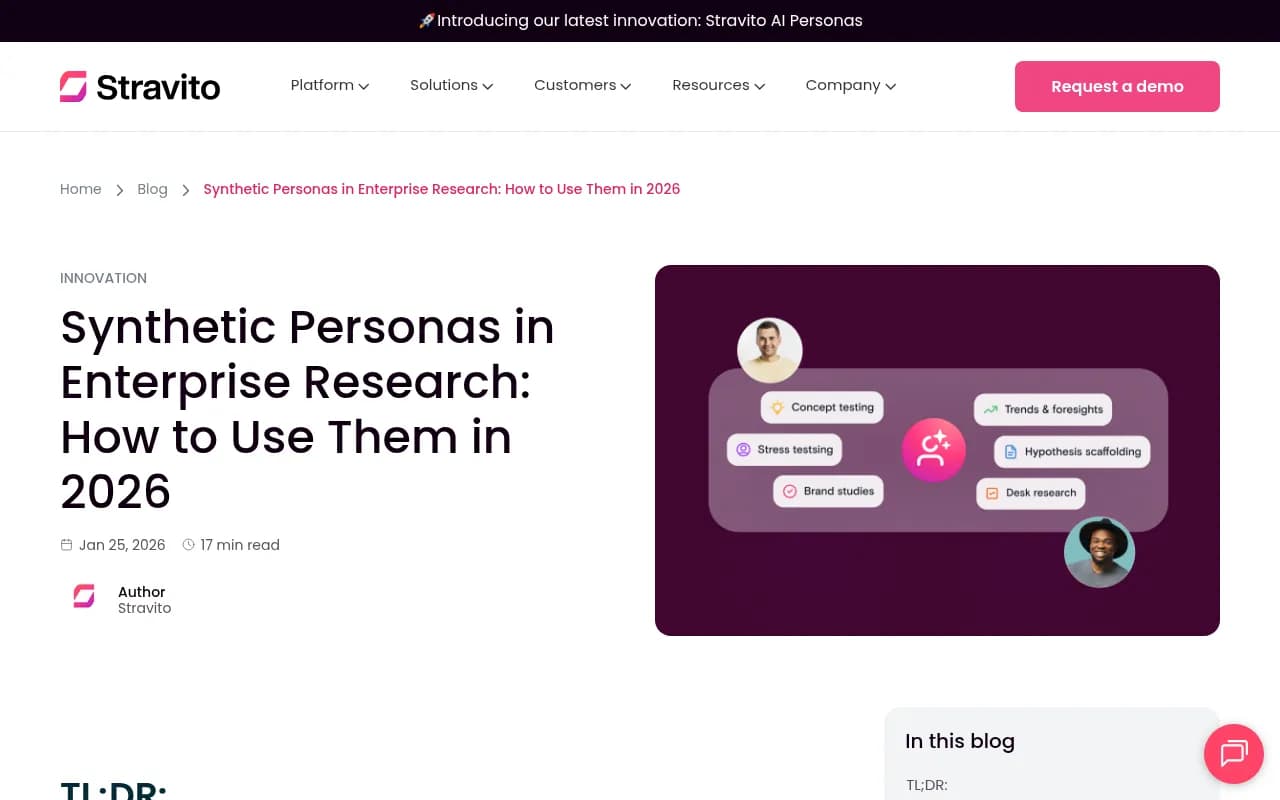
- Stravito — centralizes human and synthetic persona assets in one hub, with provenance tracking and bias checks built in
- Qualtrics — offers synthetic panels for survey research, with synthetic responses generated from existing data
- Peasy — AI market research platform with synthetic audiences at scale
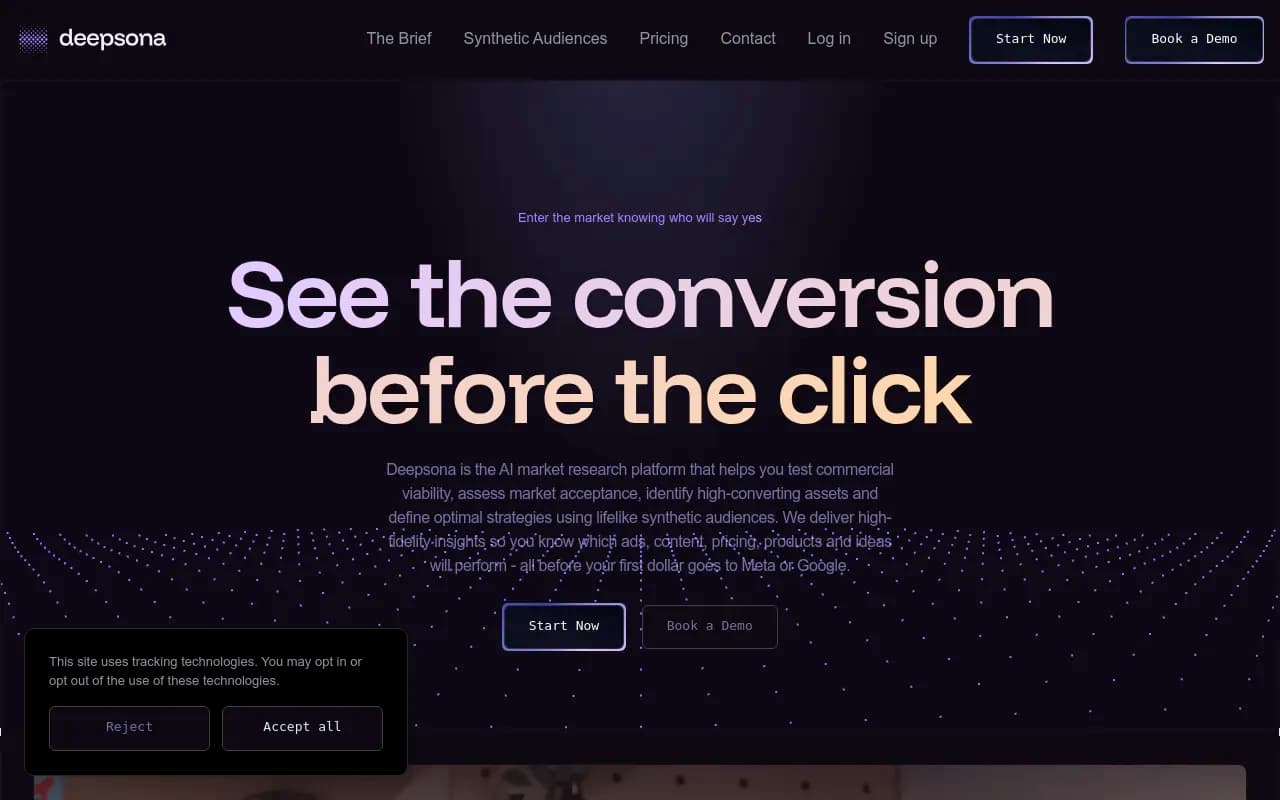
These platforms handle the technical complexity and governance for you, but may be less customizable than DIY approaches.
Agency Services
If you lack in-house expertise, agencies can build and manage synthetic audiences for you. Look for agencies with:
- Proven experience building synthetic audiences on proprietary client data
- Clear governance frameworks for bias checks, provenance tracking, and privacy
- Integration with human research — agencies that use synthetic audiences to accelerate, not replace, human research
How Synthetic Audiences Fit Into Your Content Workflow
Synthetic audiences work best when integrated into a broader research and content workflow. Here's how to use them effectively.
Phase 1: Exploration (Synthetic)
Use synthetic audiences to explore the landscape before you commit to concepts:
- Test 10-20 content angles with synthetic personas
- Simulate reactions across segments, markets, and channels
- Identify obvious misfires and prioritize concepts for human validation
Output: A shortlist of 3-5 concepts that deserve real-world testing.
Phase 2: Validation (Human)
Validate your shortlist with real participants:
- Quantitative surveys to test messaging and positioning at scale
- Qualitative interviews to explore motivations and pain points in depth
- A/B tests to measure real-world performance
Output: Data-backed decisions on which concepts to produce.
Phase 3: Production (Content)
Once you've validated concepts with human research, produce content:
- Brief writers and designers with validated angles and messaging frameworks
- Use synthetic audiences to pressure-test drafts before publication (e.g. "Does this headline match the validated angle?")
- Iterate based on feedback from synthetic and human audiences
Output: Content that's grounded in real audience insights and optimized for resonance.
Phase 4: Optimization (Performance)
After publication, track performance and iterate:
- Monitor engagement metrics (clicks, time on page, conversions)
- Compare performance to synthetic predictions — where did the synthetic audience get it right vs. wrong?
- Refine your synthetic audience based on real-world performance data
Output: A feedback loop that makes your synthetic audience more accurate over time.
Synthetic Audiences and AI Search Visibility
As AI search engines like ChatGPT, Perplexity, Claude, and Google AI Overviews reshape how people discover content, synthetic audiences can help you understand how your content might perform in AI-generated answers.
Test How AI Models Might Cite Your Content
Use synthetic audiences to simulate how AI search engines might respond to queries in your category:
- Ask synthetic personas how they would search for solutions in your category
- Simulate AI responses based on your content vs. competitors
- Identify content gaps — what questions are AI models answering with competitor content instead of yours?
This helps you prioritize content that's more likely to get cited by AI search engines.
Validate Content Angles for AI Visibility
Before you publish, use synthetic audiences to test whether your content matches the angles and formats AI models prefer:
- Does your content answer the question directly?
- Is your content structured for easy extraction? (clear headings, concise answers, data-backed claims)
- Does your content cite authoritative sources?
Synthetic audiences can help you identify gaps before you publish, increasing your chances of being cited by AI search engines.
Track and Optimize with Real AI Visibility Data
Once you've published, track how AI search engines actually cite your content. Tools like Promptwatch can help you monitor brand mentions across ChatGPT, Perplexity, Claude, Gemini, and other AI models, showing you which pages are being cited, how often, and by which models.

By combining synthetic audience insights with real AI visibility data, you close the loop — you understand what AI models want, you create content that matches, and you track the results.
Common Pitfalls and How to Avoid Them
Synthetic audiences are powerful, but they're easy to misuse. Here are the most common pitfalls and how to avoid them.
Pitfall 1: Treating Synthetic Data as Real Data
The mistake: Presenting synthetic insights as if they came from real participants.
How to avoid it: Always tag synthetic insights as synthetic. Use language like "based on synthetic audience modeling" or "simulated responses" to make it clear these are not real human responses.
Pitfall 2: Skipping Human Validation
The mistake: Making strategic decisions based on synthetic data alone.
How to avoid it: Use synthetic audiences to prioritize and explore, but always validate high-stakes decisions with real human research.
Pitfall 3: Building on Generic LLM Knowledge
The mistake: Asking ChatGPT "what do millennials want" and calling it a synthetic audience.
How to avoid it: Build synthetic audiences on proprietary data with strict guardrails to prevent the model from relying on its own training knowledge.
Pitfall 4: Ignoring Bias
The mistake: Assuming synthetic audiences are neutral or objective.
How to avoid it: Implement bias checks, audit your source data for representation gaps, and document known limitations.
Pitfall 5: Overcomplicating the Process
The mistake: Building overly complex synthetic audiences with dozens of variables and edge cases.
How to avoid it: Start simple. Build 3-5 core personas based on your most important segments. Test, iterate, and expand as you learn.
The Future of Synthetic Audiences in 2026 and Beyond
By Q2 2026, synthetic audiences have moved from experimental to essential. Most major brands have integrated synthetic audience capabilities into research workflows. Those without face slower iteration cycles, higher creative waste, and weaker positioning in competitive markets.
What's Next
- Real-time synthetic audiences — synthetic personas that update continuously as new data comes in
- Multi-modal synthetic audiences — synthetic personas that respond to images, videos, and audio, not just text
- Synthetic A/B testing — simulate A/B test results before you run real tests, prioritizing concepts with the highest predicted lift
- Synthetic ethnography — AI-generated observations of synthetic personas in simulated contexts (e.g. "how would this persona use this product in their daily routine?")
The Role of Human Judgment
As synthetic audiences become more sophisticated, the role of human judgment becomes more important, not less. Synthetic audiences accelerate hypothesis generation and scenario exploration, but human researchers remain essential for:
- Identifying blind spots — what are we missing?
- Interpreting nuance — what does this pattern really mean?
- Making strategic decisions — which concept should we bet on?
- Ensuring ethics and governance — are we using synthetic audiences responsibly?
The future of research is not synthetic vs. human — it's synthetic and human, working together to deliver faster, sharper, more defensible insights.
Final Thoughts
Synthetic audiences are not a replacement for human research. They're an accelerator. They help you explore ideas, surface blind spots, and prioritize concepts before you invest in production. They reduce creative waste, widen scenario coverage, and make human research more efficient.
Used well, synthetic audiences let you move fast without sacrificing rigor. Used poorly, they generate hallucinations, amplify biases, and lead to bad decisions.
The difference comes down to governance: quality data in, strict guardrails, clear provenance, and always validating with human evidence before you make strategic decisions.
By 2026, synthetic audiences are no longer experimental — they're essential. The question is not whether to use them, but how to use them responsibly, effectively, and in service of better insights and better content.