Peasy Review 2026
Deepsona (peasy.so) is an AI-powered market research platform that simulates consumer responses using up to 1 million synthetic personas. Test ad campaigns, pricing strategies, product concepts, and email copy before launch. Built for marketers and agencies who need predictive insights fast.
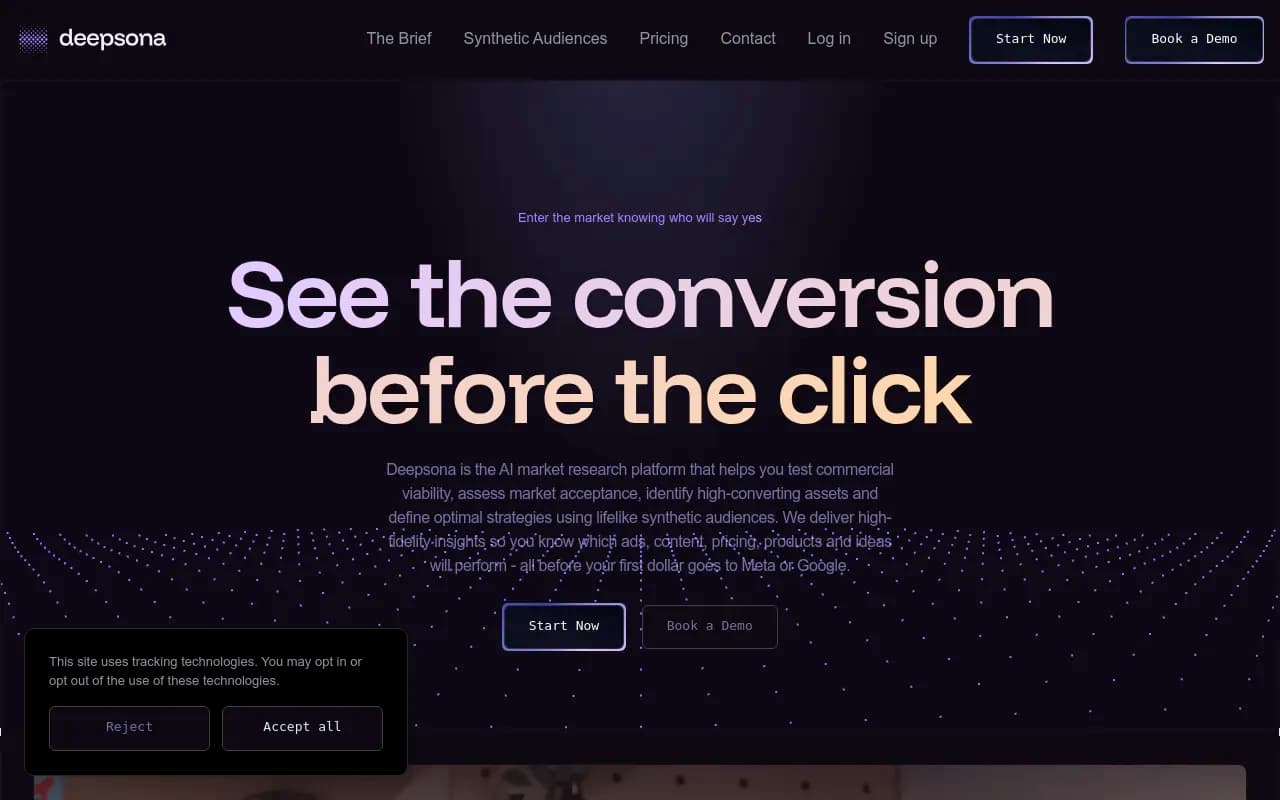
Deepsona, accessible at peasy.so, is an AI market research platform that lets marketers test campaigns, pricing, and product concepts against synthetic audiences before spending real ad dollars. Instead of running expensive A/B tests on Meta or Google, teams can simulate how different demographic and psychographic segments will respond to their creative, messaging, and offers. The platform claims 74-90% predictive alignment with real campaign outcomes and actual human responses from established research firms like YouGov and GWI.
The tool is built for performance marketers, growth teams, and agencies who need to validate creative decisions quickly. Rather than waiting weeks for traditional market research or burning budget on underperforming ads, Deepsona promises to surface winning variants in minutes. It's particularly relevant for teams launching new products, testing messaging angles, or optimizing paid acquisition funnels where every percentage point of conversion lift matters.
Deepsona positions itself as an alternative to both traditional market research (slow and expensive) and simple AI chatbot prompting (statistically unreliable). The platform uses what it calls "agentic AI" — a team of specialized AI agents that handle different parts of the research process, from building audiences to scoring responses and generating insights.
Synthetic Audience Builder (Persona Factory)
The core of Deepsona is its ability to generate custom synthetic audiences of up to one million AI personas. You define target demographics like age ranges, income brackets, education levels, job roles, and geographic locations. The platform then applies psychographic modeling using the Big Five personality framework (Openness, Conscientiousness, Extraversion, Agreeableness, Neuroticism), also known as OCEAN. Each persona is also assigned category familiarity levels and price sensitivity scores. This means a 35-year-old urban design professional with high openness and low price sensitivity will respond differently than a 45-year-old suburban parent with high conscientiousness and budget constraints. The platform enforces complexity across these traits to mirror real population distributions, so you're not just getting cookie-cutter responses.
Ad Campaign Simulation
You can test ad creative before launch by entering your offer text, primary copy, visual descriptions, call-to-action, budget parameters, and target CPA. The synthetic personas evaluate your ad based on their modeled income, lifestyle, personality, and purchase behaviors. Each persona outputs numeric scores for click probability, conversion intent, trust, clarity, novelty, and brand fit. They also generate written reactions explaining what resonates and what creates friction. The platform aggregates these individual responses into segment-level heatmaps showing which demographics and psychographics respond strongest. You can compare multiple ad variants side-by-side and see predicted lift percentages between versions. This lets you filter out weak creative before spending on live campaigns.
Product Proposition Testing
Describe your product concept, value proposition, key features, and target outcomes, then select which audience segments should evaluate it. Within minutes, you receive segment-level reactions showing which groups connect with your messaging and which remain skeptical. Unlike traditional surveys with checkbox responses, Deepsona's AI personas generate authentic written feedback explaining what excites them, what concerns them, and what would push them to convert. One segment might prioritize your innovation angle while another focuses on affordability. Another might question credibility or demand stronger social proof. The platform surfaces these patterns immediately and provides recommendations for repositioning messages by segment.
Email Campaign Optimization
Configure your email elements including campaign name, goal, subject line, preheader text, body copy, and call-to-action. Select target audiences that mirror your subscriber segments. AI personas evaluate each component based on their personality traits, communication preferences, and behavioral patterns. Introverted personas might prefer direct, no-fluff subject lines, while extroverted personas might respond better to playful, social language. Price-sensitive segments scrutinize value propositions more intensely. The simulation shows you which subject lines generate curiosity, which body copy builds trust, and which CTAs convert, all segmented by demographic and psychographic profile. This lets you optimize every element before hitting send to your real email list.
Price Discovery Engine
Define your product name, description, and current price if applicable, then set minimum and maximum price bounds. The platform simulates how different audience segments respond to various price points across that range. You can identify the optimal price that balances conversion rate and revenue potential for each segment. This is particularly valuable for SaaS companies testing pricing tiers, e-commerce brands launching new products, or agencies advising clients on positioning.
Idea Validation
Beyond marketing assets, you can test broader business ideas and concepts. This could include new product features, service offerings, brand repositioning, or market entry strategies. The synthetic audiences provide feedback on commercial viability and market acceptance before you invest in development or launch.
Multi-Agent Architecture
Deepsona differentiates itself from simple ChatGPT prompting by using specialized AI agents that work together. The Persona Factory builds your audience. Exposure and Debate agents test your marketing assets and ideas. Scoring, QA, and Insights agents deliver the final results. The platform claims this multi-agent approach delivers higher statistical confidence and result stability compared to single AI chatbot outputs. Running simulations at scale (up to 1 million personas) provides the confidence of real population data rather than anecdotal responses from a handful of prompts.
Who Is It For
Deepsona is built for performance marketers and growth teams at startups and scale-ups who are spending $10K+ per month on paid acquisition and need to improve ROAS. It's particularly valuable for direct-to-consumer brands testing creative angles, SaaS companies validating messaging and pricing, and agencies managing multiple client campaigns. Teams launching new products or entering new markets will find the concept validation and audience segmentation features especially useful. If you're running 5-10 ad variants per campaign and want to know which will perform before launch, this tool can save weeks of testing time and thousands in wasted ad spend.
The platform is less relevant for enterprise companies with established market research budgets and timelines, or for very early-stage startups that haven't validated product-market fit yet. If you're still figuring out your core value proposition, traditional customer interviews will provide richer qualitative insights than synthetic personas. Similarly, if you're in a highly specialized B2B niche with complex buying committees, the consumer-focused psychographic modeling may not capture your market dynamics accurately.
Agencies managing 10+ client accounts across different industries will appreciate the ability to quickly test multiple creative variants and generate client-ready insights reports. However, smaller freelance marketers or solopreneurs running lean campaigns may find the platform overkill if they're not testing at sufficient volume to justify the investment.
Integrations & Ecosystem
The platform is built on trusted AI and infrastructure providers, though specific integration details weren't fully disclosed in the available materials. The website shows logos for major cloud and AI platforms, suggesting enterprise-grade infrastructure. There's a hosted application at app.deepsona.ai where users sign up and run simulations. The platform appears to be a standalone web application rather than a plugin or extension, which means you'll manually input your creative assets and export insights rather than connecting directly to Meta Ads Manager or Google Ads. This is typical for pre-launch testing tools but means there's no automated feedback loop from live campaign performance back into the platform.
Pricing & Value
Specific pricing tiers were not clearly disclosed on the main website or pricing page during research. The platform offers a "Start Now" option for signing up and a "Book a Demo" option, suggesting a sales-assisted model for larger accounts. Based on the FAQ reference to "flat monthly rate that scales based on tracked events," it appears Deepsona uses usage-based pricing where smaller teams pay less and larger teams pay for volume. Without published pricing, it's difficult to assess value directly, but the positioning suggests this is a mid-market to enterprise tool rather than a $29/month self-serve product. Teams should expect to book a demo to get pricing details.
The value proposition centers on reducing wasted ad spend and accelerating decision cycles. If the platform can help you avoid launching even one underperforming campaign that would have cost $5K-10K in media spend, it likely pays for itself. The claim of 10x faster decision cycles compared to traditional A/B testing is significant for teams that need to move quickly in competitive markets.
Strengths & Limitations
Deepsona excels at providing rapid, directional insights for creative testing and concept validation. The psychographic modeling using Big Five personality traits is more sophisticated than simple demographic segmentation. The ability to simulate up to 1 million personas provides statistical confidence that you can't get from prompting ChatGPT a few times. The multi-agent architecture and confidence scoring add credibility to the outputs. For teams that need to test 10+ creative variants quickly, this is significantly faster and cheaper than traditional market research panels.
However, the platform's synthetic nature is also its limitation. While claiming 74-90% predictive alignment with real outcomes, that still leaves 10-26% variance. Real human behavior is messier than AI simulations, especially for impulse purchases, emotional decisions, or products with strong network effects. The platform works best for rational purchase decisions where you can model preferences systematically. It's less reliable for predicting viral content, cultural moments, or highly emotional creative. Additionally, without transparent pricing, it's hard for smaller teams to evaluate whether the ROI justifies the investment. The lack of direct integrations with ad platforms means you're still manually implementing insights rather than having an automated optimization loop.
Bottom Line
Deepsona is best suited for growth teams and agencies spending $50K+ annually on paid acquisition who need to test creative variants and pricing strategies before launch. If you're running multiple campaigns per month and want to filter out weak performers before they burn budget, the platform can deliver meaningful ROI. The synthetic audience approach won't replace real customer feedback or live A/B testing entirely, but it can dramatically reduce the number of variants you need to test in market. Book a demo to understand pricing and see if the predictive accuracy holds up for your specific industry and audience segments.
Tags:
Similar and alternative tools to Peasy