GetMint Review 2026
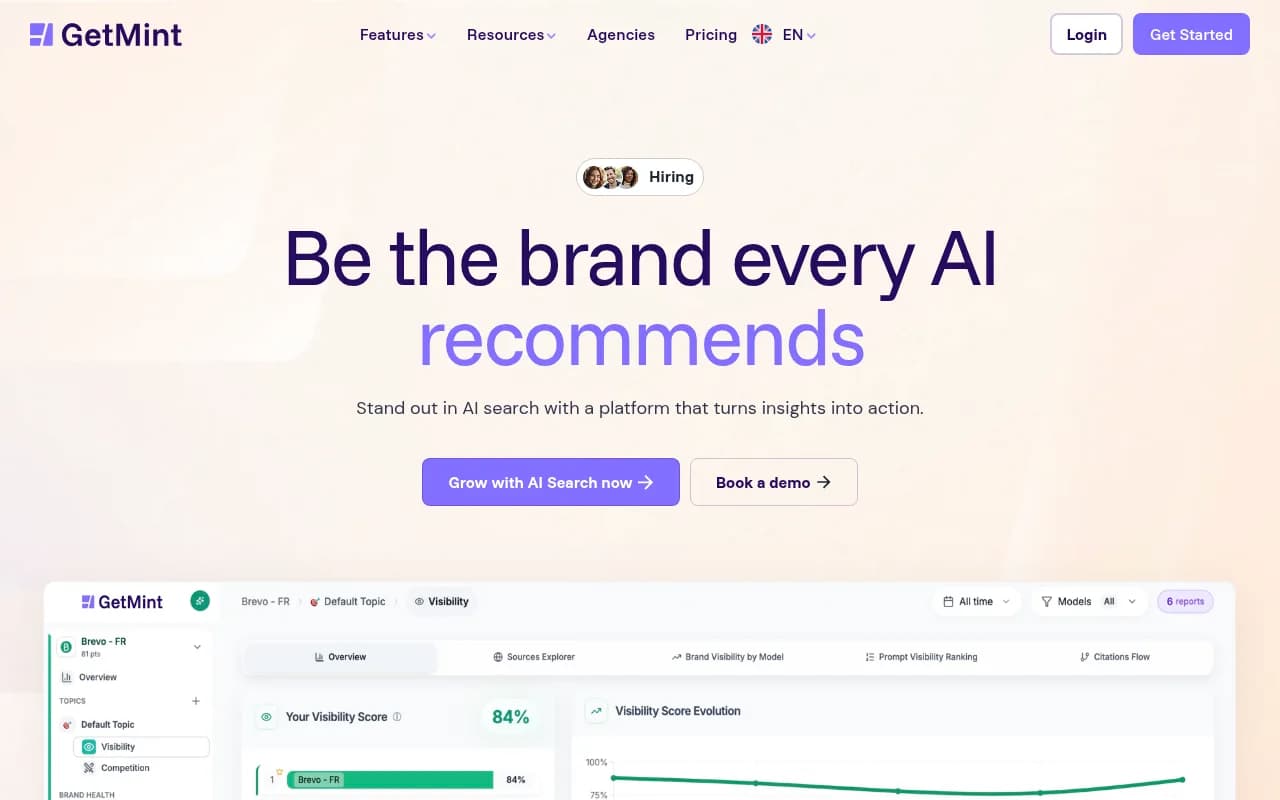
GetMint is an end-to-end Generative Engine Optimization (GEO) platform that helps brands track, analyze, and improve their visibility in AI-powered search engines like ChatGPT, Claude, Gemini, and Perplexity. Trusted by 200+ leading brands and agencies, it combines real-time monitoring with actionab
Summary: Key Takeaways
• Action-oriented platform: GetMint goes beyond monitoring to help you identify content gaps, create optimized content, and distribute it through 150K+ partner media outlets that influence AI models • Comprehensive AI coverage: Tracks ChatGPT, Claude, Gemini, Perplexity, Grok, and Google AI Overviews with real-time visibility monitoring across markets, products, and personas • Proven traction: Used by 200+ brands including Pretto, Jow, and Bulldozer agency, with testimonials highlighting measurable ROI and faster actionable insights • Pricing: Growth plan at €229/month and Pro plan at €499/month, both with unlimited seats and project-based scaling • Best for: Mid-market to enterprise brands and agencies that need to influence AI recommendations and track brand perception across multiple AI models
GetMint positions itself as "the first platform for Generative Engine Optimization (GEO)" -- a bold claim in an increasingly crowded market. Founded to address the fundamental shift in how consumers discover brands (1.6 billion people now use AI search monthly), GetMint targets companies that recognize AI-powered search engines have become the new gatekeepers of customer discovery. The platform is particularly focused on brands that can't afford to be invisible when prospects ask AI "What's the best [your category]?"
The company has gained notable traction with 200+ customers including recognizable brands like Pretto (French mortgage platform), Jow (meal planning app), and JLL (commercial real estate). Media coverage from TechCrunch and other outlets suggests the platform is being taken seriously in the emerging GEO category.
Core Capabilities: The Define-Analyze-Improve Framework
GetMint structures its platform around three phases that mirror how brands should approach AI search optimization:
Detect AI Opportunities (Define Phase): You start by defining your core topics and setting up the prompts that matter most to your business. This isn't about tracking random queries -- it's about identifying the specific questions your target customers ask AI models when researching your category. The platform helps you discover which prompts drive visibility and which represent untapped opportunities. This setup phase determines the quality of insights you'll get downstream.
Monitor AI Visibility (Analyze Phase): Real-time tracking shows how your brand performs across ChatGPT, Claude, Gemini, Perplexity, Grok, and Google AI Overviews. You can segment visibility by market, product line, and customer persona to understand exactly where you're winning and losing. The platform identifies which authoritative sources AI models cite when they do (or don't) mention you, and shows your competitive position for each tracked prompt. Unlike pure monitoring tools, GetMint surfaces the "why" behind visibility gaps -- which content topics you're missing, which external sources competitors own, and which prompts represent the biggest opportunities.
Improve AI Visibility (Action Phase): This is where GetMint differentiates itself from monitoring-only competitors. The platform provides content gap analysis that shows exactly what topics and angles you need to cover to improve AI visibility. You can create and optimize content directly within the platform, then distribute it through GetMint's network of 150K+ partner media outlets. This distribution capability is unique -- most GEO platforms tell you what's wrong but leave you to figure out how to influence the external sources that AI models actually cite. GetMint closes that loop by giving you publishing access to outlets that directly shape AI training data and retrieval sources.
Impact Measurement: Track how content changes and distribution efforts move the needle on visibility scores and, ultimately, on traffic and conversions. The platform measures performance across all tracked AI models so you can see which optimizations work and which don't.
What Makes GetMint Different
The market for AI visibility platforms has exploded in 2025-2026, with at least a dozen competitors now offering some form of GEO monitoring. GetMint's core differentiator is the end-to-end approach -- it's not just a dashboard showing you data. The content gap analysis tells you what's missing, and the partner media network gives you a direct channel to influence the sources AI models trust.
Most competitors (Otterly.AI, Peec.ai, AthenaHQ, Search Party) focus exclusively on monitoring and reporting. They'll show you when you're mentioned or not mentioned, but they don't help you fix it. GetMint positions itself as an optimization platform, not just a tracking tool. The 150K+ partner media outlet network is particularly notable -- this gives brands a way to get cited in sources that AI models actually reference, which is often more impactful than just optimizing your own website.
The platform also emphasizes persona-based tracking, allowing you to see how AI responses vary based on how different customer segments phrase their queries. This is important because a B2B buyer researching enterprise software will prompt differently than a consumer looking for a product recommendation.
Who Should Use GetMint
GetMint is built for mid-market to enterprise brands and digital agencies that:
Primary users: Marketing teams at B2C and B2B companies with €10M+ revenue that need to protect and grow brand visibility as search behavior shifts to AI. These are companies where being invisible in AI recommendations directly impacts pipeline -- think SaaS platforms, e-commerce brands, financial services, B2B software, and consumer apps. If 50% of your prospects now use ChatGPT or Perplexity to research purchases (which industry data suggests they do), you need visibility there.
Agencies: Digital marketing and SEO agencies managing multiple client brands. GetMint's unlimited seats model and project-based pricing makes it viable for agencies to monitor multiple clients. Bulldozer agency's CEO specifically called out GetMint as "the solution we recommend to our clients" because it delivers "more reliable, faster and immediately actionable insights."
Who should NOT use GetMint: Early-stage startups with limited budgets (€229/month minimum is steep if you're pre-revenue), pure content publishers without products to sell (the ROI case is weaker), and companies in highly regulated industries where AI recommendations don't significantly influence buying decisions. If your customers don't use AI search to research purchases, this isn't a priority yet.
Integrations and Technical Details
GetMint tracks six major AI models: ChatGPT (OpenAI), Claude (Anthropic), Gemini (Google), Perplexity, Grok (X.AI), and Google AI Overviews. This covers the vast majority of AI search volume, though it notably doesn't mention DeepSeek, Copilot, or Meta AI -- platforms that some competitors do track.
The platform offers a free trial (no credit card required based on the CTA language) so you can test visibility tracking before committing. The partner media network for content distribution is a key technical capability, though GetMint doesn't publicly detail exactly which outlets are included or how placement works -- this likely requires a demo or paid plan to access.
No mention of API access, Looker Studio integration, or developer tools in the public materials, which suggests GetMint is focused on serving marketers through the web interface rather than technical teams building custom workflows.
Pricing and Value
GetMint offers two main plans:
Growth Plan: €229/month (~$250 USD). Unlimited seats, project-based scaling. This plan is positioned for growing brands that need core visibility tracking and optimization capabilities.
Pro Plan: €499/month (~$545 USD). Unlimited seats, project-based scaling with expanded capabilities. Likely includes higher prompt limits, more AI models, and fuller access to the content distribution network.
Both plans include unlimited team members, which is smart positioning for agencies and larger marketing teams. The "project-based scaling" language suggests you pay more as you track more brands or product lines, but the exact limits aren't specified publicly.
No enterprise pricing is listed, but given the 200+ customer base includes large brands like JLL, there's clearly custom pricing available for bigger deployments.
How does this compare to competitors? GetMint's €229 starting price is higher than some monitoring-only tools (Otterly.AI and Peec.ai start around $100-150/month) but competitive with full-featured platforms like Promptwatch ($249/mo for Professional tier) and Profound ($99-299/mo range). The unlimited seats model is a strong value proposition for agencies and larger teams -- many competitors charge per seat, which gets expensive fast.
The big question is whether the content distribution network justifies the price premium over pure monitoring tools. If you're just tracking visibility, cheaper options exist. If you need to actively influence AI recommendations through external publishing, GetMint's network could be worth the investment.
Strengths
End-to-end workflow: GetMint doesn't just show you problems -- it helps you fix them with content gap analysis and distribution capabilities that most competitors lack entirely.
Partner media network: Access to 150K+ outlets for content distribution is a unique capability that directly addresses the challenge of influencing external sources AI models cite.
Strong customer traction: 200+ brands including recognizable names, with testimonials highlighting measurable ROI. Pretto's co-founder specifically called out "real ROI," which is rare in early-stage GEO platforms.
Unlimited seats: Makes the platform viable for agencies and larger teams without per-seat costs spiraling.
Persona-based tracking: Allows segmentation by how different customer types prompt AI models, which is more sophisticated than generic query tracking.
Limitations
Limited AI model coverage: Tracks six major models but misses DeepSeek, Copilot, Meta AI, and Mistral -- platforms that competitors like Promptwatch do monitor. For global brands, this could be a gap.
Pricing transparency: No clear breakdown of what you get at each tier or where the project-based scaling kicks in. You need to book a demo to understand the full pricing structure.
No API or developer tools mentioned: If you need to build custom workflows or integrate GEO data into your own systems, GetMint doesn't appear to offer that flexibility.
Content distribution details unclear: The 150K+ partner media network sounds impressive, but there's no public information about which outlets are included, how placement works, or what content types they accept. This is a black box until you're a paying customer.
No crawler log monitoring: Unlike platforms like Promptwatch that show you when AI crawlers hit your website, GetMint doesn't appear to offer this level of technical visibility into how AI models discover your content.
Bottom Line
GetMint is best suited for mid-market to enterprise brands and agencies that need to actively manage their presence in AI search, not just monitor it. If you're in a competitive category where AI recommendations directly influence buying decisions -- SaaS, e-commerce, financial services, B2B software -- and you have the budget to invest in optimization (not just tracking), GetMint's end-to-end approach makes sense. The content distribution network is the key differentiator: if you need to influence external sources that AI models cite, GetMint gives you a direct channel to do that.
For pure monitoring needs or tighter budgets, cheaper alternatives exist. For brands that recognize AI search is now a primary discovery channel and need a platform that helps them win there, GetMint delivers a complete solution from detection to action to measurement. The 200+ customer base and strong testimonials suggest it's delivering real value for companies that commit to the platform.
Tags:
Similar and alternative tools to GetMint