Qwairy Review 2026
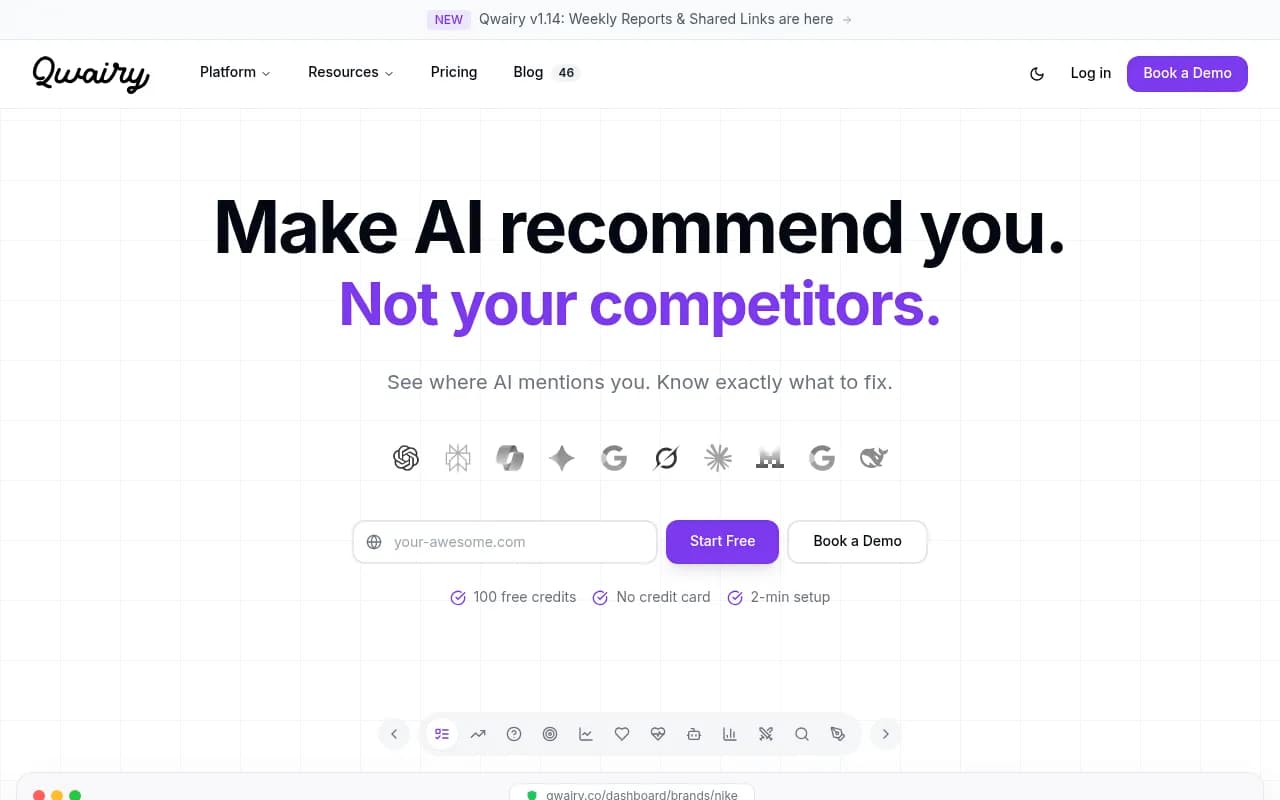
Qwairy is a Generative Engine Optimization (GEO) platform that monitors brand mentions across ChatGPT, Claude, Perplexity, Gemini, Copilot, Grok, and other AI search engines. Used by 2,000+ brands including TotalEnergies and Match Group, it tracks prompt performance, competitor visibility, and citation sources, then provides content recommendations to improve AI search rankings. Five integrated modules cover visibility tracking, insights, strategy, technical analysis, and analytics.
Key Takeaways
• Missing critical capabilities vs Promptwatch: No AI content generation engine, no Answer Gap Analysis to identify missing content, no Reddit/YouTube tracking, no ChatGPT Shopping monitoring, no prompt volume estimates or difficulty scoring, no query fan-outs, and no visitor analytics to connect AI visibility to actual revenue • Monitoring-first approach: Strong at tracking brand mentions across 10 AI models but lacks the action loop that turns visibility data into optimized content • Best for agencies: Multi-client dashboards and white-label reporting make it suitable for agencies managing multiple brands, though individual features lag behind specialized competitors • Pricing: Starts at €49/month (Starter plan) with credit-based system, making it accessible for small businesses but potentially expensive at scale • European focus: French company with strong adoption among European brands, particularly in France
Qwairy is a Generative Engine Optimization platform built by a French team that's been tracking AI search visibility since the early days of ChatGPT's rise. The company has attracted 2,000+ users including notable European brands like TotalEnergies, Air Transat, Match Group, and Fortuneo. It's positioned as an all-in-one GEO platform with five modules covering visibility, insights, strategy, technical analysis, and analytics. The core promise: see where AI mentions your brand, understand what's missing, and get recommendations to improve your presence in AI search results.
The target audience is primarily SEO teams, growth marketers, B2B SaaS companies, e-commerce brands, and marketing agencies managing multiple client portfolios. Qwairy is particularly popular among French-speaking markets and European agencies, with case studies showing clients like Webloom achieving 145% improvement in AI search rankings and Pysae tripling brand mentions in 60 days.
Visibility Module: Multi-Engine Monitoring
Qwairy monitors 10 AI platforms: ChatGPT (API + UI), Perplexity (API + UI), Claude (API), Gemini (API + UI), Google AI Overview (API), Google AI Mode (UI), Copilot (UI), Grok (API + UI), Mistral (API), and DeepSeek (API). This is one of the broadest coverage ranges in the GEO space, matching or exceeding most competitors.
Prompt Tracking lets you monitor specific queries across all engines. You can see which prompts mention your brand, track visibility scores over time, and identify which competitors appear alongside you. The interface shows prompt type (TOFU/MOFU/BOFU), visibility percentage, number of mentions, total responses, and which AI providers returned results. For example, a Nike dashboard might show "What are the best running shoes for marathon training?" with a 92.4% visibility score, 47 mentions across 89 responses from OpenAI, Claude, and Perplexity, with Adidas, ASICS, and Brooks appearing as competitors.
Response Analysis breaks down how AI models answer queries about your brand. You can see full response text, citation sources, competitor mentions within responses, and sentiment. This helps you understand not just whether you're mentioned, but how you're positioned relative to competitors.
Citation Sources shows which URLs AI models cite when mentioning your brand -- your own pages, Reddit threads, YouTube videos, news articles, review sites, etc. This is valuable for understanding which content types drive AI visibility, though Qwairy doesn't provide the depth of citation analysis that platforms like Promptwatch offer (880M+ citations analyzed with detailed source breakdowns).
Competitor Mentions tracks when competitors appear in responses about your brand or category. You can see competitor visibility scores, mention frequency, and which prompts they dominate. However, unlike Promptwatch's competitor heatmaps that show exactly which prompts each competitor wins and why, Qwairy's competitor tracking is more surface-level.
Insights Module: Finding Gaps
The Insights module aims to surface opportunities by analyzing search behavior, social discussions, and shopping patterns.
Sentiment Analysis categorizes brand mentions as positive, negative, or neutral across AI responses. You can track sentiment trends over time and identify which prompts generate negative sentiment.
Search Intelligence connects to Google Search Console to show which keywords drive traditional search traffic. The idea is to compare SEO performance with AI visibility to find gaps. However, this integration is basic -- it imports keyword data but doesn't provide the sophisticated prompt-to-keyword mapping or volume estimates that platforms like Promptwatch offer through their Prompt Intelligence feature.
Social Intelligence claims to track discussions on Reddit, YouTube, Hacker News, and 10+ platforms. In practice, this feature is limited compared to dedicated social listening tools or Promptwatch's Reddit/YouTube tracking, which directly surfaces discussions that influence AI recommendations. Qwairy's social intelligence appears to be more of a content discovery tool than a deep analysis engine.
Shopping Intelligence monitors product recommendations in AI responses. For e-commerce brands, this shows when your products appear in shopping-related prompts. However, it lacks the dedicated ChatGPT Shopping tracking that Promptwatch provides for monitoring product carousels and shopping-specific features.
Local Intelligence tracks local business mentions in AI responses -- useful for multi-location brands or local service businesses. You can see which locations get mentioned and in what context.
Strategy Module: Content Recommendations
This is where Qwairy attempts to move from monitoring to action, though it falls short of true optimization capabilities.
Content Studio generates content briefs based on visibility gaps. You input a topic or prompt, and Qwairy suggests content angles, key points to cover, and citation-worthy sources. However, this is not an AI writing engine -- it's a brief generator. You still need to write the content yourself or use another tool. Compare this to Promptwatch's built-in AI content generation that creates full articles, listicles, and comparisons grounded in 880M+ citations and real prompt data.
Content Opportunities uses what Qwairy calls "Dual Gap Scoring" to identify prompts where you're absent but competitors are visible. This is conceptually similar to Promptwatch's Answer Gap Analysis, but less sophisticated. Promptwatch shows exactly which content your site is missing -- the specific topics, angles, and questions AI models want answers to but can't find on your pages. Qwairy's gap scoring is more of a high-level indicator than a detailed content roadmap.
Google Search Console Integration imports keyword and page performance data. You can see which pages rank in traditional search and compare that to AI visibility. The integration is functional but basic.
Backlink Opportunities compares 32+ backlink marketplaces to help you find the best prices for link building. This is a unique feature in the GEO space, though it's more of a procurement tool than an optimization feature. It doesn't analyze which backlinks would actually improve your AI visibility.
Brand Perception tracks how your brand is described across AI responses. You can see common themes, attributes, and positioning statements. This is useful for brand monitoring but doesn't provide actionable optimization steps.
Technical Module: Crawler Access
The Technical module checks whether AI crawlers can access your content.
Technical Analysis scans your site for robots.txt rules, meta tags, and other technical issues that might block AI crawlers like GPTBot, ClaudeBot, and PerplexityBot. It shows which pages are accessible and which are blocked.
Site Diagnostics checks page health -- load times, broken links, mobile-friendliness, etc. This is standard technical SEO functionality, not GEO-specific. Most users will already have these capabilities in their existing SEO tools.
Notably missing: real-time AI crawler logs. Promptwatch provides detailed logs of AI crawlers hitting your site -- which pages they read, errors they encounter, how often they return, and indexing patterns. This is critical for understanding how AI engines discover your content and fixing indexing issues. Qwairy only checks whether crawlers can access your site, not whether they are accessing it.
Analytics Module: Measuring Impact
The Analytics module tracks crawler activity and referral traffic.
Content Optimization (beta) suggests improvements to existing pages based on AI visibility data. This feature is new and limited in scope.
Crawler Analytics monitors 15+ AI crawlers indexing your site. You can see crawler activity over time and which pages they visit. However, this is less detailed than Promptwatch's real-time crawler logs, which show individual requests, response codes, and crawl patterns.
Referrer Analytics tracks traffic from ChatGPT and Perplexity referrers. This is valuable for proving ROI -- you can see how many visitors come from AI search engines. However, it's limited to referrer-based tracking. Promptwatch offers three methods: code snippet, Google Search Console integration, and server log analysis, providing more comprehensive traffic attribution.
Page Performance shows which pages generate the most AI visibility and traffic. You can see top-performing content and identify optimization opportunities.
Who Is Qwairy For?
Qwairy is best suited for marketing agencies managing 5-20 client brands who need multi-client dashboards and white-label reporting. The platform's strength is breadth of monitoring across 10 AI engines, making it useful for agencies that need to track multiple brands without deep optimization capabilities. A typical user might be a French or European digital agency with B2B SaaS or e-commerce clients who want to add GEO monitoring to their service offering.
SEO teams at mid-sized companies (50-500 employees) who are just starting with GEO and want visibility tracking without the complexity of full optimization workflows. If you're in the "awareness" phase of GEO and need to understand where you stand, Qwairy provides that baseline.
B2B SaaS companies and e-commerce brands in competitive categories where AI search visibility matters. If you're competing with 5-10 direct competitors for the same prompts, Qwairy's competitor tracking helps you see who's winning.
Qwairy is not ideal for teams that need to take action on visibility gaps. If you want to generate optimized content, analyze detailed citation patterns, track prompt volumes and difficulty, or connect AI visibility to revenue, you'll need additional tools or a more comprehensive platform like Promptwatch. It's also not ideal for enterprise teams managing 50+ brands or agencies needing advanced automation -- the credit-based pricing and manual workflows don't scale well.
Integrations & Ecosystem
Qwairy integrates with Google Search Console (keyword import), Google Analytics (traffic tracking), Looker Studio (custom reporting), and Slack (alerts). It also supports hosting platforms like Vercel, Cloudflare, Netlify, Fastly, and Akamai for crawler analytics. Beta integrations include Shopify, HubSpot, and Power BI.
The platform offers an API and MCP (Model Context Protocol) support for custom integrations. You can export data as CSV or JSON for external analysis.
Notably missing: no browser extensions, no mobile apps, no Zapier integration. The platform is web-only.
Pricing & Value
Qwairy uses a credit-based pricing model. Each action (prompt check, crawler scan, content brief generation) consumes credits.
Starter Plan: €49/month (€590 annually) -- for freelancers and small businesses monitoring one brand. Includes basic visibility tracking and limited credits.
Growth Plan: Pricing not publicly listed on the main site, but third-party sources suggest around €300-500/month for advanced features, more prompts, and multi-brand monitoring.
Enterprise: Custom pricing for agencies and large brands needing white-label reporting, dedicated support, and higher credit limits.
Qwairy offers 100 free credits to start (no credit card required) and a 2-minute setup process. Annual billing provides discounts.
How does this compare? Promptwatch starts at $99/month (Essential plan: 1 site, 50 prompts, 5 AI-generated articles, crawler logs). Qwairy's €49/month entry point is lower, but the credit system can get expensive if you're actively monitoring and optimizing. Promptwatch's flat-rate pricing with included content generation is often better value for teams that need to take action, not just monitor.
Other competitors: Otterly.AI and Peec.ai are monitoring-only tools in a similar price range. AthenaHQ and Search Party are more expensive but offer deeper analytics. Profound and Scrunch are premium options with higher price points.
Strengths
• Broad AI engine coverage: Monitoring 10 platforms (ChatGPT, Claude, Perplexity, Gemini, Copilot, Grok, Google AI Overview, AI Mode, Mistral, DeepSeek) is one of the widest ranges available • Multi-client dashboards: Strong agency features with white-label reporting and bulk brand management • European focus: French company with strong support for European markets and languages • Backlink marketplace comparison: Unique feature for finding cost-effective link building opportunities • Clean interface: Well-designed UI that's easy to navigate, even for GEO beginners
Limitations
• No AI content generation: Unlike Promptwatch, Qwairy doesn't create optimized articles -- it only generates briefs. You still need to write content manually or use another tool. • No Answer Gap Analysis: Can't identify the specific content your site is missing. Promptwatch's Answer Gap Analysis shows exactly which topics, angles, and questions AI models want answers to but can't find on your pages. • No prompt intelligence: Missing volume estimates, difficulty scores, and query fan-outs that help prioritize which prompts to target. Promptwatch provides these metrics to help you focus on high-value, winnable prompts. • Limited social tracking: Claims Reddit/YouTube monitoring but lacks the depth of Promptwatch's social intelligence, which surfaces discussions that directly influence AI recommendations. • No ChatGPT Shopping tracking: Missing dedicated monitoring for product recommendations and shopping carousels in ChatGPT. • No visitor analytics: Can't connect AI visibility to actual revenue. Promptwatch offers three methods (code snippet, GSC integration, server logs) to track traffic from AI search engines and attribute it to specific pages and prompts. • Surface-level crawler logs: Shows crawler activity but not the detailed real-time logs (individual requests, errors, crawl patterns) that Promptwatch provides. • Credit-based pricing: Can get expensive at scale compared to flat-rate competitors.
Bottom Line
Qwairy is a solid monitoring platform for agencies and mid-sized companies that need to track brand visibility across multiple AI engines. If you're in the awareness phase of GEO -- understanding where you stand, who your competitors are, and which prompts matter -- Qwairy provides that baseline visibility. The multi-client dashboards and white-label reporting make it particularly useful for agencies adding GEO to their service offering.
However, if you need to actually improve your AI visibility -- not just track it -- Qwairy falls short. The lack of AI content generation, Answer Gap Analysis, prompt intelligence, and visitor analytics means you're stuck at the monitoring stage. You can see the problems but can't fix them within the platform. For teams that want to close the loop from visibility tracking to content creation to revenue attribution, platforms like Promptwatch offer a more complete solution.
Best use case: European marketing agencies managing 5-20 client brands who need multi-engine monitoring and white-label reporting, but don't require deep optimization capabilities or content generation.
Tags:
Similar and alternative tools to Qwairy