Metaflow AI Review 2026
Content automation platform that helps teams scale high-quality content production with AI-powered workflows and optimization tools.
Key Takeaways:
- Visual workflow builder that lets non-technical teams build complex AI agents and multi-step automations without code—combine LLM reasoning, tool calls, and memory in a drag-and-drop canvas
- All-in-one growth stack replacing 5+ separate tools (SEO platforms, automation tools, content generators, image tools) at a fraction of the cost—claims $350/month savings per user
- Pre-built growth agents for AEO/SEO optimization, social listening, content repurposing, warm outbound, and Reddit engagement—each designed to run autonomously with minimal human oversight
- Best for: Growth marketers at startups and agencies (teams of 1-10) who want to scale content and campaigns faster without hiring or learning to code
- Limitations: Newer platform with less brand recognition than established players like Zapier or n8n; pricing transparency could be clearer on the website
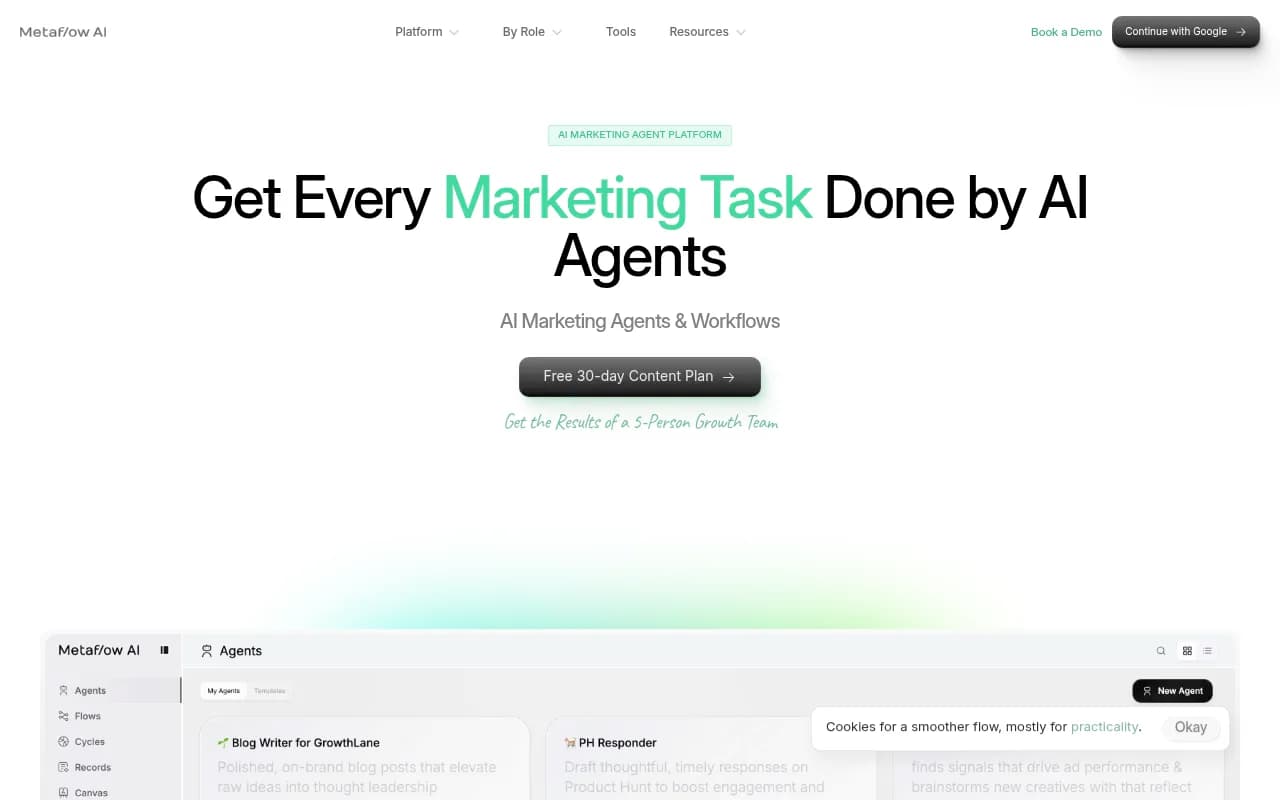
Metaflow AI positions itself as the "go-to platform for Growth Automation," targeting a specific breed of user they call "Growth Operators"—marketers, founders, and GTM engineers who want the power of AI agents without the complexity of traditional automation platforms or the need to write code. The platform launched in 2024 and has attracted over 300 early adopters, primarily from the startup and agency world.
The core promise is simple: build reliable AI workflows and autonomous agents in a visual workspace, then let them run continuously to handle growth tasks that would otherwise require hours of manual work or expensive tools. Metaflow claims teams save an average of 13 hours and $4,500 per month by consolidating their growth stack into one platform.
AEO Optimization Workflows
Metaflow's flagship use case is SEO and AEO (Answer Engine Optimization) content creation. The platform offers agents that mine intent gaps using real-time search data, auto-draft content briefs, write on-brand copy, and publish directly to your CMS. The workflow is designed to maximize visibility not just in traditional search engines but also in LLMs like ChatGPT, Claude, and Perplexity.
The SEO agent can batch-generate optimized blog posts at scale—what they call "Programmatic SEO"—with built-in quality controls to prevent generic AI slop. You define your brand voice, target keywords, and content structure once, then the agent produces articles that maintain consistency across hundreds of posts. Metaflow claims AI-assisted pages reach page one within 25 days on average, based on 2025 case studies.
Key capabilities include:
- Keyword research and intent gap analysis using live search data
- Automated content brief generation with competitor analysis
- On-brand long-form article writing (the platform emphasizes voice consistency)
- Direct publishing to WordPress, Webflow, and other CMS platforms
- Content refresh workflows to keep existing pages optimized
For teams running content-led growth strategies, this is a significant time saver. Instead of manually researching keywords, drafting briefs, writing articles, and scheduling publication, you set up the workflow once and let it run. The platform claims this frees up 13 hours per month per marketer.
Signal-to-Revenue Radar (Social Listening)
The social listening agent continuously monitors brand mentions and intent keywords across platforms, clusters relevant conversations, and either auto-generates channel-native responses or flags hot threads for your sales team. This is designed for brands that want to turn social chatter into pipeline without hiring a full-time community manager.
The workflow tracks keywords on Reddit, Twitter/X, LinkedIn, and other platforms, identifies high-intent discussions (e.g., "looking for an alternative to [competitor]"), and either drafts a reply or triggers an ad campaign targeting that audience. Metaflow claims brands using active listening grow revenue 10% faster than those that don't.
For Reddit specifically, Metaflow offers a dedicated agent that monitors relevant subreddits, surfaces threads where your product could add value, and suggests AI-assisted responses that don't sound like spam. This is particularly useful for developer tools, SaaS products, and B2B services where Reddit is a major discovery channel.
Infinite Repurposing Studio
This agent takes one core asset (e.g., a blog post, webinar recording, or product launch announcement) and automatically repurposes it into 30+ derivative assets: Twitter threads, LinkedIn carousels, email drip sequences, podcast outlines, Instagram stories, YouTube scripts, and more. Each output is aligned to your brand voice and optimized for the target platform.
The workflow uses a combination of LLM reasoning and pre-designed templates to ensure outputs don't just sound like your brand—they also look like your brand. Metaflow includes a Creative Composer tool that snaps LLM-generated text into branded visual templates, so you're not just generating copy but finished creative assets ready to publish.
Metaflow claims teams using structured repurposing cut production time and cost by half while extending reach. For content marketers juggling multiple channels, this is a major unlock: create once, distribute everywhere, without manually adapting each piece.
Any-Growth Workflow (Custom Automation Builder)
This is where Metaflow differentiates itself from simpler tools like Zapier or Make. The visual flow builder lets you combine LLM reasoning, tool calls, custom code snippets, and memory into reusable workflows—then push them live across ads, email, or web, pull performance data, and auto-loop insights back into the next iteration.
Key features:
- Drag-and-drop canvas with nodes for LLM calls, web scraping, API requests, conditional logic, loops, and more
- Multi-agent orchestration: build supervisor agents that coordinate multiple sub-agents (e.g., one agent researches, another writes, another publishes)
- Memory and context: agents can reference prior outputs, stored documents, and structured data as context for future tasks
- Code extensibility: drop in Python or JavaScript snippets when you need custom logic beyond what the visual builder offers
- Automatic RAG: the platform automatically retrieves relevant knowledge from your uploaded documents, past outputs, and connected data sources
Metaflow supports integration with major LLMs (OpenAI GPT-4, Claude, Gemini, Llama, DeepSeek) and growth tools (SEMrush, Ahrefs, Google Search Console, WordPress, Webflow, HubSpot, Salesforce). The platform also supports Model Context Protocol (MCP) for deeper LLM integrations.
Unlike traditional automation tools where you're just connecting pre-built app triggers, Metaflow lets you build truly custom workflows that reason, adapt, and improve over time. The platform claims 86% of growth teams already use AI to crank out campaigns faster—Metaflow compounds that through self-improving loops.
Warm-Outbound Autopilot
The outbound agent enriches prospect accounts, scores intent signals, drafts hyper-personalized emails and LinkedIn DMs, sequences follow-ups, and syncs replies to your CRM. This is designed for sales teams and agencies running warm outbound campaigns at scale.
The workflow pulls data from sources like LinkedIn, Clearbit, and Apollo, scores leads based on intent signals (e.g., recent funding, job changes, tech stack), and generates personalized outreach that references specific details about the prospect's company. Metaflow claims teams using automated enrichment see 70% faster responses and 10x higher lead-to-deal rates.
For agencies managing outbound for multiple clients, this is a significant efficiency gain. Instead of manually researching prospects and writing custom emails, you define the targeting criteria and messaging framework once, then let the agent handle the rest.
Agent Studio
Metaflow's Agent Studio lets you build autonomous agents using plain English instructions. The platform supports single agents, multi-agent systems, creative agents, deep researcher agents, supervisor agents, and agent swarms. Agents operate using ReAct-style reasoning (Reason + Act), meaning they can plan, execute, observe results, and adjust their approach dynamically.
You can turn any workflow into a tool that other agents can call, enabling complex multi-step automations where agents coordinate with each other. For example, you might have a supervisor agent that delegates research to one agent, writing to another, and publishing to a third—all orchestrated automatically.
Native Content Editor
Metaflow includes a built-in content editor that functions like Cursor for growth teams. Agents can create, edit, and update documents directly in the platform, and all outputs are stored in a searchable knowledge graph that agents can reference as context for future tasks.
This closes the "AI-to-publish gap"—instead of copying AI outputs into Google Docs, editing them, then pasting into your CMS, you do everything in one place. The editor supports real-time collaboration, version history, and direct publishing to WordPress, Webflow, and other platforms.
The knowledge graph is particularly powerful for teams producing high volumes of content. Every article, brief, and asset becomes structured context that agents can tap into, ensuring consistency and reducing the need to re-explain your brand voice or content strategy.
Creative Composer
The Creative Composer is a visual design tool that lets you create branded templates for social posts, ads, blog headers, and other creative assets. You define the layout, typography, colors, and placeholder text once, then the platform auto-generates variations by snapping LLM outputs into the template.
This is useful for teams that need to produce high volumes of on-brand creative without hiring a designer for every asset. For example, you could create a LinkedIn carousel template, then have an agent generate 50 variations with different headlines, stats, and visuals—all matching your brand guidelines.
Who Is It For
Metaflow is best suited for:
Growth marketers at startups and agencies (teams of 1-10): If you're a solo growth marketer or small team responsible for SEO, content, social, and outbound, Metaflow consolidates your stack and automates repetitive tasks. Instead of juggling SEMrush, Zapier, Frase, Bannerbear, and a content calendar, you do everything in one platform.
GTM engineers and ops-minded marketers: If you're comfortable with automation concepts (even if you don't code), Metaflow gives you the power to build complex workflows without learning Python or managing API keys. The visual builder is intuitive enough for non-technical users but deep enough for power users who want to add custom logic.
Founders wearing multiple hats: If you're a founder handling growth yourself, Metaflow lets you punch above your weight. You can set up agents to handle content creation, social listening, and outbound prospecting while you focus on product and fundraising.
Agencies managing multiple clients: If you're an agency running SEO, content, or outbound campaigns for 5-20 clients, Metaflow's batch workflows and reusable templates let you scale without hiring more people. You can clone workflows across clients and customize them with client-specific brand voices and targeting criteria.
Who should NOT use Metaflow:
Enterprise teams with complex compliance requirements: Metaflow is a newer platform without the enterprise-grade security certifications, SSO, and audit logs that large companies require. If you need SOC 2, HIPAA, or GDPR compliance documentation, you're better off with established players like Zapier or n8n.
Teams that need deep integrations with niche tools: While Metaflow supports major platforms (WordPress, HubSpot, Salesforce, Google Search Console), it doesn't have the 5,000+ pre-built integrations that Zapier offers. If your stack includes obscure SaaS tools, you may need to build custom API connections.
Non-technical teams that want zero learning curve: Despite being no-code, Metaflow still requires understanding automation concepts like loops, conditionals, and API calls. If you want a tool you can use with zero onboarding, simpler platforms like Buffer or Hootsuite are better fits.
Integrations & Ecosystem
Metaflow integrates with:
- LLM providers: OpenAI (GPT-4, GPT-4o), Anthropic (Claude 3.5 Sonnet), Google (Gemini), Meta (Llama), DeepSeek
- SEO tools: SEMrush, Ahrefs, Google Search Console
- CMS platforms: WordPress, Webflow, Framer
- CRM/Sales: HubSpot, Salesforce, Pipedrive
- Automation: Zapier, Make, n8n (via webhooks)
- Design: Bannerbear, Pixelicious (for image generation)
- Social: LinkedIn, Twitter/X, Reddit (via API)
The platform supports webhooks and custom API calls, so you can connect to any tool with a public API. Metaflow also supports Model Context Protocol (MCP), which enables deeper integrations with LLMs and external data sources.
There's no mobile app, but the web app is responsive and works on tablets. The platform runs workflows in the cloud, so agents can operate 24/7 even when you're offline.
Pricing & Value
Metaflow offers a 15-day free trial with unlimited content generation, agents, and workflows. Paid plans start at:
- Solo Plan: $19/month (designed for individual marketers and founders)
- Scale Pro Plan: $100/month (for small teams and agencies)
- Enterprise: Custom pricing (for larger teams with advanced needs)
Metaflow claims the platform saves teams $350/month per user by replacing:
- Model costs ($80-$120/month for OpenAI, Claude, etc.)
- Orchestration tools ($29-$70/month for Zapier, Make, or n8n)
- SEO tools ($99-$249/month for SEMrush or Ahrefs)
- Content tools ($20-$60/month for Frase or Surfer SEO)
- Image generation tools ($29-$39/month for Bannerbear or Pixelicious)
For a 3-person growth team, Metaflow estimates $12,000 in annual savings compared to buying each tool separately. This math assumes you're replacing all five categories of tools, which may not apply to every team.
Compared to competitors:
- Zapier Professional: $19/month for 750 tasks, but limited AI capabilities
- n8n Cloud: $20/month for 2,500 executions, but requires more technical setup
- AirOps: Starts at $99/month, more expensive for similar features
- Relay.app: $19/month for 750 steps, but fewer growth-specific features
Metaflow's pricing is competitive for teams that want an all-in-one growth automation platform. The Solo plan at $19/month is a steal if you're currently paying for multiple tools. The Scale Pro plan at $100/month is reasonable for agencies managing multiple clients.
The main question is whether you actually need all the features Metaflow offers. If you only need basic automation (e.g., posting to social media when you publish a blog post), Zapier or Buffer are simpler and cheaper. But if you're building complex multi-step workflows with AI reasoning, Metaflow offers better value than stitching together multiple tools.
Strengths & Limitations
Strengths:
Visual workflow builder designed for growth: Unlike generic automation tools, Metaflow is purpose-built for growth use cases. The pre-built templates for SEO, social listening, and outbound prospecting save hours of setup time.
All-in-one stack consolidation: By combining LLM access, automation, SEO data, content editing, and creative design in one platform, Metaflow eliminates the need to juggle multiple tools and subscriptions.
Agent-first architecture: The ability to build autonomous agents that reason, adapt, and coordinate with each other is more powerful than traditional if-this-then-that automation. Agents can handle complex tasks that would require dozens of steps in Zapier.
Native content editor and knowledge graph: The built-in editor and knowledge graph close the AI-to-publish gap, making it easy to review, edit, and publish AI-generated content without leaving the platform.
Affordable for solo marketers and small teams: At $19/month for the Solo plan, Metaflow is accessible to individual marketers and founders who can't afford enterprise tools.
Limitations:
Newer platform with less brand recognition: Metaflow launched in 2024 and has a smaller user base than established players like Zapier or n8n. This means fewer community resources, tutorials, and third-party integrations.
Pricing transparency could be clearer: The website doesn't clearly list what's included in each plan or how credits are consumed. You need to sign up for a trial or book a demo to get full pricing details.
Limited integrations compared to Zapier: While Metaflow supports major platforms, it doesn't have the 5,000+ pre-built integrations that Zapier offers. If you use niche SaaS tools, you may need to build custom API connections.
Learning curve for non-technical users: Despite being no-code, Metaflow still requires understanding automation concepts. If you've never used Zapier or built a workflow before, there's a learning curve.
Bottom Line
Metaflow AI is best for growth marketers, GTM engineers, and founders who want to automate repetitive growth tasks without writing code or managing multiple tools. If you're currently juggling SEMrush, Zapier, Frase, and Bannerbear, Metaflow consolidates your stack and saves you $350+/month per user. The visual workflow builder and agent-first architecture make it easy to build complex automations that would require dozens of steps in traditional tools. Best use case: Small growth teams (1-10 people) at startups or agencies running content-led growth, social listening, or warm outbound campaigns who want to scale faster without hiring.
Tags:
Similar and alternative tools to Metaflow AI