KeywordsPeopleUse Review 2026
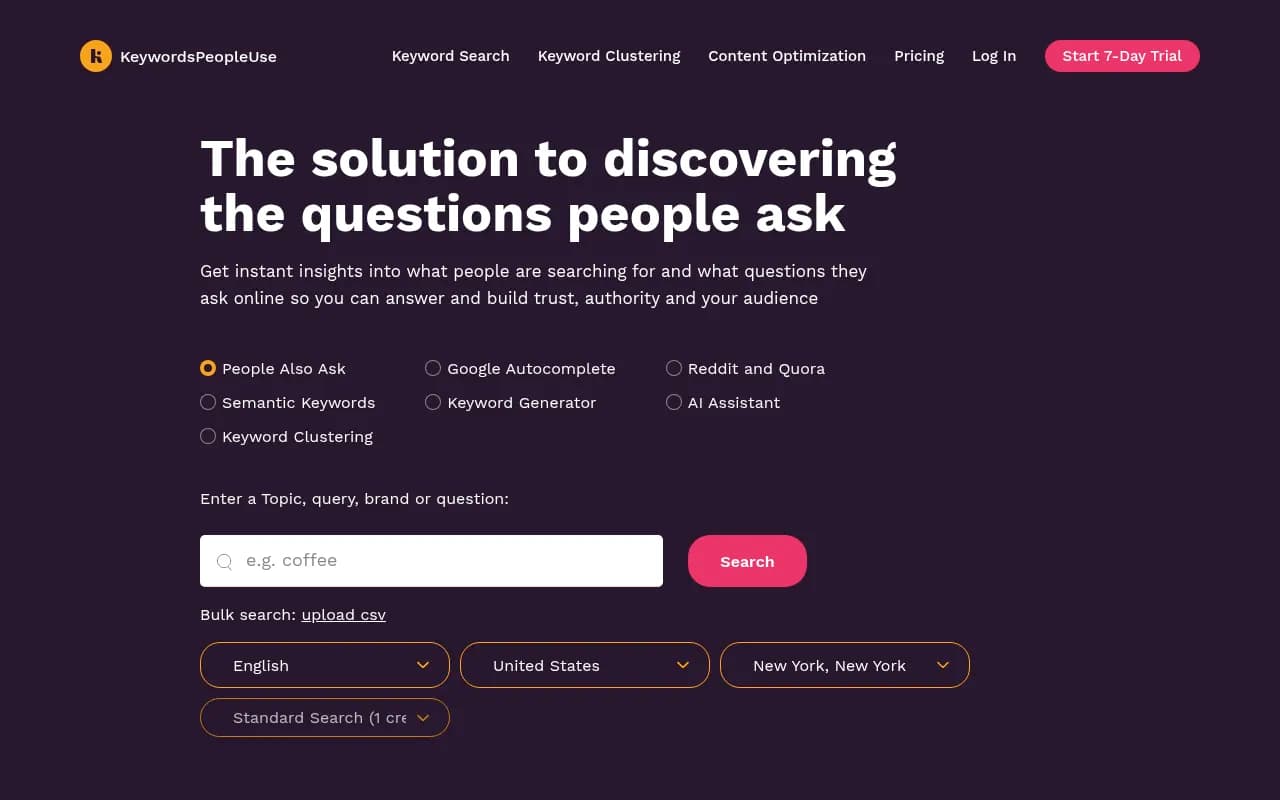
KeywordsPeopleUse is a question-based keyword research platform that mines People Also Ask results, Google autocomplete, Reddit, and Quora to uncover real user questions. Used by 15,000+ marketers in 150 countries, it helps you discover what people are actually searching for, build topical authority
Key Takeaways:
- Real-time question mining: Pulls live PAA, autocomplete, Reddit, and Quora data across 64 languages and 150+ countries
- Visual clustering: SERP-based keyword clustering shows how Google groups related terms, plus competitor analysis for each cluster
- Built for content teams: Search alerts, keyword lists, bulk search (up to 1000 terms), and full search history make it easy to scale research
- Honest limitations: No search volume data, no backlink analysis, and the AI assistant is basic compared to dedicated AI writing tools
- Best for: Content marketers, SEO teams, and niche site builders who prioritize question-based content over traditional keyword metrics
KeywordsPeopleUse is a keyword research platform built around a simple insight: people trust Google with questions they wouldn't ask anyone else. The tool, used by brands like Amazon, Citi, IKEA, and Vodafone, focuses on mining real user questions from Google's People Also Ask boxes, autocomplete suggestions, Reddit threads, and Quora discussions. It's designed for marketers who want to build topical authority by answering the exact questions their audience is asking, rather than chasing high-volume keywords.
The platform launched as a specialized PAA research tool and has expanded into a full question-based keyword suite. It now serves 15,000+ users across 150 countries, with support for 64 languages and granular location targeting down to city level. The core value proposition: discover what people are actually searching for, then build content around those real queries.
People Also Ask Mining
The flagship feature is PAA research. You enter a seed keyword, and KeywordsPeopleUse live-crawls Google to extract PAA questions. It doesn't stop at the initial four questions -- it clicks into each one, triggering Google to load more related questions, then repeats the process recursively. This "deep search" mode (costs 4 credits vs 1 for standard) can uncover hundreds of questions organized into intent-based clusters.
For each question, you get:
- The full question text
- The answer snippet Google displays
- The source URL providing the answer
- The page title of that source
Results are displayed as a visual tree showing how questions branch into sub-topics. You can see at a glance which questions lead to deeper rabbit holes of related queries. This clustering is based on Google's own logic -- if clicking question A surfaces question B in the PAA box, they're related in Google's understanding. Export everything as CSV or download the visual tree as an image.
Compared to competitors like AlsoAsked or AnswerThePublic, KeywordsPeopleUse goes deeper with its recursive crawling and provides more actionable data (source URLs, answer snippets). AlsoAsked has a cleaner visual interface but doesn't extract answers or sources. AnswerThePublic focuses on autocomplete modifiers rather than PAA data.
Google Autocomplete Research
The autocomplete tool takes your seed keyword and appends intent modifiers (who, what, when, where, why, how, can, will, are, etc.) plus letters A-Z to generate autocomplete suggestions. It then takes the top suggestions and mines them recursively to build a comprehensive map of related searches.
Results are displayed as a radial graph showing your seed term in the center with branches for each modifier. You can see which modifiers generate the most suggestions and which specific queries are most popular. This is particularly useful for discovering long-tail variations and understanding how people phrase queries around your topic.
The visual format makes it easy to spot patterns -- for example, if "how to" queries dominate, you know your audience wants tutorials. If "vs" and "alternative" queries are common, they're in comparison mode. Export the full list as CSV to feed into your content calendar.
Keyword Generator (Advanced Autocomplete)
This is autocomplete on steroids. It takes the top autocomplete suggestions for your seed term, then mines autocomplete suggestions for each of those results. The output is a massive tree of related keywords, often hundreds or thousands of terms, organized by how they branch from your original query.
This is the tool for discovering new content angles and sub-niches. If you search "project management software," you'll get branches for "for small teams," "for construction," "for agencies," each with their own sub-branches. It's excellent for mapping out a comprehensive content strategy around a broad topic.
The downside: no search volume data. You're flying blind on which terms actually get traffic. KeywordsPeopleUse's philosophy is that if Google suggests it, people are searching for it -- but you'll need to cross-reference with Ahrefs, Semrush, or Google Keyword Planner to prioritize by volume.
Reddit & Quora Mining
This feature searches Reddit and Quora for your keyword and extracts the top questions being asked on those platforms. You can filter by country and language, and results include:
- The question title
- Number of upvotes/engagement
- Direct link to the thread
- Platform (Reddit or Quora)
This is gold for understanding the real pain points and knowledge gaps in your audience. Reddit and Quora questions tend to be more specific and conversational than Google queries -- people ask things like "Why does my project management tool keep crashing when I upload large files?" rather than just "project management software."
Use this data to:
- Find content gaps your competitors aren't covering
- Discover the exact language your audience uses (for ad copy, landing pages, etc.)
- Identify opportunities to participate in discussions and build brand awareness
No other major keyword tool (Ahrefs, Semrush, Moz) offers Reddit/Quora mining. The closest competitor is GummySearch for Reddit specifically, but it's a separate tool. KeywordsPeopleUse bundles it into the same workflow as your Google research.
SERP-Based Keyword Clustering
The clustering tool groups keywords based on SERP overlap -- if two keywords return similar top 10 results in Google, they're in the same cluster. This is how Google actually understands topic relationships, making it more accurate than semantic clustering (grouping by word similarity).
You upload a list of keywords (from your PAA/autocomplete searches or elsewhere), and KeywordsPeopleUse:
- Fetches the top 10 results for each keyword
- Groups keywords that share 3+ URLs in their top 10
- Visualizes clusters as galaxies (superclusters), clusters, and individual keywords
- Shows which competitors rank for each cluster
The visual output is stunning -- a space-themed graph where related keywords orbit each other. More importantly, it's actionable: you can see which keywords can be targeted with a single piece of content (same cluster) vs which need separate pages (different clusters).
This is similar to Keyword Insights' clustering feature, but KeywordsPeopleUse's visualization is more intuitive. Keyword Insights has more advanced filtering and bulk processing, but costs significantly more ($58/mo vs KeywordsPeopleUse's $15-75/mo range).
Search Alerts & Automation
Schedule any search (PAA, autocomplete, keyword generator, Reddit/Quora) to run automatically on a recurring basis. When new questions or keywords appear, you get an email notification. Full history is saved so you can see when terms emerged or disappeared.
This is perfect for:
- Brand monitoring (track new questions about your product)
- Competitor tracking (see what questions emerge around competitor names)
- Trend spotting (catch rising topics early)
- Content refresh triggers (know when new questions appear for topics you've already covered)
No other keyword tool offers this level of automation for question-based research. Ahrefs and Semrush have keyword tracking, but it's focused on rankings and volume, not new question discovery.
Keyword Lists & Collaboration
As you research, you can save keywords to curated lists. Lists can be private or shareable via unique link (no login required for viewers). This makes it easy to:
- Organize keywords by topic, campaign, or content type
- Share research with writers, clients, or team members
- Build a content brief by collecting all relevant questions for a topic
You can manually add keywords to lists or bulk-add from search results. Edit lists to remove irrelevant terms. Export lists as CSV. The interface is simple but effective -- think of it as a lightweight project management layer on top of your research.
AI SEO Assistant
The built-in AI assistant (powered by OpenAI) lets you ask keyword and SEO questions. You can query it about search intent, content ideas, or how to target specific keywords. It's a nice convenience feature but not a replacement for dedicated AI writing tools like Jasper or Copy.ai.
The assistant doesn't have access to your keyword data or search results -- it's just a ChatGPT wrapper with an SEO focus. Useful for quick brainstorming but not for generating full articles or deeply analyzing your research.
Bulk Search
Upload a CSV with up to 1000 keywords and run any search type (PAA, autocomplete, etc.) in bulk. Results are saved to your search history for later review. This is essential for agencies or large content teams that need to research dozens of topics at once.
Credits are consumed per keyword (1 credit for standard search, 4 for deep search), so bulk searches can burn through your monthly allowance quickly. Plan accordingly.
Search History
Every search is automatically saved with full results. You can revisit any search from your history, re-download CSVs, or view the visual graphs. This eliminates the need to manually save files during research -- just search freely, then organize later.
History is searchable by keyword, date, and search type. No limit on how long history is retained (even on the cheapest plan).
API Access
All plans include API access (documented at keywordspeopleuse.stoplight.io). You can programmatically run searches, retrieve results, and integrate KeywordsPeopleUse data into your own tools or workflows. This is rare for a tool at this price point -- most competitors charge extra for API access or don't offer it at all.
Who Is KeywordsPeopleUse For?
Content marketers and SEO teams building topical authority sites or pillar content strategies. If your goal is to become the go-to resource for a topic by answering every question people ask, this tool is built for you. Particularly strong for SaaS companies, e-commerce brands, and service businesses that need to educate prospects before they buy.
Niche site builders and affiliate marketers who need to map out a content plan quickly. The keyword generator and clustering features let you identify all the sub-topics and angles within a niche, then organize them into a logical site structure.
Digital agencies managing content for multiple clients. The bulk search, keyword lists, and shareable links make it easy to scale research across accounts. The API lets you build custom reporting or integrate with client dashboards.
Freelance writers and content strategists who need to pitch ideas or build content briefs. The visual outputs (especially the PAA trees) are client-friendly and make it easy to demonstrate research depth.
Who should NOT use this tool:
- Traditional SEO pros who prioritize search volume, keyword difficulty, and backlink data. KeywordsPeopleUse has none of that. You'll need Ahrefs, Semrush, or similar alongside it.
- E-commerce sites focused on product keywords and transactional queries. The tool is built for informational/question-based research, not product discovery.
- Anyone on a tight budget who needs an all-in-one SEO suite. At $15-75/mo, KeywordsPeopleUse is affordable, but it's a specialized tool. If you can only afford one SEO subscription, get Ahrefs or Semrush first.
Integrations & Ecosystem
No direct integrations with other tools (no Zapier, no Google Search Console, no CMS plugins). The API is your integration point -- you'll need to build custom connections if you want to pipe data into other systems.
Export formats: CSV (for all search types), PNG (for visual graphs). No Google Sheets integration, no direct export to content management tools.
Browser: Web-based only, no browser extension. No mobile app.
Pricing & Value
All plans include a 7-day free trial with full feature access.
Lite - $15/mo (annual) or $19/mo (monthly):
- 200 credits/month
- All search types (PAA, autocomplete, keyword generator, Reddit/Quora)
- Keyword clustering (100 keywords/cluster)
- Search alerts (5 active alerts)
- Keyword lists (unlimited)
- API access
Standard - $35/mo (annual) or $45/mo (monthly):
- 500 credits/month
- 250 keywords/cluster
- 15 search alerts
- Everything else same as Lite
Pro - $55/mo (annual) or $75/mo (monthly):
- 1000 credits/month
- 500 keywords/cluster
- 30 search alerts
- Priority support
Credits: 1 credit = 1 standard search (PAA, autocomplete, etc.). Deep PAA search = 4 credits. Clustering = 1 credit per 10 keywords. Reddit/Quora = 1 credit.
Annual plans save 20-27% vs monthly. No enterprise tier listed, but custom plans are available (contact sales).
Value assessment: At $15-75/mo, KeywordsPeopleUse is significantly cheaper than Ahrefs ($129/mo), Semrush ($139.95/mo), or Keyword Insights ($58/mo). But it's also more limited -- no search volume, no backlinks, no rank tracking. It's best as a complement to a traditional SEO tool, not a replacement.
For agencies or content teams that do heavy question-based research, the Pro plan ($55/mo annual) is excellent value. You'd spend hours manually extracting PAA questions and Reddit threads -- this tool does it in seconds.
For solo bloggers or small niche sites, the Lite plan ($15/mo) is a steal if you're building content around questions. But if you're only doing keyword research occasionally, the monthly cost might not be justified.
Strengths:
- Deep PAA mining: Recursive crawling uncovers far more questions than manual research or basic PAA tools
- Reddit/Quora integration: No other major keyword tool offers this, and it's incredibly valuable for understanding real user pain points
- Visual outputs: The graphs are beautiful and make it easy to spot patterns and relationships
- SERP-based clustering: More accurate than semantic clustering for understanding how Google groups topics
- Search alerts: Automate question discovery and catch emerging trends early
- API access on all plans: Rare for tools at this price point
- Affordable: Significantly cheaper than Ahrefs, Semrush, or Keyword Insights
Limitations:
- No search volume data: You're guessing which keywords actually get traffic. Must cross-reference with other tools.
- No keyword difficulty scores: Can't assess how hard it will be to rank for discovered keywords.
- No backlink analysis: Can't see why competitors rank or what links you'd need to compete.
- Basic AI assistant: Just a ChatGPT wrapper, not integrated with your research data.
- No integrations: API only -- no Zapier, no CMS plugins, no Google Sheets export.
- Credit system can be limiting: Deep searches (4 credits) and large clusters burn through monthly allowance quickly on lower plans.
Bottom Line
KeywordsPeopleUse is the best tool for question-based keyword research, period. If your content strategy revolves around answering user questions and building topical authority, this tool will save you hours of manual research and uncover angles your competitors are missing. The PAA mining, Reddit/Quora integration, and SERP clustering are all best-in-class.
But it's not an all-in-one SEO tool. You'll still need Ahrefs, Semrush, or similar for search volume, keyword difficulty, and backlink data. Think of KeywordsPeopleUse as the research layer that tells you what to write about, while traditional SEO tools tell you how hard it will be to rank.
Best use case in one sentence: Content marketers and SEO teams building comprehensive, question-based content strategies who need to discover every angle and sub-topic within their niche.
Tags:
Similar and alternative tools to KeywordsPeopleUse