Nightwatch Review 2026
Track your brand's visibility across AI search engines and traditional search with comprehensive monitoring and reporting features.
Key Takeaways:
• Dual Coverage: One of the few platforms tracking both traditional search rankings AND AI/LLM visibility (ChatGPT, Gemini, Claude, Perplexity) in a unified dashboard • Precision Tracking: 99.9% rank accuracy with real-time updates and 190,000+ location tracking down to zip code level • Best for: SEO agencies managing 10+ client sites, in-house teams at scaling companies, and brands serious about local SEO • Limitations: Pricing can get expensive at scale; AI tracking uses simulations rather than real user prompt data • Starting at: $24/month (Starter plan), with 14-day free trial
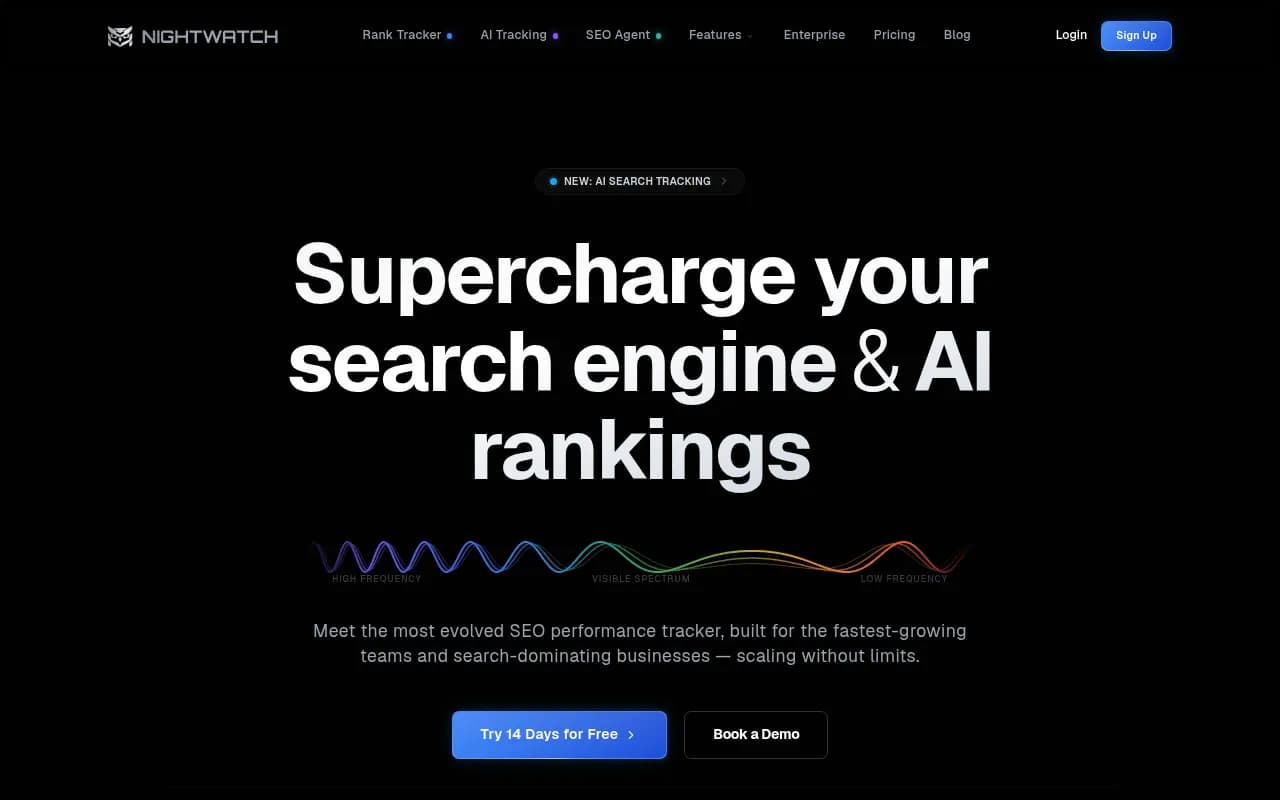
Nightwatch positions itself as an "evolved SEO performance tracker" that bridges the gap between traditional search engine optimization and the emerging world of AI-powered search. Founded as a rank tracking tool, the platform has expanded significantly to address what they call the "new search landscape" where users interact with AI before ever clicking a search result.
The platform is built for SEO agencies managing multiple client sites, in-house marketing teams at growth-stage companies, and enterprise brands with complex local SEO needs. If you're tracking fewer than 500 keywords for a single site, Nightwatch is probably overkill. But if you're managing 5,000+ keywords across multiple domains with local variations, this is where the platform shines.
Rank Tracking & Search Engine Coverage
Nightwatch's core strength remains its rank tracking accuracy. The platform claims 99.9% data precision, which they achieve by accessing more data points more frequently than competitors who "approximate data to save costs." In practice, this means daily automatic updates for all keywords, with real-time on-demand refreshes available for enterprise plans.
Search engine coverage includes Google (organic and local pack), Bing, Yahoo, YouTube, and DuckDuckGo. You can track rankings across desktop, mobile, and tablet devices, with support for 170+ languages. The location database is genuinely impressive: 190,000+ locations worldwide with zip code-level precision. This granularity matters enormously for multi-location businesses or agencies managing local SEO for franchises.
The platform tracks SERP features including Featured Snippets, Knowledge Panels, Local Packs, and other rich results. You can see not just whether you rank, but whether you're capturing these high-visibility positions that often steal clicks from traditional organic results.
AI & LLM Tracking
This is where Nightwatch differentiates itself from traditional rank trackers. The platform monitors your brand's visibility in ChatGPT, Google Gemini, Claude, and Perplexity. It simulates user interactions with these LLMs and analyzes the generated responses to determine if your brand is mentioned, cited, or recommended.
Key AI metrics include: • AI Visibility Score: A 0-100 score representing your presence in AI-generated answers • Share of Voice: Your brand mentions versus competitors in AI responses • Sentiment Analysis: Whether AI mentions are positive, neutral, or negative • Generative Rankings: Your position when AI platforms list multiple options • Active Citations: Which of your pages AI platforms are referencing
Nightwatch's thesis is that "more than 90% of AI-generated questions turn into search engine queries," so tracking the initial AI mention and subsequent search traffic gives you complete attribution. The platform attempts to connect these dots by showing when search visits originated from AI recommendations.
However, it's important to understand the methodology: Nightwatch simulates prompts rather than tracking real user queries. This means you're seeing what AI might say in response to specific questions, not what actual users are asking or how often. For real prompt volume data and actual user query tracking, platforms like Promptwatch monitor real LLM interactions rather than simulations.
Keyword Research & Prompt Analysis
The keyword research tool helps you discover new opportunities by analyzing search volume, competition, and trend data. You can filter by search intent (transactional, informational, commercial), group keywords into segments, and identify gaps in your current coverage.
The newer Prompt Research feature attempts to identify questions people might ask AI assistants related to your industry. This is useful for content planning in an AI-first world, though the data is based on predicted prompts rather than actual user behavior.
Segmentation & Analysis
Nightwatch excels at helping you organize and analyze large keyword sets. You can create global segments to filter keywords across multiple websites, segment by search intent, group by product category, or isolate branded versus non-branded terms. This is particularly valuable for agencies managing dozens of client sites or enterprises with complex product catalogs.
The Stability Index shows rank fluctuation scores, helping you identify volatile keywords that need attention versus stable rankings you can maintain. The Click Potential metric estimates untapped opportunities based on current rankings and CTR curves.
Site Audit
The technical SEO audit crawls your site to identify issues like broken links, missing meta tags, slow page speed, mobile usability problems, and other technical issues. It's a solid audit tool, though not as comprehensive as dedicated technical SEO platforms like Screaming Frog or Sitebulb. For most users, it's sufficient for identifying and prioritizing technical fixes.
Reporting & Integrations
Reporting is highly customizable with white-label options for agencies. You can schedule automated daily, weekly, or monthly reports sent to clients or stakeholders. The reports are visual and client-friendly, with sparklines, graphs, and clear progress indicators.
Integrations include: • Google Analytics: Pull traffic and conversion data alongside rankings • Google Search Console: Import actual click and impression data • Looker Studio: Native connector for building custom dashboards • API Access: Robust developer-friendly API for custom integrations • Zapier: Connect to 3,000+ apps for workflow automation
The Looker Studio integration is particularly well-executed, allowing you to combine Nightwatch ranking data with other marketing data sources in unified dashboards.
Dashboard & User Experience
The interface is clean and modern with a dark mode option. The dashboard is genuinely customizable—you can pin specific metrics, create custom views, and arrange widgets to match your workflow. Small touches like sparklines next to every metric and color-coded trend indicators make it easy to spot changes at a glance.
Navigation is intuitive with a clear sidebar structure. The platform feels fast and responsive, even when loading large keyword sets. The learning curve is moderate—simpler than enterprise platforms like BrightEdge but more complex than basic trackers like SERPWatcher.
Who Is Nightwatch For?
Nightwatch is ideal for:
SEO Agencies (5-50 person teams): Managing 10-100 client sites with 50,000+ total keywords. The white-label reporting, client management features, and ability to track multiple domains make this a strong agency platform. Agencies doing local SEO for multi-location clients particularly benefit from the zip code-level tracking.
In-House SEO Teams at Growth Companies: SaaS companies, e-commerce brands, and media sites tracking 5,000-50,000 keywords. Teams that need to prove ROI to executives will appreciate the traffic value metrics and customizable reporting.
Enterprise Brands with Local Presence: Franchises, retail chains, and service businesses with 50+ locations. The local pack tracking and location-specific ranking data are essential for multi-location SEO.
Brands Investing in AI Visibility: Companies that want to monitor how AI platforms represent their brand. While the AI tracking has limitations (simulated prompts, not real user data), it's still valuable for understanding your baseline AI presence.
Nightwatch is probably NOT the right fit for: • Freelancers or solopreneurs tracking 1-2 small sites (too expensive, too complex) • Brands needing deep AI search intelligence based on real user prompts (consider Promptwatch for actual prompt volume and citation data) • Teams needing advanced technical SEO auditing (Screaming Frog or Sitebulb are more thorough) • Businesses focused purely on content marketing without rank tracking needs
Pricing & Value
Nightwatch offers three main tiers:
Starter Plan: $24/month for basic rank tracking. Limited keywords and features. Good for testing the platform but too restrictive for serious use.
Optimize Plan: $59/month with expanded keyword limits and full feature access. This is the sweet spot for small agencies or in-house teams managing 2-5 sites.
Enterprise Plan: Custom pricing starting around $99/month and scaling based on keyword volume and feature needs. Includes real-time updates, priority support, and advanced API access.
All plans include a 14-day free trial with no credit card required. The pricing is competitive with tools like SEMrush and Ahrefs when you factor in the AI tracking capabilities, though it's more expensive than basic rank trackers like AccuRanker or SERPWatcher.
One notable advantage: Nightwatch offers better price-to-performance for high-volume keyword tracking compared to enterprise platforms that charge per keyword. If you're tracking 50,000+ keywords, Nightwatch can be significantly cheaper than alternatives.
Strengths
• Unified Search + AI Tracking: One of the few platforms attempting to bridge traditional SEO and AI visibility in a single dashboard • Location Precision: 190,000+ locations with zip code tracking is unmatched for local SEO • Rank Accuracy: 99.9% precision with real-time updates beats most competitors • Customizable Reporting: White-label reports with extensive customization for agencies • API Quality: Well-documented, developer-friendly API for custom integrations
Limitations
• AI Tracking Methodology: Uses simulated prompts rather than real user query data. You're seeing what AI might say, not what users are actually asking or how often. For real prompt intelligence, platforms like Promptwatch track actual LLM interactions. • Pricing at Scale: Can get expensive quickly as keyword volume increases, though still competitive with enterprise alternatives • Site Audit Depth: Technical SEO audit is solid but not as comprehensive as dedicated crawling tools • Learning Curve: More complex than simple rank trackers; takes time to master all features
Bottom Line
Nightwatch is a powerful, well-executed SEO monitoring platform that successfully combines traditional rank tracking with emerging AI visibility metrics. It's best suited for SEO agencies managing multiple client sites, in-house teams at scaling companies, and brands with complex local SEO needs.
The rank tracking accuracy, location precision, and reporting capabilities are genuinely best-in-class. The AI tracking is a valuable addition, though users should understand it's based on simulated prompts rather than real user behavior. For agencies and in-house teams that need a comprehensive view of search performance across both traditional and AI platforms, Nightwatch delivers strong value.
Best use case in one sentence: SEO agencies managing 10+ client sites who need accurate rank tracking, local SEO monitoring, and want to start tracking AI visibility—all in one platform with white-label reporting.
Tags:
Similar and alternative tools to Nightwatch