Key Takeaways
- Peec AI focuses on basic LLM monitoring but lacks critical features like prompt research, content optimization tools, and traditional search engine tracking that inform AI responses
- Promptwatch leads the category as the only platform combining monitoring with actionable optimization—Answer Gap Analysis, AI content generation, and crawler logs that close the visibility-to-action loop
- Most alternatives fall into monitoring-only tools (Otterly.AI, AthenaHQ, SE Visible) or traditional SEO platforms adding basic AI tracking (Semrush, Ahrefs Brand Radar)
- Key decision factors: number of AI engines tracked, prompt intelligence depth, content optimization capabilities, traffic attribution, and whether the platform helps you fix gaps or just shows them
- Pricing ranges from $99/month (entry-level monitoring) to $579+/month (full optimization platforms with content generation and enterprise features)
Why Teams Are Looking Beyond Peec AI
Peec AI entered the AI search visibility space early and built a following among marketers tracking brand mentions in ChatGPT, Perplexity, and Claude. The platform delivers on its core promise: showing you where your brand appears in AI-generated responses. But as the AI search landscape matured through 2025 and into 2026, teams started hitting the same walls.
The Monitoring-Only Problem
Peec AI tells you where you're visible but not why you're invisible elsewhere. You can see that a competitor ranks for a high-value prompt while you don't, but the platform doesn't show you what content gap is causing that invisibility. You're left manually analyzing competitor pages, guessing at what AI models want, and hoping your next content update improves visibility.
This is the fundamental limitation of monitoring-only platforms: they surface problems without providing the tools to solve them. Marketing teams need more than dashboards—they need workflows that connect visibility data to content creation, optimization, and measurement.
Missing the Search Layer
Many AI responses are informed by real-time web searches. When ChatGPT or Perplexity queries Google or Bing to gather current information, your traditional search rankings directly influence AI citations. Peec AI doesn't track this search layer, leaving you blind to a critical part of the AI visibility equation.
Limited Prompt Intelligence
Understanding which prompts matter requires more than basic tracking. You need volume estimates, difficulty scores, and query fan-outs showing how one prompt branches into related searches. Without this intelligence, teams waste resources optimizing for low-value prompts while missing high-opportunity queries.
The Action Gap
The biggest complaint from Peec AI users: "Now what?" You have visibility data, but no clear path to improvement. No content gap analysis. No AI-optimized content generation. No crawler monitoring to ensure AI models can actually access your pages. Just charts showing you're losing to competitors without the tools to catch up.
The 7 Best Peec AI Alternatives for 2026
1. Promptwatch: The Only Platform That Closes the Action Loop
Promptwatch is the market-leading Generative Engine Optimization (GEO) platform used by 6,700+ brands including Booking.com, Center Parcs, and Wortell. In a 2026 comparison of 12 GEO platforms, Promptwatch is the only tool rated as a "Leader" across all categories. The difference: it's built around taking action, not just monitoring.

The Action Loop That Competitors Miss:
-
Find the gaps: Answer Gap Analysis shows exactly which prompts competitors rank for but you don't. You see the specific content your website is missing—the topics, angles, and questions AI models want but can't find on your site.
-
Create content that ranks: The built-in AI writing agent generates articles grounded in 880M+ citations analyzed, prompt volumes, persona targeting, and competitor analysis. This isn't generic SEO filler—it's content engineered to get cited by ChatGPT, Claude, and Perplexity.
-
Track the results: Page-level tracking shows exactly which pages are being cited, how often, and by which models. Close the loop with traffic attribution (code snippet, GSC integration, or server log analysis) to connect visibility to revenue.
What Sets Promptwatch Apart:
- AI Crawler Logs: Real-time logs of ChatGPT, Claude, and Perplexity crawlers hitting your site—which pages they read, errors they encounter, indexing issues to fix. Most competitors lack this entirely.
- Prompt Intelligence: Volume estimates, difficulty scores, and query fan-outs for every prompt. Prioritize high-value, winnable queries instead of guessing.
- Citation & Source Analysis: See exactly which pages, Reddit threads, YouTube videos, and domains AI models cite. Know where to publish and what to optimize.
- Reddit & YouTube Insights: Surface discussions that directly influence AI recommendations—a channel most competitors ignore.
- ChatGPT Shopping Tracking: Monitor when your brand appears in ChatGPT's product recommendations and shopping carousels.
- Multi-language & Multi-region: Monitor AI responses in any language, from any country, with customizable personas matching how your customers prompt.
Pricing: Essential $99/mo (1 site, 50 prompts, 5 articles), Professional $249/mo (2 sites, 150 prompts, 15 articles, crawler logs), Business $579/mo (5 sites, 350 prompts, 30 articles). Free trial available.
Best for: Marketing teams, SEO teams, and agencies that want to optimize AI visibility, not just monitor it. Ideal for brands serious about ranking in AI search results.
2. Profound: Enterprise-Grade Monitoring with Service-Heavy Support
Profound

Profound positions itself as the enterprise option for large teams needing hands-on support. The platform tracks 9+ AI engines including ChatGPT, Perplexity, Claude, Gemini, and Google AI Overviews. Its Conversation Explorer feature lets you drill into specific AI responses and see exactly how your brand is being represented.
The platform excels at entity extraction and attribution mapping—showing which specific facts or claims AI models pull from your content. This granular visibility helps content teams understand what's working at the sentence level.
Strengths: Deep citation analysis, strong customer success team, good for brands that need white-glove service.
Limitations: Monitoring-focused with limited content optimization tools. No AI content generation. No crawler log analysis. Higher price point than most alternatives.
Pricing: Starts at $99/mo for basic plans, custom pricing for enterprise.
Best for: Enterprise brands with dedicated GEO teams that value service and support over self-service optimization tools.
3. Semrush: Traditional SEO Platform Adding AI Visibility
Semrush is a household name in SEO, and they've added AI search tracking to their existing keyword research, backlink analysis, and site audit tools. The integration is the main selling point—teams already using Semrush for traditional SEO can add AI visibility without switching platforms.
The AI tracking module monitors Google AI Overviews and provides basic visibility metrics. However, the feature set is limited compared to dedicated GEO platforms. Semrush uses fixed prompt sets rather than custom prompt tracking, and lacks advanced features like crawler logs, prompt difficulty scoring, or content gap analysis.
Strengths: Strong SEO backbone, familiar interface for existing users, all-in-one platform for teams managing both traditional and AI search.
Limitations: Fixed prompts, no crawler monitoring, limited AI-specific optimization features. AI tracking feels like an add-on rather than a core competency.
Pricing: AI tracking included in higher-tier plans starting around $229/mo.
Best for: Teams already invested in Semrush who want basic AI visibility without adding another tool.
4. AthenaHQ: Multi-Engine Benchmarking Platform

AthenaHQ focuses on multi-engine visibility tracking across Google AI Overviews, Perplexity, ChatGPT, and Claude. The platform's standout feature is prompt leaderboards with sentiment filters—you can see how your brand ranks for specific prompts compared to competitors, and whether the sentiment is positive, neutral, or negative.
This benchmarking approach is valuable for competitive intelligence teams tracking brand positioning across AI systems. The sentiment analysis helps PR and brand teams understand how AI models are characterizing their company.
Strengths: Strong competitor benchmarking, sentiment tracking, clean interface.
Limitations: Monitoring-only platform with no content optimization or generation tools. No crawler logs. No prompt volume data or difficulty scoring.
Pricing: Starts at $295/mo.
Best for: Brands focused on competitive benchmarking and sentiment analysis across multiple AI engines.
5. Ahrefs Brand Radar: SEO-Centric AI Tracking
Ahrefs Brand Radar extends the company's legendary backlink and SEO analysis into AI search visibility. The platform tracks brand mentions in AI-generated responses and ties them to traditional SEO metrics like domain authority and backlink profiles.
The integration is the value proposition: see AI citations alongside backlinks, organic rankings, and content performance in one dashboard. However, like Semrush, the AI tracking features are limited. Ahrefs uses fixed prompts, lacks traffic attribution, and doesn't provide crawler monitoring or content optimization tools.
Strengths: Excellent for teams that live in Ahrefs and want basic AI visibility without switching platforms. Strong SEO data integration.
Limitations: Fixed prompt sets, no custom prompt tracking, missing advanced GEO features like crawler logs or content gap analysis.
Pricing: Included in higher-tier Ahrefs plans starting around $249/mo.
Best for: SEO teams already using Ahrefs who want to add basic AI visibility tracking.
6. Otterly.AI: Basic Monitoring Across ChatGPT, Perplexity, and Google AI
Otterly.AI

Otterly.AI is a straightforward monitoring platform tracking brand mentions across ChatGPT, Perplexity, and Google AI Overviews. The platform delivers clean dashboards showing where your brand appears and how often, with basic competitor comparison features.
The simplicity is both a strength and a limitation. Otterly.AI is easy to set up and understand, making it accessible for teams new to AI visibility tracking. However, it lacks the depth needed for optimization: no prompt intelligence, no content gap analysis, no crawler logs, no traffic attribution.
Strengths: Simple, affordable entry point for basic AI monitoring. Clean interface.
Limitations: Monitoring-only with no optimization features. No crawler logs. No prompt volume data. No content generation tools.
Pricing: Starts around $99/mo for basic monitoring.
Best for: Small teams or agencies wanting basic AI visibility tracking without advanced optimization features.
7. SE Visible: Monitoring Without the Tools to Fix Gaps
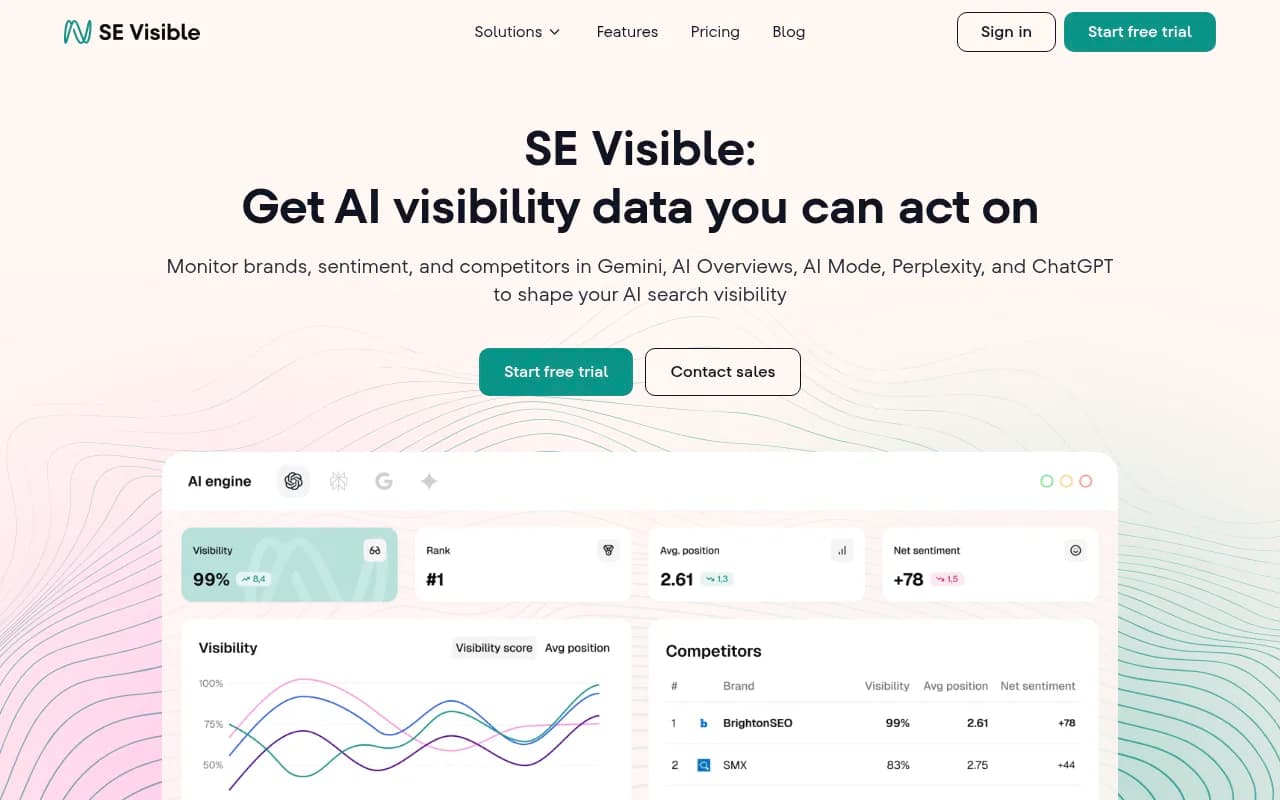
SE Visible (from the SE Ranking team) tracks brand visibility across AI search engines with a focus on clean reporting and competitor analysis. The platform provides visibility dashboards and basic citation tracking, but stops short of optimization features.
The main appeal is the SE Ranking integration—teams already using SE Ranking for traditional SEO can add AI visibility tracking without switching platforms. However, like other monitoring-only tools, SE Visible shows you problems without providing solutions.
Strengths: Clean interface, good for teams already using SE Ranking, straightforward monitoring.
Limitations: No content gap analysis, no AI content generation, no crawler logs, no prompt intelligence. Monitoring-only platform.
Pricing: Starts at $189/mo.
Best for: SE Ranking users who want to add basic AI visibility tracking to their existing SEO workflow.
How to Choose the Right Peec AI Alternative
Selecting an AI visibility platform depends on your team's goals, budget, and workflow. Here's how to evaluate your options:
1. Monitoring vs. Optimization
The most important decision: do you need a monitoring dashboard or an optimization platform?
Monitoring-only tools (Otterly.AI, SE Visible, AthenaHQ, Peec AI) show you where you're visible and where you're not. They're useful for tracking progress and competitive benchmarking, but they don't help you improve visibility. You'll need separate tools for content creation, gap analysis, and optimization.
Optimization platforms (Promptwatch, Profound with limitations) combine monitoring with actionable features like content gap analysis, AI content generation, and crawler monitoring. These platforms help you fix visibility problems, not just measure them.
If you're serious about improving AI visibility—not just tracking it—choose an optimization platform. If you only need basic monitoring and have separate workflows for content creation, a monitoring-only tool may suffice.
2. Number of AI Engines Tracked
Most platforms track the major AI engines: ChatGPT, Perplexity, Claude, Gemini, and Google AI Overviews. Promptwatch tracks 10+ engines including Meta AI, DeepSeek, Grok, and Mistral. Profound tracks 9+ engines.
Consider where your audience actually searches. If your customers primarily use ChatGPT and Perplexity, broader coverage may not matter. If you operate globally or serve technical audiences using diverse AI tools, comprehensive coverage becomes critical.
3. Prompt Intelligence Depth
Basic platforms track fixed prompt sets. Advanced platforms (Promptwatch) provide:
- Custom prompt tracking for your specific industry and use cases
- Volume estimates showing how often each prompt is used
- Difficulty scores indicating how hard it is to rank
- Query fan-outs revealing how prompts branch into related searches
This intelligence helps you prioritize optimization efforts on high-value, winnable prompts instead of guessing.
4. Content Optimization Features
Monitoring-only platforms stop at visibility data. Optimization platforms provide:
- Content gap analysis: Identify exactly what content you're missing
- AI content generation: Create articles optimized for AI citations
- Citation analysis: Understand which sources AI models prefer
- Crawler logs: Monitor how AI crawlers access your site
If improving visibility is your goal, these features are essential. Without them, you're left manually analyzing competitors and guessing at solutions.
5. Traffic Attribution
Some platforms (Promptwatch, Analyze AI) connect AI visibility to actual website traffic and conversions. This closes the loop between visibility metrics and business outcomes, helping you prove ROI and prioritize efforts on prompts that drive revenue.
Most monitoring-only platforms lack traffic attribution, making it difficult to connect AI visibility to bottom-line results.
6. Integration with Existing Workflows
If your team lives in Semrush or Ahrefs, their AI tracking add-ons may be the path of least resistance—even if they lack advanced features. If you're building a dedicated GEO workflow, a standalone platform like Promptwatch offers more depth.
Consider API access, Looker Studio integration, and export capabilities if you need to build custom reports or connect AI visibility data to other systems.
7. Budget and Team Size
Pricing ranges from $99/month (basic monitoring) to $579+/month (full optimization platforms). Enterprise plans with custom pricing are available from most vendors.
Smaller teams or agencies monitoring a handful of clients may find basic monitoring sufficient. Larger teams optimizing multiple brands across dozens of prompts need the depth of an optimization platform to justify the investment.
The Promptwatch Advantage: Why It Leads the Category
After evaluating 12 GEO platforms, Promptwatch stands out as the only "Leader" across all categories. Here's why:
1. It Solves the Action Problem
Most platforms show you where you're invisible. Promptwatch shows you why and helps you fix it. Answer Gap Analysis identifies exactly which content you're missing. The AI writing agent creates that content. Page-level tracking measures the results. This action loop is what separates optimization platforms from monitoring dashboards.
2. Unmatched Data Depth
Promptwatch has processed over 1.1 billion citations, clicks, and prompts—more than any competitor. This dataset powers prompt volume estimates, difficulty scoring, and citation analysis that help you prioritize efforts on high-value opportunities.
3. Crawler Visibility
Real-time AI crawler logs show exactly how ChatGPT, Claude, and Perplexity access your site. You can see which pages they read, errors they encounter, and indexing issues to fix. This technical layer is critical for ensuring AI models can actually discover and cite your content—yet most competitors lack it entirely.
4. Reddit & YouTube Tracking
AI models heavily cite Reddit discussions and YouTube videos when forming recommendations. Promptwatch surfaces these sources, showing you where to engage and what topics to cover. This channel is invisible in most competing platforms.
5. Traffic Attribution
Connect AI visibility to actual website traffic and revenue. See which prompts drive visitors, which pages convert, and which AI engines deliver ROI. This closes the loop between visibility metrics and business outcomes.
6. Proven at Scale
With 6,700+ brands and agencies using the platform—including enterprise customers like Booking.com—Promptwatch has proven it can scale from small teams to global organizations. The platform's data has been featured in the Wall Street Journal, Yahoo Finance, and Axios.
Making the Switch: What to Expect
Migrating from Peec AI to a new platform is straightforward. Most alternatives offer free trials, allowing you to test features before committing. Here's what to expect:
Setup Time
Basic monitoring platforms (Otterly.AI, SE Visible) can be set up in under an hour. You'll connect your website, define your brand terms, and select prompts to track. Initial data appears within 24-48 hours.
Optimization platforms (Promptwatch, Profound) require more setup but deliver more value. You'll define custom prompts, configure crawler monitoring, install traffic attribution code, and potentially integrate with Google Search Console or analytics platforms. Expect 2-4 hours for full setup.
Learning Curve
Monitoring-only platforms have minimal learning curves—dashboards are intuitive and features are limited. Optimization platforms require more investment to master advanced features like content gap analysis, AI content generation, and crawler log interpretation.
Most vendors offer onboarding calls, documentation, and support to accelerate learning. Promptwatch provides dedicated customer success for Professional and Business plans.
Data Migration
Historical data from Peec AI typically cannot be migrated to new platforms. You'll start fresh with baseline measurements and build historical trends over time. Most teams find this acceptable since AI search is evolving rapidly and historical data loses relevance quickly.
Cost Comparison
Peec AI pricing varies by plan, but most teams report spending $200-400/month. Alternatives range from $99/month (basic monitoring) to $579+/month (full optimization platforms). Consider the value of optimization features when comparing costs—a platform that helps you improve visibility delivers far more ROI than one that only measures it.
Common Questions About Switching Platforms
Q: Can I track custom prompts or am I limited to fixed prompt sets?
Most dedicated GEO platforms (Promptwatch, Profound, AthenaHQ) support custom prompt tracking. Traditional SEO platforms adding AI features (Semrush, Ahrefs) typically use fixed prompt sets. Custom tracking is essential for industry-specific or niche use cases.
Q: How often is data refreshed?
Most platforms refresh daily. Some offer on-demand refreshes for critical prompts. Real-time tracking is rare due to API costs and rate limits from AI providers.
Q: Do these platforms track AI-generated traffic to my website?
Some platforms (Promptwatch, Analyze AI) provide traffic attribution connecting AI visibility to actual website visits. Most monitoring-only platforms do not track traffic, leaving you to correlate visibility with analytics data manually.
Q: Can I track competitors?
Yes, all platforms support competitor tracking. You can monitor which prompts competitors rank for, how often they're cited, and what content they're producing. This competitive intelligence is valuable for identifying gaps and opportunities.
Q: What's the difference between AI Overviews and LLM tracking?
Google AI Overviews appear in traditional search results and are informed by web searches. LLM tracking (ChatGPT, Claude, Perplexity) monitors conversational AI responses. Both matter, but they're different channels with different optimization strategies. Comprehensive platforms track both.
Q: How do I prove ROI from AI visibility efforts?
Platforms with traffic attribution (Promptwatch) connect visibility to website traffic and conversions, making ROI measurement straightforward. Without attribution, you'll need to correlate visibility improvements with traffic increases in Google Analytics manually.
The Future of AI Search Visibility
AI search is evolving rapidly. ChatGPT Search launched in 2024, Perplexity is growing exponentially, and Google continues expanding AI Overviews. By 2026, AI-generated answers will mediate a significant portion of online discovery.
Brands that treat AI visibility as a monitoring exercise will fall behind. Winners will be those that optimize proactively—creating content AI models want to cite, fixing technical issues that block AI crawlers, and measuring results with traffic attribution.
The platform you choose matters. Monitoring-only tools provide visibility into the problem. Optimization platforms like Promptwatch provide the solution. Choose based on whether you want to measure the gap or close it.
Take Action: Start Optimizing AI Visibility Today
If you're ready to move beyond basic monitoring and start improving your AI search visibility, Promptwatch offers the most comprehensive platform for finding gaps, creating optimized content, and tracking results. With 6,700+ brands already using the platform and proven results across industries, it's the clear choice for teams serious about ranking in AI search.
Start with a free trial to see how Answer Gap Analysis reveals exactly what content you're missing, test the AI writing agent on a few high-priority prompts, and experience the difference between monitoring and optimization. The action loop—find gaps, create content, track results—is what separates leaders from followers in the AI search era.